How To Cut A Tooth Into Sections For Extraction?
Pulling a tooth sounds straightforward. But anyone who has ever dealt with a stubborn molar knows that some teeth refuse to come out in one piece. That is where surgical sectioning comes into play.
If you are a dental student, a general practitioner looking to refine your surgical skills, or simply a curious patient wanting to understand the procedure, you have come to the right place.
Cutting a tooth into sections is not about brute force. It is about precision, anatomy, and respecting the surrounding bone. This technique turns a potentially traumatic extraction into a controlled, minimally invasive procedure.
In this guide, we will walk through every step of the process. We will cover the tools, the clinical reasoning, the actual cut, and what happens after. Let’s make a complex topic feel simple and clear.
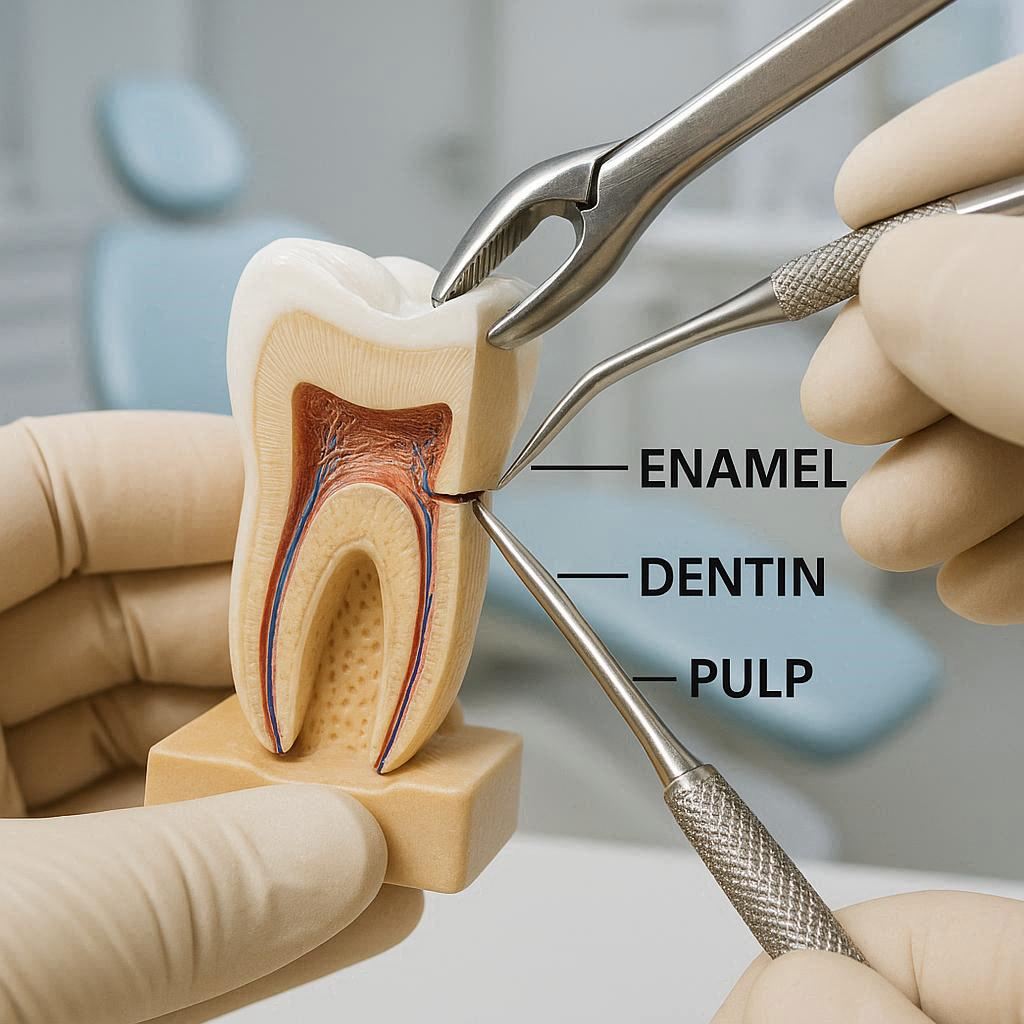
Why Cut a Tooth Into Sections? The Logic Behind the Cut
Before we talk about how, we need to talk about why. Extracting a tooth in one piece often requires a lot of force. You rock the tooth, you push, you pull. That force transfers directly to the jawbone.
When a tooth has curved roots, fused roots, or a severely damaged crown, pulling it whole can fracture the buccal bone plate. That is the thin bone on the cheek side of your mouth. Once that bone breaks, healing becomes slower and more painful.
Sectioning solves this problem. By cutting the tooth into two or three pieces, you change the path of withdrawal. Instead of fighting against root curvature, you lift each piece straight up. This preserves bone, reduces post-operative pain, and lowers the risk of dry sockets.
Important Note: Sectioning is not a sign of failure. Experienced oral surgeons use it as their first choice for lower molars and multi-rooted teeth. It is a sign of wisdom, not weakness.
Essential Tools: What You Need to Section a Tooth
You cannot cut a tooth with a basic elevator and forceps alone. You need rotary instruments. Here is the standard setup used in clinics worldwide.
| Tool | Purpose | Alternative |
|---|---|---|
| High-speed handpiece | To make the initial cuts quickly and cleanly. | Electric handpiece (more torque) |
| Surgical bur (carbide) | To actually cut through enamel and dentin. | Diamond bur (slower, less aggressive) |
| Elevators (Coupland or Cryer) | To gently separate the sections. | Luxating elevators for fine work |
| Extraction forceps | To remove each individual piece. | Bayonet forceps for posterior teeth |
| Irrigation syringe | To keep the area cool and clear of debris. | Saline with a monoject syringe |
The Most Important Bur Choice
Not all burs cut the same way. For sectioning, you want a fissure bur (like a #557 or #701L). These are long, cylindrical, and cut on the sides. They allow you to reach deep into the furcation (the area where roots separate).
Avoid using a round bur for the main cut. It creates a trough rather than a true separation line. A carbine fissure bur in a high-speed handpiece with water irrigation is the gold standard.
Step-by-Step: How To Cut A Tooth Into Sections For Extraction
Now we get to the core of the matter. Read this section carefully. Each step builds on the last.
Step 1: Assessment and Anesthesia
You cannot cut a live tooth without profound anesthesia. The patient needs to feel absolutely nothing.
- For lower molars: Give an inferior alveolar nerve block plus a long buccal infiltration.
- For upper molars: Give posterior superior alveolar and infraorbital blocks.
Wait at least 3–5 minutes for the anesthesia to take full effect. Test the gum tissue with a probe. If the patient flinches, wait longer.
Step 2: Flap Design (When Necessary)
Do you always need to cut a flap? No. If the tooth is erupted enough to see the furcation, you can section without lifting gum tissue.
But if the tooth is broken at the gum line, you need a flap. Make a triangular or envelope flap using a #15 scalpel blade. Reflect the tissue with a periosteal elevator. This exposes the bone and the tooth surface.
Step 3: Removing Bone (Osteotomy)
Sometimes the tooth sits deep in the socket. You cannot cut what you cannot see. Use a surgical length round bur to remove a small amount of bone around the crown. This is called an osteotomy.
Do not remove too much. You only need enough space to see the furcation entrance. Preserving bone is always the goal.
Step 4: The Mesial-Distal Cut (The Main Sectioning Cut)
This is the critical moment. You will cut the tooth in half along its long axis.
- For lower molars: Cut from the central groove down through the furcation, separating the mesial and distal roots.
- For upper molars: Cut through the central groove to separate the palatal root from the buccal roots.
Place the bur exactly in the center of the tooth. Go straight down until you feel the bur pass through the floor of the pulp chamber. You will know you are deep enough when you see the two halves begin to slightly separate.
Keep water flowing. Tooth cutting generates heat. Without irrigation, you risk thermal necrosis of the bone. That means dead bone cells. Always use coolant.
Step 5: The Split (Using Elevators)
Now you have a groove, not a complete separation. Insert a Coupland elevator into the cut. Gently twist.
Pop.
You should hear and feel a clean crack. The tooth will now be two distinct pieces.
“The secret to a good sectioning is not the cut itself, but the elevator work that follows. A gentle twist does what a saw cannot.” — Dr. James R., Oral Surgeon
Step 6: Elevating Each Root Separately
Take each piece individually. Start with the easier root.
- Insert a fine elevator between the root and the bone.
- Use a lever motion. Push down, not toward the adjacent tooth.
- The root should rise slightly. Then grab it with forceps.
Do not force a root that resists. Re-cut deeper if necessary. Repeat the sectioning for a multi-rooted tooth. Sometimes a lower molar needs to be cut into three pieces: mesial root, distal root, and a separated distal root half.
Step 7: Debridement and Irrigation
After all pieces are out, look inside the socket. Do you see any fragments? Use a surgical curette to gently remove debris. Irrigate thoroughly with sterile saline.
Check for a lingual undercut. It is easy to leave a small root tip on the tongue side. Palpate the area with a probe.
Common Challenges and How to Overcome Them
Even with perfect technique, problems happen. Here is how to handle them.
The Tooth Splits Badly (Uncontrolled Fracture)
Sometimes the tooth does not split along your cut line. It shatters into sharp shards.
Solution: Stop using elevators. Go back to the high-speed handpiece. Convert to a multipiece sectioning. Remove fragments one by one using fine-tipped forceps or a root tip pick.
The Bur Breaks Inside the Tooth
This is rare with good burs, but it happens. A broken bur fragment is metal and can be left in place if small and non-mobile. But if it is large, you must remove it.
Solution: Use a magnification (loupes or a microscope). Locate the fragment. Create a trough around it with a smaller bur, then lift it out with a micro-elevator.
The Root Is Fused (No Separation Line)
Some teeth have dentin bridges that block the furcation. You cut, but the pieces refuse to separate.
Solution: Cut deeper. You may need to cut through the entire tooth until the bur touches the bone floor. Then use a thin cryer elevator directly into the cut with more forceful rotation.
Tooth Sectioning by Type: A Comparative Guide
Different teeth require different strategies.
| Tooth Type | Sectioning Pattern | Difficulty Level |
|---|---|---|
| Lower First Molar | Mesial root vs. Distal root (split) | Medium |
| Lower Second Molar | Often fused roots. Cut in thirds if needed. | High |
| Upper First Molar | Palatal root separated from two buccal roots. | Medium |
| Upper Second Molar | Often three roots, but smaller. Straight cut works. | Low-Medium |
| Wisdom Tooth (Impacted) | Multiple cuts: crown off, then root division. | High |
Wisdom Teeth Require Special Attention
For a fully impacted lower wisdom tooth, you do not just cut it in half. You perform a coronectomy (cut off the crown) first. Then you section the roots from each other. Finally, you remove each root in a different direction. This protects the inferior alveolar nerve.
Post-Operative Care: What Happens After Sectioning
Cutting a tooth into sections is more traumatic than a simple extraction. But if done well, healing is still fast. However, the patient needs clear instructions.
Immediate Aftercare (First 24 Hours)
- Bite on gauze for 30 minutes with firm pressure.
- No spitting, no straws. Suction forces dislodge the blood clot.
- Ice packs on the cheek (20 minutes on, 20 minutes off).
- Pain medication: Ibuprofen 600mg every 6 hours is usually enough. For severe cases, add acetaminophen.
The “Bone Graft” Question
When you section a tooth, you often remove bone to access the furcation. That bone does not grow back on its own. Consider placing a bone graft (like freeze-dried bone allograft) into the socket.
A graft preserves the ridge height for future implants. Without a graft, the jawbone shrinks by 30–50% over six months.
Signs of Complications
Tell your patients to watch for these red flags:
- Pain that increases after day 3 (not decreases).
- Bad taste or foul odor from the socket.
- Visible bone in the hole (this is a dry socket or sequestrum).
- Swelling spreading to the eye or neck.
Any of these signs means a call to the clinic or a visit to the emergency room.
Frequently Asked Questions (FAQ)
Does cutting a tooth hurt?
No. The patient is completely numb during the procedure. You should never cut a tooth without profound local anesthesia. After the numbness wears off, there is soreness, but that is normal healing pain, not the cutting itself.
Can a dentist cut a tooth that is already broken to the gum line?
Yes. In fact, that is when sectioning is most helpful. The dentist will reflect a gum flap to expose the remaining tooth structure. Then they cut as usual.
How long does a sectioned tooth extraction take?
A simple single-rooted tooth takes 5 minutes. A sectioned molar takes 15 to 30 minutes. An impacted wisdom tooth with multiple sections can take 45 to 60 minutes.
Is it safe to cut a tooth near a nerve?
Yes, if done carefully. The bur stays inside the tooth structure. The cutting motion is controlled. The real risk is not the cut, but the elevation after. That is why sectioning reduces nerve risk—you lift pieces straight up rather than prying against the nerve.
What happens if a small piece of tooth stays inside?
A fragment smaller than 3mm that is not infected can often be left alone. The body may expel it over time, or it may heal over it. Larger fragments must be removed because they act as a foreign body and block healing.
Can I request my tooth to be cut into sections instead of pulled whole?
Absolutely. As a patient, you can ask your dentist about their approach. If you have a large molar with curved roots, sectioning is actually the gentler option. Do not be afraid to ask.
Additional Resources
For a deeper understanding of surgical extraction techniques and advanced bone preservation, visit the American Association of Oral and Maxillofacial Surgeons (AAOMS) patient education library.
👉 External Link: AAOMS Patient Resources – Tooth Extraction Guidelines (Always verify medical information with your personal healthcare provider)
Important Notes for Readers (Clinical Safety)
- Do not attempt this at home. Tooth sectioning requires a high-speed dental handpiece, sterile water irrigation, and surgical training. Attempting this without proper tools will cause severe bone necrosis, infection, and potential jaw fracture.
- Referral matters. If your general dentist feels uncomfortable sectioning a tooth, ask for a referral to an oral surgeon. Wisdom and humility in medicine save teeth and lives.
- Antibiotic prophylaxis. Patients with compromised immune systems, heart valve replacements, or joint prostheses may need pre-operative antibiotics. Always disclose your full medical history.
Conclusion
Cutting a tooth into sections for extraction is a precise, bone-sparing technique that turns a risky extraction into a controlled procedure. By understanding the anatomy, using the correct burs, and applying gentle elevator pressure, you can remove multi-rooted teeth with less trauma and faster healing. Whether you are a professional or a patient, knowing this process builds confidence and leads to better outcomes.
Disclaimer
This article is for informational and educational purposes only. It does not constitute medical advice or a substitute for professional clinical judgment. Always consult a licensed dentist or oral surgeon for personal medical care. The author and publisher disclaim any liability for any adverse effects arising from the use or application of the information contained herein.