Bump on the inside of lip
You are sipping a hot coffee, eating a salty pretzel, or simply running your tongue along your lower lip. Then you feel it. A small, strange bump. It was not there yesterday. It is not exactly painful, but it is impossible to ignore.
That little intruder can spark a wave of worry. Is it a cold sore? Is it something serious? Should you poke it? (Please do not).
Here is the good news: the vast majority of bumps on the inside of the lip are benign. They are annoying, yes. They can be uncomfortable. But they are rarely dangerous. In this guide, we will walk through every possible cause, from the everyday nuisance to the rare condition you should know about. By the end, you will know exactly what to look for and when to call your doctor.
Understanding the delicate landscape of your inner lip
Before we talk about bumps, let us appreciate the terrain. The inside of your lip is not like the skin on your arm. It is a mucous membrane. This tissue is thinner, more vascular, and designed to heal quickly. It also has a lot of salivary glands.
Because the tissue is so soft and moist, it reacts differently to injury and infection. A small scratch inside your mouth can swell into a noticeable lump within hours. That same scratch on your arm might go unnoticed.
This sensitivity is a double-edged sword. It means bumps appear quickly, but it also means they tend to resolve on their own just as fast.
The 7 most common types of bumps on the inside of the lip
Let us break down the usual suspects. Use this table as your quick reference guide.
| Type of Bump | Typical Appearance | Common Sensation | Usual Duration |
|---|---|---|---|
| Mucocele | Smooth, dome-shaped, bluish or clear | Painless, feels like a soft bubble | 1 to 6 weeks |
| Canker Sore | Shallow, white or yellow center with red border | Burning, sharp pain | 7 to 10 days |
| Oral Fibroma | Firm, flesh-colored, smooth | Painless, feels like hard rubber | Permanent (unless removed) |
| Lie Bump | Small red or white pimple-like spot | Tender or slightly sore | 1 to 3 days |
| Herpes (Cold Sore) | Cluster of tiny fluid-filled blisters | Tingling, burning, then sore | 7 to 14 days |
| Fordyce Spots | Tiny pale yellow dots | None, completely painless | Permanent (normal variation) |
| Pleomorphic Adenoma | Firm, slow-growing lump under skin | None in early stages | Months to years |
Now, let us explore each one in detail so you can recognize them with confidence.
Mucocele: the classic bubble
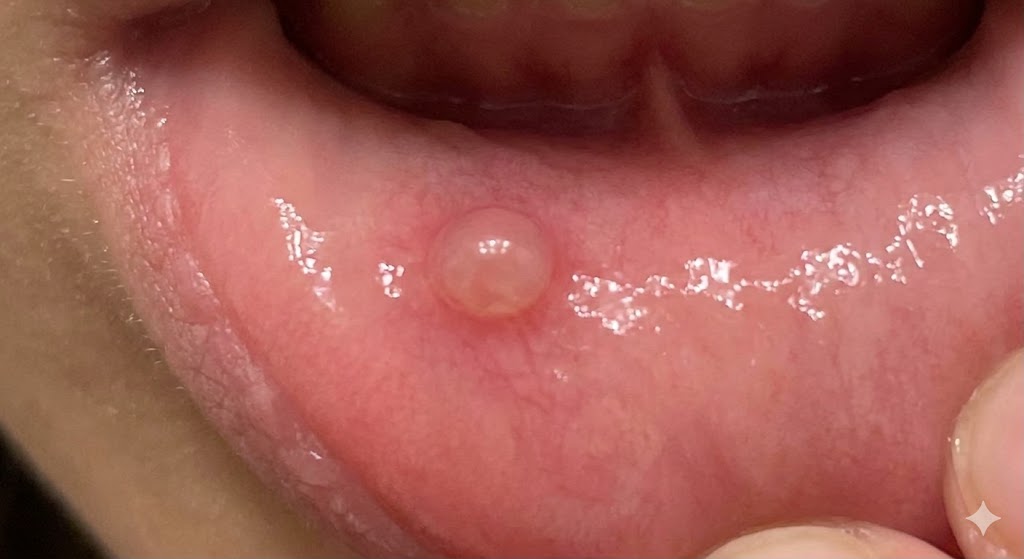
If you have ever accidentally bitten your lip and then noticed a soft, squishy bubble a few days later, you have met a mucocele. This is the most common bump on the inside of the lower lip.
How it happens: You have hundreds of tiny salivary glands just beneath the surface. When you bite or trauma your lip, a gland duct can tear. Saliva has nowhere to go. It pools into a little pocket of tissue and forms a smooth, dome-shaped bump.
What it looks like: A mucocele often has a bluish or translucent tint. It feels soft and can vary in size from a small pea to a large grape.
What it feels like: Most people report no pain at all. It just feels like a fluid-filled balloon under the skin. However, if it gets large, it can feel annoying when you eat or speak.
Important note: Do not try to pop a mucocele. It is not a pimple. If you puncture it, clear, sticky fluid will come out. The bump will deflate for a day or two. Then it will fill right back up because the underlying damaged gland is still leaking.
Most mucoceles go away on their own within a few weeks. If one sticks around for more than two months, a dentist or oral surgeon can remove the gland entirely. It is a quick, in-office procedure.
Canker sores: small but mighty
Canker sores are the troublemakers of the mouth. They are not contagious, but they can make eating, talking, and even smiling feel like a chore.
Where they show up: Canker sores love soft, movable tissue. The inside of the lip is a prime location. You can also find them on the inside of the cheeks, under the tongue, or at the base of the gums.
What they look like: A classic canker sore starts as a red spot. Within a day or two, it becomes a shallow crater. The center is white or yellowish. The edge is bright red and inflamed.
What they feel like: The word here is sharp. Canker sores hurt. They burn when touched by spicy, salty, or acidic foods. Even the pressure from your own lip moving over the sore can sting.
Common triggers:
- Minor injury (biting your lip, brushing too hard)
- Stress and lack of sleep
- Acidic foods (tomatoes, citrus, pineapple)
- Toothpaste with sodium lauryl sulfate (SLS)
- Hormonal changes
Most canker sores heal in 7 to 10 days without treatment. Over-the-counter gels with benzocaine can numb the area. Avoiding irritants helps speed things along.
Oral fibroma: the tough little knot
An oral fibroma is different. It is not a fluid-filled sac. It is a solid knot of collagen and fibrous tissue.
How it develops: Chronic irritation causes a fibroma. Maybe you have a habit of chewing the same spot on your lip. Maybe a sharp tooth edge or a denture rubs there day after day. The body responds by laying down extra tough tissue as a form of protection.
What it looks like: A fibroma is firm, smooth, and usually the same pink color as your lip. It does not change size quickly. It grows very slowly over months or years.
What it feels like: Painless. Most people notice it by running their tongue over it, not because it hurts. It feels like a hard piece of rubber or a small pebble under the skin.
Fibromas do not go away on their own. They are benign, but if they bother you, a dentist can remove them in minutes. The lab will send the tissue for analysis just to confirm the diagnosis.
Lie bumps: transient lingual papillitis (on your lip?)
Wait. The name says “lingual,” which means tongue. But many people use “lie bump” to describe any small, pimple-like irritation inside the mouth. True lie bumps happen on the tongue. However, small, red, tender spots can appear on the inner lip for similar reasons.
These are often just inflamed minor salivary glands or tiny areas of irritation. They pop up overnight and vanish just as fast. Within one to three days, they are usually gone. No treatment is needed.
Herpes simplex (cold sores): the contagious one
This is the bump that gets the most worry, and for good reason. Unlike canker sores, cold sores are highly contagious.
Location matters: Cold sores usually appear on the outside of the lip, right on the vermilion border (the line where the colored part of the lip meets regular skin). However, they can occur on the inside of the lip, especially during a first outbreak.
What they look like: A cluster of tiny, fluid-filled blisters on a red base. The blisters may merge, pop, and then crust over with a yellow scab.
What they feel like: Several hours before any bump appears, you might feel tingling, burning, or itching in that spot. This is called the prodrome. Once the blisters form, they are sore and tender.
Key difference from canker sores: Cold sores start as blisters. Canker sores start as craters. Cold sores crust over. Canker sores do not.
If you suspect a cold sore, avoid kissing, sharing cups, or touching the area unnecessarily. Antiviral creams (like docosanol) or oral medications (like acyclovir) can shorten the outbreak if started early.
Fordyce spots: the ones everyone has
Let us clear up a common misconception. Those tiny, pale yellow dots you see on your inner lip? They are not a disease. They are not an infection. They are Fordyce spots.
These are simply visible sebaceous (oil) glands. Normally, sebaceous glands connect to hair follicles. Inside your mouth, you have no hair. So the glands open directly to the surface. They look like small, yellowish-white grains.
Fordyce spots are completely normal. They affect up to 80% of adults. They do not hurt, grow, or change. No treatment is needed or recommended.
Pleomorphic adenoma: the rare one
We include this for completeness, not to scare you. A pleomorphic adenoma is a benign tumor of the salivary glands. It is the most common salivary gland tumor, but it is still uncommon overall.
What sets it apart: This bump grows slowly, often over many months or years. It feels firm, rubbery, and moves slightly under the skin. It is usually painless. Unlike a mucocele, it does not change size after meals. Unlike a fibroma, it may feel lobulated (like multiple small bumps fused together).
If you have a bump on the inside of your lip that has been growing steadily for more than eight weeks and feels firm to the touch, see a dentist or an ear, nose, and throat (ENT) specialist. They can perform an ultrasound or biopsy to confirm.
When should you worry about a bump on the inside of your lip?
Honesty is important here. Almost every bump is harmless. But a small number of bumps deserve professional attention.
Schedule a visit with your dentist or doctor if you notice any of these red flags:
- The bump has been there for more than three weeks without improving.
- It is growing steadily in size.
- It feels hard or fixed to deeper tissue (it does not move when you push it).
- It bleeds easily when you touch it or brush against it.
- You have numbness or a burning sensation in that area.
- You have other symptoms like a lump in your neck, unexplained weight loss, or difficulty swallowing.
A note on oral cancer: Oral cancer on the lip usually appears on the lower lip and often on the outside surface due to sun exposure. Inside the lip, cancer is very rare. When it does occur, it typically looks like a non-healing ulcer with rolled edges, not a smooth bump. Still, any sore that does not heal after two weeks should be evaluated.
Home care for common lip bumps
While you wait for a bump to heal on its own, you can make yourself more comfortable. Here is a practical toolkit.
What to do
- Rinse with warm salt water. Dissolve half a teaspoon of salt in a cup of warm water. Swish gently for 30 seconds, three times a day. Salt water reduces inflammation and keeps the area clean.
- Apply a cold compress. If the bump feels swollen or tender, hold a cold pack or an ice cube wrapped in a cloth against the outside of your lip for 10 minutes.
- Switch to soft foods. Yogurt, smoothies, mashed potatoes, and soup will not irritate a tender spot like chips or toast will.
- Use a topical oral gel. Products with benzocaine (Orajel) or hydrogen peroxide (Peroxyl) can provide relief. Follow the package instructions.
What to avoid
- Do not poke, pick, or pop. This is the most important rule. You will introduce bacteria, slow healing, and possibly create a scar or an infection.
- Avoid spicy, salty, and acidic foods. That means hot wings, salt and vinegar chips, citrus fruits, and tomato sauce.
- Skip alcohol-based mouthwashes. They will burn and dry out the tissue.
- Stop lip biting or chewing. If you have a nervous habit, try chewing sugar-free gum instead.
A simple decision guide for your lip bump
Use this flow chart in text form to help you think through what you are seeing.
Step 1: How long has it been there?
- Less than 3 days → Likely a lie bump or minor trauma. Wait and watch.
- 3 to 14 days → Could be a canker sore, mucocele, or healing injury.
- More than 3 weeks → Time to have a professional look at it.
Step 2: What does it feel like?
- Soft and squishy → Likely a mucocele.
- Firm and rubbery → Could be a fibroma or, rarely, a benign tumor.
- Shallow crater with pain → Canker sore.
- Cluster of blisters → Suspect herpes (cold sore).
Step 3: Does it change size?
- Grows slowly over months → Possibly a fibroma or pleomorphic adenoma.
- Grows after eating → Mucocele (saliva fills it).
- Comes and goes in days → Canker sore or transient irritation.
Step 4: Are you worried?
- If your gut says something feels wrong, trust it. See a dentist. Peace of mind is worth the visit.
Preventing future bumps on the inside of your lip
You cannot prevent every bump. Accidental bites happen. Stress happens. But you can lower your odds.
Adjust your daily habits
- Chew slowly and mindfully. Many lip bumps start with a misplaced bite while eating.
- Fix sharp teeth or dental work. A dentist can smooth a jagged edge on a tooth or adjust an ill-fitting crown.
- Change your toothpaste. If you get frequent canker sores, try an SLS-free brand like Sensodyne or Burt’s Bees.
- Manage stress. Stress is a known trigger for canker sores and cold sores. Regular sleep, exercise, and relaxation techniques help.
Protect your immune system
- Get enough B vitamins and iron. Deficiencies in B12, folate, or iron are linked to recurrent mouth sores.
- Stay hydrated. A dry mouth is more prone to irritation.
- Avoid known triggers. If you notice a pattern (e.g., a canker sore every time you eat walnuts or chocolate), simply avoid that food.
Busting common myths about lip bumps
Let us clear up a few things you might have heard.
Myth: All white bumps inside the mouth are canker sores.
Fact: Fordyce spots, mucoceles, and even early fibromas can appear white or pale. Canker sores have a very specific appearance: a crater with a red halo.
Myth: If it hurts, it is serious.
Fact: Painful bumps are usually canker sores or injuries. The most dangerous bumps are often painless in their early stages. Pain is a sign of inflammation, not necessarily disease.
Myth: You can pop a mucocele like a pimple.
Fact: We said it before, but it bears repeating. Do not do this. You will not solve the problem. You may cause an infection or scar tissue.
Myth: A bump that does not go away is always cancer.
Fact: Most persistent bumps are fibromas or mucoceles. Oral cancer inside the lip is genuinely rare. Your dentist sees dozens of benign lip bumps for every one concerning lesion.
What to expect at a dental or medical visit
If you decide to have a bump checked, knowing what will happen can ease your mind.
The examination: Your dentist or doctor will look at the bump. They will feel it with a gloved finger. They will ask how long it has been there and whether it has changed.
The questions they will ask:
- When did you first notice this?
- Have you bitten your lip recently?
- Does it hurt? If so, on a scale of 1 to 10?
- Have you had anything like this before?
- Do you smoke or use tobacco?
- Do you have any other medical conditions?
Possible next steps:
- Watch and wait: If it looks like a classic mucocele or canker sore, they may ask you to return in two weeks.
- Biopsy: If the bump is firm, growing, or atypical, they may take a small sample. This is done with local anesthesia. You will not feel the biopsy itself. The sample goes to a pathologist.
- Referral: For complex cases, they may send you to an oral surgeon or an ENT.
Most people walk out with reassurance and no procedure needed.
The connection between lip bumps and systemic health
Sometimes a bump on the inside of your lip is not just a local issue. It can be a clue about what is happening in the rest of your body.
Recurrent canker sores are linked to:
- Inflammatory bowel disease (Crohn’s or ulcerative colitis)
- Celiac disease
- Behçet’s disease
- HIV (when sores are very large and persistent)
Persistent or unusual bumps can appear with:
- Hand, foot, and mouth disease (viral illness, common in children)
- Oral lichen planus (an autoimmune condition)
- Pemphigus vulgaris (a rare blistering disorder)
If you have recurrent or multiple bumps along with other symptoms like joint pain, skin rashes, or digestive issues, mention this to your doctor. The mouth is often a window to overall health.
A week-by-week healing timeline
Let us map out what normal healing looks like for the most common bumps.
Day 1-3 (Acute phase)
- The bump appears, often after known trauma or with tingling.
- Swelling may peak.
- Pain is usually worst in this phase for canker sores.
Day 4-7 (Repair phase)
- The bump may start to shrink.
- Pain decreases significantly.
- For a mucocele, the bump may fluctuate in size.
Day 8-14 (Remodeling phase)
- Canker sores should be nearly gone.
- Mucoceles may still be present but often smaller.
- Cold sores should be crusted over and healing.
Week 3 and beyond
- Any bump still present after three weeks needs a professional evaluation.
- Fibromas and pleomorphic adenomas will not change much week to week.
Special considerations for children and older adults
Children
Kids get lip bumps often. They bite their lips. They put things in their mouths. They get viral illnesses.
Most pediatric lip bumps are mucoceles or canker sores. Recurrent herpes (cold sores) is also common. Children with frequent, painful canker sores should be checked for nutritional deficiencies.
When to call the pediatrician:
- The bump is large enough to interfere with eating or drinking.
- Your child has a fever along with mouth sores.
- The bump bleeds or looks infected.
- Your child is dehydrated because it hurts too much to swallow.
Older adults
As we age, the risk of persistent bumps changes. Mucoceles and canker sores still occur, but fibromas and salivary gland tumors become more relevant.
Older adults with dentures have a higher risk of irritation fibromas from rubbing. Smokers or former smokers need regular oral cancer screenings.
Any new bump in someone over 50 that does not heal within two weeks deserves a biopsy more readily than in a younger person. This is not because cancer is likely, but because early detection saves lives.
Additional resource
For a deeper dive into oral health and to find a board-certified oral pathologist in your area, visit the American Academy of Oral Medicine at www.aaom.com. Their patient resources section offers downloadable fact sheets on mouth sores, bumps, and chronic oral conditions.
Conclusion
A bump on the inside of your lip is usually nothing to fear. Most are harmless mucoceles, fleeting canker sores, or normal Fordyce spots. Watch for the key warning signs: duration beyond three weeks, steady growth, firm texture, or bleeding. Practice gentle home care with salt water rinses and soft foods while the bump heals. And remember, your dentist is your best partner for anything that lingers or worries you.
Frequently Asked Questions (FAQ)
1. Can stress cause a bump on the inside of my lip?
Yes, indirectly. Stress weakens your immune system and can trigger canker sores or cold sore outbreaks. Stress also increases lip biting and chewing habits, which can lead to mucoceles or fibromas.
2. Is a bump on the inside of my lip contagious?
It depends on the cause. Cold sores (herpes) are highly contagious. Canker sores, mucoceles, fibromas, and Fordyce spots are not contagious at all. If you are unsure, avoid kissing or sharing utensils until you know what it is.
3. How do I tell the difference between a canker sore and a cold sore inside my lip?
Canker sores are shallow craters with a white or yellow center and a red border. They never start as blisters. Cold sores start as tiny fluid-filled blisters that may pop and crust. Cold sores also often cause tingling before they appear.
4. Can I get cancer from a bump on the inside of my lip?
No. The bump itself is not a cancer. In extremely rare cases, a bump could be an early cancer. But the bump does not cause cancer. If you have a persistent, non-healing bump, see a professional for evaluation.
5. What is the clear bump on my lip that keeps coming back?
That is almost certainly a mucocele. The damaged salivary gland continues to leak saliva into the tissue. The bump deflates if you pop it (do not pop it), but it refills. The only permanent fix is minor surgery to remove the gland.
6. When should I go to the emergency room for a lip bump?
Almost never. The ER is for emergencies. A lip bump is not an emergency unless:
- You have sudden, severe swelling of your lip or face (possible allergic reaction).
- You have difficulty breathing or swallowing.
- The bump is bleeding heavily and will not stop.
- You have a high fever and feel very ill.
For routine bumps, see your dentist or primary care doctor.
7. Do lip bumps hurt more than other mouth sores?
The inside of the lip is very sensitive and moves constantly when you talk, eat, and swallow. So yes, a canker sore on the lip often hurts more than one on the inside of the cheek because your lip is always in motion.
8. Can a lip bump be a sign of an STD?
Rarely. Primary syphilis can cause a chancre (a firm, painless ulcer) on the lip or inside the mouth. This is uncommon and usually occurs after oral contact with an infected partner. Most lip bumps are not sexually transmitted.
9. My child has a blue bump on the inside of their lip. Is that dangerous?
No. A blue or bluish bump is likely a mucocele. Children get them frequently after biting their lip. It is benign. If it bothers the child or does not go away after two months, a pediatric dentist can remove it.
10. What is the fastest way to get rid of a bump on my lip?
There is no magic trick, but you can speed healing by:
- Rinsing with warm salt water 3 times daily.
- Avoiding irritating foods.
- Not touching or picking at it.
- Using an over-the-counter oral gel for pain relief.
For cold sores, an antiviral cream at the first tingle can shorten the outbreak significantly.
Disclaimer: This article is for informational purposes only and does not constitute medical advice. You should not use this information to diagnose or treat a health condition. Always consult a qualified dentist or physician for any health concerns or before starting any treatment.