Do Sealants Really Protect Your Teeth?
You have probably heard the word at the dentist’s office. Maybe a hygienist mentioned it while looking at your child’s X-rays. Or perhaps a friend told you that her son got “that plastic coating” on his molars.
Dental sealants sound almost too simple. A liquid painted onto a tooth that hardens into a shield? No drilling, no needles, no numbness? It feels like magic.
But magic does not exist in dentistry. What exists is solid, well-researched preventive care.
So let us answer the big question honestly: Do sealants really protect your teeth?
The short answer is yes. But the real answer is more nuanced. Sealants are not invincible armor. They do not work on every tooth. And they are not a replacement for brushing or flossing.
By the time you finish reading this guide, you will know exactly what sealants can do, what they cannot do, and whether they are a smart choice for you or your family.
Let us dive in.
What Exactly Is a Dental Sealant?
Before we talk about protection, we need to understand what a sealant actually is.
A dental sealant is a thin, plastic-based coating. A dentist or hygienist applies it to the chewing surface of a tooth. Usually, this means the back teeth. Your premolars and molars.
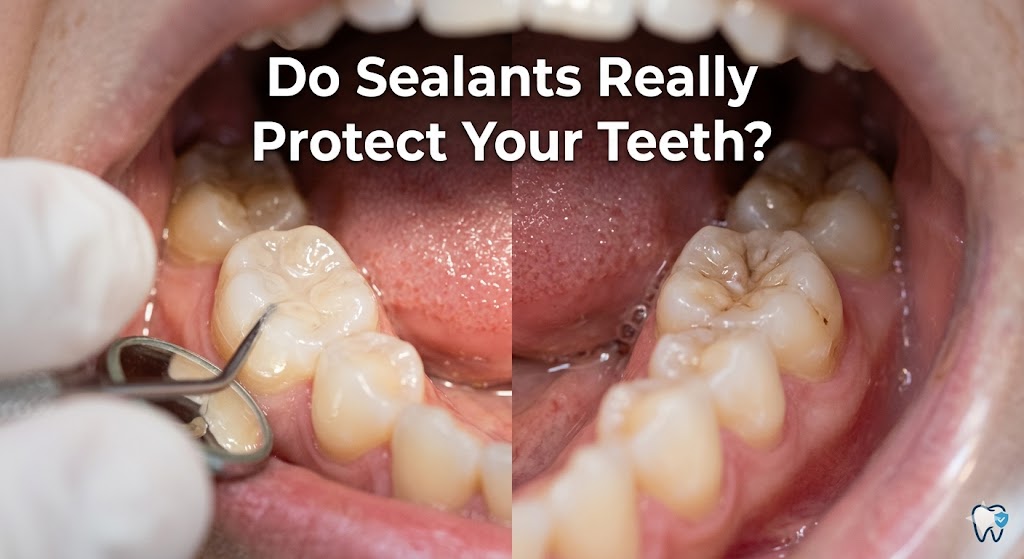
These teeth are not flat. They have deep grooves, pits, and fissures. Some of these grooves are so narrow that a single toothbrush bristle cannot fit inside them.
The sealant flows into those tiny spaces. Then it hardens. It creates a smooth, flat surface over the natural bumps and valleys of the tooth.
Think of it like a raincoat for your tooth. The raincoat does not change the tooth. It just covers it. And it stops food, bacteria, and acid from sitting inside those hard-to-clean grooves.
The Material: What Is It Made Of?
Most sealants are resin-based. That means they come from a family of dental materials similar to white fillings.
Some older formulas used glass ionomer. That material releases small amounts of fluoride. But resin sealants are much more common today because they last longer and stick better.
Here is a simple breakdown:
| Feature | Resin Sealant | Glass Ionomer Sealant |
|---|---|---|
| Longevity | 5–10 years | 2–5 years |
| Fluoride release | No | Yes (low level) |
| Bond strength to tooth | Excellent | Good but weaker |
| Visibility | Clear, white, or tooth-colored | Usually white or opaque |
| Cost | Moderate | Slightly lower |
Important note: Just because a sealant releases fluoride does not automatically make it better. Resin sealants often provide longer physical protection. Your dentist will recommend a type based on your child’s age, cooperation level, and cavity risk.
Who Can Get Sealants?
Many people think sealants are only for children. That is not entirely true.
Children are the most common candidates. Why? Because their adult molars come in around age six and again around age twelve. Those fresh new teeth have never had a cavity. Applying a sealant early keeps them that way.
But adults can also benefit. If you have deep grooves in your molars and no fillings or decay in those grooves, a sealant can still help you.
The only real requirement is that the tooth must be free of decay. You cannot paint a sealant over an existing cavity. That would trap bacteria inside. And that would make the problem worse, not better.
Reader note: Some insurance plans only cover sealants for children up to a certain age, often 14 or 16. Adults may pay out of pocket. But the cost is usually low compared to a filling.
How Do Sealants Actually Protect Your Teeth?
Let us get into the mechanics. Because protection is not a single thing. It happens in several ways.
Physical Blocking
This is the main job. Sealants create a barrier. Once applied, the tooth surface becomes smooth. Food particles cannot get stuck in deep grooves. Bacteria cannot hide in tiny crevices.
Imagine a brick road versus a paved highway. The brick road has gaps between every brick. Those gaps collect dirt, water, and weeds. The paved highway has no gaps. Water runs off. Nothing gets stuck.
Your natural tooth without a sealant is like the brick road. A sealed tooth is like the paved highway.
Reducing Plaque Accumulation
Plaque loves rough surfaces. It also loves sheltered spots. The deep pits of an unsealed molar are a five-star hotel for plaque bacteria.
When you apply a sealant, you remove those hiding places. Plaque can still form on the sides of the tooth. But the chewing surface becomes much less hospitable.
Making Cleaning Easier
This benefit is underrated. A smooth tooth is simply easier to clean.
Think about washing a textured plate versus a flat plate. The textured plate takes more scrubbing. The flat plate cleans up in seconds.
When a tooth has sealants, brushing becomes more effective. Flossing does not change much because sealants only cover the top chewing surface. But that top surface represents a huge percentage of cavity risk in children and young adults.
Slowing Early Decay
Here is something many articles do not mention. Sealants can sometimes stop very early decay. If a tooth has what dentists call an “incipient lesion” (the very first stage of a cavity), a sealant can seal it off from food and bacteria.
This is controversial to some. But multiple studies have shown that sealing over a tiny, non-cavitated lesion can arrest the decay process. The bacteria trapped underneath have no new fuel. They eventually die or become inactive.
That said, your dentist will not seal a visible cavity. But if the decay is only visible on X-ray and has not broken through the enamel surface, a sealant might still be an option.
The Real Numbers: How Effective Are Sealants?
Let us look at the data. Because claims without evidence are just noise.
According to the Centers for Disease Control and Prevention (CDC), school-age children without sealants have almost three times more cavities in their first molars than children with sealants.
That is not a small difference. That is a massive reduction in risk.
A systematic review published in the Journal of the American Dental Association looked at multiple studies over several years. Here is what they found:
| Time Period | Cavity Reduction in Sealed Molars |
|---|---|
| 12 months | 86% fewer cavities |
| 24 months | 78% fewer cavities |
| 36 months | 71% fewer cavities |
| 48 months | 64% fewer cavities |
You will notice the protection decreases over time. That makes sense. Sealants wear down. They can chip. They can fall off. But even at four years, a 64% reduction in cavities is outstanding.
For comparison, fluoride toothpaste reduces cavities by about 25% when used consistently. Fluoride varnish adds another 30-40% reduction. Sealants work alongside these methods, not instead of them.
Do Sealants Work on All Teeth?
No. And this is where we need to be realistic.
Sealants only work on teeth with deep pits and grooves. That means:
- Molars – Yes, absolutely.
- Premolars – Sometimes, if the grooves are deep.
- Front teeth (incisors and canines) – Almost never. These teeth are smooth. They do not have the same type of grooves.
Your dentist will examine each tooth. Not every back tooth needs a sealant. Some people have naturally shallow grooves. Those teeth are already low risk.
What About Between Teeth?
This is the biggest limitation of sealants.
Sealants only cover the chewing surface. They do nothing for the spaces between your teeth. Those spaces are where flossing matters most.
If you get sealants but never floss, you can still get cavities between your molars. The sealant did not fail. You just asked it to do a job it was never designed for.
Think of sealants as a helmet. A helmet protects your head in a fall. But it does not protect your arms or knees. You still need other protective gear.
The Application Process: What Actually Happens?
If you have never watched a sealant being placed, you might imagine a long, complicated procedure. It is not.
The entire process for one tooth takes about two to five minutes. For all four molars? Maybe fifteen minutes total.
Here is the step-by-step.
Step 1: Cleaning the Tooth
The dentist or hygienist cleans the tooth surface with a small rotating brush and a special cleaning paste. This removes any plaque or debris from the grooves.
Step 2: Isolating the Tooth
They will dry the tooth and place a small piece of cotton or a rubber dam around it. Saliva is the enemy of sealants. A dry tooth allows the sealant to bond properly.
Step 3: Etching the Enamel
This sounds scary, but it is not. The professional applies a mild acid gel to the chewing surface for about fifteen to thirty seconds. This acid does not hurt. It creates microscopic pores in the enamel. Those pores give the sealant something to grip.
Step 4: Rinsing and Drying
They rinse off the acid gel. Then they dry the tooth completely. The tooth will look chalky white at this stage. That is normal.
Step 5: Applying the Sealant
The liquid sealant is painted onto the prepared tooth. It flows into all the tiny grooves and pits.
Step 6: Hardening
For resin sealants, the dentist uses a blue curing light. This light hardens the liquid into a solid plastic coating in about twenty seconds. For glass ionomer sealants, they simply wait a few minutes for the material to set chemically.
Step 7: Checking the Bite
Finally, the dentist checks your bite. They make sure the sealant is not too high. If it is, they polish it down slightly. You should not feel any difference when you bite down.
That is it. No needles. No drilling. No numbness. You can eat and drink immediately after.
Does It Hurt?
Not at all. The only sensation you might feel is the suction tip and the air syringe. Some people do not like the taste of the acid gel. But it is mild and goes away quickly.
Children as young as five or six can easily handle sealant placement. In fact, many kids find it much easier than a routine cleaning.
How Long Do Sealants Last?
This is one of the most common questions. And the answer depends on several factors.
On average, a well-placed resin sealant lasts between five and ten years. Some last longer. Some fail sooner.
Here is what affects longevity:
- Your eating habits – Chewing ice, hard candy, or very sticky foods can chip or pull off sealants.
- Your grinding habits – If you grind your teeth at night (bruxism), you will wear down sealants faster.
- The skill of the person placing them – A properly isolated, well-etched tooth creates a stronger bond.
- Regular dental checkups – Dentists can spot a chipped or partially lost sealant before decay starts.
Do They Need Maintenance?
Yes. Sealants are not “set it and forget it.”
At every dental checkup, the dentist will examine your sealants. They will look for:
- Chips or cracks
- Worn-down areas
- Sealants that have partially lifted off the tooth
- Decay underneath the sealant (rare but possible)
If a sealant is damaged but still mostly intact, the dentist can usually repair it by adding more material. If the sealant is completely gone, they will clean the tooth and reapply it.
What Happens When a Sealant Falls Off?
First, do not panic. A lost sealant does not mean the tooth is doomed.
If you lose a sealant, the tooth returns to its natural state. It has the same deep grooves it had before. If you have been keeping it clean, there may be no decay at all.
But here is the risk: If you did not know the sealant was gone, you might have stopped cleaning that area thoroughly. That is why regular dental visits matter. Your dentist will notice a missing sealant months before you do.
Reader note: Some people worry that sealants “trap decay” if they fail. That only happens if decay was already present before the sealant was placed. A properly applied sealant on a healthy tooth does not cause decay. It prevents it.
Sealants for Children: A Smart Investment?
Let us talk specifically about kids. Because this is where sealants have the strongest evidence.
Children get their first permanent molars around age six. They get their second set around age twelve. These teeth are meant to last a lifetime. But children are not always great at brushing.
A six-year-old does not have the dexterity to clean deep molar grooves. Even if they brush twice a day, they will miss spots. That is not bad parenting. That is just childhood.
The Cost Argument
A single sealant typically costs between $30 and $60 per tooth without insurance. A filling costs between $150 and $400. A crown costs $800 to $1,500. A root canal on a molar? $1,000 to $2,000.
Preventing a cavity with a $40 sealant is not just healthier. It is financially smarter.
Many dental insurance plans cover sealants at 100% for children up to a certain age. Some state Medicaid programs also cover them. And many community health centers offer sliding-scale fees or free sealant programs in schools.
When Should a Child Get Sealants?
The ideal time is as soon as the permanent molars fully erupt. That means the tooth has broken through the gum and come all the way up to meet the opposing tooth.
For first molars, that is usually between ages six and seven. For second molars, between ages eleven and thirteen.
You can wait longer. But every month you wait is a month where those deep grooves are unprotected.
What About Baby Teeth?
Some dentists offer sealants on primary (baby) molars. This is less common. Baby teeth have shallower grooves. And they fall out anyway.
However, if a child has very deep grooves in their baby molars and a high risk of cavities, some dentists will recommend it. Baby teeth hold space for permanent teeth. Losing a baby molar early to decay can cause crowding problems later.
If your dentist suggests sealants on baby teeth, ask why. There is usually a good reason. But it is not a universal recommendation.
Sealants for Adults: Is It Too Late?
Adults often assume sealants are only for kids. That is not correct.
If you are an adult with healthy, unfilled molars that have deep grooves, you can absolutely benefit from sealants.
Here is a quick self-assessment. Ask yourself:
- Do I have any fillings on the chewing surfaces of my back teeth?
- Have I had a cavity between my molars but not on top?
- Do I struggle to keep my back teeth clean?
- Do I have naturally deep grooves (you can feel them with your tongue)?
If you have no fillings on the chewing surfaces, sealants can protect those teeth for years to come.
The Adult Caveat
Here is the honest truth. Many adults already have small fillings in their molars. Or they have enamel that is worn down from years of grinding or acidic drinks.
If a tooth already has a filling, a sealant is useless. You cannot seal a filling. The filling itself has already replaced the natural grooves.
If your enamel is heavily worn, the grooves may be gone. In that case, sealants are unnecessary.
Your dentist can tell you in thirty seconds whether sealants make sense for your specific mouth.
Common Myths About Sealants
Let us clear up some confusion. There is a lot of misinformation online.
Myth 1: Sealants Contain BPA
This myth will not die. Early dental sealants contained trace amounts of BPA derivatives. Modern sealants do not.
The Academy of Pediatric Dentistry and the American Dental Association both confirm that the BPA exposure from sealants is far lower than exposure from everyday items like receipts, canned foods, or dust.
In fact, you get more BPA from handling a grocery store receipt than from getting four sealants placed. And the body clears that tiny amount within hours.
Myth 2: Sealants Weaken Teeth
Some people worry that the etching process damages enamel. It does not.
The mild acid gel only affects the very outer layer of enamel. It creates microscopic pores. Those pores are filled by the sealant material. When the sealant is removed years later, the enamel returns to its original state or better.
No healthy enamel is lost. No weakening occurs.
Myth 3: Sealants Are Unnecessary If You Use Fluoride
Fluoride and sealants work differently. They are not competitors. They are teammates.
Fluoride strengthens enamel from the outside in. It makes the entire tooth more resistant to acid attacks. But fluoride cannot physically fill a deep groove. It cannot create a smooth surface where bacteria cannot hide.
Sealants provide physical protection. Fluoride provides chemical protection. Together, they are more effective than either one alone.
Myth 4: Sealants Last Forever
No dental material lasts forever. Sealants wear down. They chip. They fall off. That is normal.
Think of sealants like tires on a car. Tires do not last the life of the vehicle. They need inspection and replacement. Same with sealants.
Myth 5: You Can Apply Sealants at Home
Please do not try this. You cannot buy real dental sealants online. If you find something sold as a “DIY sealant kit,” it is not the same material. It will not bond properly. It may even trap bacteria against your tooth.
Sealants require a dry, clean, etched surface. You cannot achieve that in your bathroom mirror.
The Risks and Downsides (Be Honest)
No medical or dental procedure is perfect. Sealants have limitations and rare risks.
Risk 1: Sealing Over Decay
This is the most serious risk. If a dentist misses a small cavity and seals over it, the decay will continue. The bacteria are trapped inside with no way for saliva or brushing to help.
This is why dentists always examine the tooth carefully before applying a sealant. They may take X-rays to check between teeth. They will probe the grooves. A competent provider will not seal a decayed tooth.
The risk is extremely low in experienced hands. But it exists.
Risk 2: Allergic Reaction
Resin sealants are made from methacrylate-based materials. True allergies are incredibly rare. But they are possible.
If you have a known allergy to acrylics or dental resins, tell your dentist. They can use a glass ionomer sealant instead.
Risk 3: Chipped Sealant Edges
A partially chipped sealant can create a rough edge. That edge can trap plaque just like a natural groove. If the chip is small, your dentist can polish it smooth. If it is large, they will replace the entire sealant.
This is not dangerous. But it is a reason to keep your regular checkups.
Risk 4: False Sense of Security
This is the most common real-world problem. People get sealants and think, “Great, I do not need to brush those teeth anymore.”
That is wrong.
Sealants only protect the chewing surface. The sides of the tooth are still vulnerable. The areas between teeth are still vulnerable. And the sealant itself can get stained if you drink coffee, tea, or soda without brushing.
Never use sealants as an excuse to skip oral hygiene.
How to Maximize the Protection of Sealants
If you decide to get sealants, do these things to make them last.
Do This After Placement
- Chew normally. You do not need to avoid any foods immediately after. The sealant is fully hardened.
- Do not bite ice or hard candy. This chips sealants just like it chips natural teeth.
- Wear a night guard if you grind. Your dentist can make a custom guard. It will protect both your teeth and your sealants.
Do This at Home
- Brush twice a day. Use a soft-bristled brush. Pay attention to the gumline, not just the chewing surface.
- Floss daily. Sealants do nothing for flossing. You still need to clean between teeth.
- Use fluoride toothpaste. This strengthens the exposed sides of your teeth.
Do This at the Dentist
- Get regular checkups every six months. Your dentist will check the sealants at every visit.
- Ask for a sealant evaluation. Do not assume they will automatically mention it. Ask, “How are my sealants looking?”
- Replace missing sealants quickly. If a sealant falls off, schedule a reapplication within a few months.
Sealants vs. Other Preventive Options
Sometimes people wonder whether sealants are the best choice. Let us compare.
| Preventive Method | What It Does | Best For | Limitations |
|---|---|---|---|
| Sealants | Physically blocks grooves | Deep pits and fissures | Does not protect between teeth |
| Fluoride toothpaste | Strengthens enamel | Whole tooth surface | Cannot reach deep grooves well |
| Fluoride varnish | Adds concentrated fluoride | High-risk patients | Temporary, needs reapplication every 3-6 months |
| Silver diamine fluoride (SDF) | Kills bacteria, hardens decay | Arresting active cavities | Stains teeth black permanently |
| Xylitol | Reduces bacteria levels | Between-meal snacking | Does not repair or block anything |
| Prescription fluoride rinse | Daily fluoride boost | Moderate-risk adults | Requires compliance |
Notice that none of these do exactly what sealants do. That is why dentists recommend combining methods.
Can You Get Sealants and Fluoride Varnish Together?
Yes. In fact, many dentists apply fluoride varnish to the whole mouth and sealants to the molars at the same appointment. They work on different surfaces.
Reader note: Some offices apply sealants first, then fluoride varnish over everything. Others do fluoride first, then sealants. Order does not matter much. Both methods are effective.
The Cost Breakdown (Real Numbers)
Let us talk money. Because prevention only works if people can afford it.
Without Insurance
- Per tooth: $30 to $60
- Full set of four molars: $120 to $240
- Full set of eight molars (first and second): $240 to $480
Some dentists offer package deals for children. You might pay $150 for all four first molars.
With Dental Insurance
- Most PPO plans cover sealants at 100% for children under 14 or 16.
- Some plans cover adults if the tooth has no fillings.
- DHMO plans may have a small copay, often $10 to $25 per tooth.
With Medicaid (USA)
- Medicaid covers sealants for children in most states.
- Some states have school-based sealant programs that are completely free.
Is It Worth Paying Out of Pocket?
Let us do simple math.
A $40 sealant that lasts five years costs $8 per year. A $200 filling that lasts ten years costs $20 per year. But the filling required a needle, drilling, and potential sensitivity.
Even if you pay full price for sealants, they are cheaper than fillings. And they are painless.
School-Based Sealant Programs
Many people do not know about these. School-based sealant programs are public health initiatives. A mobile dental team visits elementary or middle schools. They provide sealants for free or at very low cost to children who have parental consent.
These programs target schools with high numbers of children on free or reduced lunch. The evidence shows they work.
A CDC study found that school-based sealant programs reduce cavities in high-risk children by over 60% for up to four years.
If your child’s school offers this, say yes. The teams are licensed dental professionals. They use the same materials as a private dental office.
How to Find a Program
Search online for “[your state] school sealant program.” Or ask your child’s school nurse. Many programs are run by local health departments or nonprofit dental clinics.
What Dentists Wish You Knew About Sealants
I spoke with several general dentists and pediatric dentists while researching this article. Here is what they want you to know.
“The most common thing parents say is ‘I didn’t know sealants were for baby teeth too.’ But really, I just want parents to know that sealants are not permanent. They need to be checked every year. A lost sealant is not a failure. It’s normal maintenance.”
— Dr. Sarah M., general dentist
“Adults always ask me if it’s too late. It’s almost never too late unless the tooth already has a filling. I’ve placed sealants on people in their fifties. Their molars were still healthy. Why wouldn’t you protect them?”
— Dr. James T., restorative dentist
“My biggest frustration is when patients think sealants mean they don’t have to floss. That’s like wearing a helmet and thinking you don’t need a seatbelt. Different tools for different risks.”
— Dr. Lisa R., pediatric dentist
Step-by-Step Decision Guide for Parents
If you are a parent wondering whether to get sealants for your child, use this flow chart in text form.
Step 1: Are your child’s permanent molars fully erupted?
- No → Wait until they are fully visible.
- Yes → Go to Step 2.
Step 2: Does your dentist see deep grooves on those molars?
- No → Sealants may not be necessary.
- Yes → Go to Step 3.
Step 3: Does your child have a history of cavities?
- Yes → Strongly recommend sealants.
- No → Still consider them for prevention.
Step 4: Does your insurance cover sealants?
- Yes → Get them. It is a no-brainer.
- No → Still consider. $40 per tooth is cheaper than a filling.
Step 5: Schedule the appointment. The entire process takes fifteen minutes.
Step-by-Step Decision Guide for Adults
Step 1: Do you have any fillings on the chewing surfaces of your molars?
- Yes → Sealants will not help on those teeth.
- No → Go to Step 2.
Step 2: Can you see or feel deep grooves on your back teeth?
- No → Your teeth may already be low risk.
- Yes → Go to Step 3.
Step 3: Have you had a cavity in the last three years?
- Yes → Sealants are a good preventive measure.
- No → Sealants are optional but still helpful.
Step 4: Are you willing to pay out of pocket if insurance does not cover it?
- Yes → Ask your dentist for an estimate.
- No → Focus on excellent brushing and flossing instead.
Frequently Asked Questions (FAQ)
Q: Do sealants hurt?
A: No. There is no drilling and no needles. You might feel the air syringe and the suction tip. That is it.
Q: Can sealants be placed on teeth that already have fillings?
A: No. Sealants only work on natural, unfilled tooth surfaces. A filling has already replaced the grooves.
Q: How do I know if my sealant fell off?
A: You might feel a rough spot with your tongue. Or your dentist will notice at your checkup. Many people never notice because the tooth feels normal to them.
Q: Can I eat right after getting sealants?
A: Yes. The sealant hardens immediately under the curing light. No waiting period is needed.
Q: Do sealants whiten teeth?
A: No. Sealants are clear or tooth-colored. They do not change the shade of your teeth.
Q: Will sealants make my teeth feel different?
A: For the first few days, you might notice a slightly smoother feeling when you bite down. Most people stop noticing within a week.
Q: Can I get sealants if I am pregnant?
A: Yes. There is no risk to pregnancy from dental sealants. The material does not enter your bloodstream. However, some dentists prefer to wait until after the first trimester simply for your comfort.
Q: Do sealants work on wisdom teeth?
A: In theory, yes. In practice, no. Wisdom teeth are often removed. And they are hard to keep clean. Most dentists do not seal wisdom teeth.
Q: How many times can a tooth be sealed?
A: As many times as needed. Each time the old sealant is removed or worn away, a new one can be applied. The enamel is not damaged by repeated etching.
Q: Are sealants noticeable when I smile?
A: Not at all. Sealants go on the chewing surface of back teeth. No one sees them when you talk or smile.
Additional Resource
For a deeper dive into the scientific evidence behind dental sealants, including the Cochrane review and the CDC’s community guide findings, visit the American Dental Association’s Center for Evidence-Based Dentistry:
🔗 www.ada.org/en/resources/ada-library/oral-health-topics/dental-sealants
This page provides free, unbiased summaries of the latest research. It also includes printable guides for parents and fact sheets for educators.
Conclusion
Dental sealants do protect your teeth. They are one of the most effective, lowest-risk preventive treatments in all of dentistry. When applied to healthy molars with deep grooves, they reduce cavities by over 70% for several years. They are affordable, painless, and appropriate for both children and adults.
However, sealants are not a complete solution. They do not protect between teeth or replace daily flossing. They need regular checkups and occasional replacement. And they must be applied to clean, cavity-free teeth by a dental professional. Used correctly and combined with good oral hygiene, sealants are a smart, science-backed investment in long-term dental health.
Disclaimer: This article is for informational purposes only and does not constitute medical or dental advice. Always consult a licensed dentist for diagnosis and treatment recommendations specific to your oral health needs. The author and publisher are not liable for any actions taken based on the content of this article.