are filling crown or root better for teeth
When you sit in the dental chair and hear that a tooth is compromised, a rush of questions usually follows. You want to keep your smile healthy, functional, and pain-free, but the path to getting there can feel confusing. You might wonder: are filling crown or root better for teeth?
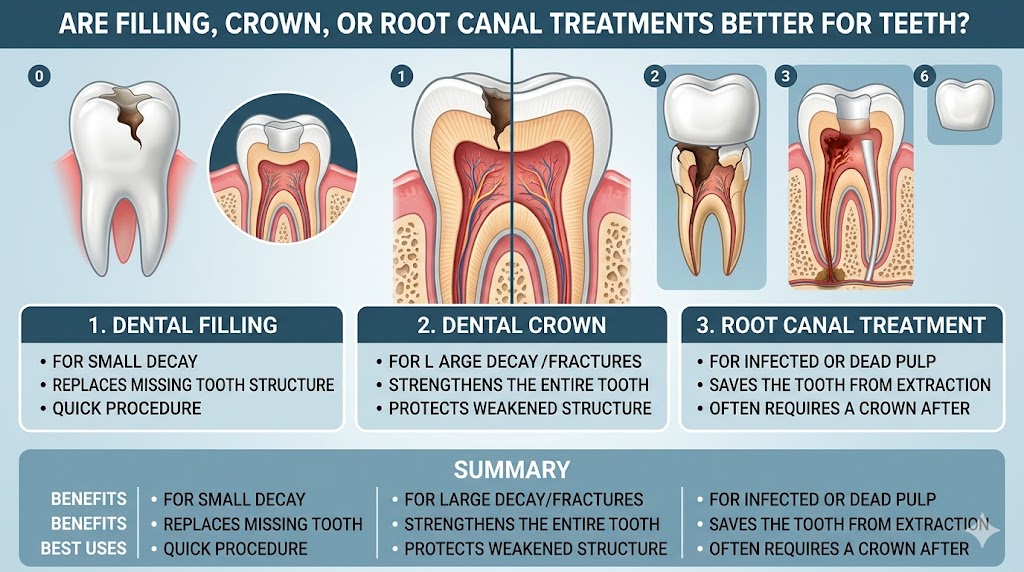
The short answer is that none of these treatments is universally “better” than the others. Instead, each procedure serves a highly specific purpose based on how deeply damage or decay has penetrated your tooth structure.
- A filling fixes minor, superficial surface decay.
- A crown protects and caps a severely weakened or broken tooth.
- A root canal (root treatment) saves a tooth when the inner nerve becomes infected.
Choosing the right option is not about picking a favorite treatment; it is about accurately matching the dental solution to the exact stage of your tooth’s damage.
This comprehensive, deep-dive guide will walk you through everything you need to know about dental fillings, crowns, and root treatments. We will explore how they work, compare their costs, map out timelines, and give you the exact knowledge you need to make an informed choice alongside your dentist.
1. Demystifying Tooth Anatomy: Why the Layer of Damage Matters
To truly understand why a dentist recommends one treatment over another, we must first look at what lies beneath the surface of your smile. Your teeth are not solid bone blocks. They are complex, layered structures. The specific layer where your decay or structural damage stops determines exactly which treatment you need.
+-------------------------------------------------------+
|                   ENAMEL (Outer Layer)                |
|               --> Treated via Fillings                |
+-------------------------------------------------------+
|                   DENTIN (Middle Layer)               |
|               --> Treated via Fillings / Crowns       |
+-------------------------------------------------------+
|                   PULP (Inner Nerve Chamber)          |
|               --> Treated via Root Canals             |
+-------------------------------------------------------+
The Enamel: The Outer Shield
The outermost layer of your tooth is the enamel. It is the hardest substance in the human body, built to withstand the intense pressure of chewing. Enamel contains no living cells or nerves. When cavities form here, you usually will not feel any pain. Minor decay restricted to the enamel is the ideal scenario for a standard dental filling.
The Dentin: The Sensitive Middle Layer
Beneath the enamel lies the dentin. This layer is softer than enamel and contains millions of microscopic tubes leading directly to the tooth’s nerve center. When decay breaks through the enamel and reaches the dentin, your tooth becomes sensitive to hot, cold, and sugary foods. If a large portion of dentin is compromised by a deep cavity or a fracture, a filling might not provide enough structural support. This is where a dental crown becomes necessary to prevent the tooth from splitting apart.
The Pulp Chamber: The Living Center
Deep inside the core of your tooth is the pulp chamber, which extends down into the root canals. The pulp contains live blood vessels, connective tissues, and highly sensitive nerves. If bacteria breach the enamel and dentin to infect the pulp, or if trauma cuts off the blood supply, the pulp will inflame and eventually die. This causes intense, throbbing pain. Once the pulp is infected, neither a filling nor a crown can fix the underlying problem. You must undergo a root canal treatment to clear out the dying tissue and eliminate the infection.
2. All About Dental Fillings: The First Line of Defense
A dental filling is the most common, minimally invasive restorative procedure in modern dentistry. Dentists use fillings when a cavity has formed but the overall structure of the tooth remains strong, stable, and uncracked.
The Core Purpose of a Filling
The main goal of a filling is simple: stop decay in its tracks and patch the hole left behind. By cleaning out the decayed material and sealing the cavity, your dentist prevents bacteria from traveling deeper into the dentin and pulp layers.
Types of Filling Materials
Dentists use several different materials to fill teeth today, each with its own set of pros and cons:
- Composite Resins: These are tooth-colored fillings made from a mixture of plastic and glass particles. They blend in seamlessly with your natural smile and bond directly to the tooth structure, requiring less enamel removal.
- Amalgam Fillings: Often called “silver fillings,” these are made from a mixture of metals, including silver, tin, copper, and mercury. They are incredibly durable, cost-effective, and long-lasting, making them excellent for back molars. However, they are highly visible and require more tooth structure removal to hold them in place.
- Glass Ionomer: Made of acrylic and a specific type of glass material, these fillings release fluoride over time, helping to protect the tooth from further decay. They are typically used for fillings near the gumline or in young children.
- Gold Inlays/Onlays: Exceptionally durable and long-lasting, gold does not corrode and can withstand heavy chewing forces. The downside is the high cost and the need for multiple appointments.
The Filling Procedure: Step-by-Step
- Numbing: The dentist applies a topical numbing gel to your gums and then injects a local anesthetic to completely numb the area around the target tooth.
- Decay Removal: Using a dental drill, laser, or air abrasion tool, the dentist carefully removes all compromised, decayed, and soft tooth material.
- Cleaning and Prepping: The dentist cleans the remaining cavity space to remove any lingering debris or bacteria. If using a composite filling, they will etch the tooth with a mild acid solution to help the material bond.
- Layering and Curing: The dentist places the filling material into the cavity. For composite resins, they apply the material in layers and harden each layer using a specialized blue curing light.
- Shaping and Polishing: Once the cavity is completely filled, the dentist trims away any excess material, shapes it to match your natural bite alignment, and polishes it smooth.
Lifespan and Expectations
On average, a standard composite filling lasts between 5 and 10 years, while an amalgam filling can easily last 10 to 15 years or longer with excellent oral hygiene. Fillings are excellent for minor damage, but they cannot save a tooth that has lost more than 50% of its natural structure.
3. Deep Dive into Dental Crowns: The Structural Helmet
When a tooth experiences major trauma, exhibits deep structural cracks, or loses a significant portion of its structure to an expansive cavity, a simple filling is no longer a safe option. If you try to put a massive filling in a severely weakened tooth, the remaining thin walls of enamel will eventually crack under the pressure of chewing. In these scenarios, a dental crown is the ideal protective solution.
What Exactly is a Dental Crown?
A dental crown is a custom-fabricated, hollow cap shaped exactly like a natural tooth. It fits over the entire visible portion of your remaining tooth structure, all the way down to the gumline. Think of it as a structural helmet that encases the weak tooth, redistributing the heavy forces of chewing so the underlying natural tooth does not break apart.
Common Reasons You Might Need a Crown
- Protecting a weak tooth from breaking or fracturing.
- Holding together parts of a cracked or split tooth.
- Restoring a tooth that is already badly broken or severely worn down.
- Covering and supporting a tooth that has a massive filling with very little natural tooth structure left.
- Capping a tooth that has just undergone a root canal procedure to restore its structural integrity.
- Covering misshapen, severely discolored, or cosmetically flawed teeth.
Material Varieties for Modern Crowns
Your choice of crown material will depend on your budget, cosmetic goals, and where the tooth is located in your mouth:
- Porcelain-Fused-to-Metal (PFM): These crowns feature a strong metal inner core covered by a layer of tooth-colored porcelain. They offer excellent strength and a natural appearance, though a dark metal line can sometimes show near the gumline over time.
- All-Ceramic or All-Porcelain: These offer the best, most lifelike aesthetic match for your natural teeth, making them the premier choice for highly visible front teeth. They are metal-free, which is ideal for patients with metal allergies.
- Zirconia: A modern, incredibly strong type of ceramic crown. Zirconia is virtually indestructible, making it perfect for back molars that endure intense grinding and chewing forces.
- Gold and Metal Alloys: Made from gold, platinum, or base metal mixtures, these crowns require the least amount of healthy tooth removal. They never chip or break and cause minimal wear on opposing teeth. Their obvious drawback is their metallic appearance, restricting their use mostly to out-of-sight back teeth.
The Multi-Step Crown Procedure
Getting a traditional dental crown typically requires two separate visits to your dentist:
Appointment 1: Preparation and Impression
- Anesthetic: The dentist numbs the tooth and surrounding gum tissue.
- Shaping: The dentist carefully trims down the outer chewing surfaces and sides of the tooth to make room for the thickness of the crown. If a large area of the tooth is missing due to decay, they will use a special composite material to “build up” a solid core to support the crown.
- Impression: The dentist takes a digital scan or a physical impression of your prepared tooth, along with the surrounding teeth, to ensure your new crown matches your bite perfectly. This data is sent out to a specialized dental laboratory.
- Temporary Crown: The dentist fabricates and cements a temporary acrylic crown onto your tooth to protect it while the dental lab custom-builds your permanent crown over the next two to three weeks.
Appointment 2: Permanent Placement
- Removal: The dentist gently removes the temporary crown and thoroughly cleans the underlying tooth.
- Fitting: They place the new permanent crown on your tooth, carefully checking its fit, margin seals, color match, and bite alignment.
- Final Cementation: Once everything looks and feels perfect, the dentist uses a high-strength dental cement to permanently anchor the crown in place.
Lifespan and Expectations
A high-quality dental crown typically lasts between 10 and 15 years, but with impeccable brushing, flossing, and regular dental checkups, many crowns easily last 20 to 30 years.
4. Understanding Root Canals (Root Treatments): Saving the Core
Few dental terms spark as much unearned anxiety as a “root canal.” In reality, modern root canal treatments do not cause pain—they relieve it. A root canal is a specialized endodontic procedure designed to save a natural tooth that is dead, dying, or severely infected at its core.
When is a Root Canal Absolutely Essential?
A root canal is required when bacteria break through the protective outer layers of enamel and dentin and invade the sensitive pulp chamber. This invasion can stem from an untreated, deep cavity, a profound crack in the tooth, or a traumatic physical injury to the jaw that cuts off the tooth’s blood supply.
Once bacteria enter this enclosed chamber, the pulp swells. Because the hard walls of the tooth cannot expand, the pressure inside rises dramatically. This restricts blood flow, causes intense pain, and eventually kills the nerve tissue. If left untreated, the infection will travel down the root tips and pour into the surrounding jawbone, creating a highly painful, swollen dental abscess.
Tell-Tale Signs You Need a Root Canal Treatment
- Spontaneous, sharp, or throbbing tooth pain that keeps you awake at night.
- Lingering, intense sensitivity to hot or cold foods that lasts for minutes after the stimulus is gone.
- Severe pain or tenderness when chewing or applying even light pressure to the tooth.
- Visible swelling or a pimple-like bump (fistula) on the gums near the painful tooth.
- A noticeable darkening or gray discoloration of the troubled tooth.
The Root Canal Procedure Breakdown
- Preparation and Imaging: The dentist takes detailed digital X-rays to map out the shape, length, and number of your root canals and check for surrounding bone infection.
- Profound Numbing: Local anesthetic is administered to ensure you do not feel any pain during the procedure. The area is isolated using a small protective rubber sheet called a dental dam, which keeps the tooth dry and sterile.
- Accessing the Chamber: The dentist drills a small access hole through the chewing surface of a back tooth or the backside of a front tooth to reach the inner pulp chamber.
- Cleaning and Shaping: Using specialized, flexible micro-files, the dentist carefully extracts the diseased, infected, and dead pulp tissue from the entire length of the chamber and root canals. They continuously flush the hollow canals with antibacterial solutions to kill off any remaining microscopic bacteria.
- Sealing the Canals: Once the canals are fully cleaned, dried, and shaped, the dentist fills the empty spaces with a biocompatible, rubbery material called gutta-percha. This material is sealed in place with an adhesive cement to permanently lock out future bacterial invasions.
- Temporary Sealing: The dentist closes the initial access hole with a temporary filling material. Because a tooth without a living blood supply becomes brittle over time, a root-canal-treated back tooth almost always requires a dental crown at a subsequent visit to restore its long-term strength.
5. Direct Comparison: Are Filling Crown or Root Better for Teeth?
To truly settle the question of are filling crown or root better for teeth, we must compare these three key dental treatments side-by-side across the factors that matter most to patients: preservation of natural tooth structure, procedural complexity, physical comfort, investment costs, and long-term durability.
Comparison Matrix
| Feature / Criteria | Dental Filling | Dental Crown | Root Canal (Root Treatment) |
| Primary Goal | Patches small holes; stops superficial decay. | Protects, caps, and reinforces a weak or broken tooth. | Eliminates deep bacterial infections inside the pulp chamber. |
| Tooth Structure Kept | High (Only the decayed spot is drilled away). | Moderate (Outer layer of the tooth must be trimmed down). | High (Preserves the natural root structure in your jawbone). |
| Pain Level | None to minimal during/after. | Minimal; mild soreness for a few days post-prep. | Relieves severe pain; minor soreness for a few days. |
| Appointments Needed | 1 quick visit (30 to 60 minutes). | 2 visits (unless using a same-day CEREC machine). | 1 to 2 visits depending on infection severity. |
| Average Lifespan | 5 to 15 years depending on the material. | 10 to 30 years with excellent home hygiene. | Permanent (The tooth structure itself lasts for decades if crowned). |
| Average Cost Range | $150 – $450 per tooth. | $1,000 – $2,500 per tooth. | $700 – $1,500 per tooth. |
6. How Your Dentist Decides: Clinical Decision Trees
Dentists do not guess when determining whether a filling, crown, or root canal is the appropriate solution for your smile. They follow strict clinical protocols and gather objective evidence using advanced diagnostic tools.
Diagnostic Tools in Action
- Visual Exams: Your dentist uses high-powered magnification loupes and bright lighting to look for cracks, chips, structural breakdowns, or surface discolored lesions.
- Digital X-Rays: These images allow dentists to see right through the dense layers of your teeth. X-rays reveal cavities hiding between teeth, show how close a cavity is to the inner nerve chamber, and detect bone loss or abscesses at the base of the roots.
- Electronic Pulp Testing & Cold Tests: To see if a tooth’s nerve is alive and healthy, the dentist might touch the tooth with an intensely cold cotton pellet or use a gentle electric current tool. If you feel a quick flash of cold that goes away instantly, your nerve is healthy (filling or crown territory). If you feel a lingering, throbbing ache, the nerve is dying (root canal territory). If you feel nothing at all, the nerve is already dead (root canal territory).
- Percussion Testing: The dentist gently taps on your teeth with the handle of a dental mirror. Pain from light tapping usually points to inflammation in the ligaments holding the root in place, which is a common sign of a deep root infection.
Clinical Decision Guidelines
Clinical Protocol:
- Scenario A: Decay is limited entirely to the enamel or dentin layer; the tooth structure remains strong and stable. Verdict: Dental Filling.
- Scenario B: Large parts of the tooth walls are missing or cracked, but the inner nerve tests as completely healthy and pain-free. Verdict: Dental Crown.
- Scenario C: The inner pulp tissue is inflamed, infected, abscessed, or completely dead. Verdict: Root Canal Treatment (usually followed by a Dental Crown).
7. The Financial Factor: Balancing Upfront Costs and Long-Term Value
Dental health is an investment, and understanding the financial side of fillings, crowns, and root canals can help you plan your care without stressful surprises.
Upfront Cost vs. Total Value
At first glance, a dental filling looks like the most financially attractive option because it has the lowest upfront price tag. However, trying to push a filling beyond its clinical limits to save money is a costly mistake. If you place a large filling in a tooth that actually requires a protective crown, the tooth will eventually fracture under pressure. When it breaks, it often splits so deeply down into the root that it cannot be saved at all, forcing you to pay for a complete extraction and an expensive dental implant.
Investing in a crown or a root canal when your dentist first recommends it protects the foundational structure of your mouth, saving you thousands of dollars in emergency treatments down the road.
Dental Insurance Navigation
Most dental insurance policies categorize these three treatments into distinct tiers:
- Basic/Preventive Care (Fillings): Usually covered at a high rate, often between 70% and 80% of the total cost, leaving you with a minor co-pay.
- Major Restorative Care (Crowns & Root Canals): Typically covered at a lower rate, usually around 50%. You will need to meet your yearly deductible before the insurance pays its share, and you must keep an eye on your plan’s maximum annual limit (which often ranges between $1,000 and $2,000 per year).
8. Step-by-Step Patient Recovery Guides: What to Expect
Every dental procedure comes with its own unique timeline for recovery and healing. Knowing what to expect helps you manage post-visit care with confidence.
Recovering from a Dental Filling
- Timeline: 1 to 3 days.
- What to Expect: Your mouth will remain completely numb for 2 to 4 hours after your appointment. Avoid eating hot foods or chewing during this window so you do not accidentally bite your tongue or cheek.
- Symptom Management: You may notice some mild sensitivity to very cold or hot drinks for a couple of days. This is completely normal as the tooth’s nerve adjusts to the new material. Use a desensitizing toothpaste to find quick relief.
Recovering from a Dental Crown Preparation
- Timeline: 3 to 7 days.
- What to Expect: While wearing your temporary acrylic crown, you must be careful with what you eat. Avoid chewing sticky candies, chewing gum, or incredibly hard foods on that side of your mouth, as these can easily pull the temporary crown off.
- Symptom Management: The gum tissue around the shaped tooth may feel slightly tender or inflamed for a few days due to the dental work. Rinsing your mouth gently with warm salt water three times a day will soothe the tissue and speed up healing.
Recovering from a Root Canal Treatment
- Timeline: 3 to 5 days.
- What to Expect: The intense, throbbing ache caused by the active infection should disappear immediately after your treatment. However, the tooth and surrounding jaw area will likely feel tender to the touch or when chewing for a few days.
- Symptom Management: You can easily manage this temporary soreness with standard over-the-counter pain relievers like ibuprofen or acetaminophen. Avoid biting down hard on the treated tooth until your dentist places the final permanent crown.
9. Home Oral Care: Maximizing the Lifespan of Your Dental Restorations
No matter how skilled your dentist is, the ultimate lifespan of your dental fillings, crowns, and root canals depends entirely on how well you care for your mouth at home. Restorations cannot get cavities themselves, but the natural tooth structure holding them in place is still highly vulnerable to decay.
       DAILY ORAL HYGIENE CHECKLIST
+-------------------------------------------------+
| [ ] Brush twice daily with fluoride toothpaste  |
| [ ] Floss daily (slide floss out for temporaries)|
| [ ] Clean along the gumline of all crowns       |
| [ ] Wear a nightguard if you grind your teeth   |
| [ ] Visit your dentist every 6 months           |
+-------------------------------------------------+
Essential Brushing and Flossing Strategies
- Brush Twice a Day: Use a soft-bristled manual or electric toothbrush and a premium fluoride toothpaste. Pay extra attention to the exact line where your dental crown or filling meets your natural gum tissue. This boundary layer is where plaque bacteria love to collect and form new cavities.
- Floss Daily: Slide dental floss gently between your teeth every night. Never pull up aggressively on floss around a temporary crown, as this can dislodge it. Instead, slide the floss all the way through the gap and pull it out sideways from the side of the tooth.
Lifestyle Choices for Long-Lasting Smiles
- Kick Bad Chewing Habits: Avoid biting down directly on ice cubes, hard candy shells, popcorn kernels, or non-food objects like pens and fingernails. These hard items can crack porcelain crowns and chip composite fillings.
- Wear a Nightguard: If you wake up with a sore jaw or have a habit of clenching and grinding your teeth at night (bruxism), ask your dentist for a custom-fitted nightguard. The intense pressure from nightly grinding can cause fillings to leak and crack porcelain crowns prematurely.
- Stay Consistent with Cleanings: Visit your dental office every six months for a professional cleaning and checkup. Your hygienist can clean away hardened tartar that your toothbrush cannot touch, and your dentist can examine your restorations early to ensure they remain sealed and solid.
Conclusion
Choosing between a filling, a crown, or a root canal is not about selecting a “better” treatment option. Instead, it is about precisely matching the right dental solution to how deeply decay or damage has entered your tooth structure. By understanding your tooth’s anatomy and working closely with your dentist, you can choose the ideal treatment to eliminate pain, save your natural smile, and keep your teeth strong for decades to come.
FAQ: Frequently Asked Questions
Can a tooth with a dental filling eventually need a root canal?
Yes. If a dental filling leaks, cracks, or if new decay forms underneath it and is left untreated, bacteria can travel deep into the inner dentin and reach the pulp chamber. Once bacteria invade the pulp, the nerve becomes infected, and you will need a root canal to save the tooth.
Does a root canal always have to be covered with a dental crown?
For back teeth (molars and premolars), yes. Back teeth handle the intense pressure of chewing. Once a root canal removes the inner blood supply, the tooth becomes brittle over time and can easily crack under pressure. A crown is essential to protect it. Front teeth (incisors and canines) do not experience the same heavy chewing forces, so they can sometimes be sealed with a simple filling after a root canal if enough natural tooth structure remains.
How do I know if my old dental filling is failing?
A failing filling may cause sharp sensitivity when you drink cold or hot liquids, or slight pain when you bite down. You might also feel a rough edge with your tongue, or notice food constantly getting trapped around that tooth. Regular dental X-rays are the best way to catch a failing filling before it hurts.
Is it better to pull a tooth out instead of getting a root canal and crown?
It is almost always better to keep your natural tooth whenever possible. Extracting a tooth creates an empty gap in your jaw, which causes your surrounding teeth to shift out of alignment over time, altering your bite and making it harder to chew. Replacing an extracted tooth with a dental bridge or an implant is far more expensive and invasive than saving the tooth with a root canal and a crown.
How long do I need to wait to eat after getting a new dental filling?
If you receive a composite (tooth-colored) resin filling, it is fully hardened by the dentist’s blue curing light before you leave the chair, so you can eat right away. If you receive a silver amalgam filling, you should wait at least 24 hours before chewing hard foods on that side of your mouth to let the material fully set. Regardless of the material, it is smartest to wait until the local anesthetic wears off completely so you do not accidentally bite your tongue or lip.
Additional Resources
- American Dental Association (ADA) – Patient Education Portal: Offers excellent video guides and clear articles detailing what to expect during root canals, fillings, and crown placements.
- American Association of Endodontists (AAE): The premier online resource for understanding root canal treatments, dispelling common myths about dental nerve pain, and learning how preserving natural teeth protects your long-term health.
- Your Local Dentist’s Office: Your personal dentist is the absolute best resource for your smile. Never hesitate to ask for a detailed walkthrough of your treatment plan, a breakdown of diagnostic X-rays, or a clear estimate of your restoration costs before your procedure begins.