Is It Safe to Delay Dental Treatment?
We have all been there. You feel a slight twinge in your tooth while drinking a cold beverage, or you notice a bit of blood in the sink when you brush. Your first thought might be to ignore it. Life is busy, dental appointments can be stressful, and the cost of dental care can feel overwhelming. You tell yourself, “I will handle it next month.”
But when it comes to oral health, procrastination is rarely your friend. Unlike a minor cold or a scraped knee, dental problems do not heal on their own. Teeth cannot regenerate enamel, and oral bacteria do not simply pack up and leave.
So, is it safe to delay dental treatment?
The short answer is: almost never. While delaying a routine cleaning by a couple of weeks won’t cause your teeth to fall out, putting off actual treatment for cavities, gum disease, or broken restorations is a high-stakes gamble. What starts as a microscopic speck of decay can silently transform into an agonizing infection, leading to tooth loss, expensive root canals, and even systemic health complications.
This comprehensive guide breaks down exactly what happens to your mouth when you delay care, how minor issues escalate into major emergencies, and how procrastination ultimately hurts both your physical well-being and your wallet.
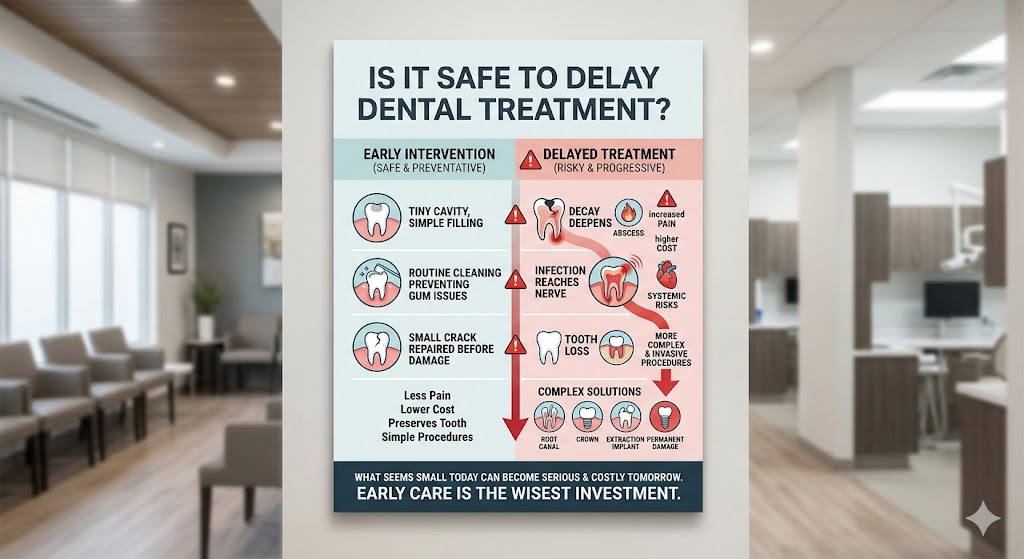
The True Cost of Dental Procrastination
When people delay dental care, they usually do so to save time or money. Ironically, delaying dental treatment achieves the exact opposite. In dentistry, time equals complexity—and complexity equals cost.
How Small Issues Escalate
Dental diseases progress through distinct stages. Understanding this progression helps explain why waiting is so dangerous.
- The Asymptomatic Stage: In the early stages of cavities or gum disease, there is often zero pain. You might feel completely fine, but harmful bacteria are already structural integrity.
- The Structural Damage Stage: As decay breaches the hard outer enamel, it reaches the softer dentin layer. This is when mild sensitivity to sweets, hot, or cold temperatures typically begins.
- The Inflammatory Stage: Once bacteria penetrate the innermost part of the tooth—the pulp—the nerve becomes inflamed. This triggers persistent, throbbing pain that disrupts sleep and daily life.
- The Infestation Stage: If left untreated, the dying nerve becomes a breeding ground for bacteria, leading to an abscess, bone loss around the root, and potential systemic infection.
Financial Implications: Prevention vs. Reaction
Let us look at the financial reality of delaying dental work. Treating a problem early is always affordable compared to treating an advanced emergency.
| Initial Presentation | Immediate Action Cost | Delayed Action Consequence | Delayed Action Cost |
| Incipient Cavity | Minor Composite Filling (Low Cost) | Deep decay reaching the nerve | Root Canal & Crown (High Cost) |
| Mild Gingivitis | Routine Cleaning & Better Hygiene (Low Cost) | Advanced Periodontitis with bone loss | Deep Scaling, Root Planing, Surgery (Very High Cost) |
| Chipped Tooth | Smooth edges or simple bonding (Low Cost) | Tooth fractures below the gumline | Extraction and Dental Implant (Maximum Cost) |
Common Dental Conditions and the Risks of Delay
To fully understand why waiting is risky, we must examine specific, common dental issues and how they behave over time.
1. Dental Caries (Cavities)
A cavity is a permanent hole in your tooth structure caused by bacterial acid production.
- If treated early: A dentist removes the decayed portion and places a small, tooth-colored filling. The tooth retains most of its natural strength.
- If delayed by 6 months: The decay spreads sideways and downward through the dentin. The filling required will be much larger, weakening the overall tooth structure.
- If delayed by 12+ months: The bacteria reach the pulp chamber. You now require a root canal therapy to save the tooth, followed by a full-coverage crown to prevent the fragile shell from shattering.
2. Periodontal (Gum) Disease
Gum disease is a chronic bacterial infection affecting the tissues that support your teeth. It starts as gingivitis (inflamed, bleeding gums) and progresses to periodontitis.
- The Danger of Waiting: Unlike teeth, which show damage locally, gum disease destroys the underlying alveolar bone. Once this bone dissolves, it cannot grow back naturally.
- The Ultimate Result: As bone support diminishes, teeth become loose, shift out of alignment, and eventually fall out or require extraction.
“Gum disease is a silent thief. It rarely hurts in its early and moderate stages, meaning patients frequently delay treatment until their teeth are literally floating in infected tissue.”
— Dr. Aris Thorne, Clinical Periodontist
3. Cracked or Chipped Teeth
Teeth can crack due to trauma, grinding, or biting down on hard objects.
- The Hidden Risk: Even if a crack does not hurt, it flexes every time you chew. This microscopic movement allows bacteria to seep directly into the center of the tooth. Over time, the crack can expand, splitting the tooth entirely in half. A split tooth cannot be saved and must be extracted.
4. Failing Existing Restorations
Old fillings, crowns, and bridges do not last forever. They can develop micro-leaks or cracks around their margins.
- Why you cannot wait: When an old filling fails, bacteria hide underneath it. Because the area is sealed from the outside, you cannot clean it with a toothbrush. Decay can rot the tooth from the inside out without your knowledge until the entire restoration collapses.
Urgent vs. Non-Urgent Dental Situations
While delaying care is generally unwise, certain situations require instantaneous intervention, while others offer a narrow window of flexibility. Knowing the difference can save your life or your smile.
Critical Dental Emergencies (Seek Care Within Hours)
The following symptoms indicate a severe issue that cannot wait for an appointment next week:
- Swelling of the Face, Jaw, or Neck: This indicates a spreading infection that can block your airway or travel to your brain.
- Uncontrolled Bleeding: Persistent bleeding following an extraction or trauma.
- Knocked-Out (Avulsed) Permanent Tooth: A permanent tooth knocked out by impact can often be replanted successfully, but only if a dentist treats it within 30 to 60 minutes.
- Severe, Debilitating Pain with Fever: Signs of an acute systemic response to an infection.
Non-Urgent Dental Situations (Can Wait a Few Days to Weeks)
These conditions still require professional attention, but they generally do not present an immediate risk to your systemic health:
- Mild Tooth Sensitivity: Minor twinges when consuming hot or cold foods.
- Lost Cosmetic Bonding: A small chip on a front tooth that does not involve sharp edges or intense pain.
- Dull, Intermittent Ache: A mild discomfort that comes and goes but is easily managed with over-the-counter pain relievers (though this should still be evaluated within a couple of weeks).
- Routine Preventive Cleanings: Moving your bi-annual checkup by a week or two due to an unexpected scheduling conflict.
The Systemic Connection: Oral Health and the Rest of Your Body
Your mouth is not isolated from the rest of your body. It serves as the primary gateway to your respiratory and digestive tracts. When you delay dental treatment and allow chronic infections to fester, the consequences ripple throughout your entire systemic health.
Cardiovascular Disease
The bacteria that cause advanced gum disease can easily enter your bloodstream through inflamed, bleeding gums. Once inside the circulatory system, these pathogens can attach to fatty deposits in the blood vessels of the heart. This contributes to clot formation, arterial clogging, and a significantly increased risk of heart attacks and strokes.
Diabetes Management
The relationship between gum disease and diabetes is a dangerous two-way street. Chronic oral inflammation impairs your body’s ability to utilize insulin effectively. When you delay treatment for periodontal disease, your blood sugar levels can skyrocket, making diabetes incredibly difficult to manage. Conversely, poorly controlled diabetes makes you more susceptible to oral infections.
Respiratory Infections
If your mouth is filled with pathogenic bacteria due to severe decay or gum disease, you inhale those micro-organisms into your lungs daily. This can lead to severe respiratory illnesses, including bacterial pneumonia and chronic obstructive pulmonary disease (COPD) flare-ups, particularly in older adults or immunocompromised individuals.
Overcoming the Barriers to Seeking Dental Care
If delaying dental care is so risky, why do millions of people still do it? Understanding the psychological and financial roadblocks is the first step toward overcoming them.
Dental Anxiety and Phobia
Fear of pain, needles, or the sounds of dental instruments keeps countless people away from the clinic.
- The Solution: Modern dentistry focuses heavily on patient comfort. Express your anxieties openly with your dental provider. Many clinics offer sedation options, ranging from nitrous oxide (laughing gas) to oral sedatives or IV conscious sedation.
Financial Challenges
The perceived cost of dental treatment is a massive barrier. However, there are strategic ways to access affordable care without neglecting your teeth.
- Dental Schools: University dental clinics offer high-quality treatment performed by students under the direct supervision of licensed faculty dentists, usually at a fraction of the cost of private practices.
- Payment Plans and Financing: Most dental offices offer third-party financing plans that allow you to break down large treatment bills into manageable monthly installments.
- Phased Treatment Planning: If you require extensive work, ask your dentist to phase the treatment. They can prioritize stabilizing urgent infections and cavities first, delaying purely cosmetic or elective procedures until your budget permits.
                        +---------------------------------------+
                        |      Unresolved Dental Issue          |
                        +---------------------------------------+
                                            |
                                            v
                        +---------------------------------------+
                        |     Bacterial Infection Spreads       |
                        +---------------------------------------+
                                            |
                    +-----------------------+-----------------------+
                    |                                               |
                    v                                               v
+---------------------------------------+       +---------------------------------------+
|        Localized Consequences         |       |         Systemic Consequences         |
+---------------------------------------+       +---------------------------------------+
|  * Severe, Throbbing Pain             |       |  * Increased Risk of Heart Disease    |
|  * Bone Loss Around the Root          |       |  * Worsened Diabetic Blood Glucose    |
|  * Structural Tooth Loss              |       |  * Bacterial Respiratory Infections   |
|  * Costly Emergency Interventions     |       |  * Spreading Facial/Neck Abscesses    |
+---------------------------------------+       +---------------------------------------+
Frequently Asked Questions
Can a small cavity go away on its own if I brush better?
No. While very early enamel demineralization can sometimes be reversed with high-dose topical fluoride and immaculate oral hygiene, a true cavity that has broken through the enamel cannot heal itself. It requires professional removal and restoration.
What should I do if a dental emergency occurs after hours?
If you experience severe swelling, trauma, or uncontrollable bleeding over the weekend or at night, call your regular dentist’s emergency line. If they do not have an on-call system, visit your local hospital’s emergency room immediately.
How long can I safely delay a root canal?
Once a dentist determines you need a root canal, you should not delay treatment for more than a few weeks. Even if pain subsides temporarily, it usually means the tooth nerve has died. The underlying infection is still active and destroying the bone surrounding the tooth roots.
Does dental insurance cover emergency treatments?
Most dental insurance plans cover preventive services fully and provide partial coverage for basic treatments (like fillings) and major procedures (like root canals and crowns). Check your specific policy details or ask your dental clinic for a pre-treatment estimate.
Additional Resources
- The American Dental Association (ADA): Provides comprehensive patient education resources, practice finders, and evidence-based guidelines on oral health maintenance.
- Local Community Health Centers: Many government-funded clinics offer sliding-scale dental services based on income for individuals lacking traditional insurance coverage.
- The National Institute of Dental and Craniofacial Research (NIDCR): Offers deep insights into current scientific research regarding the strong connections between oral conditions and general systemic health.
Conclusion
Delaying dental treatment escalates simple, painless issues into severe infections, substantial financial burdens, and complex health problems. Addressing oral health concerns early preserves your natural smile, protects your overall physical well-being, and saves you significant time and expense. Whenever dental issues arise, prompt professional intervention remains your safest and most cost-effective solution.