ADA Dental Code for Post-Operative Care
Navigating the world of dental billing can feel like learning a second language. You’ve just completed a complex procedure, focused entirely on the patient’s comfort and the clinical outcome. Now, you turn your attention to the paperwork, and a familiar question arises: “How do I properly document and code for the follow-up care that’s often an integral part of the treatment?”
This is a critical area that directly impacts your practice’s revenue cycle and compliance. The post-operative period in dentistry isn’t just a clinical concept; it’s a defined billing entity governed by specific rules and codes. Misunderstanding these rules can lead to claim denials, lost revenue, or even compliance flags.
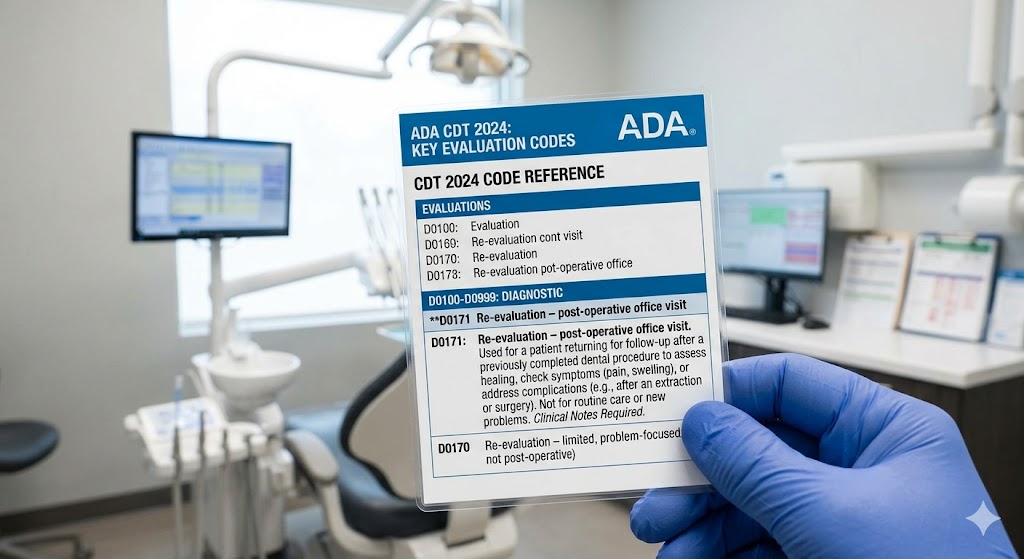
This comprehensive guide will serve as your definitive roadmap. We will explore the specific American Dental Association (ADA) Code related to post-operative care, dissect what it covers, and explain exactly how to use it correctly. Whether you are a seasoned dentist, an office manager, or a new biller, this article will provide the clarity, detail, and practical strategies you need. Let’s demystify this essential piece of the dental coding puzzle.
Understanding the Global Surgical Package in Dentistry
Before we can dive into a specific code, we must first understand a foundational concept known as the “global period.” This is the heart of all post-operative coding confusion. The global surgical package is a set of rules, maintained by the ADA and mirrored by many insurance carriers, that bundles all the routine and necessary components of a surgical procedure into a single, all-inclusive fee.
Think of it as a fixed-price menu for a surgical event. When you bill for a surgical extraction (D7140), you aren’t just billing for the moment the tooth is removed. You are billing for a package of services that extends both before and after the actual procedure. Understanding the boundaries of this package is the first step to knowing when you can and cannot bill separately for a post-operative visit.
What the Global Period Actually Includes
The global period is not an arbitrary timeline. It’s a logical grouping of services that are considered inherent to the procedure. The ADA’s Code on Dental Procedures and Nomenclature (the CDT Code) provides the framework, and while payers may have slight variations, the core concept is universally accepted.
A standard dental surgical global package generally includes the following components, all bundled under the fee for the primary surgical code:
- Preoperative Evaluation: A limited clinical examination of the specific area to be operated on. This is not a comprehensive oral evaluation, but the focused assessment you do on the day of the procedure to confirm the diagnosis and plan the surgery.
- Local Anesthesia: The administration of a local anesthetic and the drug itself. This is never separately billable on the same date as a surgical procedure.
- The Surgical Procedure Itself: This is the main act, described by the CDT code you select (e.g., D7210 for surgical removal of an erupted tooth).
- Immediate Post-Operative Care: This includes writing prescriptions, providing verbal and written post-operative instructions, and performing any immediate complication management within the first hours after surgery.
- Routine, Uncomplicated Follow-up Care: This is the most critical and misunderstood component. It includes all normally expected post-surgical visits during a defined period. This covers suture removal, dressing changes, and checking the healing progress when no separate, identifiable problem exists.
Important Note for Practitioners: The global period for dental procedures is generally 10 days, although this can vary significantly by payer for more complex procedures like osseous surgery. Always verify with the specific third-party payer’s contract. The crucial takeaway is that a standard post-operative check after a surgical extraction, where you simply remove sutures and confirm healthy healing, is never separately billable. It’s part of the global fee you’ve already been paid.
The Specific ADA Dental Code for Post-Operative Care
Given the global period rules, you might wonder if there is any code at all for a post-operative visit. The answer is yes, but its application is highly specific and frequently misused. The primary CDT code designed for a post-operative visit is D9430: Office visit for observation (during regularly scheduled hours) — no other services performed.
This code is the linchpin for billing a post-op visit that falls outside the standard global package. It signals to the payer that the patient’s return to the office was for a separate, identifiable issue that required a distinct evaluation, and that you performed no other separately identifiable service on that date.
Let’s break down the code’s official nomenclature to understand its power and its limits.
Decoding D9430: A Deep Dive into Its Description
The official CDT descriptor for D9430 is meticulous. Every word carries weight and billing significance.
- “Office visit for observation…” This confirms that the code is for an evaluation service. It establishes that the patient’s physical presence in the office is the core of the service.
- “…(during regularly scheduled hours)…” This is a critical qualifier. D9430 is strictly for office visits that occur within your standard practice schedule. A separate code, D9440 (office visit — after regularly scheduled hours), exists for true emergency after-hours visits. Using D9430 for a 9 PM emergency call is incorrect.
- “…no other services performed.” This is the most restrictive and most ignored part of the definition. D9430 is a stand-alone evaluation code. If, during the same visit, you take a radiograph, place a sedative dressing, incise and drain an abscess, or perform any other coded procedure, you cannot bill D9430. You would only bill the more definitive procedure(s) performed.
This code is not a loophole to bill for a routine suture removal. It’s a precise tool for a specific scenario: a patient returns during the global period with a problem that requires a separate diagnostic work-up but does not culminate in a separate therapeutic procedure on that same day.
Appropriate Scenarios for Billing Post-Operative Care
To truly master the use of D9430, it’s more helpful to think in clinical narratives than just in code numbers. The key differentiator between a non-billable global visit and a billable D9430 visit is the presence of a complication or a separate, significant concern that requires a diagnostic evaluation beyond normal healing.
Let’s illustrate this with a comparative table that acts as a practical guide.
Comparative Scenarios: Global Visit vs. Billable D9430 Visit
| Clinical Scenario | Is This a Global Period Visit? | Can You Bill D9430? | The Rationale |
|---|---|---|---|
| A 5-day post-extraction patient arrives. You remove sutures, see excellent soft tissue closure, no pain, no swelling. You say, “Everything looks great, keep it clean.” | Yes | No. This is the definition of routine, uncomplicated post-operative care. | The suture removal and reassurance are part of the global surgical package. No separate, identifiable problem exists. |
| A 3-day post-extraction patient calls with “terrible pain.” You bring them in. A visual exam reveals a completely clean socket, but you strongly suspect a root tip was left behind. You take a periapical radiograph to confirm your suspicion. | No | Yes, but only if that’s the end of the visit. If you then surgically remove the root tip (D7251), you would bill D7251, not D9430. | The patient presented with a separate, significant problem (pain, suspected retained root tip). The observation and diagnosis required a focused, additional work-up. The radiographic image (D0220 or D0230) can be billed separately. The office visit for this evaluation before deciding on surgery is D9430. |
| A 7-day post-extraction patient returns with severe pain, bad taste, and exposed bone. You diagnose alveolar osteitis (dry socket). You place a sedative dressing (D7953) for relief. | Yes, for the “check-up.” No, for the specific diagnosis. | No. You would bill for the definitive procedure you performed: D7953. | The visit is driven by a complication, but you performed a specific, coded therapeutic service. You do not bill an evaluation code when a separate therapeutic procedure is delivered on the same day. |
| A patient had a large tori removal (D7473) two weeks ago. They return today, concerned about a small, loose bone fragment that feels sharp. The global period might be extended by the payer. You perform a focused evaluation, use an instrument to gently flick off a 1mm mobile spicule, and see a healthy, pink base. No sutures are needed. | No, if the removal was simple and non-surgical. | Yes. This is a perfect use case. The patient had a separate concern. You performed a limited problem-focused evaluation. The removal of the splinter-like spicule is considered a minor procedure not requiring a separate surgical code and is part of the observation visit management. | The core service is the professional diagnostic evaluation of an unplanned complication. The minor manual removal is incidental and not a separate, billable surgical act. |
| Two weeks after an extraction, a patient returns on their own initiative because they are worried about a “white spot” that is just normal granulation tissue. You listen to their concerns, look at the site, and spend ten minutes educating and reassuring them that it is a normal part of healing. No procedures are performed. | The routine global period (often 10 days) has likely lapsed. | Yes. This is an excellent example. The patient returned for a separate, non-surgical concern (anxiety about normal healing). You performed a problem-focused evaluation and provided extensive explanation, but no other coded service. Time spent counseling and coordinating care is a component of the evaluation service. | Even though the finding was normal, the service was driven by a distinct patient concern requiring your professional diagnostic expertise to differentiate normal from abnormal healing. |
Key Takeaway Logic for D9430
Use this simple mental checklist to decide if D9430 is appropriate:
- Is the patient in a global post-operative period from a prior surgery? If no, a standard evaluation code (D0140, D0160) is likely more appropriate.
- Did the patient return for a separate, specific problem or complaint, not just a scheduled routine check? If it’s a scheduled suture removal with no complaint, the answer is no.
- Did you perform any other separately identifiable, coded service during this visit? If yes, bill for that service, not D9430.
If your answer is “yes” to the first two questions and a definitive “no” to the third, D9430 is likely your correct code.
Disclaimer: This information is for educational purposes and does not constitute legal or billing advice. Always consult your specific payer contracts and a certified professional coder for definitive guidance.
Documentation: The Non-Negotiable Foundation of a Post-Op Claim
You can perfectly understand the coding rules, but without airtight documentation, your claim is a house of cards. D9430, in particular, is a code that can attract payer scrutiny precisely because it lives in the post-operative space, an area they expect to be bundled. Your clinical notes must tell the story of why this visit was a distinct, medically necessary service.
A simple entry like “Post-op check #30, healing well” is a recipe for a denied D9430 claim. Your documentation must clearly separate this visit from routine global care. It must paint a picture of a patient with a separate problem and a doctor performing a separate diagnostic evaluation.
Building Your D9430 Documentation Narrative
Think of your clinical note as a story with four key chapters. Each one must be present and clear.
- The Chief Complaint (The Reason for the Visit):
- Don’t write: “Post-op visit.”
- Do write: “Patient presents 4 days post-extraction of tooth #30 with a chief complaint of ‘constant, throbbing pain that won’t stop, even with the ibuprofen I was told to take.'”
- This immediately establishes a separate, problem-driven reason for the encounter, distinct from routine healing.
- The History of Present Illness (The Investigation):
- Detail the patient’s account of the problem. “Reports pain began 24 hours ago and has increased in intensity. Rates pain as 7/10. Denies fever but reports a bad taste.” This shows you collected a detailed history related to the new complaint.
- Objective Findings (The Diagnostic Workup):
- This is the core of your service. Be descriptive.
- “Extraoral exam: No facial swelling or palpable lymphadenopathy.”
- “Intraoral exam: #30 socket appears partially collapsed with loss of the dark blood clot. Surrounding gingiva is erythematous and exquisitely tender to palpation. No purulent exudate visible, but a strong fetid odor is present. Probing of the socket reveals exposed bone that is intensely painful.”
- If you took a radiograph, note the relevant findings: “A periapical radiograph was taken to rule out a retained root tip or fracture. The image reveals an intact lamina dura with no evidence of root fragments or bony sequestrum.”
- This objective evidence validates your diagnosis and proves the medical necessity of the evaluation.
- Assessment and Plan (The Medical Decision-Making):
- State your clear diagnosis: “Assessment: Alveolar osteitis (dry socket) #30.”
- Outline the plan, and this is crucial. If you bill D9430, the plan cannot include another coded service on that day. The plan for D9430 might be: “Plan: Discussed the diagnosis of dry socket and its natural history. Prescribed chlorhexidine rinse and analgesic regimen. The patient was given thorough irrigation instructions for home care. We will continue to monitor. The decision was made against placing a sedative dressing at this time to allow for natural healing.”
- This plan demonstrates that the entire visit was a diagnostic and management planning session, and no separately billable procedure was performed.
Without this narrative, you are billing for a conclusion without showing your work. With it, your claim for D9430 is supported, justified, and defensible.
The Financial Perspective: Fee Allocation and Relative Value
Justifying a fee for a service where “no other procedure is performed” requires a shift in thinking. The value of D9430 doesn’t lie in materials or a technical act; it lies in the cognitive work, the diagnostic skill, and the doctor-patient time spent. Your fee must reflect this intellectual and time-based value.
What’s in a Fee? The Components of D9430’s Value
| Value Component | Description | How to Quantify It for Your Fee |
|---|---|---|
| Professional Cognitive Labor | This is the core of the service. Taking a history, differentiating a dry socket from a fractured jaw, interpreting a radiograph in context, and deciding whether to intervene or allow natural healing. This is high-level medical decision-making. | Compare it to the diagnostic component of a complex case. This is not a simple problem. |
| Time Intensity | D9430 often involves a long, problem-focused conversation with an anxious patient in pain. It consumes significant chair time that could be used for production. | Track the average time spent on a true D9430 visit. A 20-30 minute diagnostic session is common. Your fee should be commensurate with the time of a doctor-only or doctor-primary procedure. |
| Risk Management | The failure to diagnose a serious post-operative complication (like a developing infection or nerve injury) has massive medico-legal and clinical risks. The evaluation service is a critical act of risk mitigation. | This is intangible but real. The fee reflects the responsibility you carry when making a potentially complex post-surgical diagnosis. |
| Practice Overhead | A D9430 visit consumes a room, staff time for the emergency work-in, and administrative overhead. | Calculate your hourly overhead cost. A visit that ties up an operatory for 20 minutes has a baseline cost that the fee must first cover. |
Your fee for D9430 should be strategically set, not an afterthought. It should be significantly higher than a periodic oral evaluation (D0120) because the medical decision-making is more complex and problem-focused. Many practices set the D9430 fee to be on par with, or only slightly less than, a limited oral evaluation—problem focused (D0140), recognizing the unique time and diagnostic pressure of a post-operative emergency.
Navigating the Maze of Third-Party Payer Rules
Here lies the greatest practical challenge. You can master the CDT code and perfect your documentation, but a third-party payer’s internal policies can still dictate the outcome of your claim. The ADA’s global period is a guideline, but Delta Dental, MetLife, Cigna, and others may have their own defined timelines and bundled service lists.
Common Payer Post-Operative Policies
You are navigating a patchwork system. A code that is perfectly valid per the CDT manual may be automatically bundled and denied by a payer’s claims processing software. This isn’t always a denial of medical necessity; it’s a denial based on a contractual definition of “standard follow-up.”
- Defined Global Days: Most payers strictly adhere to a 10-day global period for basic surgical procedures like simple and surgical extractions. However, more complex periodontal and oral surgery procedures (like osseous surgery, D4260, or complex extraction, D7251) can have a 30-, 60-, or even 90-day global period.
- Bundled Services List: Payers maintain a list of codes they will not reimburse separately when performed during the global period. Radiographs taken as part of a post-op complication workup are generally eligible for separate reimbursement. However, a palliative emergency treatment (D9110) on the same day as a post-op visit will almost always be bundled into the surgical package by the payer’s system.
- The “With Evaluation” Modality: Some payers, particularly for medical-dental cross-coding, may require you to use a specific modifier (like a -25 modifier on the CPT side for medical claims) to signify that a separately identifiable evaluation service was performed on the same day as a procedure. The CDT code set does not use the -25 modifier in the same way, which can create friction.
Strategic Tips for Medical Necessity
Your most powerful tool is the “medical necessity” letter. When a claim for D9430 with a narrative is denied, a simple phone call or a templated letter can often overturn the denial.
- Don’t just resubmit the claim. Send a brief, powerful letter. Use the terms “significant, separately identifiable diagnostic service.” Explicitly state: “This visit was unrelated to routine global follow-up. The patient presented with an acute, separate complaint [quote the chief complaint]. The time and cognitive labor were devoted to diagnosing a potential pathologic process, as outlined in the attached clinical notes.”
- Attach your notes. Let your impeccable clinical narrative do the heavy lifting. Highlight the sentences that prove the complexity and separateness of the service.
A real-world tactic: If a patient with a post-op complication needs a procedure on the same day (like a sedative dressing), don’t try to bill an evaluation code alongside it. The payer will see one “sick visit” and pay for the definitive procedure. This is clinically and financially correct. Save D9430 for the visit where your diagnostic evaluation is the definitive service.
A Broader View: Post-Op Codes for Specialized Scenarios
While D9430 is the primary workhorse for general post-surgical observation, the CDT code set provides other codes that address post-operative and post-treatment care in other dimensions. These codes are for distinctly different scenarios and are essential for comprehensive billing.
The Post-Operative Pain Management Code
There is one code directly related to pain management following a surgery, but its application is also very specific.
- D9613: Infiltration of sustained-release therapeutic drug – single or multiple sites
- What it is: This code covers the administration of a long-acting, non-opioid analgesic (like Exparel, a liposomal bupivacaine injection) into a surgical site.
- When to use it: You use this code on the day of surgery, in addition to the primary surgical code. It’s for the provision of a pharmacologic agent designed to manage post-operative pain beyond the duration of a standard local anesthetic. It is not a “post-operative” visit code. It’s a prophylactic, intra-operative service code for post-operative care.
When the Post-Op Visit Isn’t About Observation
A confused patient, a worried parent, or a complex case often requires more than observation. It requires a dedicated consultation, sometimes after the global period has ended. This is where you shift from an “observation” code to a “consultation” or “evaluation” code.
- Scenario: A patient is 14 days post-extraction from an oral surgeon. They return to you, their general dentist, not for a specific problem, but with a high degree of anxiety about implant placement, asking for a comprehensive treatment plan discussion. The global period for the extraction has lapsed, and the visit is no longer about the extraction healing.
- Correct Coding: You would not use D9430. This visit has transitioned from a post-op surgical check to a separate diagnostic and treatment planning service. The correct code is a comprehensive oral evaluation (D0150) or a limited oral evaluation (D0140), depending on the scope, because the service is now about future treatment, not past surgery.
The Patient Experience: Framing the Post-Operative Visit
The technical side of coding is meaningless without its human context. A patient who just had surgery is not thinking in CDT codes; they are thinking in comfort, fear, and expectations. How you frame the post-operative process from the very first consultation dramatically affects their compliance, their anxiety, and ultimately, their satisfaction. Billing is a part of this, but only a small one.
Setting Clear Post-Op Expectations
The moment you discuss the surgical plan, you must also discuss the after-plan. This conversation is a clinical necessity and a powerful tool for preventing misunderstandings, including billing misunderstandings.
- The Verbal Script: “Mrs. Jones, I’m going to remove that broken molar, and we’ll get you all fixed up. Now, I want to talk about what happens after. The procedure itself has a fee that includes everything from the numbing to the actual removal, and importantly, it includes the standard follow-up. This means I’ll want to see you back in about a week to check the healing and remove any stitches. That visit is part of the package; there’s no extra charge for it because taking care of you through the normal healing process is my responsibility.”
- Why This Works: You’ve just defined value. You’ve told them what they are getting. You’ve also subtly defined what is “normal,” making it easier to later explain that a visit for an unexpected, painful problem is a separate medical event.
Communicating When a Problem Arises
Now, imagine the patient calls with dry socket pain. Their mental frame is, “I’m having a problem with the tooth you took out.” Your team’s response must gently re-frame this clinically and financially.
- The Team’s Script: “Oh, Mr. Davis, I’m so sorry you’re in pain. We absolutely need to see you today. That doesn’t sound like the routine healing we expect. Please come in at 2:00 PM. When you arrive, just so you’re aware, this won’t be a standard suture removal check. The doctor will need to perform a special diagnostic evaluation to figure out what’s causing this specific, unexpected pain. This separate diagnostic service will have a fee associated with it, which we can check against your specific insurance, and we’ll of course do our very best to get them to cover it given the circumstances.”
- Why This Works: You’ve shown empathy and urgency. You’ve re-categorized the visit as a new, separate event (“specific, unexpected pain”). You’ve seeded the idea of a fee for a “separate diagnostic service,” and you’ve framed the insurance as a shared challenge, with your office on the patient’s side. This proactive, caring approach resolves the vast majority of potential billing conflicts before they even arise.
Conclusion
Mastering the ADA dental code for post-operative care is about understanding the subtle but critical difference between a bundled service and a separately identifiable medical event. The global surgical package includes all routine, uncomplicated follow-up, and trying to bill for this is incorrect. The code D9430, Office visit for observation, is your precise instrument for the specific scenario where a patient returns with a distinct problem that requires a dedicated diagnostic evaluation, and no other therapeutic procedure is performed on that day. The true key to success lies not just in knowing the code, but in creating airtight, narrative-driven clinical documentation that justifies the separate nature of the service and in communicating these boundaries clearly and compassionately to the patient from the start.
Frequently Asked Questions (FAQ)
Q: Can I bill for a post-operative visit if I remove sutures?
A: No, not ordinarily. Suture removal is a routine, expected component of the global surgical package for most procedures. You cannot bill a separate D9430 or any other code for this service when it is the sole reason for the visit and the healing is uncomplicated.
Q: My patient returned with a dry socket, and I placed a sedative dressing. Can I bill D9430 for the visit and D7953 for the dressing?
A: No. You should only bill D7953 for the therapeutic service you performed. The evaluation is considered part of the procedure when a separately identifiable, coded treatment is delivered on the same day. D9430 is strictly for an observation visit where no other services are performed.
Q: What is the difference between D9430 and D9440?
A: The official descriptor is the key. D9430 is an office visit for observation during regularly scheduled hours. D9440 is for an office visit after regularly scheduled hours. D9430 is for a work-in during your normal practice day; D9440 is for a true after-hours emergency where you have to open the office specifically for the patient.
Q: Does a standard dental global period also cover any needed radiographs?
A: Absolutely not. If a post-operative complication requires a diagnostic radiograph, that radiograph (e.g., D0220, D0230) is separately identifiable and billable in addition to the visit code (if only an evaluation is performed) or the therapeutic procedure code (if you also perform a treatment like a dressing). The global package does not include radiographic imaging for complications.
Meta Description:
Confused about billing for post-op visits? This definitive guide clarifies the ADA D9430 code, global period rules, and provides clear scenarios for when you can and cannot bill. Includes documentation secrets and payer tips.
Additional Resource:
For the official and most current definitions of all CDT codes, including D9430, always refer directly to the source: The American Dental Association’s CDT Code on Dental Procedures and Nomenclature manual, available at ADA.org/en/publications/cdt.