The Complete ADA Dental Codes Glossary
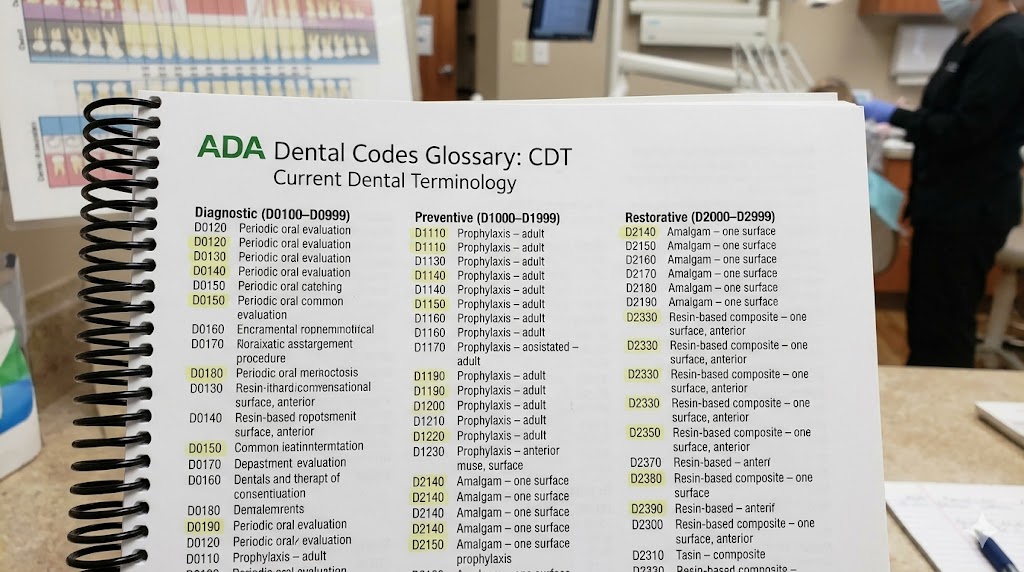
Navigating the world of dental billing and insurance can feel like learning a secret language. Every procedure, from a simple cleaning to a complex implant, has a specific code. These codes form the backbone of dental claims, record-keeping, and patient communication. The American Dental Association (ADA) develops and maintains this essential system, known as the Code on Dental Procedures and Nomenclature, or CDT codes. This guide serves as your comprehensive ada dental codes glossary, designed to demystify this critical system for dental professionals, office staff, and curious patients alike.
I created this resource to be the single most complete and user-friendly reference you can find online. We will explore the structure, purpose, and practical application of dental codes. This isn’t a simple list. It’s an in-depth journey through the logic of the CDT system, ensuring you walk away with a genuine, working knowledge. Forget copied snippets from official manuals. Every explanation here stems from a practical understanding of how these codes function in real dental practices every day.
You will learn how the codes are organized, what the key categories mean, and how to avoid common billing errors. We will cover the most frequently used codes, delve into complex procedural categories, and discuss the nuances that often cause confusion. This guide respects your intelligence and time. We will use clear language, practical examples, and helpful comparisons to build your expertise from the ground up.
Why a Reliable ADA Dental Codes Glossary is Your Practice’s Best Friend
A trustworthy ada dental codes glossary is not just a book on a shelf. It is a living tool that impacts the financial health of a dental practice and the satisfaction of its patients. The ADA updates the CDT codes annually, with new codes added, old ones revised, and some deleted. Staying current is a non-negotiable aspect of professional practice management.
Consider the chaos that unfolds with an incorrect code. A claim gets rejected. The patient receives an unexpected bill. Your front desk team spends precious hours on the phone with an insurance company. This cycle frustrates everyone and delays revenue. A deep and working knowledge of the correct codes prevents these breakdowns. It streamlines the workflow from the treatment room to the ledger.
This guide aims to build that knowledge. We will move beyond rote memorization. Instead, you will understand the “why” behind the code. When you grasp that a code for a core buildup exists because it’s a distinct procedure from placing the crown itself, you will never misuse it. This conceptual clarity is the true power of a genuine glossary. It empowers you to make correct coding decisions in complex, real-world situations.
Let’s lay a solid foundation before we dive into specific codes. The CDT system is remarkably logical, built on a hierarchical structure that groups similar procedures together. Understanding this structure is the first key to unlocking its full potential.
Decoding the Structure: The Anatomy of a CDT Code
The CDT code is a simple five-character alphanumeric sequence. The first character is always a letter, “D,” which stands for Dentistry. The following four characters are numbers. This format, D####, may look arbitrary, but it conceals a highly organized classification system. Each code fits into a specific category of service, and the numbers reflect that category.
The Twelve Categories of Service
The ADA groups all procedures into twelve distinct categories. Each category represents a broad area of dental practice. When you look at a code, the first number after the “D” tells you immediately which category it belongs to. This instant recognition is the first step in mastering the ada dental codes glossary.
| Category Number | Category Name | Code Range | Primary Focus |
|---|---|---|---|
| I | Diagnostic | D0100-D0999 | Examinations, X-rays, Tests |
| II | Preventive | D1000-D1999 | Cleanings, Sealants, Fluoride |
| III | Restorative | D2000-D2999 | Fillings, Crowns, Inlays/Onlays |
| IV | Endodontics | D3000-D3999 | Root Canals, Pulp Therapy |
| V | Periodontics | D4000-D4999 | Gum Treatment, Deep Cleanings |
| VI | Prosthodontics (Removable) | D5000-D5899 | Dentures, Partial Dentures |
| VII | Maxillofacial Prosthetics | D5900-D5999 | Prostheses for Defects/Missing Structures |
| VIII | Implant Services | D6000-D6199 | Implant Placement & Restoration |
| IX | Prosthodontics (Fixed) | D6200-D6999 | Bridges, Crown Retainers |
| X | Oral and Maxillofacial Surgery | D7000-D7999 | Extractions, Biopsies, Jaw Surgery |
| XI | Orthodontics | D8000-D8999 | Braces, Retainers, Aligners |
| XII | Adjunctive General Services | D9000-D9999 | Anesthesia, Appliances, Behavior Management |
This table is your roadmap. A code starting with D0… is always diagnostic. A code starting with D7… is always a surgical procedure. Internalize these ranges, and you will instantly know the general type of service associated with any code you encounter. This foundational knowledge makes the rest of the glossary far easier to navigate.
What Lies Beneath the Surface: Code Nomenclature
Each code is a complete package. It includes the five-character identifier and a written name, the nomenclature. The nomenclature is the legal and contractual definition of the procedure. The official definition is intentionally brief. It must cover all the components that the ADA deems inclusive to that procedure.
“The nomenclature is the single most important part of a CDT code entry. It is the definition that stands alone. Anything not listed in the nomenclature is a separate procedure.”
— Guideline from the ADA CDT manual philosophy
For example, D2750 is “Crown – porcelain fused to high noble metal.” The nomenclature tells you the exact materials and intent. It does not explicitly mention the impression, the temporary crown, or the cementation. This is because separate codes exist for those steps, a crucial point we will explore in the restorative section. Understanding the precise scope of a code’s nomenclature prevents you from “unbundling,” a common billing error where you incorrectly report component parts of a procedure separately.
Category I: Diagnostic (D0100-D0999) — The Foundation of Every Treatment Plan
Diagnostic procedures form the starting point for every patient relationship. Without a proper diagnosis, any treatment is guesswork. This category in our ada dental codes glossary covers the essential services that let the dentist see, evaluate, and plan. These codes are used on almost every patient, every single day.
Clinical Evaluations
The periodic oral evaluation, D0120, is the workhorse of the diagnostic category. You use this code for an established patient receiving a routine checkup. It involves a comprehensive assessment of the patient’s medical and dental history, a head and neck exam, an oral cancer screening, and a charting of existing conditions. The key word here is “established patient.” A new patient, or an established patient with a new problem, needs a different code.
The comprehensive oral evaluation, D0150, is for a new patient or an established patient who presents with a complex set of issues requiring a full-scale re-evaluation. This involves everything in a periodic exam but to a far greater depth. You would use D0150 when a patient has not been seen in years and presents with systemic health changes, multiple broken teeth, and a need for a complete treatment plan.
The limited oral evaluation, D0140, covers a focused, problem-specific exam. A patient calling with a toothache, a broken tooth, or a specific sore spot needs a limited evaluation. You do not perform a comprehensive periodontal charting during this visit. You focus on the chief complaint.
| Code | Nomenclature | When to Use |
|---|---|---|
| D0120 | Periodic oral evaluation | Routine recall visit for an established patient of record. |
| D0150 | Comprehensive oral evaluation | New patient, or a patient of record with significant new systemic or oral conditions. |
| D0140 | Limited oral evaluation | Symptom-focused visit for an established patient with a specific problem. |
| D0160 | Detailed and extensive oral evaluation – problem-focused, by report | A more intense evaluation than D0140, requiring extensive diagnostic workup. |
| D0170 | Re-evaluation – limited, problem-focused (established patient) | A follow-up visit after a procedure to check healing or condition status. |
| D0180 | Comprehensive periodontal evaluation | Full charting for patients showing signs of gum disease, including probing depths, recession, and mobility. |
The Crucial Difference Between D0120 and D0150
Many billing errors stem from confusing D0120 and D0150. The trigger is not the amount of work you do, but the patient’s status. If you saw John Doe last year for a cleaning, he is an established patient. His recall exam this year is D0120, even if his oral health has deteriorated. He is still an established patient.
Now, imagine John Doe brings his wife, Jane, for her first appointment. She is a new patient. Her initial comprehensive exam is D0150. If Jane returns in six months for a recall, her exam is D0120. The patient status dictates the code, not the complexity of the exam on that particular day. This simple rule saves countless claim denials.
Diagnostic Imaging: The Eyes of the Practice
Radiographic images are an inseparable part of the diagnostic process. The codes for X-rays are specific to the technique and the area they capture. Understanding these codes is vital for proper billing.
Intraoral Radiographs:
- D0220: Periapical – first film. This captures the entire crown and root of a single tooth or a small group of teeth in one specific area.
- D0230: Periapical – each additional film. You report this for every periapical image beyond the first one taken on the same day.
- D0270: Bitewing – single film. Captures the crowns of the upper and lower teeth in one area to check for decay between teeth.
- D0272: Bitewings – two films. A standard set to check the posterior teeth on one side.
- D0274: Bitewings – four films. A complete set, capturing all posterior contact areas.
- D0210: Intraoral – complete series of radiographic images. A full-mouth series (FMX), typically consisting of 14-22 periapical and bitewing images. You do not bill the individual periapical and bitewing codes separately when you use D0210.
Extraoral Radiographs:
- D0330: Panoramic film. A single, wide-view image that shows the entire dentition, jaws, and temporomandibular joints.
- D0340: Cephalometric film. A side view of the head, used extensively in orthodontic diagnosis and treatment planning.
Important Note for Billers: A common pitfall is billing a complete series (D0210) and then adding a panoramic image (D0330) on the same day without a clear clinical justification. Most payers consider the panoramic film duplicative for a standard caries diagnosis if a full-mouth series is also taken. However, if the purpose of the panoramic is for an orthodontic workup or to evaluate a specific lesion not visible on an FMX, it becomes separately payable. You must document the distinct diagnostic need.
Category II: Preventive (D1000-D1999) — Stopping Disease Before It Starts
Preventive dentistry is the cornerstone of long-term oral health. This category in our ada dental codes glossary focuses on services that control bacterial plaque and strengthen tooth structure. These codes represent the procedures most frequently associated with “a checkup and cleaning.”
Dental Prophylaxis
Prophylaxis, or “prophy,” involves the removal of plaque, calculus, and stains from the tooth structures above the gumline. The code D1110 refers to prophylaxis for an adult. This procedure assumes a generally healthy mouth with no significant bone loss or active periodontal infection. The cleaning targets supragingival deposits.
The code D1120 is prophylaxis for a child. The age limitation varies by payer, often applying to patients under 12 or 14 years old. The technique and instruments are similar, but the procedure is tailored to a primary or mixed dentition. You should never bill D1120 for an adult, even one with very little tartar. The code defines the patient, not just the amount of deposit.
Fluoride and Sealants: The Dynamic Duo of Caries Prevention
Topical fluoride application, D1206 or D1208, strengthens enamel and makes it more resistant to acid attacks. D1206 is the typical code for a varnish application, a concentrated fluoride that sets on contact with saliva. D1208 is often used for a gel or foam applied in a tray. The age of the patient may dictate coverage, but the clinical benefit of fluoride is lifelong, especially for patients with dry mouth, exposed root surfaces, or a high caries history.
Sealants, D1351, are a mechanical barrier against decay. The dentist or hygienist flows a thin, plastic resin material into the deep grooves and pits of posterior teeth, sealing out food and bacteria. The code D1351 is per tooth. Proper documentation is essential here. You should only apply and bill a sealant on a tooth without a previous restoration and without visible decay. Sealing over a small, incipient carious lesion in a fissure is clinically sound, but it requires a specific code (D1352) and informed consent.
Category III: Restorative (D2000-D2999) — Rebuilding the Broken Tooth
Restorative dentistry restores the form, function, and aesthetics of teeth damaged by decay or trauma. This section of our ada dental codes glossary is vast and heavily utilized. The codes are structured by material, location, and the number of tooth surfaces involved. Precision in surface identification is non-negotiable for accurate restorative coding.
The Language of Tooth Surfaces
Before you can code a filling, you must speak the language of tooth surfaces. Each letter defines a specific area of a tooth’s crown.
- M: Mesial (the surface towards the front/midline)
- O: Occlusal (the chewing surface on posterior teeth)
- D: Distal (the surface towards the back)
- B: Buccal (the cheek-side surface on posterior teeth)
- L: Lingual (the tongue-side surface)
- I: Incisal (the biting edge on anterior teeth)
- F: Facial (the cheek/lip-side surface on anterior teeth, used interchangeably with Labial)
Amalgam Restorations (Silver Fillings)
Amalgam codes start with D21. The fourth and fifth digits specify the number of surfaces restored.
- D2140: Amalgam – one surface, primary or permanent.
- D2150: Amalgam – two surfaces, primary or permanent.
- D2160: Amalgam – three surfaces, primary or permanent.
- D2161: Amalgam – four or more surfaces, primary or permanent.
The key here is to count the surfaces that are physically filled, not just prepared. If decay on the occlusal surface connects to a small distal pit, but you place a single, contiguous filling, it’s a two-surface restoration, coded as D2150 and documented as an OD filling.
Composite Resin Restorations (White Fillings)
Composite, or tooth-colored fillings, use the D23 series. The surface logic is identical to amalgam.
- D2330: Resin-based composite – one surface, anterior.
- D2331: Resin-based composite – two surfaces, anterior.
- D2332: Resin-based composite – three surfaces, anterior.
- D2335: Resin-based composite – four or more surfaces or involving incisal angle, anterior.
- D2391: Resin-based composite – one surface, posterior.
- D2392: Resin-based composite – two surfaces, posterior.
- D2393: Resin-based composite – three surfaces, posterior.
- D2394: Resin-based composite – four or more surfaces, posterior.
You will notice a clear separation between anterior (front) and posterior (back) teeth. The physical demands and techniques differ significantly, which warrants separate codes. A posterior composite must withstand massive chewing forces and is a more technique-sensitive procedure than an anterior one.
Direct vs. Indirect Restorations: The codes above are for direct restorations, where the dentist places a pliable material into the tooth and hardens it in a single appointment. An indirect restoration is fabricated outside the mouth, in a dental laboratory, and cemented or bonded in at a later date. Inlays and onlays are classic indirect restorations.
| Feature | Direct Restoration (D2330-D2394) | Indirect Restoration (Inlay/Onlay D2510-D2664) |
|---|---|---|
| Fabrication | By the dentist in the mouth, single visit. | By a lab technician from an impression, requires two visits. |
| Material | Composite resin, glass ionomer. | Porcelain/ceramic, composite resin, gold. |
| Best Use | Small to medium-sized cavities. | Large cavities where a filling would compromise tooth integrity. |
| Strength | Good, but can wear over time on large chewing surfaces. | Superior strength and wear resistance, especially for large restorations. |
| Code Start | D23XX | D25XX (Inlay), D26XX (Onlay) |
Category IV: Endodontics (D3000-D3999) — Saving the Tooth from the Inside
Endodontics deals with the interior health of the tooth, specifically the dental pulp. When the pulp becomes inflamed or infected, a root canal treatment is required to preserve the tooth. The CDT codes for endodontic procedures are very precise, based on tooth type and treatment stage.
Pulpal Therapy Codes
Before a complete root canal, there are vital pulp therapy procedures, often used in primary teeth or young permanent teeth where the root is not fully formed.
- D3220: Therapeutic pulpotomy. This involves removing the coronal portion of the pulp, usually after a traumatic or deep carious exposure. The goal is to maintain the vitality of the remaining radicular (root) pulp.
- D3221: Pulpal debridement. This is a palliative emergency procedure. The dentist removes the bulk of the inflamed pulpal tissue to relieve a patient’s severe pain. It is not the definitive root canal. You will bill the final root canal at a later appointment.
- D3240: Pulpectomy. This is the complete removal of the pulp tissue from the crown and root canals of a primary tooth, without placing a permanent filling material. It’s a precursor to the final obturation.
Root Canal Therapy Codes
The definitive root canal procedure has its own set of codes, categorized by tooth type. The classification reflects the anatomical complexity of the root canal system in different teeth.
- D3310: Endodontic therapy on an anterior tooth. These are the incisors and canines, typically single-rooted and single-canaled teeth.
- D3320: Endodontic therapy on a bicuspid tooth. Premolars can have one or two roots and often have a more complex canal anatomy than anteriors.
- D3330: Endodontic therapy on a molar tooth. This is the most complex and time-consuming category. Molars have multiple roots and small, curved, and interconnected canals.
Retreatment and Apexification: Not all root canals heal perfectly. D3346 is the code for retreatment of a previous root canal on an anterior tooth, D3347 on a bicuspid, and D3348 on a molar. These procedures involve removing the old filling material, disinfecting the canals again, and placing a new seal. For an immature tooth with a non-vital pulp and an open root end, D3351 (apexification) or D3354 (pulpal regeneration) may be indicated.
Category V: Periodontics (D4000-D4999) — The Support System
Periodontics focuses on the supporting structures of the teeth—the gums, periodontal ligament, and alveolar bone. This category in our ada dental codes glossary distinguishes between maintenance care for health and active treatment for disease. This distinction is the source of many coding questions.
Defining Prophylaxis vs. Scaling and Root Planing
The difference between a “regular cleaning” (D1110) and a “deep cleaning” (D4341/D4342) is a clinical diagnosis, not a patient preference. A prophylaxis is a preventive procedure for a patient with a healthy periodontium, characterized by no clinical attachment loss, no bone loss, and minimal bleeding on probing.
Scaling and root planing (SRP) is a therapeutic procedure for a patient with active periodontal disease. This disease is diagnosed by clinical attachment loss, alveolar bone loss visible on radiographs, and periodontal pocketing with bleeding. SRP involves removing subgingival calculus and smoothing the root surfaces. This requires local anesthesia and is performed by quadrants.
- D4341: Periodontal scaling and root planing – four or more teeth per quadrant.
- D4342: Periodontal scaling and root planing – one to three teeth per quadrant.
Important Clinical Reality: You cannot ethically or legally bill D4341 on a patient with a healthy mouth just because they haven’t had a cleaning in a long time. A heavy, supragingival stain and calculus buildup on a healthy foundation is still a prophylaxis, though it may be a difficult one. SRP requires a specific periodontal diagnosis.
Periodontal Maintenance
After active periodontal treatment, the patient enters a phase of ongoing maintenance to prevent disease recurrence. This is periodontal maintenance, D4910. This procedure is for patients who have previously completed SRP or periodontal surgery. It includes an evaluation of the gum health, removal of supra- and subgingival bacteria from the now-reduced pockets, and site-specific scaling where inflammation persists.
The critical rule is: once a periodontal patient, always a periodontal patient for coding. A patient with a history of treated disease cannot revert to D1110 prophylaxis. The procedure may be less intensive over time, but the clinical needs and the code remain D4910. Billing a D1110 on a perio-maintenance patient is a frequent audit trigger.
Category VIII: Implant Services (D6000-D6199) — The Modern Solution
Implant dentistry has revolutionized tooth replacement. The CDT codes for implants are structured to capture the two main phases: the surgical placement of the implant body, and the prosthetic restoration that attaches to it. This separation is fundamental to understanding this section of the ada dental codes glossary.
Surgical Phase Codes
A dental implant is an artificial root, typically made of titanium, that is surgically placed into the jawbone.
- D6010: Surgical placement of implant body: endosteal implant. This is the primary code for placing a standard root-form implant directly into the bone. The code covers the surgical procedure itself: incision, flap reflection, osteotomy preparation, and implant placement.
- D6056: Prefabricated abutment – includes modification and placement. An abutment is the connector piece that screws into the implant body and supports the final crown. Some systems require a separate abutment to be placed during a second, minor surgery after the implant has healed.
- D6057: Custom fabricated abutment – includes placement. For complex aesthetic or angled cases, a laboratory will fabricate a custom abutment from a model.
Prosthetic Phase Codes
Once the implant has integrated with the bone (a process called osseointegration), the restorative phase begins. The codes describe what is attached to the implant abutment.
- D6058: Abutment supported porcelain/ceramic crown. A single, all-ceramic crown that is cemented or screwed onto the abutment.
- D6059: Abutment supported porcelain fused to high noble metal crown. Same as above, but with a high-gold-content metal substrate for strength.
- D6065: Implant supported porcelain/ceramic crown. This code is used when the crown attaches directly to the implant body without a separate intermediate abutment, a design used in some implant systems.
The “D60XX” range also includes codes for implant-supported bridges (D6066-D6077) and implant-supported dentures, both removable (D6110, D6111) and fixed (D6114, D6115). A fixed complete denture, often called an “All-on-4” prosthesis, is a screw-retained full-arch bridge supported by four or more implants.
The Most Common Pitfalls in Dental Coding: A Real-World Guide
No ada dental codes glossary is complete without a frank discussion of the errors that disrupt office cash flow and trigger audits. Avoiding these pitfalls is more important than memorizing every niche code.
Pitfall 1: Unbundling the Crown Procedure
This is the most infamous coding mistake. The CDT code for a single crown, such as D2740 (porcelain/ceramic crown), is a complete procedure code. Its nomenclature inherently includes many component steps. You cannot typically bill separately for:
- D2950: Core buildup, including any pins. A buildup is only separately billable if a significant portion of the clinical crown is missing and the buildup provides necessary retention for the crown. The dentist must document the missing tooth structure. A tiny hole or a small existing filling does not justify a separate core buildup.
- D2951: Pin retention. In modern adhesive dentistry, pins are rare. Billing for them alongside a crown almost always triggers an automatic denial.
- Temporary Crown: The fabrication and cementation of a provisional crown is part of the global crown service. Do not bill a D2971 code for an additional temporary crown during the final delivery appointment.
“The global fee for a crown includes the preparation, impression, temporary, and insertion. Only a documented, clinically significant build-up on a severely broken-down tooth is a separately identifiable and reportable procedure.”
— Common Payer Audit Standard
Pitfall 2: Misusing the “D0180” Periodontal Evaluation Code
D0180 is a comprehensive periodontal evaluation. It is not a simple upgrade code for a prophy appointment. You should use D0180 when a patient presents with signs of periodontitis and you need to create a new, in-depth baseline. The procedure involves six-point pocket charting, recession, furcation grade, mobility, and a full assessment of the mucogingival complex. Billing D0180 alongside D0120 on the same day will likely be denied. The comprehensive exam for a new patient (D0150) already includes a baseline periodontal screening. D0180 is for a dedicated, separate diagnostic work-up on a perio-compromised patient.
Pitfall 3: Billing a Prophylaxis and SRP on the Same Day
You should not bill a “full mouth debridement” (D4355) or a prophylaxis (D1110) on the same day as scaling and root planing. A full mouth debridement is for a patient with so much heavy calculus that a proper exam is impossible. It’s a preliminary, gross removal. The SRP should take place at a later appointment after the gums heal. Performing a “regular cleaning” on the few teeth that are not treated by SRP on the same day is also incorrect. Once you treat one quadrant with SRP, the entire mouth is in a disease state, and all future cleanings become periodontal maintenance (D4910).
New and Revised Codes: Staying Current
The digital age has transformed dentistry, and the CDT code set evolves to match. In recent years, we have seen a major expansion of codes for digitally fabricated restorations and teledentistry. Staying current with this annual evolution is a professional responsibility.
One of the most significant recent additions is the D29XX series for intraoral scanning and digital impression procedures. Previously, the capture of a digital image for the fabrication of a restoration or an orthodontic aligner had no specific code. Now, a path exists to report this technology-driven step.
- D2917: Intraoral occlusal adjustment of a bridge. This reflects a more nuanced approach to adjusting restorations.
- D2929: Prefabricated porcelain/ceramic crown – primary tooth. A specific code for pediatric aesthetic crowns, usually for severely decayed anterior primary teeth.
- D9995 and D9996: Teledentistry codes. D9995 is for synchronous (real-time) teledentistry, and D9996 is for asynchronous (store-and-forward) teledentistry. These codes recognize that evaluating diagnostic records remotely is a distinct service with its own medico-legal and coding requirements. You use these for the dentist’s diagnostic and treatment planning time, not just for sending a photo.
You can find the official current year’s CDT manual and summary of changes on the ADA’s official website: ADA.org/CDT. A yearly review of the changes is the only way to ensure your practice’s coding is compliant and maximizes legitimate reimbursement.
How to Build a Practical Office Protocol with Your ADA Dental Codes Glossary
Knowledge is only powerful when you apply it systematically. An ada dental codes glossary is the starting point for creating a foolproof office protocol. This protocol will reduce errors, improve claim acceptance rates, and make your practice more resilient to staff turnover.
Step 1: The Chart-to-Code Crosswalk
Create a one-page “cheat sheet” that links your most common clinical chart entries to the correct code. For example:
- “2-MO caries” → Anesthetize, prep, restore with composite → Chart note: “MO caries removed, restored with resin composite” → Code: D2392.
- “Moderate sub calc, 5mm PDs, BOP on #3,4,5” → Anesthetize, SRP UR quadrant → Chart note: “SRP UR quadrant, sites #3-DB, 4-ML, etc.” → Code: D4341 for the quadrant.
Step 2: The Narrative Necessity
Train your clinical team that for every code that requires a “by report” narrative, the chart note is the report. The ADA manual specifies many codes with the “by report” designation. This means the procedure is unusual, variable, or its necessity is not immediately obvious from the code itself. Insurance will want to see the documentation. A code like D0160 (detailed and extensive oral evaluation) or D2999 (unspecified restorative procedure) will never be paid without a clear, concise, and compelling narrative explaining the clinical necessity and the specific work performed.
Step 3: The Morning Huddle Code Review
During your daily morning huddle, review each patient’s planned treatment codes. The front desk can ask clarifying questions: “Dr., I see you planned D2740 and D2950 for Mr. Jones. Can you show me where the buildup is needed for my claim notes?” This simple 30-second conversation can prevent a denied claim three weeks later. It makes coding a team responsibility, not just a billing problem.
Step 4: The Annual Update Meeting
Every January, the dental director and office manager must sit down with the new CDT book or a legitimate online update. Identify every new, revised, and deleted code. Discuss which ones apply to your practice’s services. Delete old codes from your practice management software and replace them. This single meeting is your annual immunization against systemic coding decay.
Conclusion
An accurate understanding of the ADA dental codes glossary transforms a dental practice from a reactive repair shop into a predictable, well-managed business. This guide has equipped you with the foundational principles of CDT coding, from the twelve categories of service to the subtle distinctions between a preventive prophylaxis and a therapeutic scaling and root planing. You now possess a working knowledge of how to avoid the most devastating billing pitfalls, like unbundling a crown buildup, and how to build a proactive office protocol that makes correct coding a daily habit. Finally, we have explored how new digital and teledentistry codes are keeping pace with modern clinical reality, ensuring your practice remains both compliant and efficient.
Frequently Asked Questions About the ADA Dental Codes Glossary
What is the most important single rule in dental coding?
Code what you do, and do what you code. Never let a patient’s insurance coverage dictate the clinical treatment. Select the code that most accurately describes the procedure you performed based on the patient’s clinical need. If the code is not a covered benefit, the patient is responsible. The clinical record must justify the code.
Who is responsible for selecting the correct CDT code in a dental office?
The treating dentist bears the ultimate responsibility for the code that describes their clinical procedure. However, a well-trained administrative team is critical. The dentist must clearly communicate the diagnosis and treatment in the clinical notes. The billing coordinator translates that note into a code, and the dentist must verify the final claim. It is a collaborative process built on a foundation of clinical truth.
When should I use an “unspecified” code like D1999 or D2999?
You should only use an “unspecified” code as a last resort, when no existing specific code accurately describes the procedure. Using an unspecified code should be a rare event. These codes always require a detailed narrative “by report” explaining what you did and why no other code is appropriate. Frequent use is a red flag to insurers and auditors.
What is the difference between a “re-evaluation” (D0170) and a “limited oral evaluation” (D0140)?
A D0170 re-evaluation is a scheduled, post-operative check. For example, you place a sedative filling three weeks ago, and now you check the tooth’s vitality and symptoms before placing the final crown. A D0140 limited oral evaluation is an unscheduled visit for a new and specific problem, like a patient walking in with a broken tooth.
Is a full-mouth debridement (D4355) always required before a comprehensive exam (D0150)?
No. D4355 is for the very specific situation where heavy, confluent calculus covering most of the teeth completely prevents any clinical or radiographic evaluation. You perform it to enable a diagnosis. Most patients with heavy, but not completely obscuring, calculus can still receive a proper comprehensive exam, leading directly to a definitive diagnosis and treatment plan for scaling and root planing without the need for a separate gross debridement visit.
Additional Resource
For the most current, authoritative, and legally binding definitions, always consult the official source. The ADA’s official CDT website provides the code set, the current manual for purchase, and crucial updates.
Official Resource: American Dental Association – Code on Dental Procedures and Nomenclature (CDT)
Disclaimer: This article provides a comprehensive, educational overview of the ADA dental codes glossary for informational purposes only. The information presented here does not constitute legal, financial, or professional coding advice. Dental procedure codes and payer policies change frequently. Always consult the most current official American Dental Association (ADA) CDT manual, your specific provider contracts, and a qualified dental billing professional or attorney for advice concerning your individual practice’s coding and billing procedures.