ADA Dental Code for Sedative Fillings
Pain has a way of erasing everything else from your mind. When a toothache strikes with its dull, persistent throb or sharp, electric jolt, you want one thing and one thing only: relief. Dentists understand this urgency intimately. They also understand that sometimes, rushing into a permanent fix can cause more harm than good. This is precisely where a sedative filling enters the picture. It serves as a calming intermediary, a therapeutic pause button for an irritated tooth. The American Dental Association recognizes this specific procedure under its own distinct code. This guide explores every facet of the ADA dental code for a sedative filling, providing you with clear, actionable information whether you are a patient seeking understanding, a dental office manager handling billing, or a clinician refining your treatment protocols.
We will walk through the clinical rationale, the exact code definition, documentation essentials, insurance navigation, and the critical role this temporary treatment plays in modern dentistry. No confusing jargon. No unrealistic promises. Just a thorough, honest explanation built to be your lasting reference.
Understanding the Purpose of a Sedative Filling
Before we dissect the code itself, we need to grasp the clinical reality the code represents. A sedative filling is not a definitive restoration. It is a therapeutic, provisional treatment designed to calm a symptomatic tooth.
What Exactly Is a Sedative Filling?
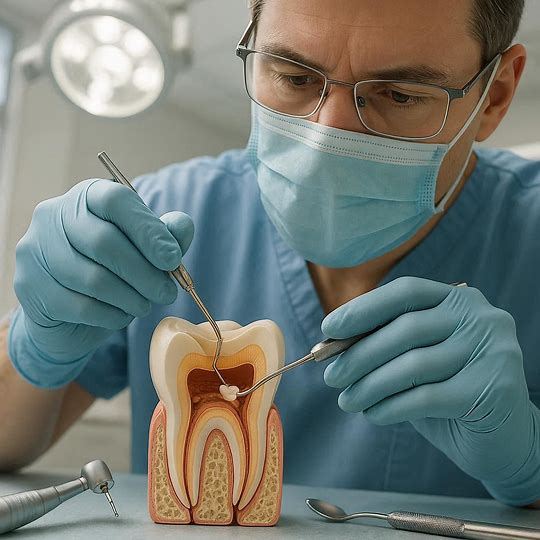
A sedative filling is a temporary restoration placed to alleviate pain, reduce inflammation, and allow the pulp of a tooth to heal or “quiet down” before a more permanent procedure. Think of it as a soothing bandage for the inside of your tooth. The material used is not the standard composite resin or amalgam meant to last for years. Instead, the dentist packs a medicated, soothing material directly against the sensitive areas of the tooth. Common materials include zinc oxide eugenol, calcium hydroxide preparations, or other resin-free temporary cements known for their obtundent, or pain-relieving, properties.
The primary goals are straightforward. First, the procedure aims to eliminate acute discomfort. Second, it seals the tooth against bacteria, fluids, and oral debris. Third, it buys valuable time. That time allows the dental team to assess the tooth’s healing capacity and plan the ideal final restoration without the pressure of a patient in immediate distress.
The Clinical Scenario: When Do You Need One?
Not every cavity calls for a sedative filling. This treatment enters the conversation under specific, often urgent, circumstances. A dentist will recommend this path when the nerve of the tooth is irritated but still potentially healthy.
Imagine a scenario involving deep decay. A cavity has burrowed close to the pulp chamber, the tooth’s inner sanctum housing nerves and blood vessels. The patient feels a sharp sensitivity to cold or sweetness that lingers, but there is no spontaneous, radiating pain indicative of irreversible nerve damage. Removing all the decay and placing a permanent filling immediately might shock the fragile pulp, tipping it into irreversible inflammation and necessitating a root canal. The sedative filling acts as a gentle, protective step.
Another common situation is following an emergency visit for a cracked tooth or a lost filling that exposed sensitive dentin. The exposed tooth structure screams at every breath of air or sip of water. A sedative dressing calms the screaming nerves. It also serves as a diagnostic tool. The dentist uses the temporary phase to monitor the tooth’s response over several weeks. If the pain resolves completely, the pulp is likely healthy, and a permanent crown or filling proceeds safely. If the pain persists or worsens, the dentist has crucial diagnostic information pointing toward the need for root canal therapy.
The Exact ADA Dental Code: D2940
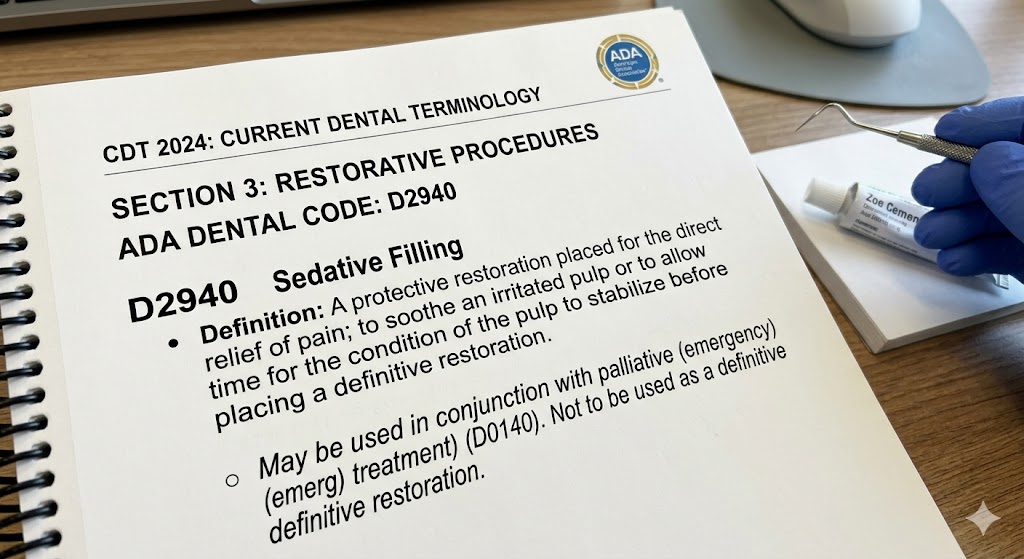
Every recognized dental procedure resides in the Code on Dental Procedures and Nomenclature, maintained by the ADA. The sedative filling has a clear home there. The code you need is D2940.
This code carries the official nomenclature: “Sedative filling”. The descriptor is remarkably direct, reflecting the procedure’s singular, focused intent.
Important Note: Understanding the code’s descriptor is critical for proper application. The ADA defines D2940 as a temporary restoration intended to relieve pain. The code’s formal language clarifies that it is not to be used as a base under a permanent restoration. This distinction is a key source of confusion and claim denials. A base or liner placed under a composite or amalgam filling is an integral part of that permanent restoration and is not billed separately as D2940. D2940 stands alone as a discrete treatment visit, solely for the purpose of palliating a painful tooth.
How D2940 Differs from Definitive Restorations
The divide between a sedative filling and a permanent filling is vast, and the coding reflects this. A definitive restoration, like a one-surface posterior composite (coded D2391) or a multi-surface amalgam (coded D2161), restores the tooth’s form and function permanently. The material bonds or mechanically locks into the tooth structure, providing long-term strength.
A sedative filling, using D2940, makes no claim to permanence. It may last for a few weeks or, in some complex treatment plans, a few months. Its physical properties are intentionally weak, making it easy to remove when the time comes for the final restoration. You cannot expect to chew on a tooth with a sedative filling the same way you would on a tooth with a permanent onlay. The material is soft, almost crumbly in texture. The code D2940 describes a palliative, not a restorative, procedure.
D2940 vs. Other Provisional Codes: A Clear Comparison
The Code on Dental Procedures contains other “temporary” codes, and mixing them up is easy. The most frequent confusion occurs between D2940 and D2970, a temporary crown. These are not interchangeable. Let’s break down the differences.
| CDT Code | Nomenclature | Primary Purpose | Material & Longevity | Clinical Example |
|---|---|---|---|---|
| D2940 | Sedative Filling | Relief of pain; pulpal calming; diagnostic assessment. | Soft, medicated cement (e.g., IRM, zinc oxide eugenol). Lasts weeks. | Placed in a deep cavity to quiet an irritated nerve before a permanent filling. |
| D2970 | Temporary Crown (Fractured Tooth) | Protection and stabilization of a broken tooth until a final crown. | Acrylic or composite resin shell. Can last weeks to months. | Placed on a cracked cusp to prevent further fracture and maintain space. |
| D2971 | Additional Temp Crown (each) | Temporization for an additional tooth in the same treatment plan. | Same as above. | Second temporary crown made during the same appointment as D2970. |
| D2975 | Temporary Crown (Preformed) | Office-made temporary from a mold, not custom built. | Polycarbonate or metal shell, relined with temporary cement. | A quick, protective shell used for a single crown tooth until a custom temp is made. |
The critical takeaway from this table is intent. Use D2940 when the primary goal is medicinal: soothing the pulp. Use the D2970 series when the primary goal is structural: protecting a prepared tooth and preventing shifting.
The Step-by-Step Procedure: From Diagnosis to Temporary Relief
The application of a sedative filling is a dance of precision, biology, and patient empathy. The process, while relatively quick, involves a sequence of critical decisions.
Initial Diagnosis and Testing
The journey starts not with a drill but with a conversation and a series of diagnostic tests. The patient describes the pain: its nature, duration, triggers, and location. Is it a sharp, fleeting sensitivity to cold that disappears instantly? This suggests reversible pulpitis, the ideal candidate for a sedative filling. Is it a dull, throbbing pain that lasts for minutes after a cold stimulus is removed, or a pain that wakes you up at night? These symptoms raise red flags for irreversible pulpitis, where the nerve is dying and a root canal is the predictable treatment.
The dentist then performs clinical tests. A percussion test—tapping gently on the tooth—helps assess the health of the ligament holding the tooth in the socket. Pain on biting often indicates inflammation there, not just in the pulp. Palpation of the gum tissue near the root tip checks for infection. Thermal testing, using a cold cotton pellet or an electric pulp tester, gauges the nerve’s health. A healthy nerve responds and the sensation stops when the stimulus is removed. A dying nerve may have a lingering, painful response, or no response at all. Radiographs are essential to see the depth of decay or fracture and the condition of the bone around the root.
All this information converges to form a pulpal diagnosis. The diagnosis of “reversible pulpitis” opens the door for the sedative filling. This step is non-negotiable. Placing a sedative filling on a tooth with a dying nerve provides only fleeting false hope, and the pain will inevitably return, leading to patient frustration and a justifiably questioned diagnosis.
The Clinical Procedure: A Calming Sequence
With reversible pulpitis diagnosed, the actual treatment can begin. The first step is profound local anesthesia. The goal is to conduct the procedure in a pain-free environment, breaking the cycle of pain and anxiety for the patient.
Once the area is fully numb, the dentist meticulously removes the decay. This is the most delicate phase. A high-speed handpiece clears the bulk of the softened, infected dentin. Near the pulp, the dentist often switches to a slow-speed handpiece or hand excavators. These manual tools provide tactile feedback, allowing the removal of decay without plunging into the pulp chamber. The objective is to remove all infected, mushy dentin while preserving a thin layer of affected, but hardened, dentin over the pulp to protect it. Irrigation with water keeps the tooth cool, as heat from the drill can itself cause pulpal injury.
After cavity preparation, the dentist does not etch, bond, or apply a bonding agent. Instead, they mix a sedative dressing. Zinc oxide and eugenol (ZOE) remains a classic choice. Eugenol, derived from oil of cloves, has a long history of soothing dental pain. The material is mixed to a thick, putty-like consistency and gently condensed into the dried cavity preparation. The eugenol in the material directly calms the nerve endings in the dentin tubules. In some cases, a calcium hydroxide liner is placed on the deepest part of the preparation first. Calcium hydroxide is highly alkaline, neutralizing the acidic environment of bacteria and stimulating the formation of reparative dentin, the pulp’s natural defense barrier.
Finally, the dentist checks the patient’s bite. The sedative filling must be entirely clear of the opposing teeth. Any premature contact on a hyper-occluded temporary filling would constantly traumatize an already inflamed periodontal ligament and keep the tooth symptomatic. The dentist uses articulating paper to mark the contacts and carefully adjusts the soft material until the bite feels normal.
Post-Operative Care and Expectations
The dentist provides clear, realistic instructions. The patient should not chew on the tooth until the permanent restoration is placed. The material is soft and will break under force. Some mild discomfort to cold or chewing pressure may persist for a few days as the periapical tissues heal, but the sharp, acute nerve pain should be gone immediately. The dentist will schedule a follow-up appointment for the permanent restoration, typically in four to eight weeks. This waiting period is crucial. It confirms the tooth remains asymptomatic, validating the diagnosis of reversible pulpitis.
Navigating Insurance and Billing for D2940
Dental benefits can feel like a labyrinth. Understanding how payers view D2940 can prevent unexpected bills and patient disappointment. This section translates the complex world of coordination of benefits and plan limitations into a clear roadmap.
Is D2940 a Covered Benefit?
The answer is a qualified “yes, but.” Most dental benefit plans recognize D2940 as a valid, necessary procedure for palliative care. They understand its role in preventing more extensive and expensive treatment. However, coverage is not a blank check. The clinical narrative is everything. The payer wants to see medical necessity. A claim for D2940 on a small, shallow filling with no pain history will face automatic denial.
The claim form submission must connect the clinical dots. A pulpal diagnosis of reversible pulpitis must be evident. The narrative should succinctly state the presenting condition. A simple line like, “Patient presented with acute cold sensitivity. Clinical and radiographic exam revealed deep caries approximating the pulp. Tooth diagnosed with reversible pulpitis. D2940 sedative filling placed for palliation and diagnostic assessment prior to planned definitive restoration,” establishes a clear, logical, and defensible rationale.
The “Global” Period and Definitive Restoration Timing
One of the most significant billing pitfalls involves the concept of a global period or bundling. Payers often view the treatment of a tooth as a single episode of care. They do not want to pay separately for a temporary step if the permanent filling follows within a timeframe they define as “global.”
This is where the strategic value of time becomes apparent. If a dentist places D2940 and then a permanent amalgam or composite on the same tooth within a week or two, the payer may bundle the D2940 payment into the permanent restoration fee, effectively zeroing out the sedative filling line item. However, if a legitimate medical reason exists to wait—and the record shows a diagnostic waiting period of four to eight weeks to confirm pulpal health—the two procedures are clearly separate episodes of care. The claim for the definitive restoration, submitted weeks later, is processed independently. Document the dates clearly. The temporal separation is your strongest argument against bundling.
Coordination of Benefits and Plan Limitations
A few practical points for the dental office. Always check the patient’s plan for frequency limitations. Some plans may limit palliative or temporary restorations to once per tooth per lifetime or once every two years. Prior authorization is rarely required for D2940, but if a patient has a history of frequent emergency visits, a look at their plan details is wise.
For patients with dual coverage, the standard coordination of benefits rules apply. The primary carrier processes the claim first. If they allow the full fee, the secondary may not pay an additional benefit. If the primary leaves a patient co-pay, the secondary may cover all or part of it, up to the secondary’s own fee schedule. Sending a clear narrative with the secondary claim, including the primary carrier’s explanation of benefits (EOB), smooths the process.
A Direct Quote on Documentation:
“In my twenty years of practice, I’ve learned one immutable truth: an unsupported code is an unpaid claim. For D2940, your clinical note must tell a story of pain, a diagnosis of reversible pulpitis, and a documented intent to wait and re-evaluate the tooth’s vitality. Without that story, an auditor only sees a temporary filling, and they will deny it every time. Your narrative is your defense.”
— A Seasoned Dental Office Manager
Common Misconceptions and Clinical Pitfalls
Knowledge of the code is not enough. Mastery comes from understanding how to avoid the common traps that lead to treatment failure or financial loss.
Misconception: A Sedative Filling Is a “Permanent Fix”
This is a dangerous misunderstanding for patients. A patient might feel so much better after D2940 placement that they cancel the follow-up for the permanent restoration. Months later, the soft temporary material wears away or fractures. Bacteria leak in, the decay resumes with a vengeance, and what was once reversible pulpitis becomes an abscess. Clear patient communication is the antidote here. The dentist must explicitly state the temporary nature of the filling and the consequences of neglect. Scheduling the definitive appointment before the patient leaves the chair is a strong practice.
Misconception: Using D2940 to Buy Time on a Hopeless Tooth
The code D2940 is not a “delay the root canal” button. If a tooth has irreversible pulpitis or a necrotic pulp, a sedative filling will not work. The pain might temporarily lessen because the cavity is sealed, but the pathogenic process inside the pulp chamber continues. Gases and necrotic debris build up, leading to pressure and a painful infection at the root tip. Using D2940 in this situation is clinically inappropriate and represents a misdiagnosis. The proper emergency treatment for a necrotic tooth is a pulpectomy, the first stage of a root canal, coded as D3221 for a therapeutic pulpotomy or the root canal code itself.
Misconception: Billing D2940 with Every Deep Filling
Some clinicians, in an effort to fully document the complexity of a case, mistakenly bill D2940 for the placement of a liner like Dycal or Theracal under a permanent composite on the same day. This is incorrect. As the ADA descriptor explicitly states, the sedative filling is a stand-alone procedure, not a component of a final restoration. The placement of a base or liner is an integral part of the permanent restoration code. Billing D2940 and D2391 for the same tooth on the same day is a red flag for payers and is almost certain to result in a bundled or denied claim. The correct path is to bill only for the definitive restoration, documenting the use of the liner in the clinical notes to support the medical necessity of the treatment.
Materials and the Future of Pulpal Therapy
The world of sedative dressings is not static. While the principle of calming the pulp remains constant, the materials science behind it continues to evolve, offering new, biologically active options.
Traditional Eugenol-Based Cements
Zinc oxide eugenol (ZOE), often sold under brand names like IRM (Intermediate Restorative Material), has been the gold standard for generations. Its benefits are undeniable. It has an obtundent effect on the pulp, calming nerve fibers directly. It provides an excellent bacterial seal. It mixes to any consistency and is easy to place and remove. Its disadvantages are equally well-known. Eugenol is a potent inhibitor of resin polymerization. Any ZOE residue on the tooth at the time of the permanent bonding procedure will severely compromise the bond strength of a composite restoration. The dentist must meticulously remove all traces of ZOE, often micro-abrading the tooth surface, before bonding.
Calcium Silicate Cements: The Bioceramics
A new frontier in vital pulp therapy, which is the clinical cousin of sedative fillings, involves calcium silicate cements like Biodentine and MTA (Mineral Trioxide Aggregate). While these are often used for direct pulp capping or pulpotomies, their properties are worth noting here. They are highly biocompatible, alkaline, and stimulate the formation of a dentin bridge better than calcium hydroxide. They also set in the presence of moisture, making them less technique-sensitive.
Can you use a calcium silicate cement for a sedative filling coded as D2940? Yes, absolutely. The code is not material-specific. It is purpose-specific. If a dentist places Biodentine as a temporary, medicated dressing to calm a reversible pulpitis and plans a future composite, D2940 is the correct code. The advantages are significant. Because Biodentine is resin-free, it does not contaminate the tooth for future bonding like ZOE does. It is harder than ZOE and provides a better temporary seal. The higher material cost is a factor, but the clinical outcome and simplified later procedure can justify it.
A Helpful List: Choosing a Sedative Filling Material
- Zinc Oxide Eugenol (IRM): Best for short-term, purely palliative use when low cost and ease of removal are priorities. Be prepared for meticulous cleaning before bonding.
- Calcium Hydroxide Base + ZOE: A classic combination. The calcium hydroxide stimulates reparative dentin, and the ZOE provides a secure, soothing surface seal.
- Resin-Modified Glass Ionomer (RMGI): A strong option for a longer-term temporary seal (e.g., in a full-mouth rehabilitation case). RMGI releases fluoride and bonds to tooth structure without the resin-inhibiting eugenol. Its soothing effect is less than ZOE, but it offers superior durability.
- Biodentine (Calcium Silicate): The state-of-the-art choice. It combines pulpal stimulation with a hard, non-contaminating surface, making it ideal for a waiting period before an adhesive definitive restoration.
Documentation and Clinical Notes for D2940: Building an Impeccable Record
A clinical note for a sedative filling must be a self-contained legal and billing document. It should tell a story so clear that any reader—an auditor, another dentist, or a specialist—understands exactly what happened and why. A note that simply reads “Tooth #30, D2940” is a liability.
The Essential Components of a D2940 Clinical Note:
- Chief Complaint: “Patient reports a sharp, shooting pain in the lower right jaw when drinking cold liquids that dissipates within seconds.” Use the patient’s own words.
- Objective Findings: Detail the exam. “Tooth #30 has a deep mesial-occlusal carious lesion visible radiographically, penetrating into the inner third of dentin. No periapical radiolucency. Percussion test negative. Endo-Ice cold test produces a sharp sensation that stops immediately upon stimulus removal. EPT reading WNL.”
- Diagnosis: State it explicitly. “Diagnosis: Reversible pulpitis. Tooth #30.” Do not make anyone guess.
- Treatment Rendered: “Profound anesthesia achieved with 2.0 carpules 3% Carbocaine via buccal infiltration. Caries removed with high-speed and slow-speed handpieces, followed by hand excavation. Decay was deep, with a pinpoint near-exposure on the mesial pulp horn. Cavity irrigated with chlorhexidine scrub. A calcium hydroxide liner (Dycal) was placed directly over the near-exposure site. The remainder of the cavity was filled with zinc oxide eugenol (IRM) temporary sedative filling, adjusted out of occlusion.”
- Post-Op and Plan: “Post-operative instructions reviewed. Patient verbalized understanding to avoid chewing on the tooth. The tooth’s vitality will be re-evaluated in six weeks. Appointment scheduled for definitive composite restoration (D2392) at that time, pending a continued asymptomatic state. Prognosis for tooth #30 is guarded but hopeful, dependent on pulpal healing.”
This note format is defensible, transparent, and easily supports the D2940 billing code.
A Closer Look at Reversible Pulpitis: The Diagnosis Behind the Code
The code D2940 cannot be properly used in a vacuum. It is inextricably linked to a specific pulpal diagnosis. The more we understand about reversible pulpitis, the more effectively we can apply this treatment.
The dental pulp, encased in rigid dentin walls, has a limited repertoire of responses to injury, which is almost always inflammation. When the insult—be it bacteria from a cavity, thermal injury, or chemical irritation—is mild and transient, the pulp mounts a defensive, reversible inflammatory response. Microscopically, there is vasodilation, increased blood flow, and the infiltration of immune cells. This causes an increase in intrapulpal pressure, which manifests clinically as sharp, fleeting pain when a stimulus like cold causes vasoconstriction and subsequent reactive hyperemia.
The critical feature of reversible pulpitis is that the pulp’s immune response and regenerative capacity remain intact. Remove the irritant—in this case, the bacteria-laden decay—and the pulp can heal. The sedative dressing provides a sterile, soothing environment that tilts the balance toward repair. The odontoblasts, the cells lining the pulp chamber, upregulate their activity, laying down reparative dentin, a more amorphous, protective layer of tissue. This is the biological miracle we rely on every time we place a D2940. We are not just plugging a hole; we are creating the conditions for the body to heal itself from the inside out.
Conclusion
The ADA dental code D2940 for a sedative filling represents a deliberate, therapeutic pause in restorative care. It is a targeted intervention for a tooth with reversible pulpitis, providing immediate pain relief and creating a protected environment for the pulp to heal before a permanent restoration. Proper use hinges on a precise diagnosis of reversible inflammation, meticulous caries removal, placement of a soothing medicament, and clear communication with the patient about the temporary nature of the treatment. Mastering the documentation and billing nuances for D2940 ensures this vital palliative service is both clinically successful and properly compensated, making it an indispensable tool in ethical, patient-centered dentistry.
FAQ: Common Questions About the Sedative Filling Code
1. Can I bill D2940 and a permanent filling on the same tooth on the same day?
No. The sedative filling code is for a stand-alone, temporary procedure. If you place a permanent restoration, the liner or base placed under it is part of that permanent code. Billing both on the same date for the same tooth will result in the D2940 being bundled and denied.
2. How long should a sedative filling stay in a tooth?
The typical diagnostic waiting period is four to eight weeks. This provides enough time for the symptoms of reversible pulpitis to completely resolve, confirming the health of the pulp. Leaving a D2940 in place indefinitely is not advisable, as the temporary material will eventually break down, leading to recurrent decay.
3. What is the difference between a sedative filling (D2940) and a pulp cap?
A pulp cap can be indirect or direct and involves placing a protective dressing over a near-exposure (indirect) or a pinpoint exposure (direct) of the pulp. A direct pulp cap is coded as D3110. A sedative filling can include an indirect pulp cap (a liner) as part of the procedure, but D2940 describes the entire temporary, pain-relieving restoration, whereas a direct pulp cap (D3110) is a very specific, high-stakes treatment for a pulp that has been physically exposed.
4. If a patient’s plan denies D2940, can I charge the patient the fee?
Yes, if the treatment is medically necessary but the plan does not provide a benefit. However, best practice is to inform the patient of the potential for denial before the procedure. Use a financial agreement form, clearly stating that the procedure may not be a covered benefit and the patient is responsible for the fee in the event of a denial.
5. Is a sedative filling always the best option for a painful deep cavity?
No. It is only appropriate for a tooth with a diagnosis of reversible pulpitis. If the tooth has irreversible pulpitis (lingering pain to cold, spontaneous pain) or a necrotic pulp (no sensation, pain to heat and biting), a sedative filling will not solve the problem. In those cases, root canal therapy is the predictable, necessary treatment to save the tooth.
Additional Resource
For the most current and official definitions of all dental procedure codes, visit the American Dental Association’s dedicated coding resource:
ADA Code on Dental Procedures and Nomenclature