
Can Dental Cavities Heal Themselves?
You wake up one morning with a slight twinge in your tooth. It is not a full-blown ache. Just a little whisper of sensitivity when you sip your coffee. A thought crosses your mind: Maybe this will just go away on its own.
You have heard whispers online. Claims that cavities can reverse. That you can “heal” your teeth with nothing but diet and positive thinking.
Is that true? Or is it a dangerous myth that could cost you a tooth?
Let us sit down together and talk honestly about your teeth. I will not give you false hope. I will not sell you a miracle. But I will share the real science about how teeth work, when they can repair themselves, and when you are just fooling yourself.
By the end of this guide, you will know exactly what is possible, what is not, and how to protect your smile for the long run.
What Actually Is a Cavity? (Let’s Start Here)
Before we answer whether a cavity can heal, we need to understand what a cavity really is. Most people imagine a hole in the tooth. And yes, that is the end result. But the process is much more interesting.
Your teeth are alive. Yes, alive. Each tooth has three main layers.
The outer layer is enamel. It is the hardest substance in your body. Harder than bone. But here is the catch: enamel has no living cells. It is like a suit of armor. Strong, but not able to heal itself like your skin.
Below the enamel sits dentin. This layer is softer. It contains tiny tubes that connect to the nerve of the tooth. Dentin is alive. It can feel temperature and pressure. And it has some ability to repair itself.
Deeper inside is the pulp. This is the heart of the tooth. It contains blood vessels and nerves. When decay reaches the pulp, you enter a world of pain, infection, and root canals.
So a cavity starts small. It begins as a weak spot in the enamel. Bacteria in your mouth feed on sugar. They produce acid. That acid dissolves the minerals in your enamel. This process is called demineralization.
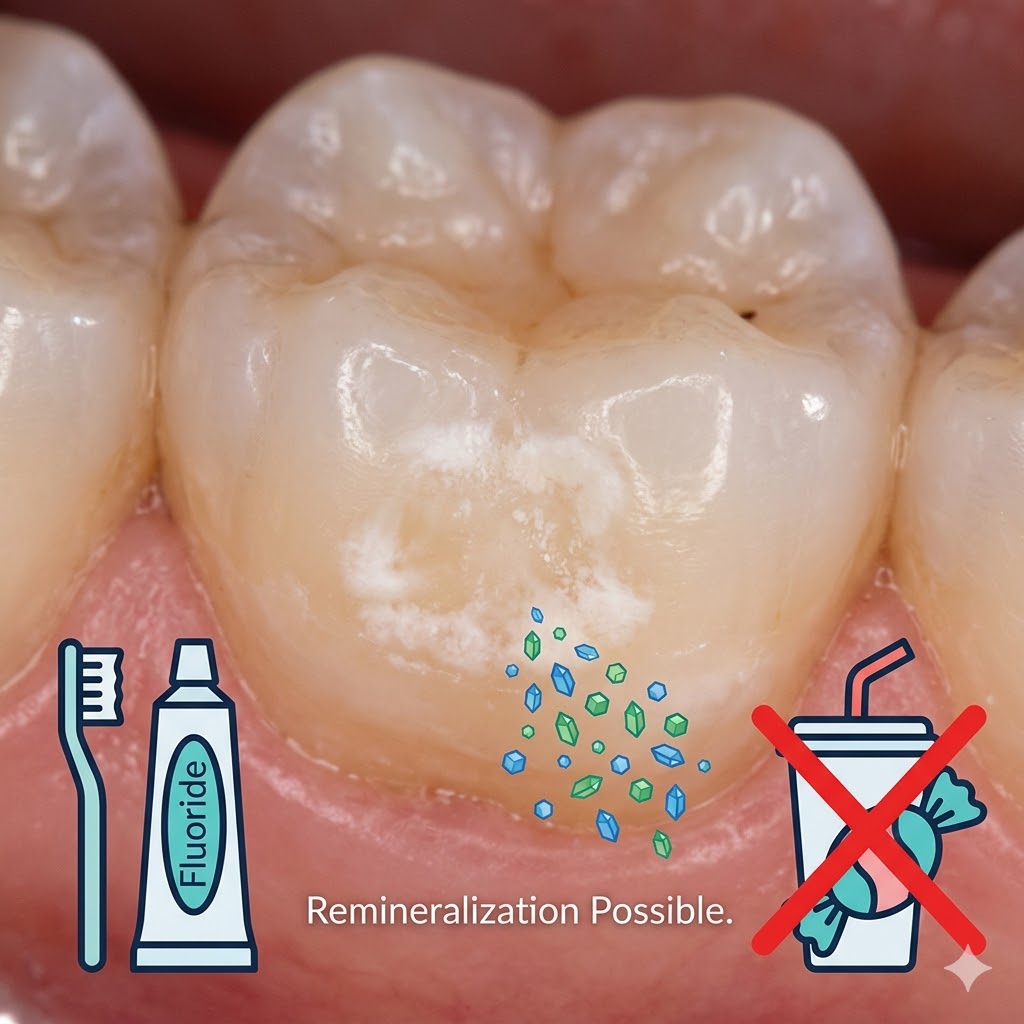
At first, there is no hole. Just a soft, white spot on your tooth. This is the critical moment. This white spot is the only stage where your tooth can truly “heal” itself.
Once the enamel breaks open and forms a physical cavity, the game changes. That hole will not close on its own. Ever.
Let me repeat that for clarity: A true hole in your enamel will not heal without a dentist.
But early decay? That is a different story.
The Short Answer: Yes and No
Let me give you the honest, realistic answer right now.
Can dental cavities heal themselves?
- Yes, but only in the earliest stage. If decay has not broken through the enamel, your body can reverse it. This is called remineralization. You can help this process naturally.
- No, once a physical hole forms. If the enamel is breached, the cavity will not heal on its own. You need a filling, an inlay, or a crown. No diet change, oil pulling, or magic toothpaste will rebuild that lost tooth structure.
This is not pessimism. This is reality. And knowing this reality will save you pain, money, and unnecessary tooth loss.
Think of your tooth like a ceramic bowl. If the glaze gets a tiny scratch, you can polish it. If the bowl cracks all the way through, you cannot glue it back together with wishful thinking.
So the real question is not can cavities heal? The real question is how do I catch a cavity before it is too late?
The Science of Remineralization (How Teeth Actually Repair Themselves)
Your teeth are in a constant battle. Every single day, two things happen inside your mouth.
Demineralization: Acids from bacteria strip minerals like calcium and phosphate from your enamel.
Remineralization: Your saliva delivers minerals back to your enamel, repairing the tiny damage.
This war never stops. When the two processes are balanced, your teeth stay healthy. When demineralization wins, decay starts.
Your saliva is your mouth’s natural medicine. It contains calcium, phosphate, and fluoride. These minerals rebuild your enamel on a microscopic level. Every time you eat, your saliva goes to work.
But saliva cannot rebuild a hole. It can only fill in the microscopic pores that form before a cavity becomes a hole.
Here is a comparison to help you visualize it.
| Stage of Decay | Can It Heal Naturally? | What Happens |
|---|---|---|
| Healthy enamel | Yes (maintenance) | Saliva maintains mineral balance |
| White spot lesion (early decay) | Yes | Remineralization can reverse the spot |
| Enamel cavity (small hole) | No | The hole will trap food and bacteria |
| Dentin cavity | No | Sensitivity and pain begin |
| Pulp infection | No | Root canal or extraction needed |
The white spot is your warning light. Ignore it, and you get a hole. Treat it, and your tooth can return to full health.
The Truth About “Healing” Cavities Naturally: What Works
Let me be very clear. I am not going to tell you that you can cure a cavity with coconut oil and positive thinking. That is dangerous nonsense.
But I will tell you what actually helps your teeth remineralize. These strategies are supported by dental science. They work for early decay. They also prevent future cavities.
1. Fluoride: The Most Proven Tool
Fluoride is not a toxin. It is not a conspiracy. It is the single most effective substance for remineralizing enamel. Period.
Fluoride does three amazing things:
- It attracts calcium and phosphate to your enamel
- It creates a new mineral called fluorapatite, which is stronger than your original enamel
- It stops bacteria from producing as much acid
Using fluoride toothpaste twice a day is the easiest way to help your teeth heal early damage. Prescription fluoride varnishes from your dentist are even stronger.
2. Your Diet Controls Everything
You cannot out-brush a bad diet. Sugar is the fuel for cavity-causing bacteria. Every time you eat sugar, the bacteria produce acid for 20 to 40 minutes.
But here is the good news. You can change the balance.
Foods that help remineralization:
- Cheese and dairy (calcium and casein)
- Leafy greens (magnesium and calcium)
- Nuts and seeds (phosphate)
- Meat and fish (phosphorus)
- Crunchy vegetables (stimulate saliva)
Foods that hurt your teeth:
- Soda and sports drinks (acidic and sugary)
- Candies and cookies (sugar bombs)
- Dried fruit (sticky sugar)
- White bread and crackers (fermentable carbs)
The most important change? Reduce snacking. Every time you eat, your mouth becomes acidic for 30 minutes. If you snack all day, your teeth never get a break. Give your saliva time to work.
3. Saliva Is Your Best Friend
Dry mouth is a disaster for your teeth. Without enough saliva, remineralization cannot happen. Cavities spread fast.
If you take medications that dry your mouth, talk to your dentist. If you breathe through your mouth at night, try to change the habit. Chewing sugar-free gum with xylitol can stimulate saliva flow.
4. Xylitol: The Bacteria Fool
Xylitol is a natural sweetener that bacteria cannot digest. When you chew xylitol gum or use xylitol mints, the bacteria starve. They also become less sticky, so they wash off your teeth more easily.
Studies show that using xylitol three to five times a day can significantly reduce cavity risk. But it will not heal a hole. It only prevents new decay.
5. Calcium and Phosphate Products
You can buy special toothpastes and mouthwashes with “amorphous calcium phosphate” or “casein phosphopeptide-amorphous calcium phosphate.” These products give your saliva extra minerals to work with.
They are not miracles. But for people with high cavity risk, they make a real difference.
What Absolutely Will Not Heal a Cavity
The internet is full of bad advice. Some of it is harmless. Some of it will cost you a tooth.
Let me save you time and disappointment.
Oil pulling will not heal a cavity. Swishing coconut oil in your mouth might reduce some bacteria. It will not rebuild enamel. It will not fill a hole.
Avoiding the dentist will not make a cavity disappear. Cavities do not reverse themselves once they form holes. They only grow larger and deeper.
Herbal remedies like clove oil can reduce pain temporarily. They do not remove decay. The infection is still there.
Activated charcoal is actually abrasive. It can wear down your enamel and make your teeth more sensitive. Do not use it.
Remineralizing toothpastes only work on early white spots. They will not fix a hole. Anyone selling you a toothpaste that claims to fill cavities is lying.
Here is a hard truth from Dr. Mark Burhenne, a well-known family dentist: “Once a cavity reaches the dentin, no amount of remineralization will reverse it. The tooth structure is lost forever.”
I want you to heal your teeth. But I also want you to be smart. Do not waste months trying natural remedies on a cavity that needs a simple filling. That small cavity can become a root canal. That root canal can become an extraction.
How to Know If Your Cavity Can Still Heal
You cannot always see or feel a cavity in its early stage. That is why dentists use X-rays. But you can look for clues.
Signs of early decay (reversible):
- A white, chalky spot on your tooth
- No pain or sensitivity
- The spot feels smooth when you touch it with a toothpick
Signs of a real cavity (not reversible):
- A visible hole or dark spot
- Sensitivity to sweets
- Sensitivity to cold drinks that lasts a few seconds
- A rough edge you can feel with your tongue
- Pain when you bite down
If you have any signs from the second list, you need a dentist. Natural remedies will not work. You are beyond the healing stage.
But here is good news. Even if you need a filling, you can still remineralize the rest of your mouth. Preventing future cavities is always possible.
A Step-by-Step Plan to Remineralize Early Decay
Let us say your dentist finds a white spot. No hole yet. You want to heal it naturally. Here is your action plan.
Step 1: Improve your brushing technique.
Use a soft toothbrush. Brush for two full minutes. Focus on the gum line. Use fluoride toothpaste. Do not rinse immediately after spitting. Leave the fluoride on your teeth for 20 minutes.
Step 2: Change your snacking habits.
Eat three meals a day. Avoid snacks between meals. If you must snack, choose cheese, nuts, or crunchy vegetables. Rinse your mouth with water after eating.
Step 3: Add a fluoride rinse.
Use an over-the-counter fluoride mouthwash once daily. Swish for one minute. Do not eat or drink for 30 minutes afterward.
Step 4: Chew xylitol gum.
After meals when you cannot brush, chew xylitol gum for five minutes. This stimulates saliva and starves bacteria.
Step 5: Consider professional fluoride varnish.
Ask your dentist for a fluoride varnish treatment. It takes five minutes. It provides a concentrated dose of fluoride that lasts for months. Many dental insurance plans cover it.
Step 6: Wait and monitor.
Give it three to six months. White spots can take time to reverse. Visit your dentist again for a checkup. They can measure whether the spot has improved.
This plan works for early decay. It does not work for holes. Be honest with yourself.
When You Absolutely Need a Dentist (No Exceptions)
Some people avoid the dentist out of fear. Some avoid it out of cost. I understand both. But ignoring a cavity will always cost you more in the end.
You need a dentist immediately if you have:
- A visible hole or pit in your tooth
- Pain that wakes you up at night
- Swelling in your cheek or gum
- A pimple on your gum (this is an abscess)
- A tooth that has changed color to grey or black
- Pain when you bite down that lasts more than a few seconds
These are signs of advanced decay. The infection is deep. Natural healing is impossible. You need a filling, a root canal, or an extraction.
I know dental work is not fun. But a filling takes 20 minutes. A root canal takes an hour. An extraction takes 10 minutes. Ignoring the problem leads to months of pain, expensive emergency visits, and lost teeth.
Do not let a small problem become a big one.
Realistic Expectations: What Modern Dentistry Can Do
Modern dentistry is amazing. We can fix almost anything. But it is not magic. Here is what you can expect at different stages.
| Decay Stage | Treatment | How Long It Lasts |
|---|---|---|
| White spot | Remineralization (no drilling) | Permanent if you maintain habits |
| Small enamel cavity | Filling (composite resin) | 5-10 years |
| Medium cavity (into dentin) | Filling or inlay | 5-15 years |
| Large cavity (near pulp) | Onlay or crown | 10-20 years |
| Pulp infection | Root canal + crown | 10-20 years |
| Unsaveable tooth | Extraction + implant | 20+ years |
The smaller the cavity, the simpler and cheaper the treatment. A filling costs between $150 and $400. A root canal costs $800 to $1,500. An implant costs $3,000 to $5,000.
Which sounds better to you? That is why catching cavities early matters so much.
Prevention Is Always Better Than Healing
Here is the best news I can give you. Most cavities are preventable. You have enormous control over your oral health.
The six habits that stop cavities before they start:
- Brush twice a day with fluoride toothpaste. Not once. Twice. And do it properly.
- Floss once a day. Brushing misses 40% of your tooth surfaces. Flossing cleans between teeth where most cavities start.
- Drink water throughout the day. Water rinses away food and bacteria. It also helps your saliva do its job.
- Limit sugar to mealtimes. It is not about how much sugar you eat. It is about how often. Three sugar exposures a day is fine. Fifteen is a problem.
- Get regular checkups every six months. Your dentist can find white spots before they become holes. They can also clean off hard plaque that you cannot remove at home.
- Consider dental sealants. These are plastic coatings painted onto your back teeth. They seal the deep grooves where food gets trapped. Sealants reduce cavity risk by nearly 80% in molars.
If you do nothing else from this article, do these six things. They will save your teeth.
Special Situations: Children, Seniors, and Dry Mouth
Not everyone is the same. Your cavity risk changes throughout your life.
Children and Cavity Healing
Children have one advantage. Their enamel is not fully mature. It is more porous. This means it demineralizes faster, but it also remineralizes faster.
Small white spots in children often reverse completely with good habits. Fluoride varnish is especially effective for kids.
But children also have disadvantages. They eat more frequently. They brush poorly. They love sugar. So while their teeth can heal faster, they also decay faster.
If your child has a white spot, act immediately. Improve their diet. Supervise their brushing. Take them to the dentist every six months.
Seniors and Cavity Healing
Older adults face different challenges. Many take medications that cause dry mouth. Many have receding gums that expose soft root surfaces. Root cavities grow faster than enamel cavities.
For seniors, prevention is everything. Use prescription fluoride toothpaste if your dentist recommends it. Chew xylitol gum. Drink water constantly. And never skip dental checkups.
Root cavities almost never heal on their own. They need fillings. Do not wait.
People with Chronic Dry Mouth
If you have Sjögren’s syndrome, diabetes, or take antidepressants, antihistamines, or blood pressure medications, you are at high risk.
Your saliva flow is low. Remineralization happens slowly. Cavities spread fast.
Talk to your dentist about:
- Prescription fluoride toothpaste
- Saliva substitutes
- Medications that stimulate saliva (like pilocarpine)
- More frequent cleanings (every three to four months)
You cannot rely on natural healing. You need aggressive prevention and early treatment.
Common Questions People Ask (And Honest Answers)
Can a cavity heal in one week?
No. Remineralization takes months. If you have a true cavity, it will not heal at all.
Does fluoride reverse cavities?
Fluoride reverses white spots. It does not fill holes.
Can I reverse a cavity with diet alone?
Only the earliest white spots. And even then, diet alone is less effective than diet plus fluoride.
What happens if I ignore a small cavity?
It grows. It reaches the dentin. You feel pain. It reaches the pulp. You need a root canal. It becomes infected. You lose the tooth.
Do cavities heal when you stop eating sugar?
Stopping sugar stops new decay. It does not repair existing holes.
Can a cavity heal on its own without fluoride?
Very rarely. Your saliva contains minerals, but without fluoride, the repair process is much slower and less effective.
Why do some people never get cavities despite poor habits?
Genetics. Some people have harder enamel, better saliva, or less aggressive bacteria. That does not mean you can ignore your teeth.
Is it too late if I have pain?
Pain usually means decay has reached the dentin or pulp. You need dental treatment. But it is not too late to save the tooth.
What the Internet Gets Wrong About Healing Cavities
Let me address some popular claims directly.
Claim: “The body can heal any cavity naturally.”
False. Once enamel is broken, the body cannot regrow it. You are not a starfish growing back a limb.
Claim: “Dentists lie to sell fillings.”
Mostly false. Are there unethical dentists? Sure, in every profession. But the vast majority of dentists want to save your teeth. A small filling is better for you and easier for them than a large problem.
Claim: “Fluoride is dangerous.”
False at normal doses. Fluoride toothpaste and tap water are safe. The only risk is fluorosis in children who swallow too much toothpaste. That is why young kids use a rice-sized amount.
Claim: “Oil pulling healed my cavity.”
Unlikely. Either you never had a real cavity, or the cavity is still there and you just stopped feeling pain. Oil pulling can reduce bacteria, but it does not rebuild enamel.
Claim: “You only need to brush with baking soda and peroxide.”
Dangerous. Baking soda is abrasive. Peroxide can irritate your gums. Neither provides fluoride. You are setting yourself up for cavities.
I am not saying all natural approaches are bad. Good diet, xylitol, and saliva stimulation are excellent. But do not abandon real dentistry for internet fairy tales.
A Note on Hope and Reality
I want you to feel hopeful about your teeth. But I want that hope to be realistic.
Here is the truth you can celebrate.
You can stop cavities from ever forming. You can reverse early white spots. You can keep your natural teeth for your entire life. These are not fantasies. Millions of people do it.
But you cannot ignore a hole and wish it away. That is not how teeth work. And pretending otherwise leads to tooth loss, expensive dental bills, and unnecessary pain.
So here is my honest advice to you.
Look at your teeth today. Do you see any dark spots? Do you feel any rough edges? Do you have any pain or sensitivity?
If yes, call a dentist. Not next month. Tomorrow.
If no, celebrate. Then double down on your prevention habits. Brush. Floss. Limit sugar. See your dentist twice a year. You are on the right track.
Your teeth are the only ones you will ever have. Take care of them with knowledge, not magical thinking.
Conclusion (Three Lines)
Early cavities in the form of white spots can heal through remineralization using fluoride, a healthy diet, and good saliva flow. Once a physical hole forms in the enamel, natural healing is impossible, and you need a dental filling to stop the decay from spreading. Prevention and early detection are your real superpowers for a lifetime of healthy teeth.
Frequently Asked Questions (FAQ)
Q1: How long does it take for a cavity to heal naturally?
A: If the cavity is still a white spot, remineralization usually takes three to six months of consistent good habits. A true cavity with a hole will not heal at all.
Q2: Can a cavity heal without going to the dentist?
A: Only if it is an early white spot. You still need a dentist to diagnose it properly, but you can reverse it at home with fluoride, diet changes, and good oral hygiene.
Q3: Does coconut oil pulling heal cavities?
A: No. Coconut oil pulling may reduce some bacteria, but it cannot rebuild enamel or fill a hole. Do not rely on it to heal a cavity.
Q4: Can a dentist tell if a cavity is healing?
A: Yes. Dentists use X-rays and visual exams to monitor white spots. They can measure whether the spot is getting smaller or larger over time.
Q5: What happens if a cavity is left untreated for a year?
A: It will grow significantly. It will likely reach the dentin or pulp, causing pain, infection, and the need for a root canal or extraction.
Q6: Can kids’ cavities heal faster than adults’?
A: Yes. Children’s enamel is more porous and remineralizes faster. Early white spots in kids often reverse completely with proper care.
Q7: Can you feel a cavity healing?
A: If a white spot is reversing, you may notice less sensitivity and a smoother tooth surface. But you cannot feel the remineralization process directly.
Q8: Is it ever too late to reverse a cavity?
A: Yes. Once the enamel is physically broken, it is too late for natural reversal. You need a filling.
Q9: Do all cavities need fillings?
A: No. White spots do not need fillings. Very small cavities that are caught early can sometimes be managed with fluoride and monitoring, but most enamel cavities that have formed a hole need a filling.
Q10: How can I prevent cavities forever?
A: Brush twice daily with fluoride toothpaste, floss once daily, limit sugar to mealtimes, drink water, chew xylitol gum after meals, and visit your dentist every six months for checkups and cleanings.


