Cost of a Full Denture Replacement in Jacksonville
Replacing a full set of dentures is a significant decision. It’s a step that restores not just your smile, but also the simple joys of eating, speaking, and laughing with confidence. You’re likely here because that time has come, and the first question on your mind is practical: “What will this cost?”
You may have heard wildly different numbers from friends, seen confusing ads online, or received a quote that made you pause. The truth is, the cost of a full denture replacement in Jacksonville isn’t a single, fixed price. It’s a spectrum. The final number on your treatment plan depends on a mix of materials, dental expertise, and your unique oral health needs.
This guide cuts through the noise. We’ll walk through every factor that shapes the price, from the basics of a standard set to the precision of implant-supported solutions. You’ll get realistic price ranges, understand what your insurance might cover, and learn how to approach this investment wisely. Our goal is simple: to give you the clear, honest information you need to make a confident choice for your health and your wallet.
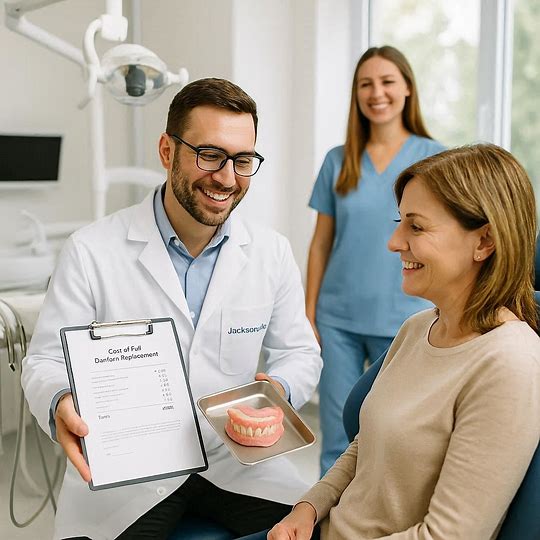
Understanding Full Denture Replacement: More Than Just New Teeth
Before we talk numbers, a clear definition helps. A full denture replacement involves creating an entirely new upper and lower denture set. This is different from a reline (which reshapes the interior of an existing denture) or a simple repair.
Why do people seek a full replacement? The reasons are common:
- Wear and Tear: Even with perfect care, dentures last about 5 to 10 years. The acrylic teeth wear down, making it harder to chew.
- Changes in Your Jaw: The bone that once held your natural teeth gradually resorbs or shrinks over time. An old denture becomes loose, causing sore spots and slipping.
- Facial Support: A properly built denture supports your lips and cheeks. An old, worn one can lead to a sunken appearance and more wrinkles.
- Aesthetic Update: Dental materials improve. You may simply want a more natural-looking set of teeth that matches your current facial features.
A true replacement process starts fresh. Your Jacksonville dentist or prosthodontist should take new impressions, record your unique bite, and customize every detail of the new set. This process is an investment in your daily function and long-term oral health.
Patient Perspective: “I thought I could make my old dentures last forever with drugstore adhesive. When I finally saw a dentist after ten years, I learned my jawbone had changed so much that the old denture was actually causing damage. The replacement wasn’t just cosmetic; it was necessary for my health.” – Robert, 67, Jacksonville Beach
The Core Factors: What Drives the Cost in Jacksonville?
The price of a denture isn’t just pulled from a list. Several key variables come together to form your quote. Understanding these will help you compare apples to apples.
1. The Type of Denture Material: Standard vs. Premium Teeth
This is the biggest driver of cost. The teeth themselves come in different grades, and this choice profoundly impacts both aesthetics and durability.
Standard Acrylic Teeth
These are the most common and budget-friendly option. They are made of a basic, harder acrylic resin.
- Pros: Lower initial cost, lightweight.
- Cons: They wear down faster against opposing teeth, can appear more uniform and less natural, and are more prone to staining and chipping over 5-7 years.
Premium Acrylic Teeth (High-Density)
Made with advanced, cross-linked acrylic resins. These are significantly more durable and stain-resistant.
- Pros: Excellent wear resistance (can last 10+ years), more natural layering of color and translucency, better at resisting plaque buildup.
- Cons: Higher upfront investment.
Porcelain Teeth
Once the gold standard, porcelain teeth are now less common for full dentures but are still an option.
- Pros: Unmatched natural appearance and translucency, extremely hard and stain-resistant.
- Cons: The hardness can accelerate wear on opposing denture teeth or natural teeth. They are heavier and more expensive. They can also make a slight “clicking” sound when chewing.
The choice is a personal one, but a dentist will guide you based on the strength of your jaw ridge and your aesthetic goals.
2. The Denture Base Material: The Foundation Matters
The “gums” of the denture are just as critical as the teeth. A high-quality base means a secure, comfortable fit.
Standard Acrylic Base
Basic pink acrylic works well but can be more brittle and may not fit as precisely as higher-end materials. Over time, it can absorb odors and stains.
High-Impact Acrylic Base
This is reinforced for strength, making it an excellent choice for patients who have accidentally dropped a previous denture or grind their teeth. It resists fracture.
Flexible Thermoplastic Base (e.g., Valplast, Flexite)
More common for partial dentures, a flexible base can sometimes be used for full dentures, especially for patients with allergies to standard acrylic or severe undercuts. It’s exceptionally comfortable as it has no metal clasps and adapts to the mouth’s contours. However, it is more expensive and can be harder to reline in the future.
3. The Complexity of the Case
Your personal anatomy dictates the technical difficulty, which directly impacts the dental laboratory fee and the dentist’s chair time.
- Severe Bone Resorption: A flat, narrow jaw ridge offers little stability for a lower denture. Creating a functional, comfortable fit here requires advanced impression techniques and sometimes a specialized impression material to capture functional movement. This takes more time and skill.
- Complex Bite Relationships: If your jaw has an unusual alignment (e.g., a severe Class II overbite or Class III underbite), setting the new teeth so they look good and function in harmony requires a meticulous, custom setup.
- Neuro-Muscular Sensitivity: Some patients need extensive adjustments to find a “neutral zone” where the denture sits without being pushed out by the tongue or cheek muscles.
4. The Dental Professional’s Expertise and Location
A general dentist and a board-certified prosthodontist both make dentures, but their training and fee schedules differ. A prosthodontist is a specialist with three additional years of training in complex restoration and replacement cases. Their expertise is invaluable for difficult cases, but it comes at a premium.
Within Jacksonville, geographic location and practice overhead can influence cost. A practice in a high-rent area like Ponte Vedra Beach or San Marco may have slightly higher fees than one in a more suburban clinic in Mandarin or Orange Park.
Important Note: A lower fee doesn’t always mean a bargain. An ill-fitting, poorly made denture can lead to chronic pain, malnutrition from an inability to chew, and accelerated bone loss, costing far more to correct in the long run.
Price Ranges: A Realistic Look at Your Investment in Jacksonville
Let’s talk actual numbers. The following ranges are realistic estimates for the Jacksonville, FL market in 2024. These are per arch (meaning for a single upper or lower denture) and include the denture itself plus the necessary appointments for fitting and delivery. Fees for extractions, bone smoothing, or implant placement are additional.
| Service | Economy/Standard | Mid-Range (Premium Acrylic) | Premium (High-Impact/Porcelain) | Specialist (Prosthodontist) |
|---|---|---|---|---|
| Single Complete Denture (Upper or Lower) | $900 – $1,500 | $1,600 – $2,500 | $2,600 – $4,000 | $3,500 – $5,500+ |
| Complete Set (Upper & Lower) | $1,800 – $3,000 | $3,200 – $5,000 | $5,200 – $8,000 | $7,000 – $11,000+ |
What’s Included in a Standard Fee:
A comprehensive quote for a replacement denture should typically bundle the following:
- Initial exam and consultation.
- Preliminary and final impressions.
- Bite registration records.
- Selection of teeth (shade, mold, size).
- A “try-in” appointment where you see and approve the denture setup in wax before it’s finished.
- The final delivery and insertion appointment.
- At least 1-2 follow-up adjustment visits post-delivery.
Always get a detailed, written treatment plan that itemizes each of these steps so you know exactly what your payment covers.
Deep Dive: The Full Spectrum of Replacement Options
We can now explore each type of replacement in detail, from the foundational standard set to the life-changing implant-retained solutions.
Standard Economy Dentures: The Accessible Foundation
This is the entry point for many. An economy denture uses stock, standard acrylic teeth processed into a basic acrylic base. The teeth are chosen from a limited selection of pre-made molds and shades.
The Process:
The goal is efficiency. The process may use fewer steps and less labor-intensive techniques to create a functional, decent-looking set of teeth quickly.
Who Is It For?
This option serves as an immediate denture or a budget-friendly replacement. It’s a solid choice for those who need a quick, affordable way to restore function.
Realistic Lifespan and Value:
You can expect 3-7 years of wear before the teeth show significant flattening or staining. The base may need a reline sooner as it may not adapt as precisely from the start. The value is in immediate affordability. The long-term cost can be higher if the fit accelerates bone resorption, requiring more frequent replacements down the line.
Pro Tip: If you choose this route, ask about an upgrade path. Some clinics will credit part of the cost if you upgrade to a premium set within a certain timeframe. This is rare, but worth asking.
Mid-Range and Premium Conventional Dentures: The Sweet Spot
This is where you’ll find the best balance of aesthetics, durability, and cost for most people. A mid-range denture typically pairs high-density premium acrylic teeth with a stronger, better-fitting acrylic base.
The Art of Customization:
The lab fee is higher because the process is more artisanal. A dental lab technician will often hand-layer different shades of pink acrylic to replicate natural gum tissue. The teeth themselves are not just a single block of white; they have layered color, varying from the neck of the tooth (slightly yellower) to the incisal edge (more translucent). Multiple try-ins may be scheduled to perfect the smile.
The “Denture-Smile” Design:
Your dentist will work with you to design a smile that reflects who you are. They will consider your age, gender, facial shape, and even personality. Men’s teeth tend to be more squared and rugged, while women’s teeth are often more rounded and delicate. The arrangement is everything. You have full control to see and approve the look in wax before the final processing.
Value Proposition:
For a replacement set you wear every single day for a decade, the additional $1,000–$2,000 over an economy set translates to pennies per day for a dramatic improvement in comfort, confidence, and chewing ability.
Immediate Dentures: A Temporary Solution with a Purpose
An immediate denture is placed the same day your natural teeth are extracted. It’s a temporary healing device, not a definitive long-term replacement.
Why Choose This Path?
The primary benefit is cosmetic. You never have to go without teeth. The denture also acts like a bandage, protecting the surgical sites and controlling swelling.
The Real Cost of an Immediate Denture:
The fee is for the denture (made in advance using your pre-extraction impressions) and the surgical extractions. This is typically paid as a single package fee.
The Critical Second Phase:
This is where many people are caught off guard. As the extraction sites heal over 6-9 months, your jawbone will reshape rapidly. The immediate denture will become loose and ill-fitting. A temporary reline (a soft, cushioned material added to the inside of the denture) is required to keep it wearable. This reline can cost $200–$400.
The most important part: the immediate denture is not your final denture. After full healing, you will need either a permanent, hard reline ($400–$800 per arch) to retrofit the old denture, or, ideally, a completely new, well-fitting conventional denture. So, the sequence of costs is:
Immediate Denture Fee → Temporary Reline(s) → Permanent Reline OR New Conventional Denture.
Always plan for this second financial step.
Implant-Supported Overdentures: Redefining Stability
No conversation about modern dentures is complete without discussing dental implants. This is the premium tier, where the cost reflects a dramatic leap in function and preservation of your jawbone. An implant-supported overdenture clips onto two or more implants, eliminating the “floating” feeling.
The Life-Changing Difference:
A traditional lower denture sits on a movable floor-of-the-mouth, pushed around by the tongue. An implant-retained lower overdenture is rock solid. It restores up to 90% of natural chewing force, compared to 10-20% with a conventional denture. It also stops the cycle of bone loss by transmitting chewing forces into the jaw.
Option 1: Locator-Retained Overdenture (The Most Popular Choice)
This system uses 2-4 small-diameter implants with a “Locator” abutment on top. The denture has corresponding housings with tiny, replaceable nylon caps that snap securely onto the abutments.
The Fee Breakdown in Jacksonville:
This is a multi-step surgical and restorative process. A single specialist or a team manages it.
- Surgical Phase: Implant placement surgery, often with a CBCT scan for 3D planning. This cost is per implant.
- Restorative Phase: After healing, the denture is either fabricated new or your existing denture is retrofitted with the Locator housings.
Realistic Investment Table:
| Component | Cost Range (Per Item) |
|---|---|
| CBCT Scan (3D X-ray) | $300 – $650 |
| Single Dental Implant Placement (Surgery & Fixture) | $1,800 – $2,800 |
| Locator Abutment (Attachment on implant) | $500 – $800 |
| The Overdenture (New, Premium Set with Housings) | $3,000 – $4,500 |
| Total for 2-Implant Lower Overdenture | $7,100 – $11,550 |
Option 2: Bar-Retained Overdenture (The Ultimate in Precision)
Instead of individual Locator attachments, a custom-milled metal bar connects the implants. The denture runs along this bar, clipping in with multiple advanced clips.
- Pros: Unmatched stability, even force distribution, the bar can splint weaker implants, and the retention mechanism is metal-on-metal, requiring less frequent replacement than the nylon Locator caps.
- Cons: Significantly higher lab cost due to the custom bar fabrication. Requires more vertical space in the denture. More expensive to maintain if a clip breaks.
- Cost Premium: A bar-retained overdenture can add $2,500–$4,000+ to the total cost over a Locator system.
Is It Worth the Investment?
For a lower denture, the answer from patients is a resounding “yes.” An upper denture relies on suction across the palate for stability, so implants are less critical for retention but still dramatically improve comfort by allowing the palate to be left open. If you can only afford to do one arch, start with the lower.
The All-on-4® / All-on-6 Treatment Concept: The Fixed Revolution
This is not a removable denture. It is a full-arch, fixed bridge permanently screwed into four or six strategically angled implants. You cannot take it out; only your dentist can remove it for maintenance.
Why It’s Different:
The prosthetic is milled from a solid block of acrylic wrapped around a titanium bar, or it’s a high-end zirconia bridge. Because the implants are angled, the technique often avoids the need for bone grafting. The All-on-4 is a same-day teeth solution, providing a temporary fixed bridge at the time of surgery.
The Jacksonville Investment:
This is the most expensive tooth replacement option, but it’s a complete medical and restorative procedure. Advertised fees for one arch (e.g., “All-on-4 starting at $19,999”) are common, but be cautious.
- The “All-Inclusive” Package: Look for a quote that explicitly includes the CBCT scan, all extractions, any necessary bone smoothing, sedation, the implant surgery, the immediate temporary bridge, AND the final, permanent bridge. A non-inclusive fee that only covers surgery will balloon when the restorative bridge phase is billed separately.
- Realistic Total Cost per Arch (Jacksonville): For a truly comprehensive fee with a premium final bridge, the range is typically $22,000 to $30,000 per arch.
This is a life-altering solution for those who qualify medically and financially. It’s the closest thing to having your natural teeth back.
Patient Perspective: “I wore a lower denture for 20 years and hated every minute. My wife said I stopped going out to dinner. Getting two implants to snap it in place was a game-changer. I can eat a steak again. I can sneeze without fear. The cost was significant, yes, but I measure value in quality of life, and this has been priceless.” – Linda, 72, Riverside
The Silent Cost Driver: Preliminary Procedures
The denture quote is just for the denture. A complete treatment plan often requires foundational work. These procedures have separate fees and are a critical part of the final bill.
- Extractions: Simple extractions vs. surgical extractions for broken teeth. A surgical extraction can cost 2-3 times more.
- Alveoloplasty (Bone Smoothing): After extractions, your dentist may need to recontour the jawbone to create a smooth, rounded ridge for a denture to sit comfortably on. This is charged per arch.
- Tori Removal: Bony growths on the palate (torus palatinus) or inside of the lower jaw (torus mandibularis) must often be surgically removed as they will prevent a denture from seating and cause constant pain.
Realistic Cost Table for Preliminary Work:
| Procedure | Estimated Range (Per Item/Arch) |
|---|---|
| Simple Extraction | $150 – $300 |
| Surgical Extraction | $350 – $600+ |
| Alveoloplasty (per arch) | $600 – $1,500 |
| Tori Removal | $1,500 – $3,500+ |
| Cone Beam CT Scan | $300 – $650 |
A well-planned budget accounts for these procedures first, before the denture itself.
Paying for Your Smile: Insurance, Financing, and Smart Strategies
A new denture is a planned investment. Knowing how to navigate the financial landscape can reduce stress and open up possibilities you thought were out of reach.
Dental Insurance: Reading the Fine Print
Most PPO dental insurance plans classify dentures as “Major Restorative” services. Here’s how to decode your benefits:
- The Annual Maximum: This is the total dollar amount your insurance will pay in a calendar year. It’s typically between $1,000 and $2,000. Once you hit it, you pay 100% for everything else. A denture can easily exhaust this.
- The Co-Insurance: The plan usually pays a percentage (often 50%) of the allowed amount for major services. So, if the allowed amount is $3,000, the plan pays $1,500, and you pay $1,500 — but only if you haven’t hit your annual maximum yet.
- Missing Tooth Clauses: This is a huge pitfall. Some plans will NOT cover the replacement of a tooth (or teeth) if it was missing before you enrolled in the plan. Ask your dentist’s office to get a “pre-treatment estimate” from your insurer. This is a written confirmation of what they will pay.
- Frequencies: Most plans will only pay for a new set of dentures once every 5, 7, or 10 years.
Insider Tip: If you need both upper and lower dentures and extractions, have your dentist’s office work with your calendar year. You can often do extractions and one denture in the last quarter of the year to use your maximum, and then do the second denture in January when your maximum resets. This legally maximizes your benefit.
Third-Party Financing: CareCredit, LendingClub, and More
When insurance runs out, healthcare-specific credit cards and loans fill the gap. The most common is CareCredit.
- How It Works: It’s a credit card for health and wellness expenses. You pay nothing upfront, and the provider gets paid in full.
- The Zero-Interest Trap: CareCredit offers promotional financing (e.g., no interest if paid in full in 12 months) for purchases over a certain amount. This is deferred interest. If you are a single day late on a payment or don’t pay the entire balance by the promotion end date, all the interest from the original purchase date is retroactively charged at the standard, high APR. Use this option only if you are absolutely certain you can pay it off in time.
- Fixed-Rate, Extended Plans: For larger amounts (implant cases), you can opt for plans with 24, 36, or 48-month terms at a fixed, lower APR. There’s no retroactive interest trap here. The monthly payment is predictable, which can be a much safer route for big cases.
In-House Membership Plans
Many private dental practices in Jacksonville now offer their own direct-to-patient membership plans. You pay an annual fee and receive a set of preventive care services and a flat discount (often 10-20%) on all other treatments, including dentures and implants. This can be an excellent, transparent way to save 15% on a large case without any insurance paperwork or maximums.
Jacksonville’s Resource Network: Finding Care at Every Budget
Your budget doesn’t have to be a dead end. Jacksonville has a safety net of quality providers at different price points.
1. Private Practice Excellence (Prosthodontists & High-End GPs)
These are the go-to for complex cases, implant solutions, and an absolute dedication to aesthetics. You are paying for a specialist’s diagnostic eye, a high-end private dental laboratory, and a concierge level of care. Expect the highest level of personalized attention and the most beautiful, functional result.
2. Affordable Denture Chains and Clinics
National chains with a presence in Jacksonville fill a critical need: access and speed. They operate on a high-volume model with an on-site lab, which dramatically reduces costs and turnaround time.
What to Expect:
- Transparent Menu Pricing: You can walk in, pick up a price list, and see the cost of an economy, mid-range, and premium denture clearly.
- On-Site Lab: The technician is right there, which can speed up repairs and adjustments.
- The Bait-and-Switch Concern: Often criticized for advertising a low price on a basic denture and then upselling to a more expensive model upon consultation. Be an informed consumer. Read Google reviews for the specific Jacksonville location you’re considering. Go in knowing which level you’re interested in and ask to see samples of the different acrylic teeth to make a visual comparison.
3. UF Health Dentistry – Jacksonville
The University of Florida’s dental center on the Jacksonville campus is the city’s premier source for affordable, academically-supervised care. Care is provided by dental students and residents (graduate dentists pursuing specialty training), all under the close watch of licensed faculty dentists.
- The Pros: The most significant cost savings you will find. The treatment planning is thorough, as it’s a teaching environment. All materials meet the university’s high standards.
- The Cons: Time. Appointments are long, and the process from start to finish will take many more visits than a private practice. Getting accepted as a patient can also involve a screening process and a waitlist.
This is an ideal option for those with a limited budget and unlimited patience.
The 9-Step Journey: From First Impressions to a New Smile
Understanding the clinical process demystifies the cost. A quality denture is never made in a day. It requires a sequence of precise, artistic steps.
- Diagnosis & Impressions: Your dentist takes a complete health history and creates preliminary impressions of your arches. These are sent to the lab to create custom impression trays.
- Final Master Impressions: Using the custom trays, a highly accurate impression material captures every detail of your tissue. A functional impression, where you perform movements with your tongue and cheeks, might be taken for a notoriously tricky lower arch.
- Bite Records: Wax rims on temporary bases are placed in your mouth. You’ll bite down to record the exact vertical dimension of your face (how open your bite should be) and the centric relation of your jaw joint. This step dictates proper lip support and a comfortable, non-stressful jaw position.
- Smile Design & Tooth Selection: You choose the shade, mold, and arrangement of your teeth. The dentist will evaluate your facial midline, smile line, and phonetics.
- The “Try-In” (The Most Important Appointment): The teeth are set in a pink wax base. You look at them in a mirror. This is your dress rehearsal. You must not be polite. If a tooth is too square, if the smile line is crooked, if it feels too bulky, speak up. This is the moment to change it. Changes after processing are difficult and costly.
- Processing: The approved wax-up goes to the lab. The wax is replaced with the permanent, heat-cured acrylic in a specialized flask under high pressure.
- Finishing & Polishing: The processed denture is meticulously trimmed of any excess acrylic and polished to a glass-like shine to resist stain and be comfortable on your gums.
- Delivery & Insertion: The new denture is placed. Your dentist will meticulously check the bite using pressure-indicating paste and make tiny adjustments. You will receive detailed verbal and written home-care instructions.
- Follow-Up & Adjustments: You will return within the first week. A tiny sore spot is normal. The dentist will quickly relieve the pressure inside the denture. It’s a critical appointment. Do not try to adjust it yourself with an emery board.
A Realistic, No-Nonsense Quality-Value Comparison
This table distills the complex information into a quick reference. It’s designed to match a type of patient with the most suitable option.
| Patient Profile | Best Value Option | Why It’s the Right Choice | Expected Investment (Full Set) |
|---|---|---|---|
| The Budget-Conscious First-Timer | Standard Acrylic Set | Gets you a functional, aesthetic smile with the lowest upfront cost. A solid starting point. | $1,800 – $3,000 |
| The Long-Term Planner | Premium Acrylic Set | Best dollar-per-day value. Superior durability, stain resistance, and natural look for a decade of wear. | $3,200 – $5,000 |
| The Struggling Lower Denture Wearer | 2-Implant Locator Overdenture | Solves the #1 denture complaint: a loose lower. Stops bone loss and restores confident eating. | $7,100 – $11,550 |
| The Patient with a Strong Gag Reflex | Flexible Upper Denture | It can be designed without covering the entire palate, dramatically improving comfort and taste. | $2,500 – $4,000 (per arch) |
| The “I Want My Teeth Back” Individual | All-on-4/6 Fixed Bridge | Nothing removable. It’s a psychological and physical transformation. For those who can afford the best. | $44,000 – $60,000+ (both arches) |
Red Flags: How to Spot a “Too Good to Be True” Offer
Advertisements for “Dentures in a Day” or “$399 Dentures!” are everywhere. Be a critical reader.
- The “Just the Denture” Fee: An advertised price often reflects the denture itself, but a separate, non-optional fee for the diagnosis, X-ray, impression, and try-in appointments may be added on. Ask for the “global fee” that bundles everything.
- A Refusal to Do a Try-In: A wax try-in is a non-negotiable standard of care. A clinic that refuses to provide one, rushing straight to the finished denture, is cutting a vital corner. Walk away.
- High-Pressure Sales: Any clinic that pressures you to pay for a full treatment plan on the first visit, before you’ve had time to think, should be treated with extreme caution. A good dentist presents a plan and gives you space.
- No Follow-Up Care: Ask explicitly, “How many post-insertion adjustment visits are included?” A new denture will almost always need minor tweaks. An office that charges for a basic adjustment one week after delivery is a red flag.
Preserving Your Investment: Care That Saves You Money
A $5,000 denture set is a health asset. Treating it with care will prevent premature, costly replacement and maintain your oral health.
- The Daily Ritual: Don’t clean your denture over a hard sink. Fill it with water or lay down a towel. A dropped denture on tile is a heartbreak that costs money to repair or replace. Use a denture brush and non-abrasive denture cleaner—never toothpaste, which is abrasive and creates micro-scratches that harbor bacteria and stain.
- The Overnight Soak: Denture acrylic must stay hydrated to maintain its shape. A dry denture warps. Soak it in cool water or a denture-soaking solution every single night. This gives your gums a vital rest and prevents fungal infections.
- Do Not DIY Reline: Never, ever use a drugstore reline kit. These soft, squishy materials can feel good initially but trap massive amounts of bacteria against your palate, leading to severe tissue inflammation and fungal overgrowth. They are a temporary mask for a denture that needs professional adjustment or replacement.
- Annual Oral Health Checks: See your dentist once a year. The visit isn’t about your teeth; it’s about your mouth. You need an oral cancer screening, an evaluation of your denture’s fit and bite, and a check for signs of fungal infection under the denture. A small, inexpensive reline at year 5 can extend your denture’s life, preventing a full replacement at year 7.
Frequently Asked Questions (FAQ)
How often do I really need to replace my full dentures?
A well-made, premium denture should be evaluated after 5-7 years and often replaced between 7 and 10. The teeth wear down, and the base no longer fits the slowly changing jawbone. An ill-fitting denture accelerates bone loss, so waiting too long can be detrimental.
Does Medicare cover the cost of full denture replacement?
No. Original Medicare (Parts A and B) does not cover routine dental care, which includes dentures. Some Medicare Advantage plans (Part C) do offer a dental benefit with coverage for dentures. You must check your specific plan’s summary of benefits for its annual maximum and co-insurance for major procedures.
What’s the most affordable way to replace my dentures in Jacksonville?
For the lowest cost, a standard acrylic set from a dental school like UF Health Dentistry is the most affordable option, though it requires more time. The next most affordable path is an economy denture from a reputable, high-volume clinic with an on-site lab.
Can my old, loose denture just be fixed with a reline instead of being replaced?
Yes, if the teeth are in good condition and the denture was made relatively recently. A reline resurfacing the tissue side of the denture can improve fit. However, if the teeth are worn flat or the denture is over 10 years old, a reline is a temporary patch on a much larger problem, and replacement is the better long-term value.
Is getting an implant-supported denture really worth the extra cost?
For lower dentures, the vast majority of patients say yes. The stability transforms the ability to chew and speak confidently and eliminates the pain of a floating denture. Crucially, implants stimulate the jawbone, preserving your facial structure. The value is measured in restored function and long-term health.
Conclusion
The journey to a new smile is a partnership between you and a skilled dental professional. The cost of a full denture replacement in Jacksonville reflects a spectrum from an economy acrylic set to a precision-crafted, implant-supported bridge that feels like your own teeth. Your final investment will be shaped by the materials you choose, the complexity of your mouth’s anatomy, and the expertise of the provider you trust. Arm yourself with knowledge, ask for detailed quotes, and select the option that restores not just your teeth, but your confidence and quality of life for years to come.
Disclaimer: This article is for informational purposes only and does not constitute dental or financial advice. The price ranges provided are estimates for the Jacksonville, FL market in 2024 and can vary significantly. You must consult with a licensed dentist for a personal diagnosis and treatment plan, and with your insurance provider for exact coverage details.
Additional Resource:
For more information on finding care and understanding your options, visit the American College of Prosthodontists’ patient education site: www.gotoapro.org