The Unvarnished Truth About Dental Implant and Crown Cost in 2026
Living with a missing tooth creates a quiet, persistent anxiety. You might avoid smiling fully in photographs. You might chew cautiously on one side of your mouth. The space feels like an absence the tongue cannot stop exploring. You have researched solutions. You understand that dental implants represent the gold standard of tooth replacement. And then you encounter the numbers. The dental implant and crown cost can feel like a wall between you and a restored smile. This guide exists to transform that wall into a clear, navigable path. We will not offer vague estimates. We will not present improbable low prices designed only to capture your phone call. We will walk through the real, detailed landscape of costs, materials, procedures, and financing. By the end, you will possess the knowledge to make a confident, informed decision.
Understanding the True Anatomy of a Single Tooth Implant Cost
When a patient first searches for the dental implant and crown cost, they often imagine a single, all-inclusive price tag. The reality involves a layered structure of professional services, precision components, and laboratory artistry. Understanding this anatomy transforms you from a passive price shopper into an educated consumer who can evaluate value, not just numbers.
The Three-Part System That Defines Your Final Bill
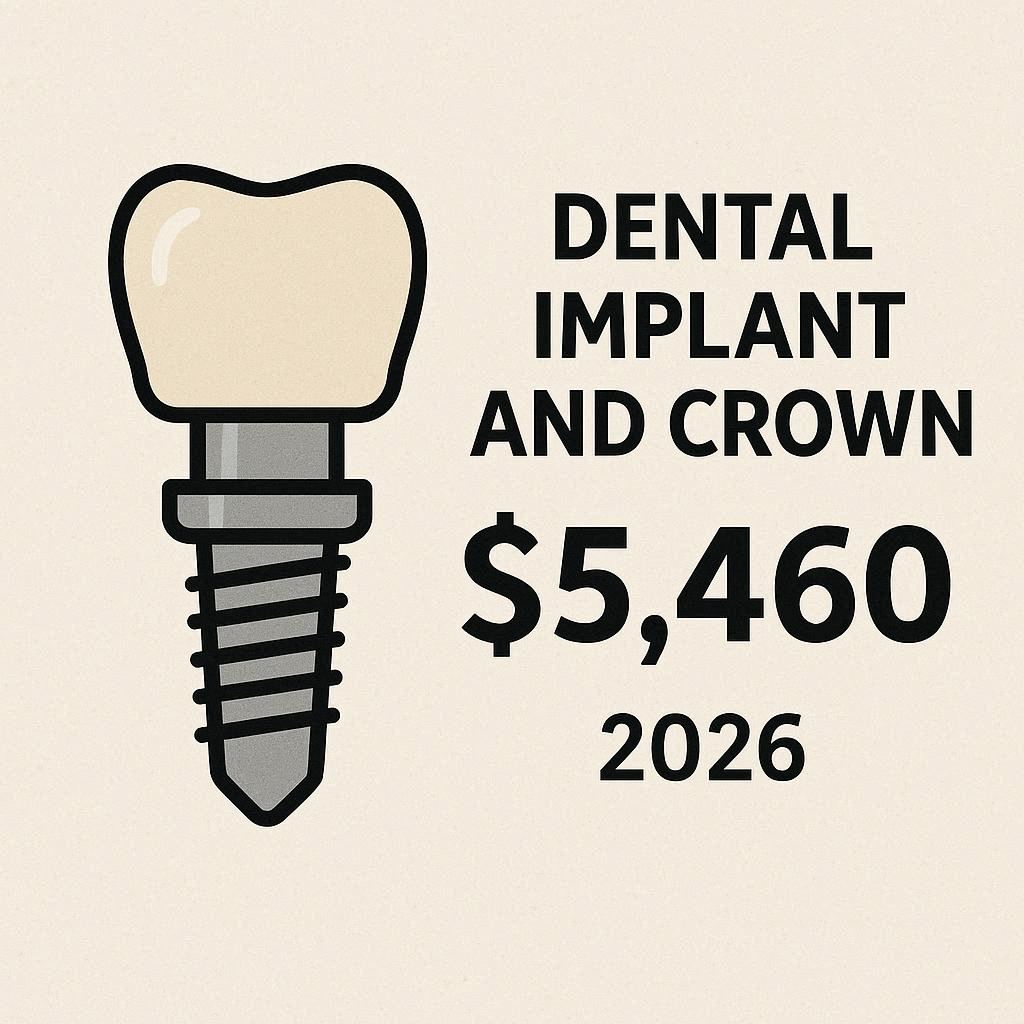
A dental implant restoration involves three distinct components. Each carries its own fee, and each plays a critical role in the long-term success of the treatment. Separating these components in your mind will help you compare quotes accurately.
The Implant Fixture functions as the artificial tooth root. A dentist surgically places this titanium or zirconia post directly into your jawbone. The cost covers the implant body itself, which is a precision-engineered medical device. It also covers the surgical procedure, including local anesthesia, the creation of a precise osteotomy in the bone, and the placement of the implant. This fee pays for the surgeon’s training, the sterile surgical environment, and the sophisticated diagnostic planning that precedes the surgery.
The Abutment is the connector piece. One end attaches to the implant fixture, hidden beneath the gum line. The other end rises above the gum tissue and provides the anchoring surface for the final crown. Some implant systems include a stock abutment. Others require a custom abutment, milled specifically to match your gum contours for optimal aesthetics. The abutment cost is sometimes listed as a separate line item. Other times, a practice bundles it into the crown cost. You must ask for this clarification when comparing treatment plans.
The Crown is the visible tooth. A dental laboratory fabricates this custom prosthesis to match the color, shape, and translucency of your natural teeth. The cost covers the impression-taking process, the temporary crown you wear during healing, the dental ceramist’s artistry, and the dentist’s time in bonding or screwing the crown into place. The material you choose for the crown significantly influences this portion of the overall dental implant and crown cost.
The Foundational Stage: Diagnostics and Planning
No responsible implant dentist proceeds without a thorough diagnostic phase. This stage adds to the upfront cost but serves as your insurance against catastrophic, and far more expensive, failures. A Cone Beam Computed Tomography (CBCT) scan creates a three-dimensional digital model of your jaw. This technology allows the dentist to measure bone volume and density, identify the location of nerves and sinuses, and virtually plan the implant position before touching a scalpel. Intraoral digital scans or traditional impressions create a model of your existing teeth and bite. The dentist uses these records to design a surgical guide—a custom-fabricated template that directs the implant into the pre-planned, ideal position during surgery. Skipping this phase to save money invites nerve damage, implant failure, and poor aesthetic outcomes. The fees for this phase typically range from $350 to $800, depending on the technology used.
The Biological Requirement: Bone Grafting and Sinus Procedures
The implant fixture requires a certain volume of healthy bone to achieve primary stability and long-term osseointegration. When a tooth is lost, the body begins resorbing the bone that once supported it. This process accelerates in the first year after extraction. If you have been missing a tooth for years, a significant bone deficiency is almost certain. A bone graft restores lost volume. The surgeon places grafting material—from a tissue bank, from another site in your own mouth, or a synthetic substitute—into the deficient area. Over several months, your body remodels this graft into mature, living bone capable of supporting an implant. In the upper posterior jaw, the maxillary sinus cavity often expands into the space left by missing teeth. A sinus lift procedure gently elevates the sinus membrane and places bone graft material beneath it, creating adequate vertical bone height.
These procedures add both time and cost to your treatment plan. A minor socket preservation graft at the time of extraction may add $400 to $900. A more substantial ridge augmentation can add $1,500 to $3,000. A sinus lift typically adds $2,000 to $4,000 per side. You must factor these potential additions into your budget. A practice offering an unsustainably low dental implant and crown cost may omit these essential procedures, leading to an implant placed in insufficient bone that fails within months.
“The biology of your jaw dictates the true cost. Respecting that biology with proper grafting is not an upsell. It is the standard of care that separates a decades-long restoration from a painful, expensive retreat.”
The Geographic, Expertise, and Material Variables
The number you see on a treatment plan is not arbitrary. It represents the convergence of three major forces: where you receive treatment, who performs the procedure, and what materials they use. Understanding these variables empowers you to make intentional choices rather than reacting to sticker shock.
The Zip Code Effect on Your Final Bill
Overhead costs for a dental practice vary dramatically by location. A clinic in the central business district of Manhattan or San Francisco pays commercial rent that can be five to ten times higher than a similar-sized clinic in a rural Midwestern town. These practices must also pay competitive wages to attract skilled dental assistants, front desk staff, and laboratory technicians who can afford to live in these high-cost areas. These operational expenses necessarily influence the dental implant and crown cost. A single implant and crown in a major metropolitan center may cost 40% to 70% more than the same procedure performed in a smaller city. This price difference does not inherently signal better quality in the city or worse quality in the smaller town. It reflects the economic reality of the practice’s location.
The Specialist vs. General Dentist Decision
You face a choice between a specialist and a general dentist who places implants. An oral and maxillofacial surgeon completes a four to six-year hospital-based surgical residency after dental school. A periodontist completes a three-year residency focused on the supporting structures of the teeth and the placement of implants. These specialists handle complex cases daily. They manage complications surgically. Their fee for the surgical phase, placing the implant fixture, typically runs higher than that of a general dentist. A general dentist who has completed significant continuing education in implant dentistry may offer a lower surgical fee. For a straightforward, single-tooth implant in abundant bone, a well-trained general dentist can provide excellent care at a lower cost. For complex cases involving multiple implants, significant bone grafting, or proximity to vital nerves, the specialist’s fee buys a deep reservoir of surgical experience that can prevent life-altering complications. The least expensive option for the surgical phase is not always the most economical long-term choice.
The Material Science Behind Crown Costs
The crown that completes your implant contributes significantly to the final price, and the material selection determines much of this cost. A crown milled from a solid block of zirconia by a CAD/CAM machine represents a different tier of dentistry than a traditional porcelain-fused-to-metal crown. Understanding these material options helps you decide where to invest your budget.
| Crown Material | Aesthetic Quality | Durability & Wear | Relative Cost Factor | Best Application |
|---|---|---|---|---|
| Porcelain-Fused-to-Metal (PFM) | Good. Base metal can show as a dark line at the gum. | Very high. The metal core resists fracture. | Standard (1x) | Posterior molars where bite forces are highest and aesthetics are less visible. |
| Lithium Disilicate (e.max) | Excellent. Translucency mimics natural enamel. | High. Strong but more brittle than zirconia. | Moderate (1.3x to 1.5x) | Front teeth and premolars where aesthetics are the primary concern. |
| Layered Zirconia | Very good. Porcelain baked onto a zirconia frame for strength and beauty. | Very high. The zirconia core is exceptionally strong. | High (1.5x to 1.8x) | Any position. A balance of extreme strength and very good aesthetics. |
| Full-Contour (Monolithic) Zirconia | Good. Highly opaque. Best color matching continues to improve. | Exceptional. Nearly indestructible, resists wear. | High (1.5x to 1.8x) | Patients with heavy bite forces or grinding habits. Posterior teeth. |
A note on titanium versus zirconia implants: Most implants are a titanium alloy, a material with decades of documented success integrating with bone. Zirconia implants offer a metal-free, white-colored alternative. The cost of a zirconia implant fixture is typically higher than a titanium fixture. The long-term data for zirconia implants is shorter than for titanium, though their use is growing for patients with metal sensitivities or specific aesthetic demands in the front of the mouth.
The Comprehensive Cost Breakdown: From Simple to Complex
Let’s move from principles to numbers. The figures below represent realistic national averages in the United States for 2026. They assume treatment in a metropolitan area by an experienced provider. Rural areas or dental schools may trend lower; high-end boutique practices in affluent urban neighborhoods will trend higher.
The Cost of a Single, Straightforward Implant
This scenario describes the replacement of a single tooth in a site with adequate bone volume and healthy gum tissue. No extractions, no grafting, no sinus procedures.
| Procedure Component | Estimated Fee Range (USD) | Notes |
|---|---|---|
| Diagnostic Records (CBCT, scans) | $350 – $800 | Essential for safe planning. |
| Implant Fixture Placement (Surgery) | $1,600 – $2,800 | Surgeon’s fee, facility, anesthesia. |
| Abutment (Stock or Custom) | $400 – $900 | Custom abutments provide better tissue support. |
| Implant Crown (Material Dependent) | $1,600 – $2,500 | Laboratory fabrication and dentist’s placement fee. |
| Total Estimated Single Implant Cost | $3,950 – $7,000 | Represents the total cost per tooth replaced. |
This is the price for a complete, functional, and aesthetically matched tooth that should last for decades with proper care. The wide range accounts for the geographic, expertise, and material variables discussed earlier.
The Added Cost of Tooth Extraction and Immediate Placement
If your damaged tooth is still present, its extraction adds a fee. A simple extraction of a single-rooted tooth may cost between $200 and $400. A surgical extraction of a broken tooth with multiple roots can cost between $450 and $800. Sometimes, the implant can be placed immediately into the extraction socket during the same surgery. This approach saves months of healing time. The immediate placement technique requires excellent initial stability of the implant and adds a premium to the surgical fee. In other cases, the extraction socket must heal for several months before implant placement, a staged approach that does not add a premium fee but extends the total treatment time. When a tooth is extracted, the surgeon will almost always recommend placing bone graft material into the socket to preserve the width of the ridge. This socket preservation graft adds $400 to $900 to the procedure but prevents a more expensive ridge augmentation later.
The Full Cost of an Implant-Supported Bridge
Replacing two or more adjacent missing teeth with individual implants is not always necessary. An implant-supported bridge uses two implant fixtures to support a span of three or more replacement teeth. This approach manages the dental implant and crown cost efficiently by limiting the number of surgical sites.
| Procedure Component | Estimated Fee Range (USD) | Notes |
|---|---|---|
| Diagnostic Records & Planning | $500 – $1,200 | More complex planning for multiple teeth. |
| Two Implant Fixtures (Surgery) | $3,200 – $5,600 | Two implant placements. |
| Two Abutments | $800 – $1,800 | Custom abutments strongly recommended for bridges. |
| Three-Unit Implant Bridge | $4,800 – $7,500 | Lab cost for a bridge is higher than for a single crown. |
| Total Estimated Implant Bridge Cost | $9,300 – $16,100 | Replaces three adjacent missing teeth. |
For a three-tooth span, an implant-supported bridge provides a fixed, bone-preserving solution. The alternative—placing three individual implants—would push the total toward the $12,000 to $21,000 range. The bridge option offers a high-functioning result at a significantly reduced per-tooth cost.
The Financial and Physical Journey of Full-Arch Restoration
Patients who have lost all or most of their teeth in an arch face a profound quality-of-life deficit. The standard of care is shifting toward implant-supported full-arch prostheses. The two dominant approaches are the fixed implant bridge, often marketed under brand names like All-on-4, and the implant-retained overdenture.
The fixed implant bridge solution typically uses four to six implants to support a full arch of teeth made from acrylic wrapped around a titanium bar, or a monolithic zirconia arch. The prosthesis is screwed into place and can only be removed by a dentist. The cost per arch for this approach, including all surgery, the temporary fixed prosthesis, and the final definitive prosthesis, typically ranges from $22,000 to $38,000.
The implant-retained overdenture uses two to four implants in the lower arch or four to six in the upper arch to snap a removable denture into place securely. The patient can remove the denture for cleaning, but the implants eliminate the debilitating looseness of a conventional denture. The cost for this approach ranges from $12,000 to $22,000 per arch, depending on the number of implants and the sophistication of the attachment system.
“Choosing between a fixed and a removable full-arch restoration is not just a financial decision. It is a lifestyle choice about how you want to clean your teeth, experience taste, and feel the roof of your mouth. A comprehensive consultation explores these personal factors deeply.”
Navigating the Maze of Dental Insurance and the Hidden Trap of Annual Maximums
Dental insurance can provide a partial offset to the dental implant and crown cost, but its structure differs fundamentally from medical insurance. Understanding this structure prevents the shock of unexpected out-of-pocket expenses.
How Dental Insurance Actually Works for Implants
Medical insurance often works on a cost-sharing model: you pay a deductible, and then the insurer covers a percentage of all covered expenses up to a high or nonexistent out-of-pocket maximum. Dental insurance operates on a capped benefit model. The plan lists a schedule of covered procedures and the percentage it will pay for each. However, it places a firm limit on the total amount it will pay out annually—the annual maximum. For most individual plans, this annual maximum sits between $1,000 and $2,000. For a procedure with a total dental implant and crown cost of $5,500, even a plan covering 50% would pay out its entire $1,500 annual maximum and leave you responsible for the remaining $4,000. The insurance acts as a coupon, not a comprehensive safety net.
The Waiting Period, the Missing Tooth Clause, and Downgrades
You must scrutinize your policy’s fine print. Many plans impose a missing tooth clause. If you lost the tooth before your coverage became effective, the plan will not pay for its replacement. Other plans enforce a waiting period of six to twelve months before you become eligible for major restorative procedures like implants. A downgrade clause allows the insurer to only cover the cost of the least expensive alternative treatment, such as a removable partial denture, and apply that smaller benefit toward the implant. You pay the difference. These clauses create significant gaps between what you assume the insurance will cover and what it actually pays. You must obtain a detailed pre-treatment estimate from your dentist and submit it to your insurance company for a written predetermination of benefits before you begin treatment.
Strategic Use of Dual Insurance, HSAs, and FSAs
If you and your spouse each have dental insurance through your employers, coordination of benefits allows you to submit the claim to your primary insurance first and then to the secondary insurance. The combined payments can significantly reduce your net cost, though the total will still not exceed the total fee charged. A Health Savings Account (HSA) or Flexible Spending Account (FSA) allows you to pay for dental implants using pre-tax dollars. A single implant and crown costing $5,500, paid from an HSA, effectively saves you $1,100 to $1,800 in taxes, depending on your marginal tax rate. This is a real, immediate discount. In-house membership plans offered by private dental practices have become a powerful alternative to traditional insurance. You pay an annual fee directly to the practice and receive a package of preventive care plus a negotiated discount, often 15% to 25%, on all restorative and surgical procedures. For patients without insurance benefits, this model often produces a lower net dental implant and crown cost than paying premiums and copays for a traditional plan.
The Shadow Costs: What Lies Outside the Treatment Plan
A transparent treatment plan lists every anticipated fee. But the patient who understands the full financial commitment also accounts for the costs that fall outside the clinical procedure. These shadow costs can strain a budget if ignored.
The Price of Replacement Parts and Biological Maintenance
A successful implant can last a lifetime. The crown, however, is a prosthetic device subject to wear, fracture, and aesthetic degradation over decades. You must budget for eventual crown replacement. A screw-retained crown allows for replacement without damaging the underlying implant, a procedure that will cost a new crown fee in today’s dollars. A cement-retained crown may require more complex removal. The abutment screw itself can sometimes loosen or fracture, requiring a replacement abutment. Most importantly, the implant is susceptible to peri-implantitis, a destructive inflammatory process similar to gum disease that causes bone loss around the implant. Treating this condition can involve surgical grafting and costs $1,000 to $3,000. Preventing it requires meticulous daily home care and professional maintenance. Your implant must be seen by a hygienist who uses special non-metal instruments and will probe the tissues annually. This maintenance visit typically costs slightly more than a standard adult prophylaxis, around $150 to $300 per visit. The choice to save money by skipping these maintenance visits invites a biological complication that can lead to implant loss and the far greater expense of starting over.
The Real Cost of Bargain Implant Dentistry
You will encounter advertisements for a complete implant and crown at a shockingly low price, sometimes under $1,500. This price signals a business model, not a charitable act. The pressure on overhead is extreme. This may translate to a provider who is not a trained surgeon, inferior implant parts from manufacturers with little to no track record, and a crown fabricated in a cut-rate laboratory with poor materials and no aesthetic customization. The implant is often placed without a three-dimensional CBCT scan, relying on two-dimensional X-rays that fail to show the true contour of the bone and the location of nerves. The result can be an implant placed in the wrong position, at the wrong angle, damaging a nerve, or perforating the sinus cavity. The cost to remove a failed bargain implant, graft the resulting bone defect, and start the process again far exceeds the fee for a properly planned and executed procedure from the start.
| Element of Care | Standard of Excellence | Bargain Approach | Long-Term Consequence of Bargain |
|---|---|---|---|
| Diagnostic Imaging | Cone Beam CT (CBCT) 3D scan. | 2D panoramic or periapical X-ray. | Blind placement leading to nerve injury or implant failure. |
| Surgical Guide | Custom 3D-printed guide for precise placement. | Freehand placement based on clinician’s estimation. | Poorly angled implant, prosthetic challenges, aesthetic failure. |
| Implant Brand | Major brand with decades of clinical research (Straumann, Nobel, etc.). | Generic clone with limited or no long-term data. | Difficulty finding parts later; higher risk of mechanical failure. |
| Crown Material | Layered zirconia or e.max on a custom titanium abutment. | Stock abutment and low-grade PFM crown. | Gray gum line, flat, unnatural tooth shape, porcelain fracture. |
| Surgeon | Board-certified or eligible specialist or highly trained general dentist. | High-volume, low-cost clinic with rotating providers. | Lack of accountability for long-term complications. |
“The bitterness of poor quality remains long after the sweetness of low price is forgotten. In implant dentistry, poor quality manifests as a numb lip, a fractured crown, or a jawbone that slowly dissolves around a failing post.”
A Geographic Mosaic: Navigating Cost by Region and Borders
The dental implant and crown cost is not uniform across the country. Regional economic pressures create distinct pricing ecosystems. Understanding these can inform a decision to travel for care or to better evaluate the quotes you receive locally.
The Metropolitan Price Peak
In coastal urban centers and high-growth cities, real estate costs, labor market competition, and higher patient demand converge to push prices to the upper end of the national range. A single implant and crown in New York City, San Francisco, Los Angeles, Boston, or Washington, D.C., will regularly fall between $5,500 and $8,000. In these markets, a fee at the lower end should prompt careful investigation. The practice may be employing aggressive marketing, using lower-cost materials, or operating as a high-volume clinic where the thoroughness of the diagnostic and planning phase is compressed to save time.
The Competitive Landscape of Mid-Tier Cities
In large but less hyper-inflated cities—think Dallas, Phoenix, Nashville, Charlotte, or Denver—the market supports a healthy competition between skilled independent practitioners and emerging corporate implant centers. The typical range for a single implant and crown settles between $4,500 and $6,500. In these markets, you often have the leverage to seek consultations from several well-reviewed providers and compare not only the price but the intangible quality of the diagnostic process and the patience of the explanation.
The Lower Cost of Living Advantage
In smaller cities and rural areas across the Midwest, South, and parts of the Southwest, the cost of providing care is simply lower. Excellent providers with advanced training practice in these communities. Their fees can range from $3,800 to $5,000 for a single implant and crown. The travel required to access these savings must be weighed against the convenience of local follow-up care and the management of any post-operative questions.
The Rise of Cross-Border Dentistry
A significant number of patients consider traveling to countries like Mexico, Costa Rica, or Hungary for implant treatment. The price difference is stark. A clinic in Los Algodones, Mexico, for example, might advertise a full-arch All-on-4 restoration for $10,000 to $15,000, compared to a $25,000 to $35,000 fee in the United States. This model can work for patients who commit to extensive research, verify the credentials and track record of the overseas surgeon, and understand the protocol for managing complications. The risk lies in what happens after you return home. If the prosthesis fractures, if an implant fails, or if a chronic infection develops, a local dentist may be reluctant to manage another provider’s work. The cost of a flight and hotel to return to the original clinic for a warranty repair erodes the initial savings. The warranty itself often comes with strict maintenance requirements that must be performed at the original clinic. Cross-border dentistry can be a viable pathway to affordable care, but only when pursued with a clear-eyed understanding of the logistical and biological risks.
A Realistic Timeline: Staging Treatment to Stage Payments
The implant process is inherently a time-staged medical procedure. This biological timeline, while sometimes frustrating, creates a natural structure for spreading the dental implant and crown cost over several months or even a year.
The Step-by-Step Journey and Payment Milestones
Your treatment will progress through clear phases. Your payments will typically align with these phases, transforming a large lump sum into a series of manageable payments.
Phase One: Examination and Planning. You will undergo the clinical exam, the CBCT scan, and the digital impressions. The dentist will present the complete treatment plan and cost. You will pay for this diagnostic phase and the treatment planning fee at this first or second visit. Your commitment at this stage is the smallest, yet it is the most critical investment in the safety of the entire process.
Phase Two: Surgical Foundation. If you require extractions and bone or sinus grafting, these procedures are performed first. You pay the surgical fee for these foundational procedures. A healing period of three to six months follows. This time allows the graft to mature into vital bone. The payment you made covers the surgery and the crucial biological waiting period.
Phase Three: Implant Placement. The surgeon places the implant fixture. You pay the implant placement fee. A second healing period, usually three to four months for the lower jaw and five to six months for the upper jaw, allows the bone to fuse to the implant surface in the process of osseointegration. If the implant is placed immediately into an extraction site, the healing clock for the implant and the socket run concurrently, saving you time but not altering the payment structure.
Phase Four: Restoration. The dentist uncovers the implant, attaches a healing abutment to shape the gum tissue, and takes the final impression for the crown. The dental laboratory fabricates your custom crown over approximately two to three weeks. You return for the final delivery appointment, where the dentist secures the abutment and crown. You pay the final crown fabrication and delivery fee at this final restorative visit.
This phased approach means the $5,500 total for a single implant may be spread over three to four payments across six to eight months. The financial load lightens through its distribution across a therapeutic timeline.
The Full Spectrum of Financing: From Traditional to Creative
When you have maximized your insurance benefit and planned your payment phases, a gap may remain. A mature industry of healthcare financing exists to bridge this gap. You must evaluate the options carefully, as the cost of borrowing can add significantly to the total dental implant and crown cost.
Traditional Healthcare Credit and In-House Plans
Companies like CareCredit and LendingClub offer credit cards and installment loans specifically for healthcare expenses. These products often feature promotional periods of zero percent interest if the balance is paid in full within a set term, commonly 6, 12, or 18 months. This tool can be extremely powerful for a disciplined borrower. You must understand the deferred interest clause. If any balance remains at the end of the promotional period, interest is charged retroactively from the purchase date at a high rate, often over 26%. A single missed payment can also terminate the promotional period.
Many private dental practices now offer their own in-house membership or savings plans. You pay a monthly or annual fee directly to the practice. In return, you receive all your preventive care, exams, and X-rays, plus a negotiated discount—often 15% to 25%—on all other procedures, including implants. This model eliminates insurance company overhead, waiting periods, and annual maximums. For a patient without dental insurance, or with a plan that offers a paltry implant benefit, an in-house plan can produce a lower net cost than paying insurance premiums and deductibles.
The Untapped Potential of Medical Insurance and HSAs
Do not assume your medical insurance is irrelevant. If your tooth loss resulted from an accident, a medically necessary pathology, or is part of reconstruction after cancer treatment, your medical insurance may cover portions of the implant surgery and the hospital or surgical facility fees. Medical insurers do not cap benefits with low annual maximums. The key is precise diagnostic coding and a persuasive narrative of medical necessity from your surgeon. An experienced oral surgeon’s office will know how to navigate this process.
A Health Savings Account (HSA) paired with a high-deductible health plan offers a triple tax advantage. Contributions are tax-deductible, growth is tax-free, and withdrawals for qualified medical expenses, which explicitly include dental implants and crowns, are tax-free. Using HSA funds to pay for your implant effectively provides a discount equal to your combined marginal federal and state income tax rate. A Flexible Spending Account (FSA) also provides a tax advantage, though with a “use it or lose it” provision within the plan year.
“Paying for a dental implant from an HSA is not a clever trick. It is a deliberate design of the tax code that recognizes this procedure as a legitimate medical restoration of function, not an elective cosmetic luxury.”
The Decision Matrix: Synthesizing Cost, Quality, and Longevity
You now face a matrix of competing offers. One practice quotes $3,500. Another quotes $6,200. How do you render a judgment?
Reading Between the Lines of a Quote
You must ask for a detailed, written treatment plan from every practice you consult. The plan should use the standard ADA dental codes. Code D6010 covers the surgical placement of an endosteal implant. Code D6056 describes a prefabricated abutment; D6057 is a custom abutment. Code D6065 or D6066 describes the implant-supported porcelain crown. If one quote includes a D6057 custom abutment and a D6066 high-noble metal ceramic crown and the other omits the abutment entirely or codes for a D6056 stock abutment and a D6065 lower-cost crown, you are not comparing equivalent restorations. The quote with the custom abutment and the higher-grade crown will cost more initially. It will also provide superior pink and white aesthetics and a much stronger long-term mechanical connection.
The Comfort Audit During Consultation
Beyond the numbers, audit your emotional and intellectual comfort during the consultation. Did the dentist sit down, make eye contact, and explain why you need a bone graft by showing you the defect on your own CBCT scan? Did they discuss the potential risks, including nerve injury and implant failure, openly? Did they name the implant system they use and explain why? A provider who invests the time to educate you and embraces transparency about risks is demonstrating a standard of care that the low-price advertiser has already omitted from their business model. The fee you pay does not simply buy a titanium post and a piece of ceramic. It purchases the surgical judgment to avoid your sinus and nerves, the prosthetic skill to place the crown so it cleans like a natural tooth, and the commitment to stand behind the work for years to come.
The Investment of a Lifetime: A Holistic View
A missing tooth is not a static condition. The absence triggers a cascade of slow, destructive changes. Adjacent teeth drift and tilt into the space. The opposing tooth in the other arch super-erupts, searching for a chewing partner it will never find. The jawbone in the edentulous site shrinks relentlessly. A healthy, well-maintained dental implant halts this process. It restores the normal distribution of chewing forces into the jaw, preserving bone. It stabilizes the neighboring teeth. It allows you to chew, speak, and smile without the burden of a removable appliance clicking against your palate.
The dental implant and crown cost, viewed through this lens, is a singular investment that pays decades of dividends in functional normalcy, preserved facial structure, and unguarded social confidence. The alternative is not a one-time savings. The alternative is a series of increasingly expensive and less satisfying treatments over a lifetime. A bridge requires cutting down healthy adjacent teeth and will itself need replacement in ten to fifteen years. A removable partial denture accelerates bone loss and caries on abutment teeth. The true price of the cheapest solution today is often the accumulated cost of its failures tomorrow.
Conclusion
The true dental implant and crown cost reflects a sophisticated medical procedure, not a commodity product. By understanding the layered components, insurance nuances, and geographic variables, you transform a shocking number into a manageable, phased investment in lifelong health. Insist on transparent treatment plans that detail every code, honor the biological requirements of your body with proper grafting, and select a provider whose expertise and ethical clarity you trust. A restored, functional, and confident smile is not an expense—it is a permanent asset that preserves your jawbone, protects your remaining teeth, and returns the simple, profound pleasure of eating and laughing without hesitation.
Frequently Asked Questions
1. Why is there such a huge price difference between quotes from different dentists?
Price differences stem from the surgeon’s level of specialization, the quality of diagnostic technology used, the brand and origin of the implant and crown materials, and the practice’s geographic overhead. A quote using a board-certified specialist, a CBCT-guided surgery, a major-brand implant, and a custom abutment with a layered zirconia crown will always be higher than a quote from a high-volume clinic using generic components and a freehand technique.
2. Does dental insurance cover dental implants?
Many plans now offer a benefit for implants, but with strict limitations. The benefit is typically 50% of the cost, but only up to a low annual maximum, usually $1,000 to $2,000. You must also check for missing tooth clauses and waiting periods. You should obtain a predetermination of benefits in writing from your insurer before starting treatment.
3. Is it cheaper to go abroad for dental implants?
The sticker price is significantly lower. However, you must factor in the cost of travel, lodging, and the risk of managing any complications once you return home. A local dentist may be reluctant to treat a failed implant placed overseas, potentially requiring you to pay for further travel or to pay a local specialist for complex revision surgery that costs more than the original procedure.
4. What is the difference between a dental implant and an abutment and a crown?
The implant is the titanium or zirconia post surgically placed in the jawbone, serving as the artificial root. The abutment is the connector piece that attaches to the implant and supports the crown. The crown is the visible, custom-made false tooth that is attached to the abutment. You pay for each of these three components.
5. Can I use my HSA or FSA to pay for dental implants?
Yes. The IRS explicitly considers dental implants, including the implant, abutment, and crown, a qualified medical expense. Paying with pre-tax HSA or FSA dollars effectively saves you 20% to 35% depending on your tax bracket.
Additional Resource:
American Academy of Implant Dentistry – Patient Resources
https://www.aaid.com/
Disclaimer:
The content provided in this article is for informational and educational purposes only. It is not intended as medical, dental, or financial advice. The cost estimates are generalized national averages and will vary significantly based on individual clinical needs, geographic location, and provider expertise. Always seek the personalized guidance of a qualified dental professional for any questions regarding a dental procedure. This article does not establish a doctor-patient relationship. Reliance on any information provided in this article is solely at your own risk. The author and publisher are not responsible for any actions taken based on this information.