Can A Loose Dental Implant Be Saved?
You are going about your day, maybe eating or brushing your teeth, when you feel it: a slight movement. A wiggle. A shift. You touch your dental implant with your finger or tongue, and your heart sinks. It feels loose.
A million thoughts race through your mind. “Is it failing? Do I need surgery again? Is this going to be expensive?”
First, take a deep breath. A loose dental implant is a serious warning sign that requires immediate attention, but it does not always mean the implant is doomed. In many cases, a loose implant can be saved.
This guide will explain the different reasons an implant feels loose, how to distinguish between a loose crown and a failing implant, and what your options are for saving your investment.
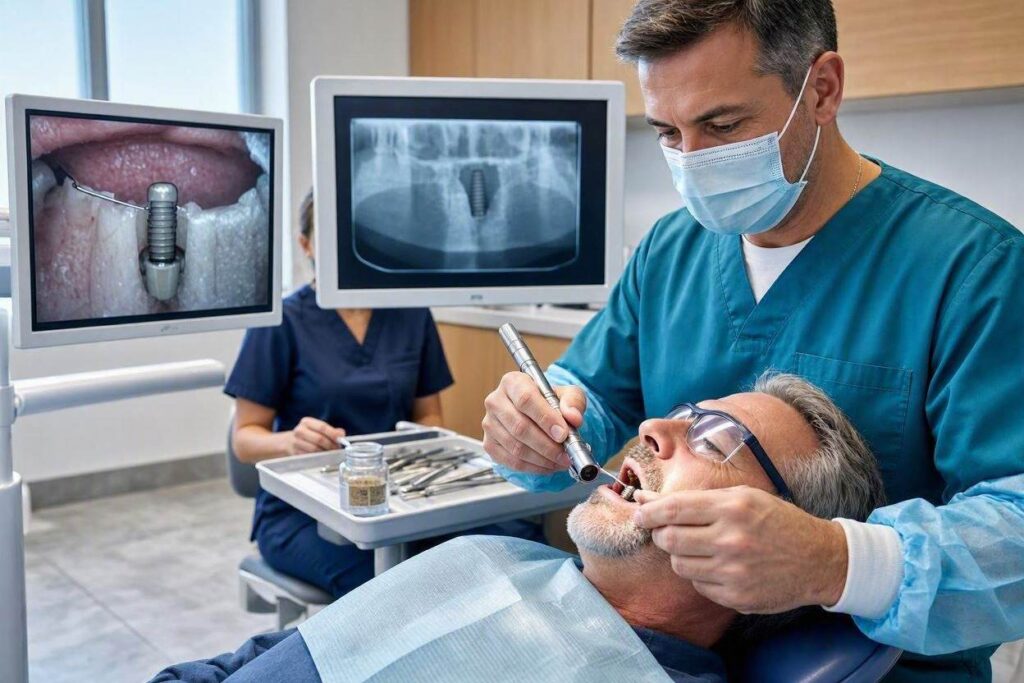
The Critical First Step: Assess What is Moving
Before you panic, you need to figure out what is actually loose. A dental implant is a three-part system:
- The Implant Post: The titanium screw in the bone.
- The Abutment: The connector piece.
- The Crown: The visible tooth.
A feeling of “looseness” usually comes from one of two completely different problems. The treatment and the prognosis are very different for each.
Scenario A: The Crown is Loose (The Good News)
This is the most common cause of a “loose implant,” and it is usually the easiest to fix. The crown (the white tooth) might be loose, or the abutment might be loose, but the implant post is still rock solid in the bone.
Scenario B: The Implant Post is Loose (The Bad News)
This means the titanium post has lost its integration with the bone. It is moving inside the jawbone. This is the definition of a “failing implant.”
Scenario A: The Loose Crown or Abutment
If the crown is loose, you might notice it wiggles when you touch it, or it might twist slightly. You might hear a clicking sound.
The Causes:
- A Loose Abutment Screw: This is the most common culprit. The tiny screw that holds the crown to the abutment (or the abutment to the implant post) has come loose. This can happen over time due to normal chewing forces.
- Cement Failure: If your crown was “cemented” into place (rather than screwed), the dental cement might have washed out or broken down. The crown is simply floating on the abutment.
Can it be saved?
Yes! This is a simple mechanical fix.
The Treatment:
- Do not ignore it. If you chew on a loose crown, you can break the abutment screw or damage the implant post.
- See your dentist immediately.
- The Fix: The dentist will remove the crown (or access the screw hole). If the screw is loose, they will tighten it to the correct torque. If the screw is broken, they can usually remove the broken piece and replace it. If the cement failed, they will simply clean the area and re-cement the crown.
The Cost: This is usually a minor repair, often costing very little (or free if it is under warranty). It does not require surgery.
Scenario B: The Loose Implant Post (The Failing Implant)
This is the scenario you fear. The implant post itself is moving in the bone. This is a sign that osseointegration (the fusion of bone to the implant) has failed, or that the bone has been destroyed.
The Causes:
- Failed Osseointegration: The implant never fully fused with the bone. This can happen if the patient smoked, had an infection, or the implant was placed improperly.
- Peri-Implantitis: This is an infection of the gum and bone around the implant. It is the leading cause of late implant failure. The bacteria destroy the bone, causing the implant to lose its support.
- Overload: If the implant was subjected to too much force too soon (or excessive grinding), the bone around it might have died.
The Symptoms:
- The implant wobbles freely.
- There is pain when you bite down.
- The gums around the implant are red, swollen, or bleeding.
- There is pus coming from around the implant.
- You can see the metal threads of the implant because the bone has receded.
Can it be saved?
This is where it gets tricky. Once the bone has receded or the implant has become mobile, saving it is difficult. However, it is not always impossible. The treatment depends on how much bone is left.
The “Mobility” Test:
Dentists define implant failure by mobility. If the implant moves even 1 millimeter, it is usually considered a failure. This is because bone cannot heal and reattach to a moving object. The micromovements prevent the bone cells from fusing to the titanium.
The Treatment Options for a Failing Implant:
1. The “Watch and Wait” (Rarely Works)
If the implant is slightly loose but not infected, some dentists might try to stabilize it and wait. This rarely works. Once mobility starts, it usually progresses.
2. The “Peri-Implantitis Surgery” (Saving the Bone)
If the implant is still slightly stable but has deep pockets of infection around it, you might be a candidate for surgical intervention.
- The dentist opens the gum.
- They clean the infected tissue and decontaminate the implant surface (using lasers, chemicals, or air abrasion).
- They might place a bone graft to fill the defect.
- The Catch: This only works if the implant is not yet mobile. It is a treatment for peri-implantitis, not for a completely loose implant.
3. The Explantation (Removal) and Replacement
If the implant is truly mobile, it must be removed. There is no way to “screw it back in.”
The Process:
- Removal: The dentist removes the loose implant. This is usually much easier than placing an implant.
- Bone Graft: Once the implant is out, the dentist will clean out the infection and often place a bone graft to rebuild the bone that was lost.
- Healing: You wait 3-6 months for the bone graft to heal.
- Reimplantation: Once the bone is healthy, a new implant is placed.
The Cost: This is the expensive scenario. You will pay for the removal, the bone graft, and the new implant. The total cost can be double the original price.
Why You Must Not Ignore a Loose Implant
If you feel your implant is loose and you decide to “wait and see,” you are making a mistake.
When an implant is loose, it is moving in the bone. Every time you chew, you are causing more trauma to the surrounding bone. The bone will continue to resorb (shrink). The defect will get bigger. What might have been a simple fix (tightening a screw) can turn into a catastrophic failure that requires a major bone graft.
Furthermore, a loose implant is a trap for bacteria. It creates a dark, warm space where bacteria can thrive, leading to severe infection and abscesses.
The “Early Warning” System: How to Catch It Early
The best way to “save” a loose implant is to catch the problem before it becomes loose.
- Mucositis: This is the first stage of gum inflammation around an implant. It is reversible. If your gums bleed around the implant, see your dentist.
- Routine X-rays: Your dentist takes X-rays at your check-ups to monitor the bone levels around the implant. If they see bone loss, they can intervene early.
Conclusion
A loose dental implant can sometimes be saved, but it depends on what is loose. If the crown or abutment screw is loose, it is a simple mechanical fix, and the implant is perfectly fine. However, if the titanium post itself is moving in the bone, it usually means the implant has failed, and the only real solution is removal, bone grafting, and replacement. The key is to see your dentist the moment you feel movement.
Frequently Asked Questions (FAQ)
1. Can I tighten my own loose implant crown at home?
Absolutely not. You do not have the sterile tools, the correct screwdriver, or the knowledge of the correct torque. You will likely strip the screw or swallow the crown. Leave it to the dentist.
2. My implant wiggles a tiny bit. Is that normal?
No. A healthy, integrated implant should be completely solid. It should not move at all. Even a “tiny” wiggle is a sign that something is wrong.
3. What does a loose implant feel like?
Some patients describe it as a “clicking” feeling when they chew. Others feel a dull ache. Most commonly, they just notice that the tooth feels “soft” or “spongy” when they bite down.
4. Can antibiotics save a loose implant?
No. Antibiotics can treat an infection, but they cannot repair the bone that has been lost or re-attach the implant to the bone. If the implant is loose due to bone loss, antibiotics are only a temporary band-aid.
5. Is there a warranty on failed implants?
Many high-end implant manufacturers (like Straumann or Nobel Biocare) offer a lifetime warranty on the implant fixture itself. If the implant fails, the manufacturer will often provide a new implant for free. However, you will still have to pay for the surgery and the bone graft.