Can Dental Implants Affect Your Eyes?
When you think about dental implants, you think about your mouth, your jaw, and your smile. The last thing on your mind is your eyes. But if you are considering implant surgery, or if you have recently had an implant placed, you might have experienced some strange sensations. Perhaps you felt a twinge behind your eye, or you are wondering if the surgery in your upper jaw could somehow damage your vision.
It sounds like a strange question, but it is one that oral surgeons hear occasionally. The face is a complex network of nerves, blood vessels, and sinuses. The roots of your upper teeth are very close to the floor of your eye socket (the orbit). So, is there a connection?
The short answer is: Dental implants rarely affect your eyes, but there are anatomical connections and rare complications that can cause eye-related symptoms. This guide will explore the relationship between your upper jaw, your sinuses, and your eyes to explain what is normal, what is not, and when you should be concerned.
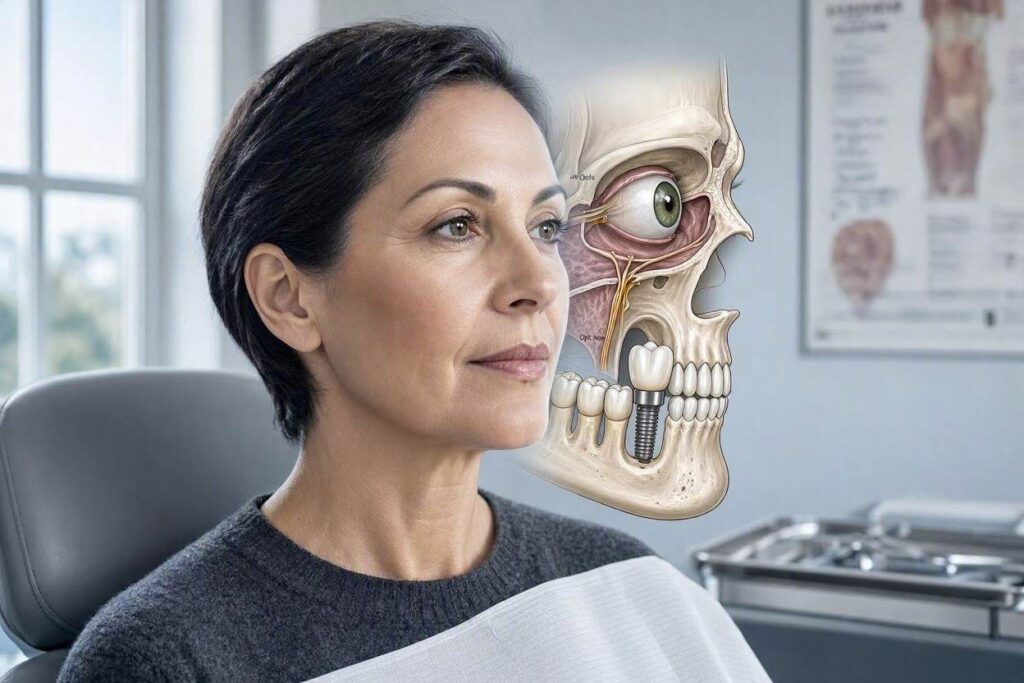
The Anatomy: It’s All Connected
To understand the connection, you need to visualize the geography of your skull.
The roots of your upper back teeth (premolars and molars) extend upward into the maxillary sinuses. These are air-filled cavities located in your cheekbones. The sinuses are separated from the roots of your teeth by a very thin layer of bone (sometimes just a few millimeters).
Directly above the maxillary sinuses are the orbits (the bony sockets that hold your eyes). The floor of the eye socket is the roof of the sinus.
Because of this close proximity, problems in the upper jaw can sometimes “refer” pain or pressure to the sinus, and the sinus can refer pressure to the eye.
The “Referred Pain” Phenomenon
This is the most common reason patients worry about their eyes after dental work. It is not that the eye is damaged; it is that the brain gets confused about where the pain is coming from.
How it works:
When you have surgery in your upper jaw (like placing an implant), the tissues swell. This swelling can press on the nerves that supply the teeth, the gums, and the lining of the sinus. The same nerve branches (specifically the branches of the trigeminal nerve) also supply sensation to the cheek and the lower eyelid.
When the nerve is irritated in the mouth, the brain might interpret the signal as coming from the cheek or the eye. This is called referred pain.
What you might feel:
- A dull ache behind the eye.
- A feeling of pressure in the eye.
- A twitching of the lower eyelid.
- Sensitivity to light (rare).
The Verdict: This is usually temporary. As the swelling in the surgical site subsides, the “eye pain” disappears. It is a nerve signaling issue, not damage to the eye itself.
Sinus Complications and the Eye
This is where things get more serious. If an implant is placed in the upper jaw, there is a risk that it can penetrate the sinus cavity.
The “Sinus Perforation”
Sometimes, when the dentist drills into the bone to place the implant, the drill (or the implant itself) can break through the thin bone and enter the maxillary sinus.
- Is it dangerous? A small perforation is actually common and often heals on its own without problems.
- The “Sinusitis” Risk: If the implant protrudes into the sinus, or if bacteria enter the sinus during surgery, it can cause an infection called sinusitis.
Symptoms of Sinusitis After an Implant:
- Foul taste or smell.
- Nasal congestion on one side.
- Post-nasal drip.
- Pressure or pain behind the eye (because the infected sinus is pressing on the floor of the orbit).
The Treatment: If an implant causes chronic sinusitis, it usually requires antibiotics, and in some cases, the implant might need to be removed.
The Good News: With modern 3D X-rays (CBCT scans), dentists can see the exact height of the bone and the location of the sinus. This has drastically reduced the risk of accidental sinus perforation. If the bone is too thin, the dentist will perform a sinus lift (a bone graft) to create space, rather than punching into the sinus.
The “Nerve Damage” Scenario: Is the Optic Nerve at Risk?
The optic nerve is the main nerve that connects the eye to the brain. It is responsible for vision.
Can an implant damage the optic nerve?
This is extremely rare and virtually impossible with standard dental implant placement.
The optic nerve is located deep within the skull. It is not located in the jawbone or the teeth. A standard dental implant is far too short to reach the optic nerve. The average implant is 8-16mm long. The distance from the upper jaw to the optic nerve is much greater, and the bone structure would prevent any penetration.
The Nerve That Matters: The Infraorbital Nerve
There is a nerve that runs through the cheekbone called the infraorbital nerve. It supplies sensation to the lower eyelid, the side of the nose, and the upper lip. If an implant in the upper premolar area is placed too deep or too high, it can bruise or damage this nerve.
What happens if this nerve is damaged?
- Numbness or tingling in the lower eyelid or cheek.
- Pain in the cheek.
This is a known risk of implant surgery (though rare), but it is sensory. It affects feeling, not vision. It does not cause blindness.
The “Anesthesia” Factor
Sometimes, after getting an implant in the upper jaw, a patient might notice their eye feels “droopy” or their vision is slightly blurry.
The Cause: This is often related to the local anesthetic injection. If the dentist injects the numbing medication slightly too high or it spreads to the muscles around the eye, it can cause temporary paralysis of the eyelid muscle (ptosis) or temporary double vision.
The Treatment: This is harmless and temporary. It wears off in a few hours as the anesthetic is absorbed by the body. You are not going blind; the muscle is just taking a nap.
When Should You Worry? Red Flags
While the connection is usually benign, there are times when you should seek immediate medical attention.
If you experience any of the following after a dental implant surgery, call your dentist or go to urgent care:
- Sudden loss of vision or severe blurriness.
- Severe, throbbing pain in the eye.
- Swelling, redness, or pus discharge from the eye.
- The eye appears to be bulging forward.
- Fever accompanied by eye pain.
These are signs of a serious infection that needs immediate treatment.
The “Dry Eye” Connection
There is another, less direct connection. Some patients report feeling like their eyes are dry after oral surgery.
Why? This is often due to the medications used during and after surgery. Sedatives and painkillers can reduce tear production. Also, lying flat for a long time during the procedure can affect fluid balance.
The Fix: Use lubricating eye drops (artificial tears) for a few days after surgery. This is usually sufficient.
Conclusion
Dental implants can affect your eyes in indirect ways, but serious complications are extremely rare. The most common issue is “referred pain” from the upper jaw or sinus, which feels like eye pressure but resolves as the surgical site heals. A sinus infection caused by an implant can cause pressure behind the eye. However, damage to the optic nerve or loss of vision is virtually impossible with standard implant placement. If you experience true vision changes or severe eye pain, seek immediate medical care.
Frequently Asked Questions (FAQ)
1. Can a sinus lift affect my eyes?
A sinus lift surgery raises the floor of the sinus. During this procedure, the membrane of the sinus is lifted. Sometimes, patients feel pressure in the cheek and around the eye after this surgery. This is normal swelling. However, if the sinus membrane tears and fluid enters the eye socket, it could cause swelling, but this is rare.
2. I have a twitching eye after my implant. Is that normal?
Yes. It is usually caused by the local anesthetic irritating the facial nerve branches near the injection site. It is a muscle spasm, not a vision problem. It should stop within a few days. If it persists for weeks, see your dentist or doctor.
3. Can a dental implant cause glaucoma?
No. Glaucoma is a disease of the optic nerve caused by pressure inside the eye. It is unrelated to the teeth or jaw. A dental implant cannot cause glaucoma.
4. Why does my cheek bone hurt up to my eye after an upper implant?
This is referred pain from the maxillary sinus. The sinus is inflamed or slightly bruised from the surgery. As the sinus heals, the pain in the cheek and eye area will subside.
5. Is it safe to get an implant if I have a history of eye problems?
Yes. Dental implants are generally safe for patients with eye conditions. However, you should always provide your full medical history to your dentist. If you have a condition that requires you to take blood thinners or certain medications, your dentist needs to know.