Does Banana Peel Help with Teeth Whitening?
The internet loves a natural hack, especially one that promises to save you hundreds of dollars in dental bills. Among the most persistent of these viral trends is the idea that rubbing a banana peel on your teeth can transform them from dull yellow to sparkling white. The premise is seductive in its simplicity: take a ripe banana, eat the fruit, and use the inside of the discarded peel to brush your teeth for a few minutes daily. The claims suggest that the “powerful minerals” inside the peel, particularly potassium, magnesium, and manganese, absorb into the enamel and lift stains gently without the harsh chemicals found in commercial whitening strips.
But does biology and chemistry support this sunny outlook? Does banana peel help with teeth whitening in a measurable, meaningful way? The realistic answer is that while banana peels are not harmful to teeth, they possess negligible to zero whitening capability compared to established methods. This article will peel back the layers of this viral claim, explore the actual composition of a banana peel, and explain why our brains might be tricked into seeing a brighter smile where chemistry says one does not exist. We will dissect the scientific studies, or lack thereof, and place this home remedy in its proper context against the backdrop of real dental science.
The Anatomy of a Viral Whitening Hack
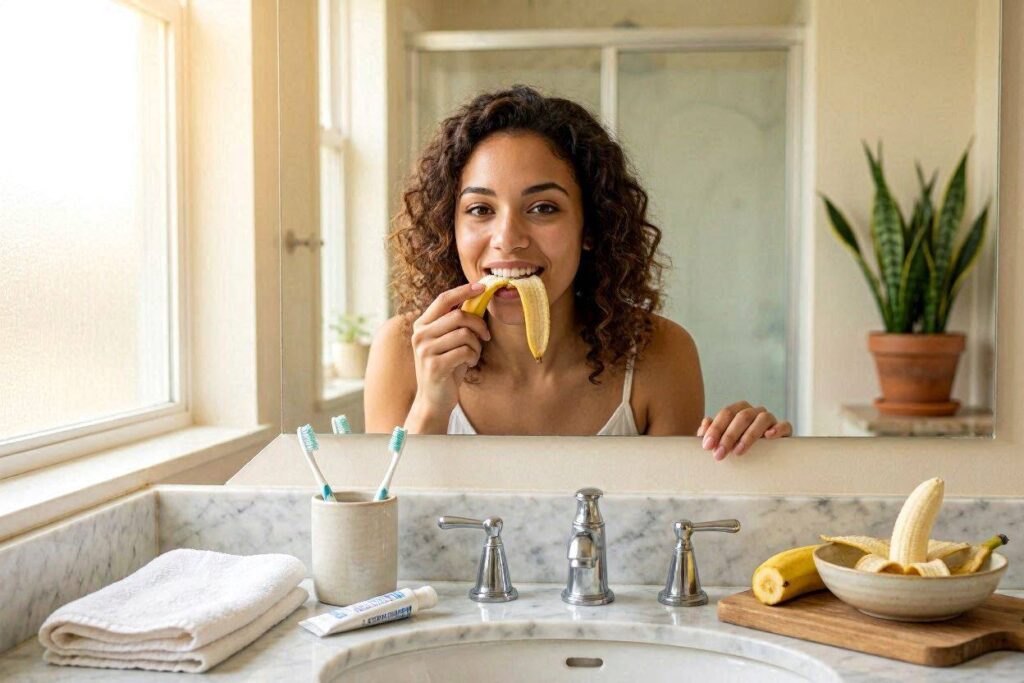
To evaluate this claim fairly, we must trace its origin and understand its proposed mechanism. The banana peel whitening theory is a classic example of the “appeal to nature” fallacy—the belief that if something is natural, it is automatically safe and effective. The protocol shared across social media platforms is remarkably uniform: users are instructed to take an organic banana (to avoid pesticides), rub the inner white fibrous side of the peel in a circular motion against their teeth for two to ten minutes, and then leave the residue unrinsed for as long as possible to “soak in” the minerals.
Proponents argue that unlike abrasive baking soda or “toxic” hydrogen peroxide, the banana peel works through passive absorption. The claim is that the cellular structure of the enamel opens up, welcomes the potassium and magnesium from the peel, and expels the yellowing stain molecules. This description is biologically inaccurate. Enamel is not a sponge. It does not actively “absorb” large organic molecules or minerals from a fibrous fruit matrix through passive rubbing. Ion exchange occurs at the molecular level in a liquid, bioavailable environment, typically mediated by saliva and bioavailable fluoride, calcium, and phosphate ions—not from the physical transfer of plant tissue.
Chemical Reality: What’s Actually in a Banana Peel?
Proponents cite the peel’s mineral content as if it is a magic bullet. It is true that banana peels contain potassium, magnesium, and manganese. But the mere presence of an element does not automatically translate to a whitening effect. To understand the gap between fantasy and reality, we need to look at the actual bioavailable concentrations.
Consider potassium, the element most often cited. A medium banana peel contains approximately 78 milligrams of potassium per gram of dry weight. However, this potassium is trapped inside the rigid cellulose plant cell walls. The human mouth does not masticate (chew) the peel, nor does the saliva contain the enzymes to break down these cellulose walls efficiently enough to release the potassium into the dental pellicle (the protein layer coating the teeth) during a two-minute rub. Even if potassium were liberated, its role in dentistry is desensitization, not whitening. Potassium nitrate works by penetrating the dentin tubules and calming the nerve; it does not oxidize stain molecules.
Magnesium and manganese operate in similar fashion. Manganese is often touted for its role in enzymatic reactions inside the human body, but those reactions happen in your blood and liver when you digest food, not on the surface of a fully crystallized, non-living enamel rod. The enamel cannot “absorb” these minerals in the solid state. The whitening effect, to occur, would require a mechanism to break the double bonds of chromophores. Minerals do not break these bonds. Only oxidation or mechanical abrasion can alter the color.
The “Optical Brightening” Effect: Why You Might Think It Works
If the chemistry is so clear-cut, why do thousands of commenters swear that their teeth look whiter after a banana peel session? The answer lies not in a permanent removal of stain, but in a temporary, superficial optical illusion created by the organic residue left behind.
The Residue Masking Effect
The inner side of a banana peel is moist, sticky, and contains microscopic fibers and starches. When rubbed vigorously against the tooth, a thin, semi-translucent film coats the enamel. This organic film can fill the microscopic pits and irregularities on the tooth surface. A roughened, porous surface scatters light, making the tooth look dull and matte. When you coat it with a smooth, moist, fibrous biofilm from the banana, the surface becomes more homogeneous. Light reflects more uniformly, which to the naked eye creates a temporary sheen that we interpret as “whiter.” This is the same principle behind some clear lip glosses making lips look plumper—the reflection of light changes, not the underlying tissue.
After about thirty minutes, saliva enzymes begin to break down this organic film, and the teeth revert to their original, duller appearance. The “whitening” was never a color change; it was a textural change in light refraction. It is a lesson in cosmetic physics, not dental chemistry.
The Mechanical Factor
A banana peel is not abrasively neutral. The fibrous inner strands act as a very mild, organic scrubbing brush. If you rub anything against your teeth for two to ten minutes, you are mechanically disrupting the dental pellicle and the very top layer of biofilm. This layer contains dietary stains from coffee, tea, and dark sauces. By physically wiping away the day’s superficial acquired pellicle, you are revealing the cleaner enamel underneath. A soft cloth dipped in water could achieve the same immediate, but extremely modest, brightening effect. This mechanical cleaning removes extrinsic loose debris, but it does not touch the intrinsic dentin stains that cause genuine yellowness.
Comparative Table: Banana Peel vs. Standard Whitening Methods
To contextualize the banana peel’s performance, we must measure it against the known standard of care. The following table breaks down the key performance metrics.
| Factor | Banana Peel (Rubbing) | Hydrogen Peroxide (Gel/Strips) | Whitening Toothpaste (Abrasive) |
|---|---|---|---|
| Mechanism of Action | Film deposition (optical illusion); mild mechanical wiping. | Oxidation (Breaking intrinsic stain bonds). | Mechanical abrasion (Silica sanding away surface). |
| Depth of Action | Superficial (pellicle/outer 1-2 microns). | Deep penetration to dentin. | Superficial (outer enamel surface). |
| Measurable Color Change | None sustained (Delta-E < 1, invisible to the eye). | High (Delta-E 5–15, clinically significant). | Minimal (Delta-E 1–3, subtle extrinsic cleaning). |
| Duration of Effect | Minutes to hours (until saliva washes residue). | Months to years (with periodic touch-ups). | Days (stain re-accumulates). |
| Active Chemistry | Starch, trapped intracellular minerals (unavailable). | Free radicals (ROS), oxygen ions. | Hydrated silica, calcium carbonate. |
| Risk Profile | Nil (unless pesticide contamination). | Transient sensitivity, gum irritation. | Enamel wear, dentin exposure, abfraction. |
As the table illustrates, the banana peel does not participate in the same category of chemical activity. It is a surface polish with an illusionary afterglow, not a whitening agent.
The Scientific Literature: A Vacuum of Evidence
When we look for clinical studies in peer-reviewed dental journals, the silence is deafening. A comprehensive search of databases like PubMed or the Journal of Dentistry reveals zero randomized controlled trials investigating the whitening efficacy of Musa sapientum (banana) peel. Not a single study has measured the color change using a spectrophotometer before and after banana peel application over a two-week period.
Why does the study not exist? Because the underlying biochemistry is so improbable that research funding is directed toward methods with plausible mechanisms, such as enzyme-activated peroxide or light-accelerated oxidation. The absence of evidence is not always evidence of absence, but in this context, the basic science of enamel chemistry predicts a null result. Enamel is a 96% mineralized crystal matrix. It does not bind to organic potassium from a fibrous solid in a time frame of two minutes, nor does it participate in a stain-lifting ion exchange with magnesium under these conditions.
The Psychological Trap of Home Remedies
This banana peel myth survives because it taps into the powerful psychology of home remedies. There is a deep-seated cultural belief that synthetic chemicals are harsh and dangerous, while fruits and vegetables are healing and restorative. This cognitive bias allows people to overlook the fact that hydrogen peroxide is simply oxygen and water—a naturally occurring compound used by your own immune cells—while a banana peel is a complex, messy matrix of decaying starches that can actually feed oral bacteria if left on the teeth too long.
Furthermore, the ritual itself creates a placebo effect. Spending ten mindful minutes in front of a mirror focusing on self-care can make you more attentive to your smile’s appearance. You might smile more, notice your teeth more, and brush more attentively afterward because you are investing time in the process. The perceived improvement is a psychological reward for the ritual, not a chemical reward from the peel.
Realistic Benefits: What Banana Peel Can Actually Do
To be fair and balanced, we must not claim the banana peel is useless for all oral health. It just isn’t a whitener. The inner peel is, however, a source of organic, gentle fiber. For individuals with extremely sensitive, abraded teeth who cannot tolerate the texture of a toothbrush temporarily (perhaps following a mouth injury or severe gum recession), a banana peel has been historically used in some folk traditions as a gentle gum massager and tooth wiper.
The act of rubbing the fibrous material stimulates the gingival tissue, increasing blood circulation. This can temporarily make gums look pinker and healthier. Healthy, pink gums provide a contrast effect against the teeth, making the teeth appear slightly whiter by visual comparison. Again, it’s an optical effect based on gingival health, not a change in tooth color.
The Danger of Unrealistic Expectations
There is a subtle harm in promoting banana peels as a legitimate whitening alternative. Patients with genuine discoloration—perhaps tetracycline staining, fluorosis, or deep age-related dentin darkening—may waste weeks or months rubbing fruit on their teeth while their expectations remain unmet. This delay can lead to frustration, a sense of personal failure (“it worked for everyone online, why not me?”), and a negative psychological spiral.
Eventually, when the banana peel inevitably fails, the person may swing to the extreme opposite and purchase dangerous, high-concentration, acidic black-market whitening kits, believing that if “natural” didn’t work, they need something industrial-strength. The banana peel myth, therefore, acts as a gateway to disappointment and potentially unsafe overcorrection. An honest, realistic guide to whitening must steer people away from useless rituals and toward proven, safe modalities from the start.
What About Other Fruit Peels? The Citric Acid Confusion
A related and more dangerous trend involves rubbing lemon, orange, or strawberry peels directly onto teeth. Some influencers combine mashed strawberries with baking soda to create a “natural whitening paste.” The banana peel myth is benign; the citrus peel trend is actively destructive.
Citrus peels contain high concentrations of citric and malic acid. When applied to enamel, these acids rapidly chelate calcium ions, causing immediate surface demineralization. The tooth feels slippery and squeaky-clean because the outer layer is literally dissolving and sloughing away. This exposes the whiter, but much softer, dentin-rich layer underneath. The tooth looks momentarily whiter not because stains were lifted, but because the stained enamel layer was thinned. This effect is catastrophic. That enamel will never grow back. Brushing immediately afterward with abrasives grinds the softened enamel away permanently. Banana peel, in stark contrast, is not acidic and does not cause this demineralization. It is harmless, just not effective. It’s crucial to distinguish between “safe but useless” (banana) and “effective but absolutely ruinous” (lemon juice and acid scrubs).
A Proper Mineral-Rich Approach: What Actually Works
If you are drawn to the banana peel trend because you want a mineral-based, non-peroxide method to support your enamel health while whitening, there is a scientifically grounded alternative. It’s called nano-hydroxyapatite (n-Ha) toothpaste.
Nano-hydroxyapatite is a synthetic form of the identical calcium phosphate mineral that makes up your enamel. The particles are engineered to be microscopic, small enough to penetrate the dentin tubules and fill in the porosities that scatter light. When enamel is densely packed with hydroxyapatite, it appears smoother, glossier, and naturally whiter because the crystalline structure reflects light more coherently. This is not an oxidative whitening; it’s a biomimetic remineralization that restores the optical properties of healthy enamel.
Studies show that n-Ha toothpaste can achieve a measurable color change in the Delta-E range of 3–5 over several weeks, which is visibly noticeable and completely safe. This is the true “natural mineral” route to a brighter smile, validated by science, and it operates on principles that the banana peel myth only pretends to access. Potassium and magnesium from a plant fiber simply cannot integrate into the enamel prism; calcium phosphate can, because it is the enamel.
Integrating Banana Peel into a Holistic Routine (If You Must)
If the ritualistic aspect of the banana peel brings you joy and mindfulness, you do not have to give it up entirely. You can incorporate it into a comprehensive oral hygiene protocol in a way that does not set you up for disappointment, and without damaging your teeth.
- Use it as a Pre-Brushing Massage, Not a Whitener: Before you brush, use the peel to gently massage the gum line and wet the tooth surfaces. Enjoy the sensory experience.
- Rinse and Brush Thoroughly: Do not leave the sugary, starchy residue on the teeth. The carbohydrates in the banana peel residue are a food source for Streptococcus mutans, the bacteria that cause cavities. Rinse your mouth completely with water, and then brush normally with a fluoride or n-Ha toothpaste to remove the sugars and provide genuine remineralization.
- Apply a Verified Whitening Method Separately: If you want measurable whitening, use a strip or a tray containing a low concentration of carbamide peroxide for a defined treatment period. Use the banana peel time as a relaxing gum massage, and the peroxide time as the actual whitening session. Do not confuse the two roles.
This way, you honor the naturalistic urge without falling prey to the false belief that the peel is an active whitening agent.
Conclusion
- Banana peels cannot whiten teeth in any clinically measurable or lasting way; any perceived brightening is a temporary optical effect caused by a starch film smoothing the enamel surface and altering light reflection for a brief period.
- The minerals in a banana peel (potassium, magnesium, manganese) are locked in plant cellulose and are not bioavailable for absorption by the crystallized enamel rods; they offer no oxidative or stain-lifting activity.
- A safe, scientifically valid mineral-based alternative exists in nano-hydroxyapatite toothpaste, which actually rebuilds and smooths enamel for a genuine optical enhancement, filling the gap between the banana peel myth and peroxide chemistry.
Frequently Asked Questions
Does rubbing banana peel remove extrinsic coffee stains?
Not directly. The mild abrasive action of the fibrous peel may dislodge the very top layer of loose pellicle and fresh biofilm, similar to wiping a surface with a damp cloth. It will not penetrate or break down the sticky, polymerized stain molecules that bind to enamel, and the stain will re-adhere quickly.
Can banana peel cause cavities if I don’t rinse?
Yes, potentially. The inner peel contains natural sugars and fermentable carbohydrates. Leaving this residue on the teeth, especially overnight or for extended periods, provides a substrate for cavity-causing bacteria to produce acid and demineralize the enamel.
What about dried and powdered banana peel in toothpaste?
Some homemade toothpaste recipes include dried, ground banana peel. The powder form does not release bioavailable whitening minerals. It acts as a very mild abrasive fiber. Its abrasive index (RDA value) is uncontrolled and may be either too gentle to clean or too harsh and cause wear, depending on the grind size.
Why do my teeth feel smoother after using a banana peel?
The starches and pectins in the peel create a slippery, lubricating film. This film fills micro-roughness, creating a tactile sensation of smoothness that can be pleasing but is strictly temporary and unrelated to whitening or enamel health.
Is banana peel better than charcoal for teeth whitening?
In terms of safety, yes, because banana peel is not abrasive. Charcoal can severely scratch and permanently remove enamel. However, neither product offers any true oxidative whitening. Between the two, the banana peel is safer but equally ineffective for color change.