Laser Teeth Whitening: How Many Sessions Do You Need?
The phrase “laser teeth whitening” carries an aura of high-tech efficiency. It conjures images of a single, futuristic procedure that transforms a dull smile into a dazzling one within a single lunch break. The marketing for these services often reinforces this expectation, promising dramatic, immediate results with minimal time investment. Yet, as many patients discover during their consultation, the answer to “How many sessions do I need?” is not a simple, universal “one.” It depends on the complex interplay of your baseline tooth shade, the depth and type of your staining, the specific laser technology used, and your aesthetic goals.
For some patients with mild extrinsic yellowing, a single laser session does indeed deliver a satisfying and complete transformation. For others with deep-set, intrinsic, grey or tetracycline-based stains, multiple sessions spaced weeks apart are required to achieve a meaningful and stable whitening outcome. This article provides a realistic, evidence-based guide to the number of laser whitening sessions you are likely to need. We will deconstruct the clinical factors that dictate the treatment protocol, explain the difference between a single-session result and a multi-session course, and set honest expectations for the time and financial commitment involved.
What “Laser Whitening” Actually Means in Session Context
Before calculating sessions, we must clarify the terminology. True laser whitening uses a dental diode laser or an argon laser to activate a high-concentration hydrogen peroxide gel (typically 35% to 40%) applied to the teeth. The laser energy is absorbed by a specific chromophore in the gel (often a red or blue dye) or by the water in the tooth, causing a rapid, localized temperature increase. This thermal energy accelerates the breakdown of hydrogen peroxide into reactive oxygen free radicals, speeding up the oxidation of stain molecules.
Many systems marketed as “laser whitening” are actually high-intensity LED or plasma arc light systems. These are not lasers in the strict physics definition (coherent, monochromatic light), but they serve a similar thermal and photocatalytic acceleration function. For the purpose of session planning, the critical variable is not whether the light source is a true laser or a broad-spectrum LED; it is the concentration of the peroxide gel and the duration and number of application cycles within each chairside visit.
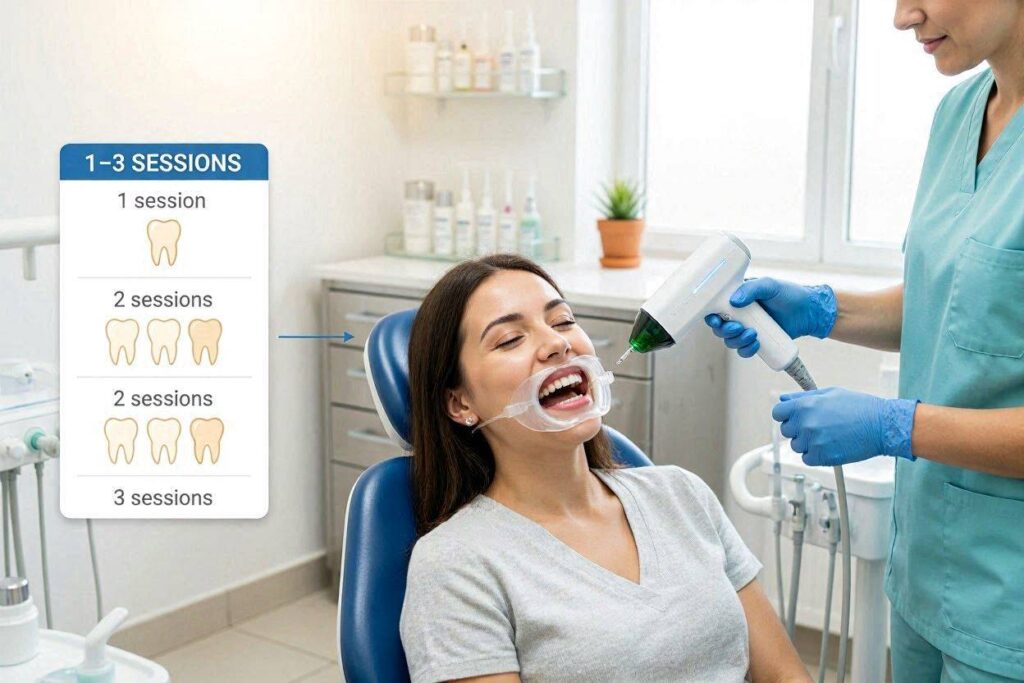
A single “session” of laser (or light-accelerated) whitening typically consists of 2 to 4 cycles of fresh peroxide gel application, each cycle lasting 15 to 20 minutes under the light. The total active bleaching time per session is therefore 30 to 80 minutes, with total chair time including isolation, gingival barrier placement, and desensitization extending to 1.5 to 2 hours.
The Single-Session Candidate: When One Visit Is Enough
A significant subset of patients achieves their desired aesthetic endpoint after just one session. You are likely a good candidate for a single session if you meet most of the following criteria:
- Mild to Moderate Extrinsic Yellow Staining: Your discoloration is primarily superficial, caused by dietary chromogens (coffee, tea, red wine) or tobacco tar deposited in the acquired pellicle and the outermost enamel layer. These fresh, loosely bound yellow stains oxidize rapidly and respond dramatically to the first intense oxidative pulse.
- Younger Age: The enamel of younger individuals (under 35) tends to be more permeable, with larger intercrystalline spaces that allow faster peroxide diffusion. The dentin is also less intrinsically yellowed by age-related Maillard pigment accumulation. A single session can often lift the shade to the natural youthful maximum.
- Realistic Cosmetic Goals: You are not seeking an unnaturally brilliant “Hollywood white” (shade B1 or beyond on the Bleachedguide), but rather a natural, healthy, noticeable brightening of 3 to 5 shades on the Vita Classical scale. You want your smile refreshed, not fundamentally re-engineered.
- Absence of Restorations in the Smile Zone: Your anterior teeth are free of large composite fillings, crowns, or veneers, meaning the entire visible smile is natural tooth structure that whitens uniformly in a single session.
For this single-session candidate, the protocol is straightforward. One appointment of 60-90 minutes of active bleaching, followed by the expected 48-hour color stabilization (rebound of 1-2 shades darker as the enamel rehydrates), and the result is a stable, satisfying whiteness that can be maintained with periodic inexpensive touch-ups.
The Multi-Session Candidate: When You Need Two or More Visits
Many patients, particularly those with more complex discoloration, require a planned series of sessions to achieve a clinically meaningful and aesthetically acceptable result. You are likely a multi-session candidate if you present with the following challenges:
Deep Intrinsic Age-Related Yellowing:
As humans age, the dentin layer thickens and undergoes progressive deposition of highly cross-linked, amber-yellow Maillard reaction pigments and other metabolic byproducts. These chromophores are chemically complex, densely packed, and reside deep within the dentinal tubules, shielded by the overlying enamel. A single oxidative burst cannot fully penetrate and degrade this dense pigment load. It takes multiple, spaced sessions to progressively oxidize and clear these deep dentin stains.
Tetracycline Staining:
Tetracycline antibiotics administered during tooth development (in utero, infancy, or childhood) bind irreversibly to the calcium phosphate crystals of the developing dentin, creating deep, intrinsic grey, brown, or banded discoloration. This is the most challenging type of staining to treat with any whitening method. The chromophore is incorporated into the mineral matrix itself, not merely deposited in the tubules.
Tetracycline-stained teeth often require 3 to 6 or more laser sessions, spaced 2 to 4 weeks apart, combined with prolonged overnight carbamide peroxide tray wear between sessions. KöR, the whitening brand particularly renowned for tackling tetracycline cases, often utilizes a protocol of multiple in-office sessions interleaved with extended at-home tray wear over several months. The result is often dramatic, but the time and financial commitment are substantial, and the patient must be thoroughly counseled that the endpoint may still retain some inherent grey undertone relative to a perfectly white, non-stained tooth.
Fluorosis (Moderate to Severe):
Dental fluorosis results from excessive fluoride ingestion during enamel formation, causing subsurface porosities and hypomineralization that scatter light and appear as opaque white spots, chalky patches, or brown mottling. Whitening can improve fluorosis by oxidizing the brown pigment component, but it can also make the white spots temporarily more prominent due to enamel dehydration. A multi-session approach, often combined with microabrasion or resin infiltration techniques between whitening sessions, is necessary to manage the dual optical defects of color and surface texture.
Stubborn Single Dark Teeth:
A single tooth that has darkened following trauma or root canal treatment (non-vital internal discoloration) often requires a different approach altogether—internal walking bleach—which is a separate procedure. However, if the dark tooth is being externally whitened alongside the rest of the arch, it will almost certainly lag behind the healthy adjacent teeth in its whitening response. The protocol typically involves full-arch sessions to lift the baseline, and then targeted, additional sessions or extended tray wear focusing on the single resistant tooth.
The Standard Multi-Session Protocol: Spacing and Rationale
If your dentist determines that you need multiple sessions, these are not scheduled on consecutive days. The standard interval between in-office laser sessions is 2 to 4 weeks. This spacing is not arbitrary; it is dictated by the biological recovery needs of the dental pulp and the enamel.
Pulpal Recovery:
Each laser session delivers a significant oxidative and thermal stress to the dental pulp. The pulp responds with a transient, reversible inflammatory response (pulpitis). While this inflammation resolves without permanent damage in a healthy tooth, it takes time—typically 1 to 2 weeks—for the nerve to fully settle and return to a resting, non-hypersensitive state. Re-treating a tooth while the pulp is still inflamed from the previous session compounds the inflammatory burden and increases the risk of crossing the threshold from reversible to irreversible pulpitis, which can lead to pulp necrosis. The 2-4 week interval provides a safe biological recovery window.
Enamel Rehydration and Color Stabilization:
Immediately after a laser session, the enamel is profoundly dehydrated, and the color is artificially, transiently bright. The true, stable, hydrated shade does not emerge for 48-72 hours. The dentist needs to evaluate this stable shade at the next appointment, not the deceptive immediate post-op shade. The spacing interval allows for complete rehydration and color stabilization, giving an accurate baseline for assessing the progress achieved and determining the gel concentration and cycle number needed for the subsequent session.
Gradual Stain Oxidation Without Overload:
Multiple short, intense oxidative pulses spaced apart may, in some clinical protocols, achieve a better final penetration and degradation of deep chromophores than a single, excessively long, high-concentration assault that saturates the enamel’s transport capacity and simply floods the pulp with free radicals without proportionally increasing the dentin oxidation. Spaced sessions allow the peroxide to penetrate incrementally deeper, oxidizing a new layer of chromophores each time.
The Hybrid Protocol: Combining In-Office and Take-Home for Fewer Chairside Sessions
For multi-session candidates, a strategically designed hybrid protocol can often reduce the total number of expensive in-office laser sessions while achieving a comparable or even superior final outcome. This is the approach favored by many cosmetic dentists for complex cases.
The hybrid model typically begins with a single in-office laser session. This delivers the initial dramatic shade jump and, importantly, the profound dehydration effect that allows the dentist to capture the maximum potential shade for custom tray fabrication and future restoration shade-matching. The patient is then sent home with custom-fitted trays and a supply of 10-15% carbamide peroxide gel to wear nightly for 2 to 4 weeks. This sustained, low-concentration oxidative bath penetrates deeply and steadily, incrementally oxidizing the deep chromophores that the single laser pulse could not reach.
After this home phase, the patient returns for a second, and possibly final, in-office session to “cap” the treatment and achieve the final desired shade lift. This hybrid approach—one laser session, weeks of home trays, one final laser session—often achieves in 2 chairside visits what 4 or 5 chairside-only sessions would accomplish, with less cumulative pulpal stress and at a lower total cost to the patient.
Session Planning Based on Starting Shade
A rough clinical heuristic can be applied based on the patient’s starting shade on the Vita Classical guide, moving from A (reddish-brownish), B (reddish-yellowish), C (greyish), to D (reddish-grey) shades.
- Starting Shade A1, A2, B1 (Already Relatively Light): These patients often need only a single session or even just a take-home tray system. Their whitening journey is a refinement, not a transformation.
- Starting Shade A3, B2, C1 (Moderate Yellowish/Brownish): One session is often sufficient for a pleasing cosmetic improvement of 4-6 shades. Two sessions may be desired for those seeking the absolute maximum whiteness.
- Starting Shade A3.5, B3, C2, D2 (Deep Yellow/Grey/Brown): Two sessions are typically the minimum expectation. Many of these patients will achieve their best outcome with 2 in-office sessions combined with home tray wear in between.
- Starting Shade A4, C3, C4, and Tetracycline Bands: Three or more sessions are usually required, almost always integrated with extensive home tray wear. Some tetracycline cases require 6 or more sessions over several months to achieve a satisfactory, though rarely perfect, result.
Conclusion
- The number of laser teeth whitening sessions needed ranges from a single 60-90 minute appointment for mild extrinsic yellowing in younger patients, to two or three sessions spaced 2-4 weeks apart for deep intrinsic age-related or moderate fluorosis staining, to potentially six or more sessions combined with home tray wear for severe tetracycline bands.
- The mandatory 2-4 week spacing between sessions is a biological necessity, allowing the dental pulp to recover from the oxidative inflammatory insult and the enamel to fully rehydrate so that the dentist can evaluate the true, stable color progression.
- The most efficient and economical approach for multi-session cases is often a hybrid protocol: one in-office laser session, an interlude of custom tray home whitening, and a final chairside session, which achieves deep stain oxidation while minimizing the number of costly laser visits.
Frequently Asked Questions
Can I have two laser whitening sessions on the same day to finish faster?
No ethical dentist will perform back-to-back sessions on the same day. The cumulative oxidative and thermal stress on the dental pulp would be extreme, the post-operative pain would be severe and prolonged, and the risk of irreversible pulpitis and nerve death would be unacceptably high. The teeth and pulp must have time to recover.
How long do the results of multiple sessions last compared to a single session?
The longevity of the final stable shade, once achieved through however many sessions it took, is roughly the same across patients. The achieved shade will begin to fade due to dietary re-staining and natural aging within 6 to 12 months without maintenance. The number of sessions needed to reach the endpoint does not change the durability of that endpoint; only maintenance habits do.
Is the number of sessions for laser whitening the same as for LED whitening?
In clinical practice, yes. The session protocols and the number of visits required are similar for true laser and high-intensity LED systems. The light source is the accelerator, but the primary determinant of the number of sessions needed is the peroxide concentration and the patient’s stain biology, not the specific light technology.
Will my teeth become more translucent and blue-ish with too many sessions?
Over-whitening can occur if you push beyond your natural whitening ceiling. The incisal edges become excessively translucent and bluish-grey as the enamel is stripped of its normal organic proteins and the light scattering properties change. A competent dentist monitors shade progression at each session and will advise you when you have reached your individual aesthetic ceiling.
How do I maintain the result after completing multiple laser sessions?
Your dentist will likely fabricate custom maintenance trays and prescribe a low-concentration (10%) carbamide peroxide gel. You will use these trays for a single overnight session every 4 to 8 weeks to counteract dietary re-staining. This maintenance protocol is essential to protect your investment in the multiple laser sessions and keep your smile at its achieved brightness.