How Long Should You Wear Teeth Whitening Trays?
You have your custom-fitted or boil-and-bite whitening trays, and you have your syringe of peroxide gel. You load the trays, insert them, and then confront the critical practical question that determines both the efficacy and safety of the entire treatment: how long should you actually wear them? Wear them too briefly, and you squander the whitening potential, achieving only a marginal shade change after weeks of effort. Wear them too long, and you invite a world of pain—pulpitis, chemical gingival burns, and enamel dehydration that can set your whitening progress back by days while your teeth recover.
The correct wear time is not a single, one-size-fits-all number. It is a variable dictated by the chemical identity and concentration of the peroxide in your gel, the specific design of your tray, your individual enamel permeability, and your subjective sensitivity threshold. This article provides a comprehensive, chemistry-based, and clinically realistic guide to whitening tray wear times. We will translate the pharmacokinetics of peroxide into a set of practical, safe protocols that maximize whitening while minimizing discomfort.
The Golden Rule: Matching Wear Time to Peroxide Chemistry
The primary determinant of safe and effective tray wear time is the specific peroxide formulation you are using. The two standard chemistries, carbamide peroxide and hydrogen peroxide, have profoundly different release kinetics and require fundamentally different wear-time strategies.
Carbamide Peroxide: The Marathon Runner (Extended Wear)
Carbamide peroxide (CP) is a precursor molecule that breaks down slowly in the presence of water to release hydrogen peroxide and urea. A 10% carbamide peroxide gel releases approximately 3.5% hydrogen peroxide over a period of 2 to 6 hours. The release curve is not linear; there is an initial burst of hydrogen peroxide in the first 30 to 60 minutes, followed by a sustained, tapering release phase that can continue for up to 6-8 hours.
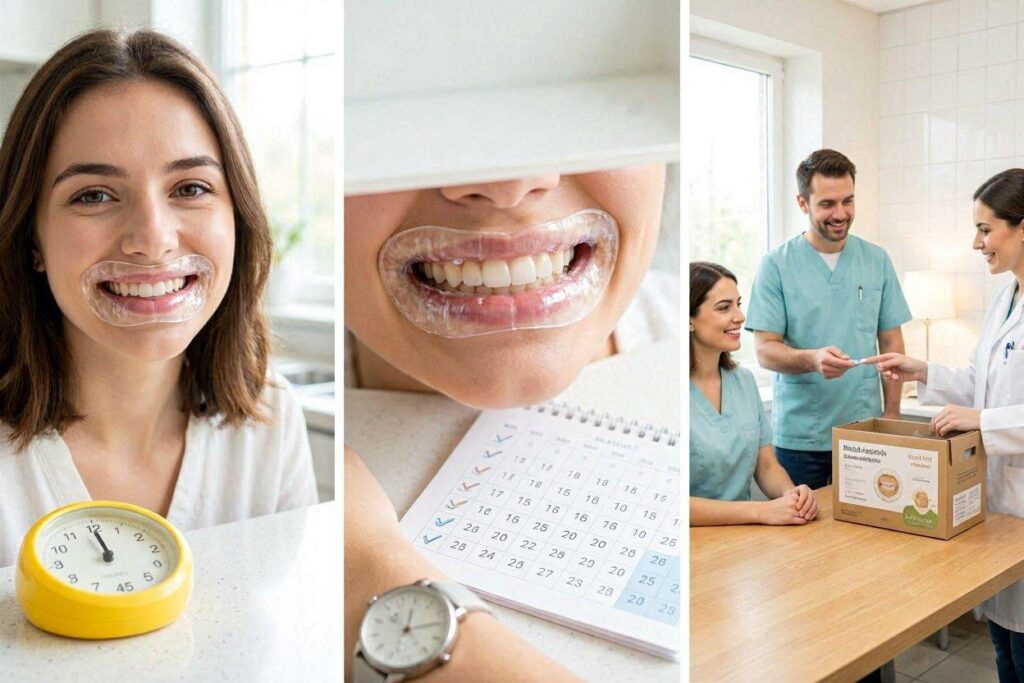
Because of this slow-release profile, carbamide peroxide gels are designed for extended wear. The standard, dentist-prescribed protocol for a 10% CP gel is an overnight wear time of 6 to 8 hours, or a daytime wear time of 2 to 4 hours for those who do not wish to sleep with trays. A 15-16% CP gel is typically worn for 2 to 4 hours during the day, or 4 to 6 hours overnight. A 20% CP gel is generally reserved for a strict 2-hour daytime wear, as the higher concentration shortens the required contact time to achieve the same cumulative oxidative dose.
The clinical advantage of carbamide peroxide’s long wear window is that it provides a prolonged, gentle oxidative bath. The peak peroxide concentration inside the enamel is lower than with a direct hydrogen peroxide gel, resulting in a slower, more gradual onset of tooth sensitivity. The disadvantage is the inconvenience of long wear times and the potential for gum irritation from the tray’s physical presence over many hours.
Hydrogen Peroxide: The Sprinter (Short, Intense Wear)
Direct hydrogen peroxide (H2O2) gels, used increasingly in at-home tray systems, deliver the active oxidative species immediately and at full concentration. There is no breakdown delay; the free radicals are available the instant the gel contacts the tooth surface. A 6% hydrogen peroxide gel peaks in its oxidative activity within the first 15 to 20 minutes and is largely spent after 45 to 60 minutes.
Hydrogen peroxide tray gels are therefore designed for short, intense wear periods. The standard protocol for a 6% H2O2 tray gel is a 30-minute wear time. A 9-10% H2O2 gel may be worn for 20 to 30 minutes. Wearing a hydrogen peroxide gel beyond its chemically active window does not contribute to additional whitening; the peroxide has been consumed or diluted to an ineffective concentration. Extended wear with hydrogen peroxide simply prolongs the contact of the inert gel base and the tray against the gums, increasing the risk of mechanical irritation and soft tissue maceration without any whitening benefit.
The Tray Fit Variable: Custom vs. Over-the-Counter
Wear time cannot be considered independently of tray design. The fit of the tray dramatically influences how much gel contacts the teeth versus how much leaks onto the gums, and how quickly saliva dilutes the active agent.
Custom-Fabricated Dental Trays:
These trays are manufactured from a precise alginate or digital scan impression of your arch. They fit intimately against the enamel, with a scalloped margin that follows the gum line contour within a fraction of a millimeter. The reservoir space between the inner tray wall and the tooth is thin and uniform, typically 0.5 to 1.0 millimeter. This close adaptation means that a very small volume of gel is required, and that gel is held in constant, undiluted contact with the enamel. Saliva ingress is minimized by the tight seal at the gingival margin.
With custom trays, the prescribed wear time is accurate and reliable. You can safely wear a 10% CP gel for 8 hours overnight because the gel stays on the teeth, not on your gums, and salivary dilution is slow and limited to the tray margins. The wear time you set is the effective oxidative contact time your teeth receive.
Boil-and-Bite or Stock Trays:
These semi-custom or one-size-fits-all trays are bulkier, with thicker walls and a looser, less precise fit. The marginal seal is poor; there is a significant gap between the tray edge and the gum line. When you load these trays, excess gel squeezes out onto the gingiva and into the floor of the mouth. Saliva freely circulates under the tray, rapidly diluting the peroxide concentration.
Because of this leakage and dilution, the effective oxidative contact time in a boil-and-bite tray is significantly shorter than the nominal wear time. You might wear the tray for 60 minutes, but the peroxide at the enamel surface may be diluted to sub-therapeutic levels within 20 minutes. Compensating by extending the wear time is dangerous because it increases the duration of gum exposure to the leaked, diluted gel and mechanical friction. With ill-fitting trays, you should adhere strictly to the recommended maximum wear time and never exceed it, even if you feel the whitening is insufficient. Instead, address the fit issue by obtaining better trays.
The Sensitivity Feedback Loop: Listening to Your Nerves
The wear time guidelines on the product label are population averages. Your individual pulpal response may dictate a shorter, personalized wear time. The onset of true dentinal sensitivity—a sharp, lancinating, electrical “zing” in response to air, cold water, or the pressure of the tray itself—is an absolute signal to end the session immediately, regardless of the clock.
Mild, diffuse warmth or a very faint ache is a common, acceptable side effect, especially in the first few sessions. However, a sudden, sharp zinger that makes you involuntarily flinch indicates that the peroxide flux has reached the pulp and is depolarizing the A-delta nerve fibers. This level of pulpal irritation is not dangerous in a single episode, but repeated episodes without reducing the peroxide dose (by shortening wear time or lowering gel concentration) will lead to cumulative pulpal inflammation that can take weeks to resolve fully.
A practical sensitivity-based protocol for titration is as follows: start with half the recommended wear time for the first two sessions. If there is zero sensitivity, increase to the full recommended time. If sensitivity develops, drop back to the half-time duration and stay there for the remainder of the treatment cycle. The total number of sessions can be extended to compensate for the shorter per-session oxidative dose. This titration method achieves the same cumulative whitening outcome over a slightly longer calendar period, with dramatically improved comfort.
Daytime vs. Overnight Wearing: A Physiological Comparison
The choice between wearing trays during the day or while sleeping involves more than just personal scheduling convenience. The oral environment is physiologically different during sleep, and this difference impacts both efficacy and risk.
Daytime Wearing:
During the day, you are upright, and your salivary flow rate is normal and continuous. Saliva circulates, bathing the tray margins and diluting any leaked peroxide. You can consciously control your position, keep your head slightly forward to pool saliva in the front of the mouth rather than the throat, and you are awake to detect early signs of gum burning or sensitivity and remove the tray. The risk of prolonged, unnoticed soft tissue contact with peroxide is low. Daytime wear is safer for higher-concentration gels (15-20% CP or 6%+ H2O2) and for first-time users who are still learning their sensitivity threshold.
Overnight Wearing:
During sleep, the salivary flow rate drops to near zero. The oral environment becomes stagnant and dry. Any gel that has leaked onto the gums remains in concentrated, undiluted contact with the tissue for hours. You are unconscious, so the early warning signs of a gingival burn—tingling, whitening, a sensation of heat—do not wake you until the damage is already done. Furthermore, in a supine sleeping position, any gel that squeezes out of the upper tray can pool and drip onto the posterior pharyngeal wall, causing a sore throat.
Overnight wearing should be restricted to low-concentration carbamide peroxide gels (10% CP, which releases only 3.5% H2O2 slowly), used in impeccably fitting, custom trays with minimal gel overloading. Even then, the patient should test the gel and tray combination during a daytime 2-hour nap session before committing to a full 8-hour overnight exposure. If any gum sloughing is observed upon waking, the gel volume must be reduced, or the overnight protocol abandoned in favor of daytime wear.
The Dangers of Exceeding Maximum Wear Time
The patient mentality of “if 4 hours is good, 8 hours is better” is the most common cause of whitening-related dental emergencies. Exceeding the recommended maximum wear time for your specific gel concentration produces a cascade of negative consequences that impair both comfort and the final aesthetic result.
Chemical Gingivitis and Soft Tissue Sloughing:
Prolonged contact of peroxide gel, even a low concentration, with the gingival epithelium causes oxidative desquamation. The outer layer of the gum tissue turns white, becomes soft and cheesy in texture, and sloughs off in sheets. This is a superficial chemical burn. It is painful, the raw underlying tissue is exquisitely tender to touch and spicy foods, and it takes 3-5 days to re-epithelialize fully. Whitening must be completely halted during this healing period.
Uncontrolled Pulpitis:
Extended peroxide contact drives an ever-increasing concentration of free radicals into the pulp chamber. The inflammatory response within the confined, rigid pulp space creates pressure against the nerve fibers. The result is a spontaneous, throbbing toothache that persists even after the tray is removed and does not respond fully to desensitizing pastes. This condition, acute reversible pulpitis, can take 1-2 weeks to resolve, during which the teeth are hypersensitive to all thermal stimuli. In rare cases of extreme overuse, irreversible pulpitis and pulp necrosis can occur.
The Rebound “Darkening” Illusion:
Severely over-whitened, dehydrated, and inflamed teeth take on a strange, flat, chalky, opaque white appearance. As the pulpitis resolves and the teeth desperately rehydrate with inflammatory exudate and saliva, the color rebounds, and the teeth can appear temporarily yellower and darker than they did at the midpoint of the correct treatment cycle. The patient, panicked by the “darkening,” resumes over-whitening, entering a destructive loop. Strict adherence to the recommended wear time prevents this cycle.
Optimized Wear Time Protocols by Gel Type
The following table synthesizes clinical guidelines into a practical reference for the most common tray-based whitening formulations.
| Gel Type & Concentration | Recommended Single Wear Time | Maximum Safe Wear Time | Session Frequency | Notes |
|---|---|---|---|---|
| 10% Carbamide Peroxide | 6-8 hours (overnight) or 2-4 hours (daytime) | 8 hours | Once daily | Ideal for overnight use; must use custom trays |
| 15-16% Carbamide Peroxide | 2-4 hours | 4 hours | Once daily | Daytime use preferred; do not sleep in these |
| 20% Carbamide Peroxide | 2 hours | 2.5 hours | Once daily | Strict time limit; higher sensitivity risk |
| 6% Hydrogen Peroxide | 30 minutes | 45 minutes | Once or twice daily | Short, intense; do not extend beyond 45 min |
| 9-10% Hydrogen Peroxide | 20-30 minutes | 30 minutes | Once daily | Professional supervision recommended |
| 3-4% Hydrogen Peroxide | 45-60 minutes | 60 minutes | Once or twice daily | Gentle formulation; suitable for sensitive teeth |
The “Less Is More” Gel Loading Principle
Wear time is intimately linked to gel volume. Overloading the tray with a thick, continuous bead of gel does not make the teeth whiten faster. It forces excess gel out over the gums and into the oral cavity, increasing the soft tissue contact and the amount of peroxide swallowed, while providing no additional whitening benefit because the tooth surface can only absorb a finite flux of peroxide.
The correct loading technique for custom trays is a single, tiny droplet of gel—no larger than a grain of rice or a small lentil—placed on the facial (front) wall of the tray for each tooth to be whitened, approximately halfway up the inner surface. When the tray is seated, this droplet compresses and spreads into a thin, uniform film across the entire facial enamel surface. The total volume of gel used for an entire arch should be no more than 0.5 milliliters. If you taste peroxide strongly, feel gel oozing onto your tongue, or see significant gel extrusion beyond the tray margins after seating, you have overloaded the tray. Wipe away the excess with a clean fingertip or a cotton swab before starting the timer.
Conclusion
- Carbamide peroxide gels (10-20%) are designed for extended wear times of 2 to 8 hours due to their slow-release hydrogen peroxide kinetics, with 10% CP being the safest for overnight use in custom trays, while direct hydrogen peroxide gels (6-10%) require strict, short wear times of 20 to 45 minutes due to their immediate and rapid oxidative peak.
- The fit of the tray is a critical wear-time modifier; custom-fitted trays with tight marginal seals maintain an undiluted peroxide reservoir for the full prescribed duration, whereas loose boil-and-bite trays suffer rapid salivary dilution, making label wear times unreliable and extension dangerous.
- Individual pulpal sensitivity should override generic time recommendations; a sharp zinging sensation is an absolute signal to end the session immediately, and a titration strategy starting with half the recommended time provides a safe path to full efficacy for sensitive users.
Frequently Asked Questions
Can I wear my whitening trays for 2 hours in the morning and 2 hours at night?
For carbamide peroxide gels, a split-day protocol can work, but the total cumulative daily wear time should not exceed the recommended maximum single-session wear time. For hydrogen peroxide gels, split sessions are not recommended because the rapid oxidative peak occurs each time, effectively doubling the daily pulpal stress.
What happens if I accidentally fall asleep with my daytime 15% CP trays?
If you wake up after an unintended full night of wear, remove the trays immediately. Rinse your mouth gently with warm water. Do not brush for at least 30 minutes. Inspect your gums for white, sloughing patches. Apply a desensitizing fluoride gel if available. Expect some gum soreness and tooth sensitivity for the next 24-48 hours. Skip the next scheduled session to allow recovery.
Should I wear trays on both arches simultaneously?
Yes, this is standard practice and saves time. However, if you experience significant sensitivity in one arch but not the other, you can decouple them and wear the sensitive arch’s tray for a shorter time or on a less frequent schedule.
My gel is clear and watery after wearing trays. Does this mean it’s still active?
No. A watery, clear liquid inside the tray at the end of the session is primarily saliva mixed with the spent gel base and the water byproduct of peroxide decomposition. The active peroxide has been consumed. The watery appearance does not indicate that you should have worn the trays longer.
Can I reuse the gel that squeezes out of the tray?
Absolutely not. The extruded gel is contaminated with oral bacteria, diluted with saliva, and its peroxide concentration is unknown and patchy. Attempting to scoop it up and reapply it introduces bacteria into the tray, causes uneven application, and provides no reliable whitening benefit.