What Are Teeth Whitening Strips Made Of?
You peel open a thin, flexible, nearly transparent strip from its foil sachet and press it against your teeth. It adheres, clings, and begins its work. The technology appears so simple, so elegantly minimal, that you might assume it is just “plastic with bleach.” The reality is significantly more sophisticated. Teeth whitening strips are precision-engineered medical devices that combine polymer science, adhesive chemistry, and controlled-release pharmacology into a laminate thinner than a human fingernail.
Understanding what whitening strips are made of is not merely an exercise in curiosity. The material composition determines the strip’s adhesion quality, the rate of peroxide release, the uniformity of whitening, and the potential for oral irritation. Consumers who grasp the basic materials science can make smarter purchasing decisions and recognize when a generic, poorly manufactured strip is failing to deliver on its promises. This article provides a layer-by-layer material decomposition of the modern whitening strip, from the backing film to the active gel matrix, explaining the function and safety profile of each component.
The Fundamental Architecture: A Two-Layer Laminate System
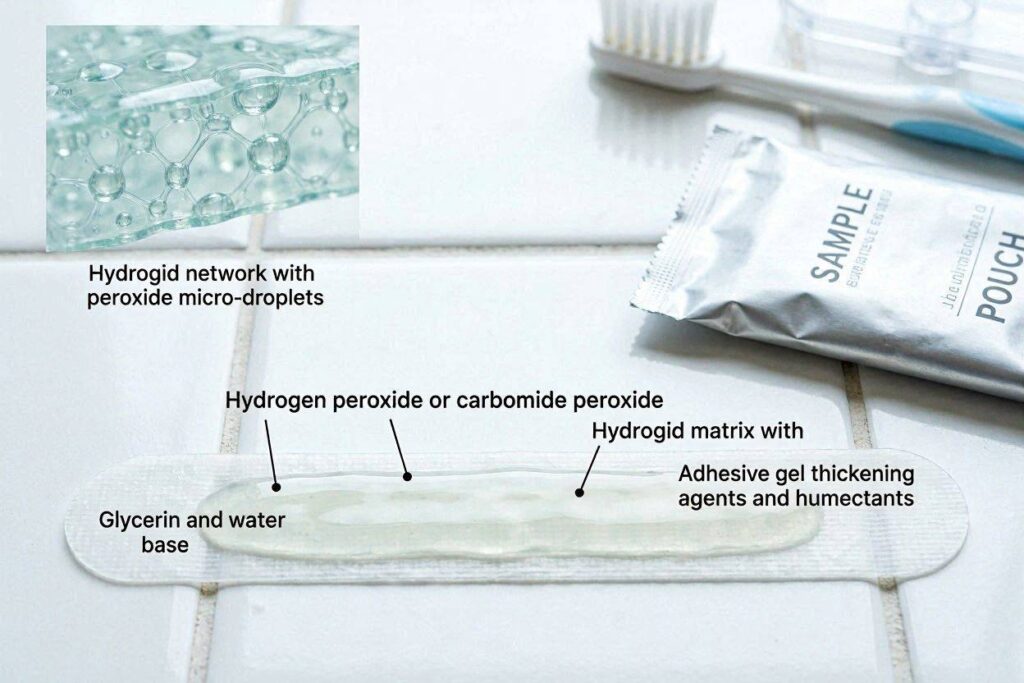
At its most basic structural level, a whitening strip is a bilayer laminate. It consists of a thin, flexible, impermeable backing film, and a layer of viscous, adhesive hydrogel coated onto one side of that film. There is no third “release liner” in most modern strips; the gel side is simply pressed against a smooth release-coated surface inside the sealed foil pouch. When you peel the strip out, the gel adhesive releases cleanly from the pouch material and remains affixed to the backing film.
This two-layer architecture serves a crucial functional purpose: the impermeable backing film acts as a barrier and an occlusive dressing. It traps the peroxide gel against the enamel, preventing the saliva in the oral cavity from immediately diluting and washing away the active ingredient. Simultaneously, it prevents the gel from being wiped off by the tongue, cheeks, and lips. The backing film is the occlusive skeleton; the hydrogel is the active drug delivery matrix. Neither component is simple.
Layer One: The Backing Film (The Occlusive Barrier)
The backing film is usually a thin, transparent, or translucent sheet of polyethylene terephthalate (PET) or a similar polyester polymer. PET is the same family of materials used in clear plastic water bottles and food packaging, chosen for its excellent combination of mechanical flexibility, tensile strength, optical clarity, and, most critically, its impermeability to water and oxygen.
The backing film must meet an exacting set of performance specifications. It must be stiff enough to allow the user to handle the strip without it folding in on itself and sticking together irreversibly, yet flexible enough to conform to the compound curves of the dental arch—bending around canines, incisors, and premolars without buckling or lifting away at the edges. It must be completely inert to the highly oxidative hydrogen peroxide gel it carries. A less stable polymer would be attacked, embrittled, or dissolved by the peroxide, leading to structural failure and gel leakage within the mouth during the 30-minute wear period.
The thickness of the backing film is typically in the range of 50 to 150 microns—roughly the thickness of a standard sheet of printer paper. Some premium strips incorporate a thin layer of ethylene-vinyl acetate (EVA) copolymer laminated to the PET to enhance the softness and improve the conformability of the strip to the tooth’s facial contours. The EVA layer also provides a slightly tacky, high-friction outer surface that helps the lip and cheek hold the strip passively in place without the user consciously clenching.
Layer Two: The Hydrogel Adhesive Matrix (The Active Drug Delivery System)
The functional heart of the whitening strip is the layer of clear, viscous gel that contacts the teeth. This gel is not a simple “peroxide paste.” It is a carefully formulated hydrogel—a three-dimensional, cross-linked polymer network swollen with water, propylene glycol, or glycerin, within which the active hydrogen peroxide is dissolved and suspended.
The Polymer Backbone:
The structural skeleton of the hydrogel is typically a high-molecular-weight polyvinyl pyrrolidone (PVP) or a carbomer (polyacrylic acid cross-linked with allyl ethers of pentaerythritol). These polymers form a tangled, physically cross-linked mesh when hydrated. This mesh provides several critical functions. It gives the gel its cohesive strength—the internal stickiness that keeps the gel layer from slumping, running, or disintegrating when wetted by saliva. It acts as a viscosity modifier, ensuring the gel remains thick enough during manufacturing to be coated onto the backing film as a precise, even layer, but thixotropic enough to flow slightly and adapt to the microscopic irregularities of the enamel surface when pressed into place.
The Humectant Base:
The liquid phase of the hydrogel is a mixture of water and a humectant, most commonly glycerin or propylene glycol. The humectant serves a dual purpose: it lowers the water activity of the gel, which inhibits bacterial growth and stabilizes the peroxide against premature decomposition, and it prevents the gel from drying out during shelf storage and during the 30-minute intraoral wear period. A desiccated gel loses its adhesiveness, cracks, and detaches from the tooth. The humectant maintains the gel’s tacky, compliant, wet-state adhesion.
The Active Ingredient:
Dissolved within this hydrogel matrix is hydrogen peroxide, typically at a concentration of 6% to 10% by weight. The peroxide molecules are not chemically bound to the polymer mesh; they are freely mobile within the aqueous channels of the hydrogel. Upon contact with the tooth, a concentration gradient drives the diffusion of hydrogen peroxide out of the gel, across the enamel pellicle, and into the enamel porosities. The hydrogel functions as a sustained-release reservoir, continually releasing a flux of peroxide molecules over the 30-minute wear period rather than dumping the entire dose in the first 60 seconds.
The Adhesion Promoter:
The inherent tack of the hydrated PVP or carbomer gel provides the primary adhesion to the enamel. However, some formulations include a specific adhesion promoter, such as a low-molecular-weight polyvinyl alcohol (PVA) or a modified starch. These molecules enhance the wet-state stickiness through hydrogen bonding with the calcium phosphate surface of the enamel. The adhesion must achieve a delicate balance: strong enough to resist the convective washout of saliva flowing over the strip, yet weak enough to allow the user to peel the strip off cleanly after 30 minutes without leaving a sticky polymer residue that requires vigorous brushing to remove.
Ancillary Functional Ingredients in the Gel Matrix
The hydrogel layer is not simply peroxide, water, and polymer. A sophisticated strip formulation includes a suite of minor but functionally critical additives.
pH Buffers:
Hydrogen peroxide is inherently acidic and is most chemically stable at a pH of 3.5 to 4.5. However, placing an acidic gel directly against enamel for 30 minutes poses a risk of surface demineralization. Reputable manufacturers add buffering agents—sodium hydroxide, triethanolamine, or sodium citrate—to raise the gel’s pH into the near-neutral range (6.0 to 7.0) just prior to or during application, balancing peroxide stability with enamel safety. The strip’s sealed pouch environment helps maintain this carefully engineered pH equilibrium.
Stabilizers and Chelating Agents:
Hydrogen peroxide decomposes rapidly in the presence of trace metal ions (iron, copper, manganese) via the Fenton reaction, generating hydroxyl radicals that do not contribute to whitening and simply degrade the peroxide potency. To prevent this, the gel includes chelating agents such as EDTA (ethylenediaminetetraacetic acid) or etidronic acid. These molecules bind tightly to any contaminant metal ions, sequestering them and preserving the peroxide shelf life. EDTA has the secondary benefit of chelating calcium ions from the dental pellicle, potentially aiding in pellicle disruption and stain removal.
Desensitizing Agents:
Many modern strips, particularly those marketed for “sensitive” or “gentle” whitening, incorporate potassium nitrate or amorphous calcium phosphate (ACP) into the hydrogel. Potassium nitrate delivers potassium ions that diffuse down the dentinal tubules and depolarize the nerve endings in the pulp, reducing the sensation of zinging pain. ACP, and the related CPP-ACP (Recaldent), provide bioavailable calcium and phosphate ions that can remineralize any transiently demineralized enamel surface and physically occlude open dentin tubules, providing a dual mechanism of sensitivity relief.
Flavorings and Sweeteners:
The taste of raw PVP and peroxide is bitter, chemical, and mildly nauseating. The gel matrix is flavored with intense, food-grade mint oils (peppermint, spearmint) and sweetened with non-cariogenic artificial sweeteners such as sucralose, sodium saccharin, or xylitol. These flavoring agents are dissolved or emulsified into the hydrogel and provide a pleasant sensory experience that encourages user compliance. Some strips also include a cooling agent like menthol or WS-3, which triggers the TRPM8 cold receptors on the tongue and palate, imparting a sensation of “clean freshness.”
The Foil Pouch: The Third Critical Material
The whitening strip does not exist in isolation; its storage environment is as material-critical as the strip itself. Each strip is hermetically sealed inside a laminated foil pouch. This pouch is a multi-layer barrier laminate consisting of an outer layer of printed polyester, a middle layer of aluminum foil, and an inner heat-sealable layer of polyethylene or a similar polyolefin.
The aluminum layer is the functional oxygen and moisture barrier. Hydrogen peroxide decomposes when exposed to oxygen from the air and moisture that can hydrolyze the polymer. The aluminum foil layer is impermeable to both, giving the strip its multi-year shelf stability. If the pouch is punctured, cut, or poorly sealed at the factory, oxygen and moisture ingress will steadily degrade the peroxide, and by the time you open the sachet, the strip may be dry, brittle, and chemically inert. A puffed-up, balloon-like pouch is a sign of gas evolution from peroxide decomposition and indicates a compromised product that should not be used.
Material Safety and Biocompatibility
A comprehensive material analysis must address the safety of these substances in the oral cavity. All components in a legally manufactured whitening strip—the PET film, the PVP or carbomer hydrogel, the glycerin, the peroxide, the buffers, the flavorings—are materials that have been previously cleared for food contact or pharmaceutical oral use. The PET film is essentially the same material approved for beverage bottles. PVP has a long history of safe use as a binder in pharmaceutical tablets. Glycerin is a GRAS (Generally Recognized as Safe) food ingredient.
The material risk is not from the chemical nature of these components in their pure state, but from the potential for poor manufacturing quality control. A poorly formulated gel may have “hot spots” of high acidity. A low-grade PET film may contain residual catalysts or plasticizer monomers like phthalates that could leach into the oral cavity. Regulatory oversight in major markets (FDA in the United States, Health Canada, European Medicines Agency) mandates biocompatibility testing and manufacturing quality standards that reputable brands adhere to.
Comparative Material Design: High-End vs. Budget Strips
The materials science distinction between a premium whitening strip and a generic, budget-priced alternative is substantial and directly affects performance.
Backing Film Conformability:
A premium strip uses a multi-layer laminate with an EVA soft-touch layer that drapes around the curved canine eminence without “tenting” or creating an air gap. A budget strip uses a single-layer, stiffer PET that resists compound curvature, lifting away at the gingival and interdental margins. The result is uneven whitening with darker zones where the gel did not contact the enamel.
Hydrogel Coating Uniformity:
Precision slot-die or knife-over-roll coating processes in pharmaceutical-grade factories lay down a hydrogel layer with thickness tolerances of ±5 microns. Budget manufacturing may use simpler gravure coating with wider thickness variations, resulting in strips with thin, peroxide-poor patches and thick, gel-wasting patches. The user experiences irregular whitening and may be tempted to press and rub the strip to redistribute the gel, introducing air bubbles and further degrading performance.
Adhesion Balance:
The adhesive gel formulation on a premium strip maintains its tack for the full 30 minutes in a wet mouth, then releases cleanly. A budget strip may rely on a simpler, overly aggressive adhesive that leaves a sticky, tenacious polymer residue on the teeth. The user then brushes aggressively to remove the residue, potentially abrading the freshly oxidized and softened enamel surface.
Conclusion
- A whitening strip is a precision bilayer laminate consisting of an impermeable polyethylene terephthalate (PET) backing film that acts as an occlusive barrier, and a hydrogel matrix of polyvinyl pyrrolidone (PVP) or carbomer swollen with glycerin and water, which functions as a sustained-release reservoir for 6-10% hydrogen peroxide.
- The hydrogel incorporates critical ancillary ingredients including pH buffers to neutralize acidity, EDTA chelating agents to stabilize peroxide against metal-ion degradation, potassium nitrate or amorphous calcium phosphate for desensitization, and non-cariogenic sweeteners and flavor oils for palatability.
- The material quality of the backing film’s conformability, the uniformity of the hydrogel coating, and the precision of the adhesion-release balance separate premium pharmaceutical-grade strips from budget alternatives that may whiten unevenly, lift away from curved teeth, or leave behind sticky polymer residue.
Frequently Asked Questions
Are whitening strips made of plastic?
Yes, the backing film is typically PET, a type of polyester plastic. This is the same material family used in food and beverage packaging. It is biocompatible, approved for oral contact, and is not biodegradable, so strips should be disposed of in the trash, not swallowed or composted.
Is the gel on whitening strips toxic if I swallow a little?
No, the incidental ingestion of the small amount of gel from a single strip is not acutely toxic. The peroxide is rapidly neutralized by salivary and gastric catalase enzymes. The PVP polymer is inert and passes through the digestive tract undigested. The glycerin and flavorings are food-grade. Deliberate ingestion of multiple strips should be addressed by calling Poison Control.
Why do some strips slide off my teeth?
This indicates a failure of the hydrogel adhesion balance. Either the strip is a budget product with a poorly formulated, low-tack gel, or you applied the strip to excessively wet teeth. The enamel surface must be dried with a tissue before application for the hydrogen bonding of the PVP to engage effectively with the enamel calcium phosphate.
Do whitening strips contain latex?
No. Whitening strips do not contain natural rubber latex. The backing film is a synthetic polyester, and the hydrogel polymers (PVP, carbomer, PVA) are all synthetic. Latex allergy is not a contraindication to strip use, but always check the specific product’s packaging for “latex-free” labeling.
Can I cut whitening strips to fit my teeth better?
Yes. The materials (PET film and hydrogel) can be safely cut with clean scissors. Trimming the strip to avoid extensive overlap onto the gingiva can reduce soft tissue irritation without compromising the whitening effect on the target tooth surface. Do not stretch the strip after cutting, as this thins the hydrogel layer.