Do All Dental Implants Have Screws?
You hear the word “screw” and your mind conjures images of hardware stores, loose parts, and things that can come undone. So when your dentist says you need a dental implant, a question naturally follows: does this thing have screws? The short answer is yes. Every dental implant system uses a screw-retained mechanism at its core. But this does not mean you will have a visible metal screw head in the middle of your shiny new tooth.
The world of implant screws is more elegant and sophisticated than you might think. Screws are the unsung heroes of implant dentistry. They provide the mechanical connection that holds everything together. Without them, the entire system falls apart. Understanding the role of screws will demystify your implant and help you appreciate the engineering behind your new smile.
This guide will take you inside the anatomy of a dental implant, explain the different types of screws, distinguish between screw-retained and cement-retained crowns, and answer the burning question: do these screws ever come loose?
The Three-Part Architecture of a Dental Implant
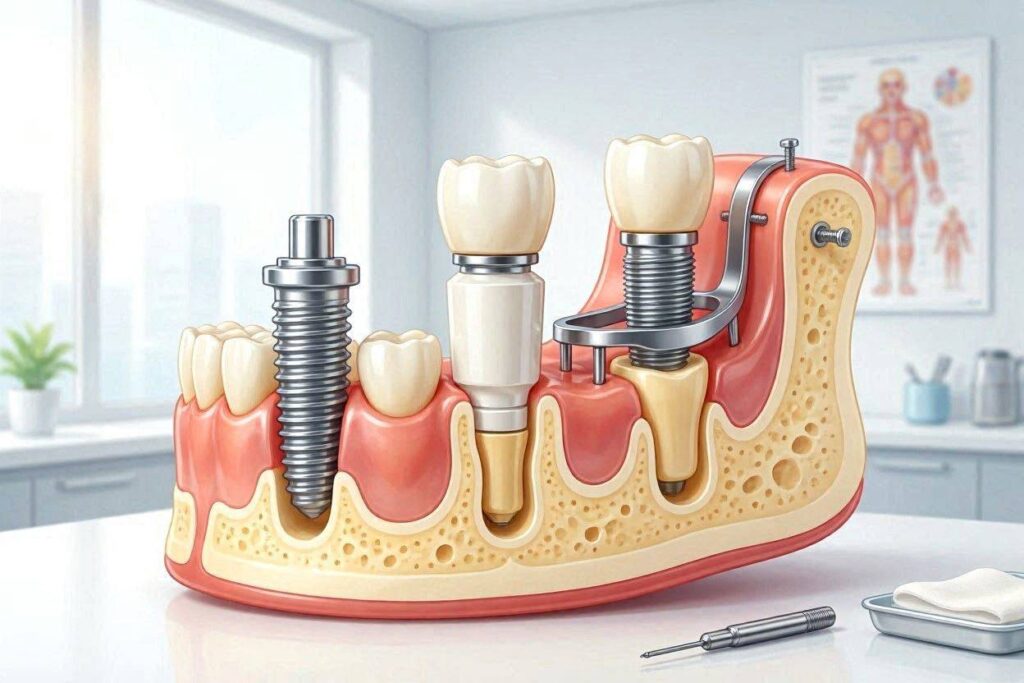
A modern dental implant is not a single piece of metal. It is a modular system of three distinct components. Think of it as a sophisticated assembly where each part has a specific job.
Component 1: The Implant Fixture (The Body)
This is the part you do not see. It is a titanium or zirconia post, shaped like a screw or cylinder, that the surgeon places into your jawbone. The outer surface is threaded, just like a wood screw, to grip the bone and maximize surface area for osseointegration. At the very top of this fixture is a precisely machined internal connection. This connection is usually a hexagonal or conical socket, and it contains internal threads. These threads are the first set of screw threads in the system.
Component 2: The Abutment (The Connector)
The abutment is a small post that screws directly into the implant fixture. One end fits precisely into the internal connection of the fixture. The other end sticks up out of the gum and is shaped to hold the final crown. The abutment is retained by a tiny but incredibly strong screw that threads down into the implant fixture. This is the abutment screw. Every implant system on the market has an abutment screw. It is the universal, mandatory connection between the invisible part in the bone and the visible part in the mouth.
Component 3: The Prosthesis (The Crown, Bridge, or Denture)
This is the visible tooth. It is a ceramic, porcelain, or zirconia crown that sits on top of the abutment. The prosthesis can be attached to the abutment in one of two ways:
- It can be cemented onto the abutment like a cap.
- It can be screwed directly onto the abutment or the implant fixture.
This is where the confusion arises. Some crowns have a screw channel running through them. Others do not and are simply glued in place. But even when the crown is cemented, there is still an abutment screw underneath. The screw is always present, hidden somewhere.
The Abutment Screw: The Heart of the Connection
Let us focus on the most critical screw: the abutment screw. This tiny fastener, often only a few millimeters long, is responsible for holding your tooth in place. It is a marvel of engineering.
Abutment screws are typically made of titanium alloy or gold-plated titanium. Gold-plated screws are common because the thin gold layer acts as a dry lubricant, reducing friction during tightening and allowing for more accurate torque delivery. The screw has a precisely machined thread that matches the internal threads inside the implant fixture. When the dentist tightens it to a specific torque value (usually 15 to 35 Newton-centimeters, depending on the system), the screw stretches slightly, creating a clamping force known as preload. This preload is what locks the abutment and fixture together as a single, stable unit.
“The abutment screw is not just a pin. It is a calibrated spring. When tightened correctly, it generates a clamping force that resists the millions of chewing cycles the implant will face over its lifetime.”
Without this screw, the abutment would simply fall off. So yes, your implant absolutely has a screw, and its integrity is vital.
Screw-Retained Crowns vs. Cement-Retained Crowns: Where Is the Screw?
Now we get to the practical question that matters to you as a patient: will my crown have a screw hole in it?
The Cement-Retained Crown
In this traditional approach, the dentist cements the crown onto the abutment using dental cement, very similar to how a crown is cemented onto a natural tooth. The abutment screw is buried under the crown. You cannot see it. The top of your tooth is solid, seamless ceramic.
Advantages:
- No visible screw hole. Superior esthetics for front teeth.
- The crown can be slightly adjusted in position to compensate for implant angulation.
- Simpler laboratory fabrication.
Disadvantages:
- If cement gets trapped under the gum during the cementation process, it can cause a devastating, rapid peri-implantitis. This is a major concern.
- If the crown needs to be removed for repair or abutment screw tightening, it must be cut off or drilled through, which is destructive.
The Screw-Retained Crown
In this design, the crown has a small, precision-drilled hole through its biting surface or the back of the tooth. The dentist positions the crown, inserts a tiny screw through this hole, and tightens it directly into the abutment or the implant fixture. The hole is then filled with a cotton pellet and a tooth-colored composite resin filling.
Advantages:
- Retrievability. This is the biggest advantage. The dentist can unscrew and remove the crown at any time without damaging it. This makes maintenance, abutment screw replacement, and peri-implantitis treatment much easier.
- No cement. Eliminates the risk of cement-induced peri-implantitis.
- Ideal for full-arch restorations where multiple implants are connected.
Disadvantages:
- A visible screw access hole, though it can be placed discreetly on the biting surface or the lingual side.
- The screw access channel can slightly weaken the ceramic crown material.
- The implant must be placed with very precise angulation so the screw hole emerges in an acceptable position.
The Hidden Truth
Even with a cemented crown, there is an abutment screw underneath. So both designs have screws. The question is simply whether the final crown has a small access hole to reach it. Modern implant dentistry is shifting strongly toward screw-retained designs because of the retrievability and cement-free benefits.
Special Cases: Full-Arch Screw-Retained Prostheses
This is where screws become completely visible and central to the patient experience. Full-arch restorations like All-on-4 or implant-supported hybrid dentures are large, full-arch bridges that replace all teeth. They are almost always screw-retained.
The prosthesis has multiple small cylinders that align with the underlying implant abutments. Tiny screws pass through these cylinders and thread into the abutments or directly into the multi-unit abutments. These screws are tightened to a high torque. The access holes are filled with Teflon tape and composite.
Patients with these restorations must have their screws checked periodically. The dentist will remove the filling, check the screw torque with a special wrench, and replace the filling. These screws are robust, but they can and do loosen occasionally. This is not a failure; it is routine maintenance.
What Are Multi-Unit Abutments?
These deserve a special mention. In full-arch cases, the implant fixture often ends up at an angle due to jawbone anatomy. The prosthetic screws that hold the full-arch bridge cannot emerge at odd angles; they need to come out straight, usually through the biting surface. Multi-unit abutments solve this problem.
A multi-unit abutment is a short, angled connector that screws into the implant fixture (with its own abutment screw). Then, the full-arch prosthesis is secured to the multi-unit abutment with yet another screw, a prosthetic screw. This means there are two screws per implant in many full-arch cases: the abutment screw retaining the multi-unit abutment to the fixture, and the prosthetic screw retaining the bridge to the multi-unit abutment.
So yes, there are even more screws in these cases.
Can Screws Break or Come Loose?
Yes, they can. But the reasons are usually understandable and preventable.
Screw Loosening
Screw loosening is the most common mechanical complication. The screw loses its preload, and a micro-gap forms. The patient might feel a slight movement or notice a bad taste from bacterial leakage. Causes include:
- Inadequate tightening at the time of placement.
- Poor fit of the crown, causing rocking forces.
- Excessive chewing forces from bruxism.
- A loose screw is often simply retightened. If it happens repeatedly, the screw and possibly the crown need replacement.
Screw Fracture
A broken abutment screw is a much more serious problem. The screw snaps, leaving a fragment deep inside the implant fixture. Retrieving this fragment requires specialized kits with tiny drills under a microscope. Causes of fracture include:
- Chronic, severe bruxism.
- A poor-fitting prosthesis that places bending forces on the screw.
- Metal fatigue over many years.
Prevention involves managing bite forces with a night guard, ensuring a passive fit of the prosthesis, and using high-quality implant systems with proven screw designs.
The Single-Piece Implant: The Exception to the Rule
So far, we have described two-piece systems: implant fixture plus abutment. There is a less common design called a single-piece implant. In this design, the implant body and the abutment are machined as one solid piece of titanium. There is no abutment screw at all.
The surgeon places the entire implant in one step, and the abutment post sticks out into the mouth from day one. The crown is later cemented onto this solid post. This design eliminates the abutment screw connection entirely. It is sometimes used for smaller diameter implants, or for specific clinical situations.
However, even these one-piece implants have external threads to screw into the bone. They are still fundamentally “screws.” The term “screw” describes the thread form that engages the bone. So in the broadest sense, even a one-piece implant is a screw; it is just a screw without a separate abutment screw.
A Summary Table to Clear the Confusion
Let us lay out the screw situation in every common scenario.
| Clinical Scenario | Implant Fixture Has Bone Threads? | Has an Abutment Screw? | Crown Has a Screw Hole? |
|---|---|---|---|
| Single tooth, cement-retained crown | Yes, screws into bone | Yes, hidden under the crown | No, crown is solid |
| Single tooth, screw-retained crown | Yes, screws into bone | Sometimes, or the crown screws directly to the fixture | Yes, filled with composite |
| Implant bridge, cement-retained | Yes, screws into bone | Yes, hidden under each retainer crown | No |
| Implant bridge, screw-retained | Yes, screws into bone | Yes, or multi-unit abutments with prosthetic screws | Yes, multiple access holes |
| Full-arch All-on-4 | Yes, screws into bone | Yes, multiple screws in the system | Yes, multiple access holes |
| Single-piece implant | Yes, screws into bone | No, the abutment is part of the implant | No, crown is cemented |
What This Means for You as a Patient
When you discuss implants with your dentist, ask about the retention method. Ask if your crown will be screw-retained or cement-retained. Ask about the rationale. A good dentist will explain the esthetic and functional trade-offs.
If you have a screw-retained crown, know that the little white filling in the middle of your tooth is normal. It is not a defect; it is an intentional access point. If that filling falls out, do not panic. The screw is still there. Just call your dentist to have the filling replaced. If you leave it open, food and bacteria can pack into the screw channel.
If you hear a clicking sound or feel movement, you may have a loose screw. Do not wait. A loose screw, left untreated, can fracture. Early intervention is a simple retightening. Delayed intervention might mean a broken screw and a complex retrieval.
Conclusion
All modern dental implants, with the exception of single-piece designs, incorporate screws as fundamental mechanical components. The implant fixture itself is a screw that threads into the jawbone, and an abutment screw universally connects the visible restoration to the fixture. Whether your final crown has a visible screw access hole depends on whether your dentist chooses a screw-retained or cement-retained design. Understanding these screw mechanisms, their maintenance needs, and the signs of loosening empowers you to care for your implant properly and communicate effectively with your dental team.
FAQ
1. Is the screw in my implant visible?
If you have a screw-retained crown, you may see a small tooth-colored filling on the biting surface or back of the tooth, which covers the screw access hole. If you have a cement-retained crown, the screw is completely hidden underneath and not visible at all.
2. What happens if the abutment screw in my implant breaks?
A broken screw requires a retrieval procedure. The dentist uses a specialized kit with fine drills under magnification to carefully back out the broken fragment from inside the implant fixture. If successful, the screw is replaced. If the implant threads are damaged, the entire implant may need removal. Prevention through good bite management is key.
3. Do single-piece dental implants have any screws?
A single-piece implant has no separate abutment screw because the implant body and the abutment post are machined as one solid unit. However, the implant itself has external threads that screw into the jawbone, so it is still fundamentally a screw-shaped device.
4. How often should the screws in my full-arch prosthesis be checked?
Most clinicians recommend an annual check of the prosthetic screws in full-arch restorations. The dentist removes the access hole fillings, tests the torque of each screw with a calibrated wrench, and replaces the fillings. This routine maintenance prevents screw loosening and potential fractures.
Additional Resource
For more detailed information on implant components and maintenance protocols, visit the International Congress of Oral Implantologists’ patient education section: https://www.icoi.org/patient-education/