What Percent Of Dental Implants Fail?
Dental implants are one of the most successful and predictable procedures in all of medicine and dentistry. But no medical intervention has a perfect, 100% success rate. The question “What percent of dental implants fail?” is a responsible and necessary one for any patient considering this life-changing treatment. Understanding the real numbers, the difference between early and late failure, and the specific factors that influence risk is essential for making an informed, confident decision.
This article provides a comprehensive, evidence-based analysis of dental implant failure rates. You will learn the widely accepted success and failure statistics, the biological and mechanical reasons an implant can fail, the critical distinction between early and late failure, and, most importantly, the risk factors you can control to ensure your implant lasts a lifetime.
The Overarching Success Rate: A Statistical View
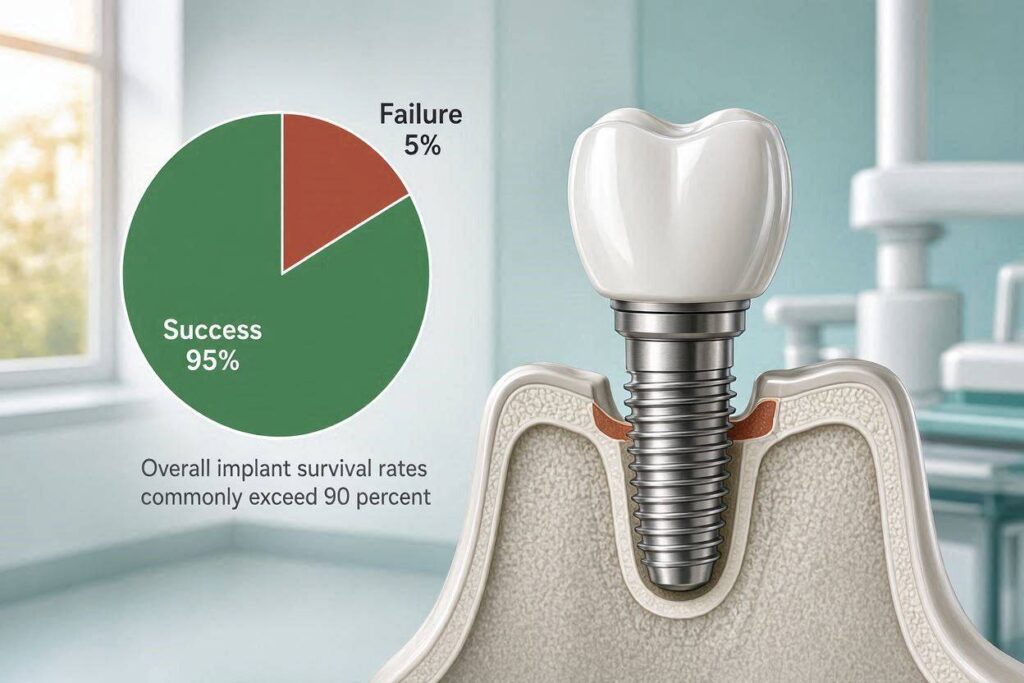
The foundational statistic that frames this entire conversation comes from decades of global clinical research. Across large, longitudinal studies, the survival rate for dental implants in healthy patients with good oral hygiene is consistently reported at 95% to 98% over a 10-year period. Some studies tracking specific implant systems in ideal conditions report even higher long-term survival.
This means the overall failure rate is, correspondingly, between 2% and 5%.
It is vital to define what “survival” and “failure” mean in these studies. Survival means the implant is still physically present in the jawbone and functioning under masticatory load. It does not always mean the implant is in a state of perfect health, free from any peri-implant inflammation. The definition of a “failing” versus a “failed” implant is a spectrum. A failing implant has progressive bone loss but is still clinically stable and may be treatable. A failed implant has lost osseointegration, demonstrates clinical mobility, and must be surgically removed.
“A 95% success rate is an extraordinary figure in medicine. However, for the individual patient, the risk is either 0% or 100%. The focus must be on rigorous diagnosis, risk factor management, and precision surgery to ensure you are in the overwhelming majority.”
The Two Distinct Categories of Implant Failure
Not all implant failures are the same. They are classified by when they occur relative to the loading of the implant with a crown. The causes and management of these two categories are entirely different.
Early Failure (Before the Final Crown)
An early failure occurs before the restorative crown is attached, or within the first few months of function. It represents a failure of the implant to achieve osseointegration. The bone has not successfully fused to the titanium surface. This is a biological failure of the healing process.
Causes of early failure include:
- Surgical Trauma: Overheating the bone during the drilling process, which causes osteocyte cell death at the bone-implant interface.
- Inadequate Primary Stability: The implant was not sufficiently tight in the bone at the time of placement, leading to micromovement during healing. Bone will not grow onto a moving surface; it will form a soft tissue scar instead.
- Systemic Patient Factors: An unrecognized or uncontrolled systemic condition that severely impairs healing.
- Infection: A bacterial contamination of the surgical site.
- Micro-motion: Excessive force on the healing implant from a poorly fitting temporary prosthesis or patient habits.
An early failure often presents as a persistently “spinning” or loose implant at the time of uncovering, or pain and mobility a few weeks after surgery. The implant is removed, the site is grafted, and after complete healing, a new implant can usually be placed successfully.
Late Failure (After Loading)
A late failure occurs after the implant has been successfully restored and has been in function for a year, or many years. The implant was successfully osseointegrated, but the biological or mechanical seal has broken down. This is the loss of osseointegration of a previously stable implant.
The two primary causes of late failure are:
- Peri-implantitis: A plaque-induced, progressive inflammatory disease affecting the soft and hard tissues around an osseointegrated implant. It is the implant equivalent of periodontitis (gum disease). Bacterial biofilm accumulates around the abutment and under the gum, causing inflammation, bleeding, and, critically, the progressive loss of the supporting alveolar bone. Without treatment, the bone loss advances until the implant becomes mobile and is lost.
- Biomechanical Overload: Excessive occlusal forces on the implant and its prosthetic components. This is not a biological infection but a physical failure. It can lead to a fracture of the abutment screw, a fracture of the crown, or, in severe cases, a fracture of the implant fixture body itself. Clenching and grinding (bruxism) is the most common source of this pathological overloading.
The Modifiable Patient Risk Factors
The 2-5% failure rate is not evenly distributed across all patients. A patient’s individual risk profile can be significantly higher if specific risk factors are present and not managed.
Smoking and Tobacco Use
This is the single most significant modifiable risk factor for both early and late implant failure. Nicotine is a potent vasoconstrictor; it constricts the tiny blood vessels in the oral mucosa and bone, dramatically reducing blood flow and oxygen delivery to the surgical site. Smokers have impaired wound healing and a diminished immune response. The literature consistently shows that the implant failure rate in heavy smokers is substantially higher than in non-smokers, with some studies reporting a failure rate two to three times greater. Many experienced implant surgeons will not place implants in active heavy smokers and will require a documented smoking cessation period before and after surgery.
History of Periodontal Disease
A patient who has lost teeth due to periodontitis is already a biologically susceptible host. The oral microbiome of a former periodontitis patient is predisposed to a pathogenic shift. If this patient does not maintain fastidious oral hygiene, the same destructive bacteria will colonize the implant surface and trigger peri-implantitis. A patient with a treated and stable periodontal condition is a good candidate. A patient with active, untreated, or poorly controlled periodontal disease is a high-risk candidate.
Poor Oral Hygiene and Lack of Maintenance
An implant is not a set-and-forget device. The patient has an absolute, non-negotiable responsibility for daily biofilm disruption. Failure to perform meticulous daily cleaning around the implant abutment will lead to peri-implant mucositis (a reversible soft tissue inflammation) which, if left untreated, will progress to peri-implantitis (irreversible bone loss). Adherence to a schedule of professional maintenance visits—typically every 3 to 6 months—for subgingival debridement and monitoring is mandatory for long-term survival.
Systemic Diseases
- Uncontrolled Diabetes Mellitus: A hemoglobin A1c level above 7.0% indicates poor glycemic control. This state impairs neutrophil function, wound healing, and collagen synthesis, significantly increasing the risk of early failure and peri-implantitis. With well-controlled diabetes, success rates approach those of healthy patients.
- Immunocompromised States: Patients on immunosuppressant medications, high-dose corticosteroids, or those with autoimmune conditions that affect healing are at higher risk.
Bruxism (Teeth Grinding and Clenching)
Implants are rigidly anchored to the bone. Natural teeth have a periodontal ligament that acts as a natural shock absorber. Implants do not have this ligament. They are a solid, unyielding bone-to-metal connection. Parafunctional habits like bruxism place extreme, uncontrolled lateral forces on the implant and its components. This dramatically increases the risk of late mechanical failure: screw loosening, porcelain fracture, and implant body fracture. A well-designed, custom-fabricated occlusal night guard is mandatory for any implant patient with a known bruxism habit.
A Comparative View: Implants vs. Other Tooth Replacements
When discussing the “failure” percentage of dental implants, it is necessary to compare it to the alternatives.
- Tooth-Supported Fixed Bridges: The long-term survival of a three-unit bridge is lower than a single implant. A traditional bridge requires the irreversible reduction of the abutment teeth, which then become susceptible to decay, pulp death requiring root canals, and fracture. The failure rate of bridges is significantly higher over a 15-20 year period.
- Removable Partial or Full Dentures: These are not measured by “failure” in the same way, but by patient satisfaction and associated bone loss. A conventional denture accelerates the resorption of the underlying bone and has a very low patient satisfaction rate for function and stability.
When viewed against these alternatives, the 95-98% success rate of dental implants represents a dramatic improvement in long-term prognosis.
How to Be in the 95% Success Group
The path to ensuring your implant does not fail is a partnership between you and your surgical and restorative team.
- Select a Skilled, Surgical Provider: Choose an experienced implant surgeon who uses 3D CBCT planning.
- Full Medical Disclosure: Be completely honest about your medical history, medications, and habits like smoking.
- Optimize Your Health: If you have diabetes, get your A1c under control. If you smoke, commit to a cessation program.
- Commit to a Lifetime of Meticulous Hygiene: You must be willing to brush, use implant-specific floss and interdental brushes, and possibly a water flosser every single day.
- Adhere to Professional Recall: Keep your appointment for professional peri-implant maintenance every 3 to 6 months. This is not optional.
Conclusion
The overall failure rate for dental implants is a low 2-5%, translating to a 95-98% success rate over a 10-year period. Failures are categorized as early failures, where the bone fails to fuse to the implant during initial healing, and late failures, where a previously stable implant is lost due to peri-implantitis or biomechanical overload. The most significant modifiable risk factors that elevate a patient’s individual failure rate include active smoking, a history of untreated periodontal disease, poor daily oral hygiene, and uncontrolled systemic conditions like diabetes. By partnering with an experienced surgical specialist and adhering to a strict, lifelong maintenance protocol, patients can confidently place themselves within the high success group.
FAQ
1. What is the most common cause of late implant failure?
Peri-implantitis, a bacterial infection that causes progressive bone loss around an otherwise healthy, integrated implant, is the leading cause of late implant failure.
2. Can a failed implant be replaced?
Yes, in most cases. A failed implant is surgically removed. After a healing and bone graft period, a new implant can usually be placed successfully, often with a slightly different surgical approach or implant type.
3. How does smoking affect implant failure rates?
Smoking significantly increases the failure rate. It impairs blood flow and healing, making smokers two to three times more likely to experience implant failure compared to non-smokers.
4. What are the signs of a failing implant?
Signs include bleeding or pus when brushing around the implant, gum recession exposing the implant threads, persistent pain or swelling, and, in the late stage, a feeling that the implant is mobile or loose.
5. Is the failure rate the same for upper and lower jaw implants?
Implants in the lower jaw have a slightly higher documented success rate. The bone in the posterior upper jaw is often less dense, and the proximity to the sinus can make placement more technique-sensitive.
Additional Resource
For a detailed, scientific review of risk factors and long-term success rates, explore the consensus reports and clinical guidelines published by the Academy of Osseointegration (AO).