Are All-on-4 Dental Implants Safe?
You have lost most or all of your teeth. Dentures slip, gag you, and make you miserable. You dream of a fixed, full arch of teeth that does not come out. Then you hear about the All-on-4 technique: a full set of teeth supported by just four implants, often placed in a single day. It sounds almost too good to be true. And the question that immediately follows is: is it safe?
The short answer is yes. The All-on-4 treatment concept is a well-documented, scientifically validated procedure with high success rates. It has been performed on hundreds of thousands of patients worldwide over more than two decades. However, like any advanced surgical and prosthetic procedure, it carries specific risks and requires a highly skilled clinical team. Safety is not just about the concept; it is about the execution.
This guide will explore the safety profile of the All-on-4 procedure in depth. We will examine the clinical evidence, the anatomical rationale, the potential complications, and the critical factors that determine a safe outcome.
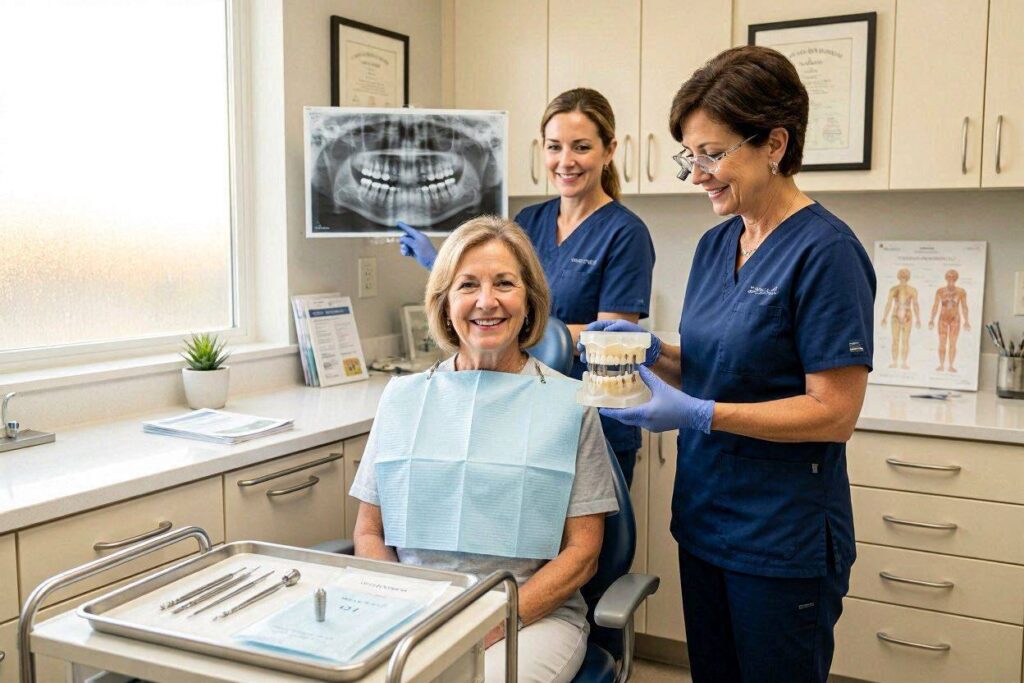
What Exactly Is the All-on-4 Concept?
Before assessing safety, we must define the procedure. The All-on-4 treatment concept is a technique for rehabilitating a completely edentulous (toothless) arch or a severely failing dentition with a fixed, screw-retained full-arch prosthesis supported by four dental implants.
The defining features are:
- Four Implants per Arch: Two straight anterior implants in the front jaw and two angled posterior implants in the back jaw.
- Posterior Implant Angulation: The back implants are tilted, typically up to 30 to 45 degrees, to avoid the maxillary sinuses in the upper jaw and the inferior alveolar nerve in the lower jaw. This angulation allows the use of longer implants and often avoids the need for bone grafting.
- Immediate Loading: In many cases, a temporary full-arch fixed prosthesis is attached to the implants on the same day as surgery. The patient leaves with a set of functional teeth.
This technique was developed by Portuguese dentist Dr. Paulo Malo in the 1990s, building on earlier work in immediate loading. It was designed specifically to address the problem of severe bone resorption in the posterior jaws without complex and lengthy grafting procedures.
The Evidence: What the Research Says About Safety and Success
The All-on-4 technique is not anecdotal. It is supported by a robust body of peer-reviewed scientific literature with long-term follow-up.
Survival Rates
Multiple systematic reviews and long-term studies report cumulative implant survival rates for All-on-4 between 94% and 99% over follow-up periods of 5 to 10 years. These success rates are comparable to those of conventional implant protocols in edentulous patients.
A landmark 10-year prospective study by Malo and colleagues, published in the Journal of the American Dental Association, reported a cumulative implant survival rate of 94.8% for the maxilla and 98.1% for the mandible. The prosthetic survival rate, meaning the actual bridge remained functional without needing replacement, was 99.2% for the mandible.
These are excellent numbers. They place All-on-4 squarely within the realm of safe, predictable, evidence-based care when performed on appropriately selected patients.
Biomechanical Safety
A common concern is whether tilting the posterior implants creates harmful forces. Would they not be subject to dangerous bending moments? Extensive finite element analysis studies and photoelastic stress analyses have demonstrated that the tilted implant configuration actually distributes forces favorably. The angled implants reduce the cantilever length of the prosthesis, which decreases the leverage forces on the anterior implants. The cross-arch stabilization provided by the rigid metal framework further distributes forces across all four implants.
The Safety Advantages: Why All-on-4 Was a Game-Changer
To understand the safety of All-on-4, we must appreciate the problems it solved.
1. Avoidance of Bone Grafting in Atrophic Jaws
Historically, a patient with severe bone loss in the back of the jaw needed a sinus lift and/or extensive onlay bone grafts before implants could be placed. These grafting procedures add significant surgical morbidity, healing time (6-12 months), cost, and risk of complications like graft infection or failure.
The angled posterior implant in the All-on-4 technique bypasses the sinus and nerve by anchoring in the denser bone of the anterior maxilla or mandible, respectively, but with a trajectory that moves the implant platform posteriorly. This graftless approach eliminates the risks associated with major bone grafting. For an older patient or a medically compromised patient, avoiding a large graft is inherently safer.
2. Reduced Number of Implants
Conventional full-arch implant protocols often used 6, 8, or even more implants. Each implant site is a surgical wound with a risk of infection, nerve injury, and post-operative discomfort. Reducing the number to four minimizes the surgical footprint while still providing adequate support.
3. Immediate Function and Quality of Life
From a psychological and nutritional standpoint, the immediate loading aspect of All-on-4 is a profound safety and health benefit. The patient does not spend months in a healing denture that may be loose, uncomfortable, and nutritionally restrictive. Immediate restoration of chewing function improves diet and overall health. The fixed prosthesis eliminates the constant trauma and ulceration that unstable dentures can cause.
Potential Complications and Risks: An Honest Assessment
No surgery is zero risk. Patient safety requires a transparent discussion of what can go wrong.
Surgical Complications
- Nerve Injury: The lower jaw houses the inferior alveolar nerve, which supplies sensation to the lip and chin. If this nerve is bruised or severed during implant placement, the patient may experience temporary or permanent numbness, tingling, or pain (paresthesia or dysesthesia). The angled anterior placement in the mandible aims to avoid the nerve, but precise planning with a CBCT scan is mandatory.
- Excessive Bleeding: The floor of the mouth contains blood vessels that, if perforated during osteotomy preparation in the anterior mandible, can cause a sublingual hematoma. This can be a medical emergency requiring airway management. Proper assessment of the lingual concavity on a CBCT scan prevents this.
- Sinus Perforation: In the upper jaw, placing angled implants involves proximity to the maxillary sinus. A minor sinus membrane perforation is usually benign and heals without issue. Larger perforations may require repair or can lead to chronic sinusitis.
- Implant Malposition: A poorly positioned implant can be non-restorable, compromise esthetics, or create a prosthesis that is impossible to clean.
Prosthetic and Mechanical Complications
- Prosthesis Fracture: The temporary acrylic prosthesis is subject to wear and fracture over time, especially in patients with heavy bites. The definitive zirconia or hybrid prosthesis is much stronger, but chipping of the ceramic teeth is possible.
- Screw Loosening or Fracture: The prosthetic screws that secure the bridge to the multi-unit abutments can loosen. This is a common, manageable complication requiring periodic maintenance. A fractured screw requires retrieval.
- Speech Difficulties: The volume of a full-arch prosthesis can initially affect speech, particularly sibilant sounds (“s”). Most patients adapt within weeks, but a poorly designed prosthesis may cause persistent problems.
Biological Complications
- Peri-implantitis: This is the primary long-term risk. The All-on-4 prosthesis covers a large area under which food and plaque can accumulate. If the patient does not maintain meticulous hygiene, especially around the implant abutments and under the bridge, peri-implantitis can develop, leading to bone loss and potential implant failure.
- Soft Tissue Hyperplasia: Chronic irritation or poor prosthesis fit can cause the gum tissue to overgrow around the abutments.
Failure Scenarios
- Early Implant Failure: Failure of one or more implants to osseointegrate. If one anterior implant fails, the case may sometimes be salvaged with a rescue implant. If multiple fail, the entire prosthesis may be lost.
- Late Implant Failure: Loss of an integrated implant due to peri-implantitis or overload years later.
The Critical Safety Preconditions
The safety of All-on-4 is not automatic. It is created through a rigorous protocol. If you are considering this treatment, ensure your provider meets these standards.
1. Comprehensive 3D Imaging and Planning
A cone beam CT scan is non-negotiable. The surgeon must visualize the bone in three dimensions, map the exact path of nerves and sinuses, measure bone density, and virtually plan the implant positions. A digitally fabricated surgical guide transfers this plan to the mouth, ensuring the implants go exactly where they are supposed to.
2. Thorough Medical Evaluation
Not every patient is a candidate. Uncontrolled diabetes, heavy smoking, active cancer, intravenous bisphosphonate use, severe bleeding disorders, and certain psychological conditions may contraindicate the procedure. A thorough medical history, often with physician consultation, protects patient safety.
3. An Experienced Surgical-Prosthetic Team
All-on-4 is a complex, team-driven procedure. The surgeon and the restorative dentist must work in seamless coordination. The surgeon must have extensive experience in implant surgery and bone grafting. The restorative dentist must understand full-arch occlusion and prosthesis design. Ask your provider about their specific training and how many cases they have completed.
4. A Realistic Informed Consent Process
The patient must understand that this is not a “no-maintenance” solution. They are committing to rigorous daily hygiene, regular professional maintenance visits every 3 to 6 months, and the possibility of future mechanical repairs or prosthesis replacement. Safety is a partnership.
Comparing All-on-4 Safety to the Alternative: The Denture Tragedy
When assessing safety, we must weigh the risks of the procedure against the risks of the alternative: continued edentulism with or without conventional dentures.
Long-term complete denture wear is associated with:
- Accelerated bone resorption, leading to facial collapse and a sunken appearance.
- Chronic malnutrition due to reduced chewing efficiency.
- Social isolation and depression.
- Increased risk of oral cancer from chronic irritation.
- Obstructive sleep apnea from altered jaw relationships.
In this context, the risks of a carefully executed All-on-4 procedure are often outweighed by the significant health and quality-of-life benefits of a fixed, functional dentition.
Conclusion
The All-on-4 dental implant technique is a safe, evidence-based procedure with high long-term success rates when performed on properly selected patients by an experienced clinical team. Its primary safety advantage is the avoidance of major bone grafting in severely resorbed jaws through the strategic use of angled posterior implants. However, the procedure carries specific surgical, prosthetic, and biological risks, including nerve injury, prosthetic complications, and peri-implantitis. These risks are mitigated through meticulous 3D planning, comprehensive medical screening, and a strong patient commitment to lifelong maintenance.
FAQ
1. Is the All-on-4 surgery more painful than a single implant?
The surgery itself is performed under local anesthesia or sedation, so you feel no pain during the procedure. The post-operative recovery is typically more involved than a single implant, with more swelling, bruising, and soreness due to the multiple implant sites and full-arch nature. However, most patients manage the discomfort well with prescribed medication and cold compresses.
2. How long does an All-on-4 procedure take from start to finish?
On the day of surgery, the implant placement and attachment of the temporary fixed prosthesis typically takes 2.5 to 4 hours per arch. The temporary prosthesis remains in place for 4 to 6 months while osseointegration occurs. The fabrication and delivery of the final, high-strength prosthesis then takes several additional appointments over a few weeks.
3. What happens if one of the four implants fails?
If an implant fails early, before the final prosthesis is made, the site may be cleaned and a new implant placed, often with a short delay. In some configurations, the case can function on three implants while the site heals. If an implant fails years later, the specific situation must be evaluated. The prosthesis might be modified, or a new implant placed, but this is a complex salvage scenario.
4. Can the All-on-4 bridge be removed by the patient?
No. The All-on-4 prosthesis is fixed and can only be removed by a dentist using specialized instruments. It does not come out at home. It functions like a set of permanent teeth. You clean it in place with special brushes and water flossers.
Additional Resource
For more information on the All-on-4 treatment concept and clinical evidence, visit the official Malo Clinic research page: https://maloclinics.com/