What Is the Best Dental Implant System?
You have decided to get a dental implant. You start researching, and suddenly you are drowning in brand names: Straumann, Nobel Biocare, BioHorizons, Zimmer Biomet, Dentsply Sirona, and a dozen others. Each claims to be the best, the most innovative, the most scientifically proven. The question “What is the best dental implant system?” feels urgent. You want the best for your body, for your investment, for your future.
The honest, nuanced answer is that there is no single “best” implant system for every patient and every situation. The top-tier global manufacturers all produce excellent, scientifically validated implants with high long-term success rates. The best system for you is the one your experienced clinician knows intimately, has a proven track record with, and selects specifically for your anatomical and restorative needs. The skill of the surgeon and the quality of the planning are more important than the brand name.
This guide will navigate the landscape of implant systems. We will identify the major manufacturers, explain what differentiates them, and empower you with the right questions to ask your dentist. You will learn to focus on what truly matters for your long-term success.
The Premise: Why the Dentist’s Choice Matters More Than the Brand
Imagine you need a complex engine repair. You would not go to a mechanic and hand them a specific piston brand you found online. You would choose a master mechanic and trust them to use the parts they know best, the ones they have been using for years, the ones with the supply chain and support they depend on.
Dental implants are similar. A Straumann implant in the hands of a novice, poorly planned, has a worse prognosis than a less-known but quality implant placed perfectly by an expert. The implant system is a tool. The clinician is the craftsperson.
That said, not all implant systems are created equal. There are legitimate differences in design philosophy, surface technology, connection type, and prosthetic versatility. Understanding these differences helps you ask informed questions and evaluate the quality of care you are receiving.
The Major Global Players: A Look at the Top Manufacturers
These companies dominate the global market and have the most extensive long-term research backing their systems. You can be confident in any of these.
1. Straumann (Switzerland)
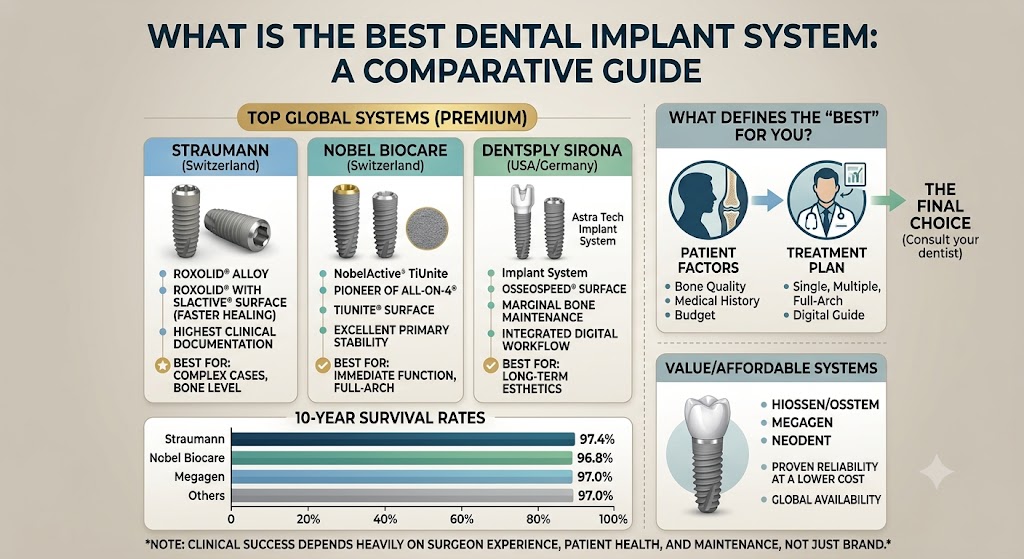
Straumann is often considered the premium global leader. They are renowned for their Roxolid material, a titanium-zirconium alloy that is stronger than pure titanium, allowing for smaller diameter implants without sacrificing strength. Their SLActive surface is a hydrophilic (water-loving) surface that has been shown in studies to accelerate the early phase of osseointegration, potentially reducing healing time. They have an extensive digital workflow and a massive library of prosthetic components. They are frequently the choice for complex esthetic cases and patients who want the most extensively researched premium option.
2. Nobel Biocare (Sweden / USA)
Nobel Biocare is the pioneer, founded by Per-Ingvar Brånemark, the father of osseointegration. They are the originators. Their TiUnite surface is one of the most studied implant surfaces in history, with decades of clinical data. They are known for the All-on-4 treatment concept and have a strong focus on immediate function and full-arch solutions. Their implants have a slightly tapered design and a tri-channel internal connection that provides excellent prosthetic stability.
3. Dentsply Sirona (Germany / USA)
Dentsply Sirona offers a broad portfolio, including the Astra Tech Implant System and the Xive and Ankylos lines. Astra Tech implants are known for their unique OsseoSpeed surface, a fluoride-modified titanium surface that stimulates bone formation. They have a distinctive conical connection design (Conelog) that creates an extremely tight seal, virtually eliminating micro-gaps and reducing the risk of bacterial infiltration.
4. Zimmer Biomet (USA)
Zimmer Biomet’s Trabecular Metal technology is a revolutionary surface material. It is not a roughened titanium surface but a porous, tantalum-based structure that mimics the architecture of natural cancellous bone. Bone cells literally grow into the three-dimensional pores. This material has shown excellent performance in soft bone and compromised situations. They also offer a comprehensive range of traditional threaded implants.
5. BioHorizons (USA)
BioHorizons is known for its Laser-Lok surface technology. A series of precisely machined micro-channels are laser-etched into the collar of the implant. This structured surface has been shown in histological studies to attract and organize connective tissue fibers, creating a physical, not just biological, seal around the implant neck. This may provide a superior barrier against bacterial invasion and peri-implantitis.
What Differentiates One System From Another?
When dentists debate implant brands, they are discussing these specific features.
Surface Technology
The surface of the implant is where the biology happens. The goal is a surface that accelerates osseointegration, maximizes bone-to-implant contact, and resists bacterial adhesion. Each manufacturer has a proprietary surface: Straumann’s SLActive, Nobel’s TiUnite, Astra’s OsseoSpeed, BioHorizons’ Laser-Lok. All are excellent. Some are more hydrophilic. Some have unique topographies. The differences are at the micron level, and all the major surfaces achieve high success rates.
Implant-Abutment Connection
This is the junction between the implant and the abutment. It is a critical area. A poorly designed connection can have micro-gaps and micromovement, leading to bacterial leakage, screw loosening, and crestal bone loss.
- External Hex Connection: The original Brånemark design. A hexagon protrudes from the top of the implant. Simple, well-studied, but more prone to micromovement and screw loosening. Largely superseded by internal connections.
- Internal Connection (Hex, Tri-Channel, Conical): The connection is inside the implant body. Internal connections provide a stronger, more stable joint, better force distribution, and a more reliable seal. Conical connections, where the abutment wedges into a cone shape inside the implant, offer a virtually bacteria-proof cold-weld seal. This is the modern standard.
Material and Strength
Most implants are made of commercially pure titanium (Grade 4) or titanium alloy (Ti-6Al-4V). Straumann’s Roxolid alloy allows for thinner implants that are still incredibly strong, ideal for narrow ridge spaces. Zirconia implants are a separate ceramic category for metal-free needs. The material choice affects surgical flexibility.
Prosthetic Versatility
A major manufacturer has a vast digital library of abutments, screws, impression copings, and prosthetic parts. This matters for your restorative dentist. If you need a custom angled abutment or a specific screw-retained crown solution, the system must support it. A robust restorative platform is essential.
The Importance of Long-Term Research and Track Record
A critical distinction between a top-tier implant and a budget generic clone is the scientific evidence. Straumann, Nobel, and Astra have decades of independent, peer-reviewed research, including long-term studies tracking patients for 10, 15, and 20 years. You know how these implants perform over a lifetime.
A newer, cheaper, or clone implant may have little to no long-term data. Its surface technology, connection design, and material quality may not have been validated over time. You are betting your health on an unknown. Insist on an implant system with a documented long-term track record.
What About the “Affordable” or “Generic” Implant Systems?
As discussed in the article on cheap implants, there is a vast market of value-oriented and clone implant systems. These implants are often machined to lower tolerances, use less sophisticated surface treatments, and have limited prosthetic components. They may work, and they do integrate in many patients. But the failure rate is higher, the risk of mechanical complications is greater, and the long-term data is sparse. If a dentist cannot tell you the brand of the implant, or the brand is an obscure name with no PubMed references, consider it a red flag.
So, How Do You Choose the “Best” for You?
Shift your focus from choosing a brand to choosing a process and a clinician.
Step 1: Select an Expert Clinician. Find a board-certified oral surgeon, periodontist, or an experienced general dentist with advanced implant training. Look at their credentials, their case volume, and their patient reviews.
Step 2: Ask These Questions During the Consultation.
- “What implant system do you use, and why did you choose it for your practice?”
- “How long have you been placing this specific system, and what has been your personal success rate with it?”
- “Can you show me the long-term research studies on this implant system?”
- “Is this implant system a major, globally recognized brand with a robust prosthetic library?”
A confident, competent clinician will welcome these questions and answer them with specifics. They will have a clear clinical rationale for their choice of system, not just a vague “it works.”
Step 3: Trust the Clinician’s Recommendation Based on Your Anatomy. For example, if you have narrow bone, a dentist might choose a Straumann Roxolid implant to avoid grafting. If you have a history of gum issues, a Laser-Lok surface might be favored. If you need a full-arch restoration, Nobel Biocare’s All-on-4 protocol and prosthetic components are the gold standard. The best system is the one matched to your biological and restorative needs.
Conclusion
There is no universally “best” dental implant system; rather, a group of top-tier global manufacturers, including Straumann, Nobel Biocare, Dentsply Sirona, Zimmer Biomet, and BioHorizons, all produce excellent, heavily researched implants with proven long-term success. The best system for you is the one your highly skilled clinician is most experienced with and selects to address your specific bone anatomy, esthetic needs, and restorative plan. Your focus should be on selecting an expert clinician who uses a well-documented, major-brand system and can clearly articulate the rationale for their choice.
FAQ
1. Which implant system has the highest success rate?
All major premium systems (Straumann, Nobel Biocare, Astra Tech, etc.) have published long-term success rates in the 95-97% range. The differences between them are not large enough to declare a single “most successful” brand. The clinician’s experience and patient selection are more significant variables.
2. Can I ask my dentist to use a specific brand of implant?
You can certainly express a preference, but the dentist will work with the system they are trained in, have the surgical kits for, and have a reliable laboratory relationship with. It is generally better to find a dentist who uses a top-tier system you trust than to ask a dentist to use a system they are unfamiliar with.
3. Is Straumann better than Nobel Biocare?
This is a classic debate. Both are elite, world-class implant systems. Straumann is often praised for its Roxolid material and SLActive surface. Nobel Biocare is revered as the pioneer with its TiUnite surface and All-on-4 protocol. Both are excellent. The choice often comes down to clinician preference and specific case requirements.
4. What implant system is used for the All-on-4 procedure?
The All-on-4 treatment concept was developed by Nobel Biocare and is most closely associated with their implant system and proprietary prosthetic components. Other manufacturers now offer solutions for full-arch immediate loading, but Nobel Biocare is the original and most widely recognized for this specific protocol.
Additional Resource
For objective, peer-reviewed comparisons of different implant systems, visit the Academy of Osseointegration: https://www.osseo.org/