When Can Dental Implants Be Put In?
A dental implant is a titanium post surgically placed into the jawbone to replace a missing tooth root. The timing of implant placement is not arbitrary. It is a critical clinical decision that influences the success rate, the aesthetic outcome, and the total treatment time. Implants can be placed at three distinct time points relative to tooth extraction: immediately, early, or delayed. Additionally, the patient’s growth status, systemic health, and prior bone grafting procedures dictate when the implant surgery can safely occur. This guide provides a comprehensive, detailed explanation of every implant placement timeline. You will understand the clinical rationale behind each approach, the advantages and risks, and which timeline applies to your specific situation.
The Three Primary Placement Protocols After Tooth Extraction
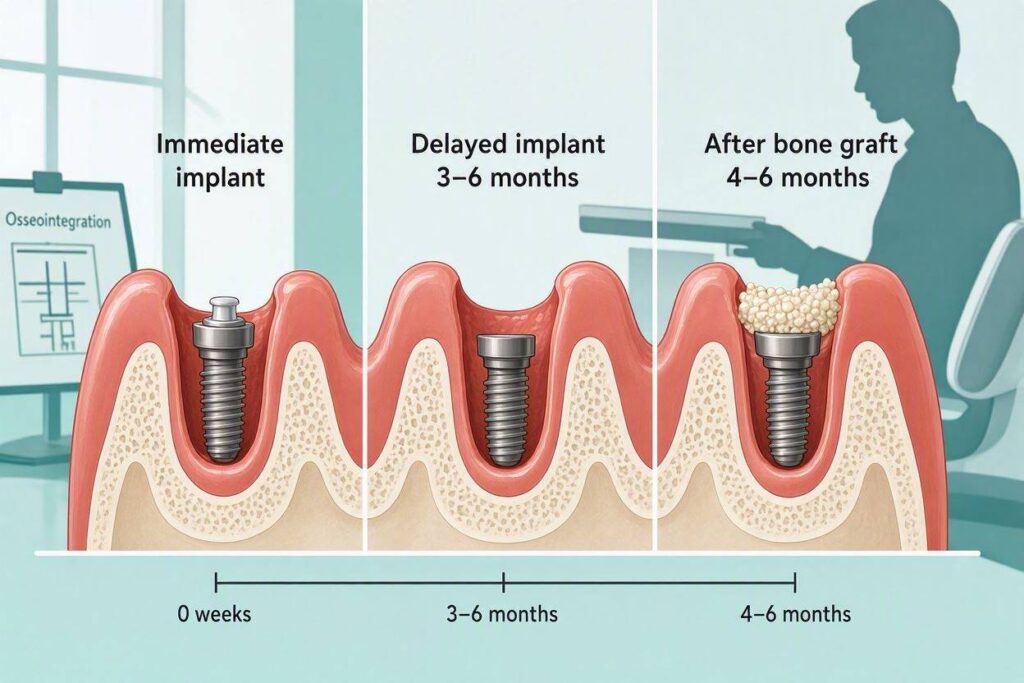
When a tooth is deemed non-restorable and requires extraction, the implant placement can be sequenced according to three well-established protocols. Each has specific indications, and the choice depends on the condition of the extraction socket, the presence of infection, and the quality of the surrounding bone and soft tissue.
Immediate Implant Placement (Type 1)
Immediate implant placement means the implant is inserted into the extraction socket at the same appointment as the tooth extraction. The patient leaves the surgical visit with the implant already in the jawbone.
This protocol is technically demanding and is reserved for ideal clinical situations. The extraction socket must have intact bony walls, particularly the facial (buccal) plate of bone. The tooth is removed atraumatically, preserving the bony housing. There must be no active purulent infection at the root apex. The implant must achieve primary stability, meaning it is firmly anchored in the native bone apical to the socket, typically engaging 3 to 5 millimeters of bone beyond the root apex.
The advantages of immediate placement include a reduced total treatment time, preservation of the alveolar ridge contour, and the psychological benefit of the patient leaving with the implant already placed. The risk is that if the socket is compromised, if there is a fenestration or dehiscence of the facial bone, or if primary stability cannot be achieved, the implant may fail to osseointegrate. Additionally, the soft tissue contour may be unpredictable without a simultaneous connective tissue graft.
Immediate placement is most commonly performed for single-rooted anterior teeth and premolars with intact sockets. Molars present a greater challenge because the multi-rooted socket does not naturally conform to a cylindrical implant shape. However, immediate molar implant placement is performed by experienced surgeons, often using wider-diameter implants that engage the inter-radicular bone.
Timeline: Implant placed on the day of extraction.
Early Implant Placement (Type 2)
Early implant placement involves a waiting period of four to eight weeks after tooth extraction before the implant is placed. This protocol allows for soft tissue healing to cover the extraction socket, but significant bone resorption has not yet occurred.
During the four to eight weeks after extraction, the gum tissue (keratinized mucosa) grows over the socket, creating a protective biological seal. The site is now a closed wound, reducing the risk of bacterial contamination during implant placement. The bone within the socket is in an active healing phase, with immature woven bone beginning to form. The facial bone is still present, although some initial crestal resorption is beginning.
Early placement offers a balance between the reduced treatment time of immediate placement and the risk reduction of delayed placement. The soft tissue is healed, making flap management and primary closure more predictable. The surgeon can evaluate the healing of the socket and address any residual infection. The primary disadvantage is that the patient must wait a month or two before the implant surgery, and a second surgical visit is required.
This protocol is the workhorse of implant dentistry. It is suitable for the majority of extraction sites that are not acutely infected and where the bone volume is adequate.
Timeline: Implant placed 4 to 8 weeks after extraction.
Delayed Implant Placement (Type 3)
Delayed implant placement waits for complete hard tissue healing of the extraction socket. The waiting period is typically three to six months. The socket fills with mature, mineralized bone, and the ridge contour stabilizes.
This protocol is indicated when there was significant infection at the extraction site, such as a large periapical abscess or a periodontal infection with extensive bone destruction. Delayed placement allows the body’s immune system to fully resolve the infection. The surgeon can then enter a healed, healthy bone environment, confident that the infection is eliminated.
Delayed placement is also indicated when a bone graft was placed at the time of extraction to preserve the ridge. The graft must heal and incorporate into the native bone before an implant can be placed. The surgeon waits for the graft to mature into dense, implantable bone.
The primary disadvantage of delayed placement is the total treatment time, which extends to eight to ten months or more from extraction to final restoration. Additionally, during the three- to six-month healing period, the alveolar ridge undergoes resorption, particularly on the facial aspect. The ridge may become narrower and shorter, potentially necessitating additional bone grafting at the time of implant placement. However, the predictability of placing an implant into mature, healed, infection-free bone is high.
Timeline: Implant placed 3 to 6 months after extraction.
The Implant Placement Decision Matrix
| Clinical Factor | Immediate (Type 1) | Early (Type 2) | Delayed (Type 3) |
|---|---|---|---|
| Socket Integrity | All four bony walls intact, no fenestrations | Soft tissue healed, socket walls largely intact | Healed bone, infection resolved |
| Presence of Infection | None or minimal, controlled | Mild to moderate, resolving | Significant, resolved |
| Primary Stability | Must achieve at least 30-35 Ncm torque | Achievable with native and immature bone | Readily achievable in mature bone |
| Soft Tissue Status | Open wound, requires tension-free closure | Closed, healed mucosa | Mature, keratinized tissue |
| Total Treatment Time | Shortest (implant placed day of extraction) | Moderate (4-8 weeks post-extraction) | Longest (3-6 months post-extraction) |
| Aesthetic Risk | Higher unpredictability of facial margin | Good predictability with grafting | High predictability with staged grafting |
| Common Indications | Single-rooted anterior/premolar, atraumatic extraction, intact socket | Most routine extractions, adequate bone | Infected sites, post-graft healing, compromised bone |
Implant Placement in the Growing Patient
Dental implants are contraindicated in children and adolescents whose jawbones are still growing. An implant is a rigidly anchored, non-movable device. It does not erupt or move with the jaw. If an implant is placed in a growing maxilla or mandible, it becomes submerged (infraoccluded) as the adjacent natural teeth continue to erupt and the alveolar process grows. The implant appears to sink below the occlusal plane, creating a significant aesthetic and functional deformity.
The determination of growth cessation is made using serial cephalometric radiographs taken at least six months apart. Growth is considered complete when there is no change in the cephalometric landmarks between two consecutive films. For females, this typically occurs by age 15 to 17. For males, growth often continues until age 17 to 21.
In a young patient who has lost a tooth to trauma or congenital absence, a temporary replacement such as a removable partial denture, a bonded bridge (Maryland bridge), or orthodontic space maintenance is used until growth is confirmed to be complete. Implant placement is deferred until the jaw is skeletally mature. This is a hard, non-negotiable rule in implant dentistry.
Implant Placement After Bone Grafting
When bone volume is inadequate for implant placement, a bone grafting procedure is required. The timing of implant placement relative to the graft depends on the type of graft performed.
Simultaneous Grafting and Implant Placement
In many cases, a minor bone defect can be grafted at the same time as the implant placement. A small dehiscence or fenestration on the facial aspect of the implant is packed with particulate bone graft and covered with a collagen membrane. The implant provides structural support for the graft. No additional healing period is required; the implant and graft heal together over three to six months.
Staged Grafting with Delayed Implant Placement
When the bone defect is substantial, a staged approach is necessary. The bone graft is placed and allowed to heal and mature before the implant is inserted.
- Particulate Grafts (Ridge Augmentation): A particulate bone graft placed to augment a narrow ridge heals for 3 to 4 months before implant placement.
- Block Bone Grafts: A block of autogenous bone harvested from the chin, ramus, or hip is secured to the deficient ridge with titanium screws. This block must revascularize and incorporate into the native bone. The healing period is 4 to 6 months. After healing, the screws are removed, and the implant is placed.
- Sinus Lift Grafts: The maxillary sinus floor is elevated, and bone graft is packed into the created space. The healing period before implant placement is typically 6 to 9 months for a lateral window sinus lift and 3 to 6 months for a crestal (osteotome) sinus lift.
Immediate Implant Placement with Grafting
In some protocols, such as the All-on-4 concept for full-arch rehabilitation, implants are placed immediately into extraction sockets or healed ridges, and a provisional fixed bridge is attached on the same day. This is immediate loading, a separate concept from immediate placement. Bone grafting of defects around the immediately placed implants is performed simultaneously. The implants must achieve high primary stability, and the patient must adhere to a strict soft diet during the healing period.
Implant Placement After Implant Failure
A patient who has experienced implant failure requires a structured re-entry timeline. After the failed implant is removed, the site is thoroughly debrided of all granulation tissue. A bone graft is often placed to restore the bone volume lost to the initial surgery and the removal procedure.
The healing period for a grafted failed implant site is 3 to 6 months. A CBCT scan is performed to confirm adequate bone regeneration. The re-entry surgery for the new implant then proceeds. The total timeline from removal of the failed implant to placement of a new implant is typically 4 to 8 months. The surgeon and patient must be disciplined about this healing period; rushing re-entry into immature bone invites a second failure.
Medical Considerations That Delay Implant Placement
Systemic medical conditions and treatments can delay or contraindicate implant placement.
Active Chemotherapy and Radiation Therapy
Patients undergoing active chemotherapy are not candidates for elective implant surgery. The immunosuppression and impaired healing capacity increase the risk of infection and failure. Implant placement is deferred until the oncologist clears the patient, typically weeks to months after the completion of chemotherapy and the recovery of blood counts.
Patients who have received high-dose radiation therapy to the head and neck (typically over 50 Gray) are at lifelong risk for osteoradionecrosis, a non-healing, avascular bone death. Implant placement in irradiated bone carries a significantly elevated risk. Hyperbaric oxygen therapy before and after surgery is sometimes used to improve tissue vascularity. Implant surgery in an irradiated field is a complex decision made in coordination with the radiation oncologist.
Uncontrolled Systemic Disease
Patients with uncontrolled diabetes (HbA1c above 8%) are poor surgical candidates. Elective implant placement is deferred until glycemic control is improved, often in collaboration with the patient’s endocrinologist or primary care physician. Similarly, patients with untreated or poorly controlled cardiovascular, renal, or hepatic disease require medical optimization before elective implant surgery.
Intravenous Bisphosphonate Therapy
Patients receiving intravenous bisphosphonates for bone metastases or multiple myeloma are at risk for medication-related osteonecrosis of the jaw (MRONJ). Elective implant placement is generally contraindicated in these patients. The risk is so high that many clinicians consider it an absolute contraindication.
The Implant Healing Period Before Crown Placement
The implant is placed, but the process is not complete. The implant must heal and osseointegrate before the crown, bridge, or denture is attached. This healing period is the final temporal phase before the implant becomes functional.
Uncovered Healing (Two-Stage Protocol)
In the classic two-stage protocol, the implant is placed and completely covered by the gum tissue (submerged). It heals buried under the mucosa, protected from the oral environment. After a healing period of 3 to 6 months in the mandible and 4 to 6 months in the maxilla, a second minor surgery is performed to expose the implant and place a healing abutment. Two to four weeks later, the final impression is taken for the crown.
Transmucosal Healing (One-Stage Protocol)
In the one-stage protocol, a healing abutment is placed on the implant at the time of surgery, extending through the gum tissue into the mouth. The implant heals exposed to the oral cavity. This eliminates the second surgery but requires the patient to keep the site clean during healing. The healing period is the same: 3 to 6 months.
Immediate Loading (Same-Day Teeth)
In select cases with high primary stability, the implant can be immediately loaded with a provisional crown or bridge on the day of surgery. The restoration is adjusted to have no occlusal contact or very light contact, protecting the implant from chewing forces during osseointegration. Immediate loading is most predictable when multiple implants are splinted together, as in the All-on-4 protocol for full-arch rehabilitation.
Conclusion
Dental implants can be placed immediately on the day of extraction when the socket is intact and infection-free, early at 4 to 8 weeks post-extraction after soft tissue closure, or delayed at 3 to 6 months post-extraction after complete bone healing, with the protocol selection driven by the condition of the extraction site. Implants are contraindicated in growing adolescents until skeletal maturity is confirmed by serial cephalometric radiographs, and placement is deferred for 3 to 9 months after significant bone grafting procedures to allow graft maturation. The osseointegration healing period of 3 to 6 months after placement is the final mandatory timeline before the crown is attached, with immediate loading possible only in cases with excellent primary stability.
Frequently Asked Questions
Can I have an implant placed on the same day as my tooth extraction?
Yes, if the extraction socket is intact with all four bony walls, there is no active infection, and the surgeon can achieve primary stability of the implant in the bone apical to the socket. This is immediate implant placement. It is most successful for single-rooted anterior teeth and premolars. The surgeon will evaluate a CBCT scan and examine the tooth’s condition to determine if you are a candidate.
How long after a bone graft can I get my implant?
It depends on the graft type. A minor particulate graft placed simultaneously with extraction heals in 3 to 4 months. A larger ridge augmentation heals in 4 to 6 months. A block bone graft requires 4 to 6 months. A lateral window sinus lift requires 6 to 9 months. Your surgeon will provide a specific timeline based on the graft volume and material used.
I am 17 years old and missing a tooth. Can I get an implant?
Probably not yet. Jaw growth in males often continues until age 17 to 21. A cephalometric X-ray and growth analysis are required to confirm that your jaw has stopped growing. If growth is still occurring, the implant will submerge (infraocclude) as the adjacent teeth continue to erupt, creating a significant aesthetic and functional problem. A temporary replacement is used until growth is confirmed complete.
Why do I have to wait 3 to 6 months after implant placement to get my crown?
The waiting period is for osseointegration, the biologic process where your jawbone cells grow onto the titanium implant surface and create a rigid, structural connection. This process cannot be accelerated. If the implant is loaded with chewing forces before osseointegration is complete, micro-movement will cause a fibrous tissue encapsulation instead of bone integration, and the implant will fail. The waiting period is a biological requirement.
Additional Resource
The American Academy of Periodontology provides a patient education portal at perio.org that explains the relationship between periodontal health and implant success, including detailed information on the timing of implant placement after tooth loss and the importance of bone and soft tissue quality. Periodontists are dental specialists with advanced training in implant surgery and the management of the supporting tissues.