Dental Implants VS Pile Foundations: What Is the Difference
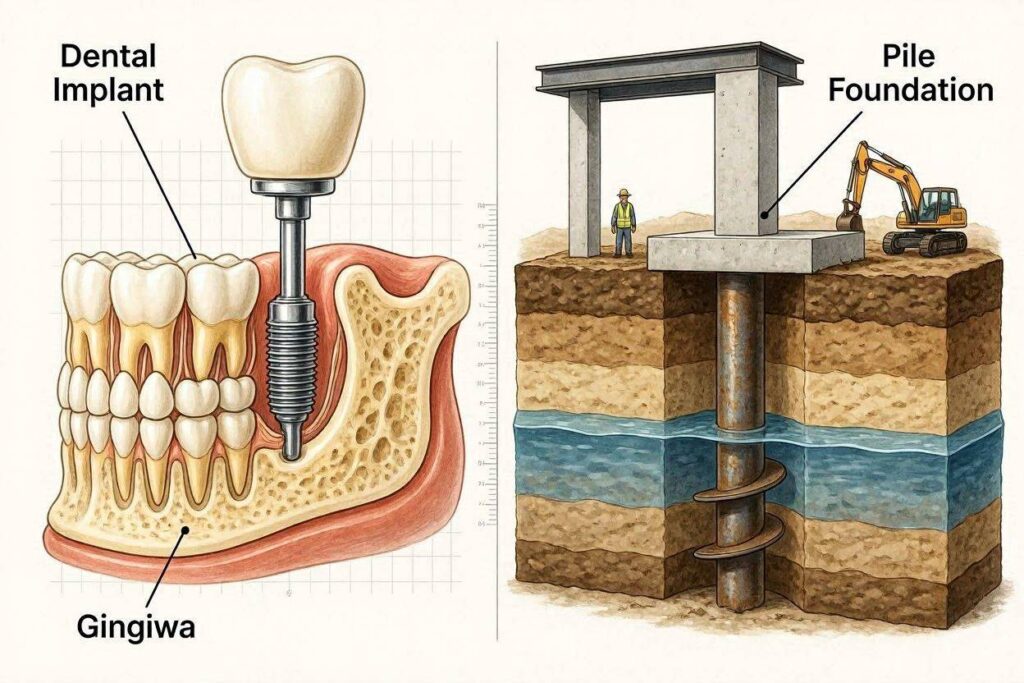
At first glance, comparing dental implants to pile foundations seems like an exercise in absurdity. One is a titanium post placed in your jawbone to replace a missing tooth. The other is a deep foundation element driven into the ground to support buildings, bridges, and other structures. What could these two possibly have in common? The answer lies in a shared engineering principle so fundamental that it governs both modern dentistry and civil engineering: the principle of transferring structural loads to a stable substrate deep beneath a compromised surface. This comparison is not merely an amusing analogy. It is a legitimate conceptual framework that helps patients understand how dental implants work by relating them to a familiar engineering concept. Understanding this parallel transforms the way you think about implant treatment and provides a deeper appreciation for the biomechanical elegance of osseointegration.
The Shared Engineering Principle
Dental implants and pile foundations solve the same fundamental problem in different contexts. The surface layer, whether it is the crest of the jawbone or the topsoil at a construction site, is inadequate to support the intended structure. The solution in both cases is to bypass the compromised surface and anchor the structure in the stable substrate below.
The Problem Both Solve
In dentistry, the problem is that the alveolar bone, the specific bone that supports teeth, is inadequate for the task. It may be insufficient because a tooth has been extracted and the bone has resorbed. It may be of poor quality, with thin cortical plates and porous cancellous bone. It may be compromised by infection, trauma, or congenital deficiency. The surface bone that is accessible to a dentist simply cannot support a functional tooth.
In civil engineering, the problem is that the surface soil is inadequate to support a structure. It may be soft clay, loose sand, or fill material that lacks the bearing capacity to support a building’s weight. It may be subject to settlement, where the soil compresses under load and the structure sinks unevenly. It may be affected by water table fluctuations, frost heave, or seismic activity. The surface soil that is accessible to excavation simply cannot support the intended structure.
The solution in both fields is conceptually identical. Do not build on the inadequate surface. Instead, bypass it and anchor the structure in the competent substrate below. In dentistry, this means placing an implant that extends through the deficient crestal bone into the denser basal bone. In engineering, this means driving piles through the weak surface soil into the competent bearing stratum below.
Why Surface Conditions Are Inadequate
The alveolar ridge, the bone that supports teeth, exists only because teeth are present. When a tooth is extracted, the mechanical stimulation that the tooth root provided to the surrounding bone is lost. The bone resorbs in response, losing both width and height. This resorption is progressive, continuing for years after extraction. The bone that remains is often of poor quality for implant support, particularly in the posterior maxilla where bone density is naturally low.
Similarly, surface soils in many locations are inadequate for structural support. Topsoil contains organic matter that decomposes over time, causing settlement. Clays expand and contract with moisture changes. Sands can liquefy during earthquakes. Fill materials are of unknown composition and compaction. Building on these materials risks settlement, instability, and structural failure.
In both cases, the solution is not to improve the surface material, which is often impractical or impossible. The solution is to bypass it entirely and transfer the load to a deeper, more competent layer.
The Shared Principle of Deep Anchorage
The fundamental principle shared by dental implants and pile foundations is deep anchorage. The structure, whether a tooth or a building, is not supported by the surface it rests on. It is supported by the deep substrate into which it is anchored. The surface material simply surrounds the anchoring element without contributing significantly to load-bearing.
This principle is so universal that it appears in nature as well. Tree roots extend deep into the soil, bypassing the loose surface layer to anchor in competent substrate. The taproots of some plants extend many times deeper than the height of the above-ground plant. Nature discovered deep anchorage long before engineers and dentists applied the principle to their respective fields.
What Dental Implants Are
To understand the comparison, it is necessary to understand what dental implants are in precise terms. They are not simply tooth replacements. They are load-bearing structural elements designed according to well-established biomechanical principles.
Definition and Function
A dental implant is a biocompatible post, typically made of titanium or zirconia, that is surgically placed into the jawbone to serve as an artificial tooth root. Its function is to transfer the loads of chewing from the visible crown, through the implant body, to the surrounding bone. The implant is the foundation. The crown is the visible structure that the foundation supports.
The implant achieves this function through osseointegration, the direct structural and functional connection between living bone and the implant surface. The bone fuses to the implant, creating a connection that can withstand the cyclic loading of chewing for decades.
The implant is not visible in the mouth. It is buried in the bone, below the gum tissue. Only the abutment and crown, the components that attach to the implant, are visible above the gum line. The implant is the hidden foundation, just as pile foundations are hidden below ground.
The Biological Foundation
Dental implants rely on a biological foundation, the living bone of the jaw. This bone is not a static material like concrete or steel. It is a dynamic tissue that constantly remodels in response to mechanical forces. The implant must work with this biology, not against it.
The implant surface is designed to encourage bone attachment. Modern implants have roughened surfaces created by sandblasting, acid etching, or anodization. These microscopic textures increase the surface area for bone contact and provide mechanical interlocking for the forming bone.
The implant must be placed with sufficient primary stability to resist micromovement during the healing period. Movement above 100 to 150 microns disrupts the cellular processes of bone formation and can lead to fibrous encapsulation rather than osseointegration. This is directly analogous to the settlement that pile foundations are designed to prevent.
Load Distribution Mechanisms
When you bite on an implant crown, the force is transmitted through the crown to the abutment, through the abutment to the implant, and through the implant to the surrounding bone. The implant threads convert some of the vertical force into compressive forces along the thread faces, which bone tolerates well.
The implant must distribute forces over a sufficient area of bone to prevent stress concentrations that could cause bone resorption or implant failure. Longer and wider implants provide greater surface area for force distribution, just as longer and wider piles provide greater bearing capacity.
The bone around the implant remodels in response to the transmitted forces, reinforcing areas of high stress and resorbing areas of low stress. This is Wolff’s law applied to implant support, directly analogous to the way soil around piles can densify under load.
What Pile Foundations Are
Pile foundations are deep foundation elements used in civil engineering to support structures when surface soils are inadequate. Understanding their design and function illuminates the comparison with dental implants.
Definition and Function
A pile foundation consists of long, slender structural elements, typically made of steel, concrete, or timber, that are driven, drilled, or vibrated into the ground. Their function is to transfer the loads of the structure above to a competent bearing stratum deep below the surface, bypassing the weak surface soils.
Piles can support loads through end bearing, where the pile tip rests on a strong layer such as bedrock or dense sand, or through skin friction, where the load is transferred to the surrounding soil along the entire length of the pile. Most piles work through a combination of both mechanisms.
Like dental implants, pile foundations are hidden from view once construction is complete. They are the invisible foundation that makes the visible structure possible. A skyscraper appears to rest on the ground, but it actually rests on piles that extend deep below the surface.
Types of Pile Foundations
End-bearing piles transfer the load primarily through the pile tip to a strong bearing stratum below. The pile acts as a column, transmitting the load vertically through weak surface soils to competent material below. This is analogous to an implant that extends through poor-quality crestal bone to engage denser basal bone.
Friction piles transfer the load primarily through skin friction along the pile shaft. The entire surface of the pile, in contact with the surrounding soil, resists the load through frictional forces. This is analogous to an implant that achieves osseointegration along its entire surface, with load transfer occurring through the bone-implant interface.
Driven piles are hammered into the ground using impact hammers. The driving process densifies the surrounding soil, improving its load-bearing capacity. This is conceptually similar to the way an implant compresses the surrounding bone as it is threaded into a slightly undersized preparation site.
Drilled piles, also called bored piles or caissons, are constructed by drilling a hole, placing reinforcement, and filling with concrete. This is analogous to the implant placement process, where the site is prepared by drilling and the implant is then placed into the prepared site.
How Piles Interact With Their Environment
Piles depend on the surrounding soil or rock for their load-bearing capacity. The pile-soil interaction is complex, involving friction along the pile shaft, bearing at the pile tip, and changes in the soil properties due to pile installation.
Soil can densify around driven piles, increasing its strength and the pile’s capacity. This is analogous to the bone compression that occurs when an implant is placed into a slightly undersized osteotomy, improving primary stability.
Piles must resist not only vertical compressive loads but also lateral loads from wind and seismic forces, and uplift forces from expansive soils or frost heave. Implants must similarly resist not only vertical chewing forces but also lateral forces from tongue and cheek movement and oblique chewing forces.
Settlement is the enemy of pile foundations. Excessive or differential settlement can cause structural damage. For implants, micromovement during healing is the enemy. Both systems require stability during the critical initial period to achieve their final load-bearing capacity.
The Structural Parallels
When examined side by side, the structural parallels between dental implants and pile foundations are striking. Both systems follow the same engineering logic applied to different materials and scales.
Load Transfer: Bypassing the Weak Layer
Both systems share the fundamental strategy of bypassing a weak surface layer to anchor in a competent deep layer. The dental implant bypasses the deficient crestal alveolar bone to engage the denser basal bone. The pile foundation bypasses the weak surface soils to engage the competent bearing stratum below.
In both cases, the weak surface layer is present but is not relied upon for structural support. The crestal bone around an implant may be thin and of poor quality, but the implant extends through it to the better bone below. The surface soil at a construction site may be soft and unstable, but the piles extend through it to the competent material below.
This strategy is employed because improving the surface material is impractical. You cannot easily thicken or densify crestal bone, though bone grafting can help in some cases. You cannot practically improve the bearing capacity of deep surface soils. Bypassing the problem is more efficient than solving it directly.
Stability Through Friction and Mechanical Interlock
Both implants and piles achieve stability through a combination of mechanical interlock and friction along their surfaces. The threads of a dental implant engage the bone, providing mechanical interlock that resists both vertical and lateral forces. The surface roughness of the implant increases friction between the implant and bone, enhancing load transfer.
Piles achieve stability through similar mechanisms. The pile surface, whether steel, concrete, or timber, develops friction with the surrounding soil. Driven piles displace and densify the soil, increasing this friction. Some piles have textured or ribbed surfaces to enhance soil-pile friction, directly analogous to the roughened surfaces of modern dental implants.
The importance of surface area in both systems cannot be overstated. Longer and wider implants provide greater surface area for bone contact and thus greater load-bearing capacity. Longer and wider piles provide greater surface area for soil friction and thus greater load-bearing capacity. The engineering principle is identical.
The Critical Importance of Initial Stability
Both systems require stability during a critical initial period. For dental implants, this is the osseointegration period, when bone is forming on the implant surface. Micromovement during this period disrupts bone formation and can lead to fibrous encapsulation rather than osseointegration. Primary stability at the time of placement is essential.
For pile foundations, the critical period is the time between pile installation and the application of structural loads. During this period, the soil around the pile may be disturbed by the installation process and needs time to recover its strength. In some soil types, pore water pressure generated during pile driving must dissipate before the pile achieves its full capacity.
In both cases, the system must remain stable during this initial period. Loading too early, before the interface has achieved its full strength, risks failure. Patience during the waiting period is essential for long-term success.
The Biological vs. Geological Substrate
While the engineering principles are shared, the substrates in which implants and piles are anchored differ fundamentally. Understanding these differences illuminates both the challenges and the advantages of each system.
Living Bone vs. Inert Soil
The most profound difference between implants and piles is the nature of the substrate. Bone is living tissue, constantly remodeling, responding to mechanical forces, repairing damage, and maintaining itself. Soil is inert material that does not actively respond to the pile’s presence beyond passive physical changes.
This difference has significant implications. The bone around an implant can strengthen over time in response to loading, while soil around a pile can only densify through physical compaction, a process with limits. The bone can repair microdamage from cyclic loading, while soil has no self-repair mechanism. The bone can become infected and resorb, a failure mode that has no parallel in soil mechanics.
The living nature of bone is what makes osseointegration possible. The bone actively grows onto and attaches to the implant surface. Soil simply contacts the pile surface passively. The attachment between bone and implant is a biological bond. The attachment between soil and pile is purely mechanical.
How Each Substrate Responds to Loading
Bone responds to mechanical loading through Wolff’s law, which states that bone remodels in response to the mechanical demands placed on it. Areas of high stress stimulate bone formation. Areas of low stress experience bone resorption. The bone around an implant literally reshapes itself to optimize force distribution.
Soil responds to loading through consolidation and compaction. Pore water is squeezed from the soil, particles rearrange into denser configurations, and the soil mass compresses. This process is purely physical and does not involve the active biological response that characterizes bone adaptation.
Both responses improve load-bearing capacity over time, but through entirely different mechanisms. Bone adds material where it is needed. Soil simply becomes denser through particle rearrangement.
Failure Modes in Each System
Implants fail primarily through biological processes. Peri-implantitis, an inflammatory condition driven by bacterial plaque, causes progressive bone loss around the implant. As bone support diminishes, the implant becomes vulnerable to overload failure. Fibrous encapsulation, where fibrous tissue rather than bone forms on the implant surface, results from micromovement during healing or bacterial contamination.
Piles fail through geotechnical processes. Bearing capacity failure occurs when the soil below the pile tip cannot support the applied load, causing sudden settlement. Excessive settlement occurs when the soil consolidates under load over time, causing gradual sinking. Lateral failure occurs when lateral forces exceed the soil’s resistance, causing the pile to lean or topple.
The failure modes differ, but the underlying principle is the same: failure occurs when the substrate can no longer support the loads transmitted by the anchoring element. Whether the substrate is bone or soil, the engineering requirement is the same: adequate load-bearing capacity and stability.
The Surgical vs. Construction Process
The processes of placing a dental implant and installing a pile foundation share remarkable similarities in their sequential steps.
Site Investigation and Planning
Both procedures begin with thorough site investigation. For implants, this involves CBCT imaging to assess bone quantity, quality, and the location of critical anatomical structures. A treatment plan is developed specifying the implant size, position, and angulation. Surgical guides may be fabricated to ensure precise placement.
For pile foundations, site investigation involves geotechnical testing including boreholes, soil sampling, and in-situ testing to determine soil properties and identify the bearing stratum. A foundation plan is developed specifying the pile type, size, length, and spacing. Load tests may be performed on test piles to verify design assumptions.
In both cases, the quality of the investigation directly affects the quality of the outcome. Inadequate imaging leads to implant complications including nerve injury and implant malposition. Inadequate geotechnical investigation leads to foundation failures including excessive settlement and bearing capacity failure.
Preparation and Placement
Both procedures involve preparing the site and placing the anchoring element. For implants, the site is prepared by sequential drilling, starting with a small pilot drill and progressing through larger drills to the final diameter. Copious irrigation prevents bone overheating. The implant is then threaded into the prepared site to the planned depth.
For piles, the site is prepared by driving, drilling, or vibrating the pile into the ground. Driven piles are hammered to refusal or to a predetermined depth. Drilled piles involve excavating a hole, placing reinforcement, and filling with concrete. The pile is installed to the planned depth or until it reaches the bearing stratum.
Precision is critical in both procedures. An implant placed at the wrong angle or depth compromises the restoration and may damage adjacent structures. A pile placed out of position or at the wrong depth compromises the foundation and may require costly remediation.
The Waiting Period
Both procedures require a waiting period before the final load is applied. For implants, this is the osseointegration period of three to six months, during which bone forms on the implant surface. For piles, this may involve waiting for soil to recover from installation disturbance, for concrete to cure, or for pore water pressure to dissipate.
During this waiting period, both systems are vulnerable. Loading an implant too early disrupts osseointegration. Loading a pile too early can cause excessive settlement or bearing capacity failure. Patience protects the investment in both cases.
Verification Before Loading
Both systems require verification that the foundation is adequate before the final load is applied. For implants, the surgeon tests stability manually, measures implant stability using resonance frequency analysis, and confirms bone-implant contact radiographically before proceeding with restoration.
For piles, engineers perform load tests, driving records are analyzed, and pile integrity is verified through non-destructive testing before the structure is built on the foundation.
This verification step is essential in both fields. Proceeding to the final load without confirming that the foundation is sound risks catastrophic failure. A crown placed on an unintegrated implant will fail. A building constructed on inadequate piles will settle, crack, or collapse.
The Restoration vs. Superstructure
The visible portion of both systems is what the user actually experiences, but it is entirely dependent on the hidden foundation.
What Rests on the Foundation
In implant dentistry, the abutment and crown rest on the implant. The abutment connects the implant to the crown, emerging through the gum tissue. The crown replicates the visible portion of the natural tooth. Together, they provide the function and esthetics that the patient desired.
In civil engineering, the superstructure rests on the pile foundation. This may include the foundation slab, columns, beams, and all the visible elements of the building. The superstructure provides the function and appearance that the building’s users experience.
In both cases, the visible structure is only as good as the foundation it rests on. A beautiful crown on a failing implant will fail. A beautiful building on inadequate piles will fail. The foundation determines the fate of the structure above.
Load Path from Top to Bottom
The load path in an implant restoration runs from the crown, through the abutment, through the implant, to the surrounding bone. Each interface in this path must be secure and stable. A loose abutment screw or a poorly fitting crown compromises the entire load path.
The load path in a pile-supported structure runs from the superstructure, through the foundation slab or pile cap, through the piles, to the surrounding soil or rock. Each connection in this path must be properly designed and constructed. A poorly connected pile cap compromises the entire load path.
The engineering principle of ensuring a continuous, secure load path is identical in both systems. Any break or weakness in the path concentrates stresses and risks failure.
Why This Comparison Matters for Patients
Understanding the parallel between dental implants and pile foundations serves several valuable purposes for patients considering or living with dental implants.
Demystifying Implant Function
The concept of osseointegration can seem abstract and mysterious. How does a metal post fuse to living bone? The pile foundation analogy makes the concept more accessible. Just as a pile transfers building loads to deep soil, an implant transfers chewing loads to deep bone. The principle is familiar from everyday experience, even if the biological mechanism differs.
Patients who understand that their implant functions like a deep foundation element are better equipped to understand why certain precautions are necessary. Just as a pile cannot be loaded before the soil has stabilized around it, an implant cannot be loaded before the bone has integrated with it. The waiting period makes sense in engineering terms.
Setting Realistic Expectations
The pile foundation analogy helps set realistic expectations about implant longevity and maintenance. Piles can last for decades, even centuries, but they require that the surrounding soil remain stable. Implants can last for decades, even a lifetime, but they require that the surrounding bone remain healthy.
Just as soil can be undermined by erosion, excavation, or seismic activity, bone can be undermined by peri-implantitis, occlusal overload, or systemic disease. The foundation is permanent only if its environment is protected. This understanding motivates the meticulous oral hygiene and regular professional maintenance that implant success requires.
Appreciating the Engineering of Implant Dentistry
Dental implants are not simply screws placed in bone. They are engineered foundation elements designed according to biomechanical principles that have been validated through decades of research and clinical experience. The implant diameter, length, thread design, surface characteristics, and placement protocol are all optimized for their load-bearing function.
Patients who appreciate this engineering are better consumers of implant treatment. They understand why implant selection matters, why surgical precision is essential, and why cutting corners on materials or technique risks the long-term success of the restoration. They are less susceptible to marketing that emphasizes low cost over quality.
Conclusion
Dental implants and pile foundations share a fundamental engineering principle: both bypass an inadequate surface layer to anchor in a competent deep substrate, transferring structural loads from a visible superstructure to a hidden foundation through a combination of mechanical interlock and surface friction along the anchoring element. The dental implant, anchored in living bone through osseointegration, functions as a deep foundation for the visible crown, just as the pile foundation, anchored in competent soil or rock, functions as a deep foundation for the visible building. Both systems require thorough site investigation before installation, precise placement technique, a critical waiting period during which the substrate stabilizes around the anchoring element, and verification of foundation adequacy before the final load is applied. While the biological nature of bone differs fundamentally from the geological nature of soil, the engineering logic governing load transfer, stability, and long-term performance is remarkably consistent across these two seemingly unrelated fields.
Frequently Asked Questions
Are dental implants really like pile foundations?
Yes, in terms of the engineering principles involved. Both are deep foundation elements that bypass a weak surface layer to anchor in a competent substrate below. Both transfer loads through friction and mechanical interlock along their surfaces. The analogy is legitimate and is sometimes used in dental education to explain implant biomechanics.
Why is this comparison useful?
The comparison makes the abstract concept of osseointegration more accessible by relating it to a familiar engineering concept. It helps patients understand why the implant must heal undisturbed before loading, why surface area matters, and why the surrounding tissue must remain healthy for the implant to survive.
Do implants use the same materials as piles?
Not typically. Dental implants are made of titanium or zirconia, materials chosen for their biocompatibility and ability to osseointegrate. Piles are made of steel, concrete, or timber, materials chosen for their structural properties and compatibility with the soil environment. The materials differ because the substrates and requirements differ, even though the engineering principles are shared.
Can an implant fail like a pile foundation can fail?
The failure modes differ because the substrates differ, but the underlying principle is similar. Both can fail when the substrate can no longer support the applied loads. Implants fail through biological processes such as peri-implantitis. Piles fail through geotechnical processes such as bearing capacity failure or excessive settlement.
How deep do dental implants go compared to piles?
Dental implants are typically 8 to 16 millimeters long, placed in the jawbone. Piles can be tens of meters long, extending through soil to bedrock. The scale is vastly different, but the principle of extending through a weak surface layer to a competent deep layer is the same.
Does the shape of an implant matter for its function?
Yes, significantly. The thread design, diameter, length, and surface characteristics of an implant are engineered to optimize load transfer to the surrounding bone, just as the shape and surface of a pile are engineered to optimize load transfer to the surrounding soil. Implant selection is based on the specific loading conditions and bone characteristics of each site.
Why do both need time before they can be loaded?
Both require time for the interface between the anchoring element and the substrate to develop its full load-bearing capacity. For implants, this is the osseointegration period when bone forms on the implant surface. For piles, this may involve soil recovery from installation disturbance, concrete curing, or pore water pressure dissipation. Loading too early compromises the development of this interface.
Is this comparison used in dental education?
Yes, the pile foundation analogy is sometimes used in dental implant education to explain biomechanical principles to students and patients. It provides an intuitive framework for understanding load transfer, the importance of primary stability, and the consequences of premature loading. The comparison is pedagogically useful even though the biological and geological substrates differ.
Additional Resource
International Congress of Oral Implantologists: Understanding Implant Biomechanics
https://www.icoi.org/patient-education/