Are You Intubated During Oral Surgery?
The thought of oral surgery triggers a cascade of specific fears, and near the top of the list, right after “Will it hurt?” and “Will I be awake?”, sits a question that gets surprisingly little direct discussion in the consultation room: “Are you intubated during oral surgery?” The image of a plastic tube being shoved down the throat while you lie helpless is a primal, claustrophobic nightmare for many patients. Yet, the answer is not a simple yes or no. It depends entirely on the complexity of the procedure, the patient’s anatomy and medical history, the chosen anesthesia modality, and a crucial technical detail that makes dental anesthesia unique: the tube often goes through the nose, not the mouth.
For simple procedures like a single wisdom tooth extraction under local anesthesia, the answer is a definitive no—you are awake, aware, and breathing comfortably on your own. For full-mouth dental implant placement under general anesthesia, the answer is almost certainly yes—a breathing tube of some kind will secure your airway. The gray zone lies in between, in the land of intravenous sedation and “twilight sleep,” where the line between a protected airway and a vulnerable one is managed by a skilled anesthesia provider reading your body’s signals second by second. This article explores the full spectrum of airway management in oral surgery, from the simple nasal cannula puffing oxygen into your nostrils to the nasotracheal tube snaking through your nose and down into your trachea, explaining why each method is chosen, what it feels like, and what risks it mitigates.
The Shared Airway Problem: Why Oral Surgery is Different
To understand intubation during oral surgery, you must first grasp the fundamental challenge that defines this corner of anesthesia: the surgeon and the anesthesiologist are competing for the same anatomical real estate. The mouth is the surgical field. It is also the primary portal for airway management. In a typical general surgery—a knee replacement, a gallbladder removal—the anesthesia provider owns the airway. The endotracheal tube goes in the mouth, down the throat, and the surgeon works far away on a limb or an abdomen. The airway is protected and undisturbed.
Oral surgery inverts this. The surgeon is drilling, cutting, suturing, and suctioning inside the oral cavity. Blood, saliva, irrigation fluid, and debris drain posteriorly toward the pharynx. The airway is under direct, continuous assault from the surgical field. If the patient is not intubated—if they are simply sedated and breathing spontaneously—every drop of blood and every shard of tooth fragment poses an aspiration risk. The anesthesia provider is playing defense, constantly suctioning the posterior pharynx, monitoring the gag reflex, and ensuring the larynx is not flooded. This is the “shared airway” dilemma, and it is the single most important variable dictating the decision to intubate or not. Intubation secures the airway with a cuffed tube that seals off the trachea, allowing the surgeon to flood the mouth with blood and water without drowning the lungs. It is a protective barrier, not just a breathing conduit.
Local Anesthesia: No Tube, Full Consciousness
At the most basic level, many oral surgery procedures are performed under local anesthesia alone. A single tooth extraction, a simple bone graft, a minor soft tissue biopsy—these are routinely done with the patient fully awake, alert, and breathing naturally. The dentist or oral surgeon injects lidocaine or articaine into the gum, the tissue goes numb, and the procedure proceeds.
There is no intubation. There is no sedation. The patient holds their own airway, swallows their own saliva, and can communicate verbally with the surgeon. The patient can raise a hand to signal discomfort or the need for a break. This is the lowest-risk scenario from an airway perspective, but it is only suitable for short, minimally invasive procedures in cooperative patients with low anxiety. The limitation is patient tolerance. Some patients are unable to withstand the sounds, pressure, and vibration of even a simple extraction without pharmacological support, which pushes the case into the sedation realm.
Nitrous Oxide and Oral Sedation: The Unsecured Airway Zone
The next rung on the ladder is minimal sedation: nitrous oxide (laughing gas) combined with local anesthetic, or an oral sedative pill (like triazolam or diazepam) taken an hour before the appointment. The patient is conscious, responsive to verbal commands, and maintains all protective reflexes, including the gag and cough reflexes. The airway is completely unsecured, and no breathing tube is necessary. A small nasal cannula may deliver oxygen under the nitrous oxide mask, but this is simply enriching the inspired air, not bypassing the upper airway.
In this zone, the surgeon must still be meticulous about fluid control. High-volume intraoral suction is the primary airway protection. The patient can cooperate—”Turn your head to the side,” “Spit please,” “Open wider”—and their intact reflexes will protect the trachea if a small amount of saliva or water trickles posteriorly. This is safe, routine, and adequate for uncomplicated wisdom teeth, multiple fillings, or periodontal surgery. Intubation would be grossly disproportionate to the risk profile of these procedures.
Intravenous (IV) Sedation: The Transitional Gray Zone
This is where the answer to “Are you intubated?” becomes clinically nuanced. IV sedation—often called “twilight sleep” or “conscious sedation”—uses titrated doses of benzodiazepines (midazolam), propofol, ketamine, or fentanyl delivered through an intravenous line. The patient drifts into a state of deep relaxation, often with significant amnesia for the procedure. They breathe spontaneously. They respond to painful stimuli. They maintain, in theory, their protective airway reflexes.
The airway is not intubated. No tube passes through the larynx. However, the drugs that produce the sedation also depress the respiratory drive and relax the pharyngeal musculature. The tongue can fall backward, partially obstructing the airway. The patient’s spontaneous ventilation may become shallow. The gag reflex may be blunted. The line between “sedated but protecting the airway” and “over-sedated and losing the airway” is a narrow pharmacological window that requires constant vigilance.
The anesthesia provider—often a dental anesthesiologist or a certified registered nurse anesthetist (CRNA) working under the dentist’s supervision—manages this by positioning the head and jaw, inserting a nasal trumpet or an oral airway device if needed, and monitoring end-tidal CO2 via a sampling line in the nasal cannula. The surgeon uses a rubber dam when possible, high-volume evacuation, and a throat pack (a gauze sponge placed in the posterior pharynx to absorb debris). The throat pack is not an airway; it is a passive trap, and it must be removed at the end of the procedure. IV sedation without intubation is safe and appropriate for many wisdom tooth extractions and implant placements, but it demands a provider who can recognize respiratory depression early and convert to active airway management in seconds if needed.
General Anesthesia: The Definitive Airway
For extensive, prolonged, or highly invasive oral surgery—bilateral sagittal split osteotomy (jaw surgery), LeFort maxillary advancement, full-arch implant reconstruction (All-on-4 or All-on-6), removal of large odontogenic tumors, or trauma reconstruction—the patient requires general anesthesia. This is a state of drug-induced unconsciousness where the patient cannot be aroused, even by painful stimuli. Protective airway reflexes are abolished. Spontaneous ventilation is often depressed or absent, and the patient requires mechanical ventilation.
In general anesthesia for oral surgery, the airway is intubated. This is non-negotiable. The question is not whether a tube is placed, but which route it takes and what type of tube is used.
The Nasotracheal Tube: The Oral Surgeon’s Friend
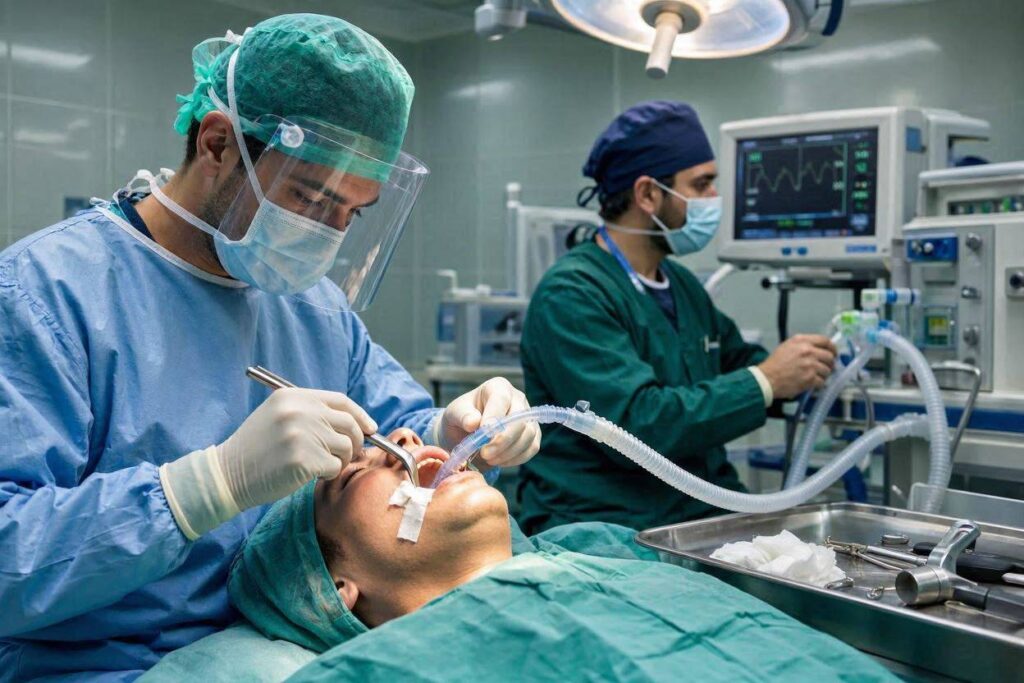
The most common intubation route for oral and maxillofacial surgery is nasotracheal intubation. The endotracheal tube is lubricated, passed gently through one nostril, navigated through the nasopharynx, visualized passing through the vocal cords with a laryngoscope, and seated in the trachea. The cuff is inflated to seal the trachea against fluid aspiration. The proximal end of the tube is then secured to the forehead with tape, and the anesthesia circuit snakes upward and out of the surgical field.
This route is chosen because the tube exits the face at the nose, not the mouth. The oral cavity is completely unobstructed. The surgeon has full access to the maxilla, the mandible, the teeth, and the palate without a tube competing for space. The mouth can be flooded with irrigant, packed with gauze, and suctioned aggressively, and the airway remains protected by the cuffed tube in the trachea. The surgical efficiency gain is immense.
The downside for the patient is nasal trauma. The tube can cause epistaxis (nosebleed) as it passes through the delicate nasal turbinates. A vasoconstrictor spray (oxymetazoline) is applied before intubation to shrink the mucosa and reduce bleeding. Post-operatively, the patient may have a sore nose and a mild sore throat from the tube passing through the larynx. These are transient and typically resolve within a day or two.
Orotracheal Intubation: When the Nose is Not an Option
In certain situations, the nasal route is contraindicated, and the tube goes through the mouth. Severe nasal obstruction, a history of nasal fractures or septal perforation, a coagulation disorder that increases the risk of uncontrollable epistaxis, or a need for the surgeon to access the nasal cavity itself (e.g., rhinoplasty combined with oral surgery) all push the intubation route to the oral cavity.
Orotracheal intubation places the tube directly in the surgeon’s way. The surgeon must work around it, retracting it, protecting it from the drill, and operating in the limited space remaining. Some procedures, like mandibular third molar removal, are still feasible with an oral tube tucked into the corner of the mouth. But for full-arch maxillary cases, an oral tube severely compromises access. The surgeon and anesthesiologist negotiate the operative field in real time, and the tube is a tolerated but unhelpful co-occupant.
Submental Intubation: The Hybrid Solution for Panfacial Trauma
A specialized technique worth mentioning, though rare in elective cosmetic practice, is submental intubation. This is used in cases of severe panfacial trauma where the nasal route is impossible (due to skull base fractures) and the oral route obstructs the surgical reduction of both the upper and lower jaw fractures.
The patient is intubated orally initially. Then the surgeon makes a small incision under the chin, tunnels through the soft tissue into the floor of the mouth, and the endotracheal tube is passed through this submental incision and secured externally. The oral cavity is now completely tube-free. The tube exits the face through a small wound under the chin, which is later sutured closed. This is a creative, elegant solution to the shared airway problem in maxillofacial trauma, and it exemplifies the ingenuity of surgical airway management.
The Laryngeal Mask Airway (LMA): A Less Invasive Alternative
A modern alternative to endotracheal intubation in selected oral surgery cases is the laryngeal mask airway (LMA). This is a supraglottic device—it sits above the glottis, not inside the trachea. It consists of an inflatable silicone mask that seals around the laryngeal inlet, connected to a breathing tube. It does not pass through the vocal cords. It is inserted blindly, often without a laryngoscope, and it causes less laryngeal irritation and coughing on emergence than an endotracheal tube.
The LMA is used for some outpatient oral surgery procedures, particularly in pediatric dental rehabilitation cases and short adult cases where muscle relaxation is not required. However, it has a critical limitation for oral surgery: it does not seal the trachea from pharyngeal debris. Blood and irrigant can pool above the LMA cuff and potentially trickle into the larynx. The LMA is acceptable for surgical procedures that produce minimal bleeding and require no heavy irrigation. For the wet, bloody field of extractions and implant osteotomies, an endotracheal tube with a high-volume, low-pressure cuff offers superior airway protection. The surgeon’s preference and the expected surgical fluid load determine the choice.
The Awake Fiberoptic Intubation: The Difficult Airway Plan
A subset of patients presents such a challenging airway that attempting to intubate after inducing general anesthesia would be reckless. Severe mandibular hypoplasia, a history of head and neck radiation with trismus, an unstable cervical spine, a massive odontogenic infection causing airway distortion—these patients cannot be “put to sleep” before the airway is secured, because if the intubation fails, the patient cannot be ventilated and will die.
For these cases, an awake fiberoptic intubation is performed. The patient is sedated but conscious, breathing spontaneously. The nasal and pharyngeal mucosa is anesthetized topically with lidocaine spray and nebulized lidocaine. The fiberoptic bronchoscope, a flexible cable with a camera at the tip, is passed through the nostril, past the vocal cords, and into the trachea. The endotracheal tube, which has been preloaded onto the bronchoscope, is then advanced over the scope into the trachea. Only after the tube is confirmed in place and the cuff is inflated is the patient anesthetized. This is the gold standard for the anticipated difficult airway, and it is a controlled, safe, and patient-tolerated procedure. The patient must be prepared psychologically for the sensation of the scope passing through the nose and the feeling of the vocal cords being sprayed with local anesthetic, which can trigger a brief coughing fit.
Comparative Table: Airway Management by Procedure Type
| Procedure | Anesthesia Depth | Airway Device | Tube in Trachea? | Aspiration Protection |
|---|---|---|---|---|
| Single Tooth Extraction | Local only. | None (spontaneous breathing). | No. | Intact reflexes. |
| Wisdom Teeth (Simple, 1-2) | Local + Nitrous/PO Sedation. | Nasal cannula O2. | No. | Intact reflexes; suction. |
| Wisdom Teeth (All Four, Impacted) | IV Deep Sedation. | Nasal trumpet / Throat pack. | No (usually). | Blunted reflexes; throat pack + suction. |
| Dental Implants (1-2) | Local or IV Sedation. | Unsecured or LMA. | No (usually). | Suction; LMA partial protection if used. |
| Full Arch Implants (All-on-4/6) | General Anesthesia. | Nasotracheal tube. | Yes. | Cuffed tracheal seal. |
| Orthognathic Jaw Surgery | General Anesthesia. | Nasotracheal tube. | Yes. | Cuffed tracheal seal. |
| TMJ Arthroscopy/Open Joint | General Anesthesia. | Nasotracheal tube. | Yes. | Cuffed tracheal seal. |
| Facial Trauma Reconstruction | General Anesthesia. | Submental or Oral tube. | Yes. | Cuffed tracheal seal. |
| Pediatric Full Mouth Rehab | General Anesthesia. | LMA or Oral tube. | Varies. | LMA partial; ETT full. |
What It Feels Like: The Patient Experience
For patients who are intubated, the tube is placed after they are unconscious and removed before they are fully awake. They have no memory of the tube being in their throat. The experience of “being intubated” is not a conscious one. The post-operative experience, however, often includes a sore throat, a hoarse voice, and a feeling of dryness and irritation that can last 24–48 hours. This is not a sign that something went wrong; it is a normal mechanical consequence of a foreign body passing through the larynx and the cuff pressing against the tracheal mucosa.
Patients who had nasotracheal intubation may also experience a mild nosebleed in the first few hours post-op, which is expected and managed with head elevation and gentle pressure. The nasal passage may feel obstructed on the side of the intubation for a few days due to mucosal swelling. Saline nasal spray and humidified air provide relief. The throat soreness is managed with warm salt water gargles, throat lozenges, and over-the-counter pain relief.
Important Note: The “I Was Awake” False Memory
A disconcerting phenomenon that occasionally occurs is intraoperative awareness under IV sedation without intubation. The patient has no memory of pain, but they recall hearing drilling, feeling vibration, or hearing voices. The amnestic quality of midazolam is dose-dependent, and some patients metabolize drugs differently. This is not a failure of airway management, but it can be psychologically traumatic. True awareness under general anesthesia with recall of pain is extremely rare (roughly 1 in 19,000 cases). The vast majority of patients who are intubated for oral surgery have zero awareness of the tube from placement to removal.
Conclusion
Whether you are intubated during oral surgery depends entirely on the anesthesia depth required: simple extractions under local anesthesia need no airway device, IV sedation for wisdom teeth typically avoids a tube but uses adjuncts like nasal trumpets and throat packs, while general anesthesia for complex procedures mandates a cuffed endotracheal tube—usually nasotracheal to keep the mouth free for the surgeon. The intubation is performed after you are unconscious and removed before you awaken, leaving only a temporary sore throat and, in the case of nasal tubes, a possible mild nosebleed as post-operative souvenirs.
FAQ
Q: Will I gag or choke during IV sedation without a breathing tube?
A: During properly titrated IV sedation, the gag reflex is depressed but not abolished. The surgeon and anesthesia provider continuously suction the posterior pharynx to prevent fluid accumulation. A throat pack is often placed to trap debris. The patient typically does not gag or choke because the sensory input that triggers the gag is blunted by the sedative medications, and the airway is actively managed. If any sign of airway compromise appears, the sedation is lightened or the airway is instrumented.
Q: Why can’t I just have local anesthesia for a complicated extraction?
A: You can choose local anesthesia alone, provided you are medically stable and psychologically prepared for the sensory experience. The limitation is not safety but tolerance. Prolonged mouth opening, the pressure of tooth elevation, the vibration of the surgical handpiece, and the taste of blood and irrigant are intense sensory inputs that many patients find overwhelming. Sedation is offered for comfort, not because local anesthesia is insufficient for surgical pain control. The choice is yours, with informed consent.
Q: Does intubation during oral surgery damage my vocal cords?
A: Permanent vocal cord injury from a routine, elective oral surgery intubation is extremely rare, occurring in less than 1 in 10,000 cases. The most common post-intubation symptom is transient hoarseness and a sore throat from the cuff pressing on the tracheal mucosa and the tube rubbing against the arytenoid cartilages during positioning. This heals spontaneously within a few days. Patients with pre-existing vocal cord pathology, or those undergoing prolonged head and neck procedures, have a higher risk profile and should discuss it with the anesthesia provider pre-operatively.
Additional Resource
For patient education materials on anesthesia types and airway management in dental settings, the American Society of Dentist Anesthesiologists provides accessible guides at www.asdahq.org.