Are Wisdom Teeth Becoming Obsolete?
The human body carries the architectural echoes of its ancestors. The appendix, a shrunken remnant of a once-capacious fermentation chamber. The tailbone, a vestigial whisper of a lost tail. The wisdom teeth, those late-erupting, frequently impacted, surgically extracted third molars, are widely understood by the public to be next on the evolutionary chopping block. The narrative is tidy and satisfying: we are evolving beyond these troublesome teeth, our jaws are shrinking, and eventually, nobody will have wisdom teeth at all. Like all tidy evolutionary narratives, the truth is messier, more interesting, and deeply revealing about the forces shaping our species in the present moment.
The question “Are wisdom teeth becoming obsolete?” demands an answer that distinguishes between evolutionary obsolescence—the loss of biological function over geological time—and clinical obsolescence—the prophylactic surgical removal that has become a rite of passage in developed nations. The wisdom tooth is functionally obsolete in the modern human masticatory apparatus; it contributes negligibly to chewing efficiency, frequently fails to erupt into functional occlusion, and is often removed before it can cause pathology. But it is not yet genetically obsolete. The majority of humans still develop one or more third molars. The evolutionary process of eliminating them is underway, driven by the same forces that shrank our jaws, but it is a slow, incomplete, and geographically variable process that will not reach completion for millennia, if ever. This article explores the paleontological evidence for jaw reduction, the genetics of third molar agenesis, the selective pressures—or lack thereof—that shape the fate of the wisdom tooth, and the clinical and cultural forces that have rendered the tooth obsolete long before evolution has finished its work.
The Paleontological Record: A Jaw in Retreat
The fossil record of the hominin lineage tells a clear story of progressive jaw reduction. Australopithecus afarensis, living over three million years ago, possessed a robust, prognathic jaw with large molars, including a fully functional third molar that erupted into occlusion and participated in the grinding of a tough, fibrous, plant-based diet. The jaw was large. The teeth were commensurate. The third molar was a valuable contributor to the masticatory surface area.
Homo erectus, appearing roughly two million years ago, shows a modest reduction in jaw and tooth size, correlating with evidence of tool use, meat consumption, and possibly the beginnings of food processing—pounding, cutting, and possibly cooking. The third molar was still present and functional but slightly reduced in size relative to the earlier hominins.
The Neanderthals, our closest extinct relatives, possessed large, heavily worn anterior teeth and a retromolar space—the area behind the third molar—that was frequently present, indicating a jaw long enough to accommodate the third molar without impaction. Neanderthal jaws were large and robust, and their third molars erupted into functional occlusion as part of a powerful masticatory apparatus.
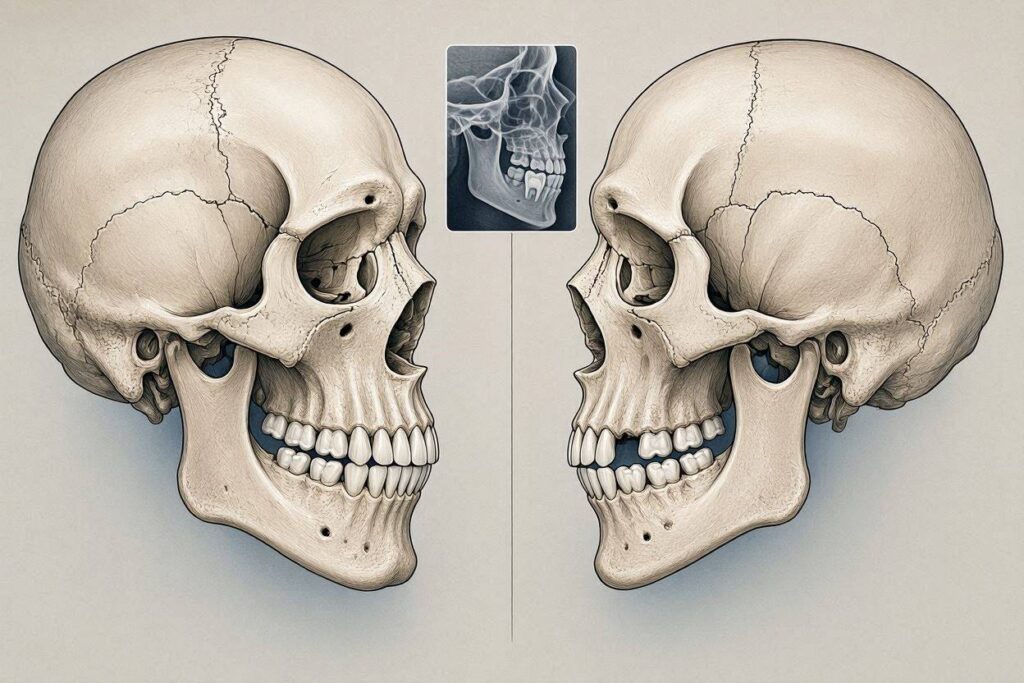
Anatomically modern Homo sapiens, emerging roughly 300,000 years ago, initially possessed jaws and teeth comparable to their archaic predecessors. But a dramatic acceleration in jaw reduction occurred in the last 10,000 years, coinciding with the Neolithic agricultural revolution. The shift from a hunter-gatherer subsistence strategy—characterized by tough, fibrous, unprocessed foods—to an agricultural one—characterized by softer, cooked grains and domesticated plant and animal foods—reduced the mechanical demands on the developing jaw. The mandible and maxilla became smaller and more retrusive. The teeth, genetically more conservative, reduced in size at a slower rate. The mismatch between jaw size and tooth size, which had been minimal in our Paleolithic ancestors, became pronounced. The third molar, as the last tooth to develop and erupt, was pushed out of the dental arch. Impaction, the hallmark of the modern wisdom tooth experience, became endemic.
The Genetics of Agenesis: PAX9, MSX1, and the Missing Molar
The evolutionary trajectory of the wisdom tooth is written in the human genome. Third molar agenesis—the congenital absence of one or more wisdom teeth—is the most common form of tooth agenesis, and its genetic basis is increasingly understood.
The development of teeth is governed by a complex network of signaling molecules, transcription factors, and growth factors, including PAX9, MSX1, AXIN2, and EDA. Mutations in these genes can cause failure of the dental lamina to initiate the third molar tooth bud. The third molar is particularly vulnerable to genetic perturbation because it is the last tooth to initiate development. The developmental cascade that forms the dentition proceeds from anterior to posterior. If the signaling gradient is slightly insufficient, the incisors, canines, premolars, and first and second molars may form normally, but the third molar bud fails to develop. The genetic threshold for third molar formation is simply not met.
Population studies show significant variation in third molar agenesis rates. Individuals of European ancestry have agenesis rates ranging from 15–25%. Asian populations show rates of 20–30%. African populations have the lowest rates, often under 10%. Indigenous populations in the Americas and the Arctic, who historically consumed a diet rich in animal protein and requiring vigorous mastication, tend to have lower agenesis rates. The genetic variation suggests that natural selection is operating—slowly, differentially, and in response to local dietary and masticatory demands—on the genes that control third molar development.
The Relaxation of Natural Selection: Why Evolution Is So Slow
The central paradox of wisdom tooth evolution is that the tooth is clearly maladaptive in modern humans—it causes pain, infection, cyst formation, and damage to adjacent teeth, all of which could, in an ancestral environment without surgery or antibiotics, reduce reproductive fitness—yet it persists at high frequency. The reason is that natural selection on the third molar has been relaxed by culture and medicine.
In a pre-industrial, pre-antibiotic, pre-surgical human population, a horizontally impacted third molar causing chronic pericoronitis, abscess formation, and eventual systemic sepsis was a potentially lethal condition. Individuals with genes promoting third molar agenesis—those who never developed the troublesome tooth—would have had a survival advantage. They would have lived longer, reproduced more successfully, and passed those agenesis-promoting genes to their offspring. Over hundreds of generations, the frequency of third molar agenesis would have increased.
In the modern industrialized world, that selective pressure has been largely removed. A teenager with impacted wisdom teeth undergoes a surgical extraction under local or general anesthesia, receives a course of prophylactic antibiotics, and recovers within a week. The condition that would have been lethal in the ancestral environment is now a routine outpatient procedure. The genes that promote third molar formation are not being weeded out of the population because their carriers survive and reproduce just as successfully as those with agenesis. The wisdom tooth has become a neutral genetic trait in much of the world: it does not kill, it does not impair fertility, and it does not reduce reproductive success. Its persistence is guaranteed by the very medical technology that treats its pathology. We have halted the evolution of the third molar by rendering it clinically manageable.
The Clinical Obsolescence: Prophylactic Extraction as a Cultural Adaptation
While biological evolution toward third molar agenesis proceeds at a glacial pace, a cultural adaptation has rendered the wisdom tooth clinically obsolete: prophylactic surgical extraction. The removal of asymptomatic, impacted third molars in adolescence or young adulthood, before the onset of pathology, is one of the most common surgical procedures performed worldwide. The rationale is that the tooth is likely to become pathological eventually—impaction is associated with pericoronitis, caries of the second molar, periodontal bone loss on the distal of the second molar, cyst formation, and root resorption of adjacent teeth—and that the surgical morbidity is lower in young, healthy patients with incompletely formed roots and elastic bone.
The practice is controversial. Evidence-based guidelines from organizations like the National Institute for Health and Care Excellence (NICE) in the United Kingdom have recommended against the routine prophylactic removal of asymptomatic, pathology-free impacted third molars, citing insufficient evidence of benefit to justify the surgical risk and healthcare cost. The American Association of Oral and Maxillofacial Surgeons (AAOMS) has maintained a more interventionist stance, emphasizing the predictable progression of pathology in impacted teeth and the lower morbidity of extraction in youth. The debate is ongoing, but the cultural reality in the United States and many other developed nations is clear: wisdom teeth are removed prophylactically, routinely, and at a population level.
This practice renders the tooth functionally obsolete regardless of its genetic status. A person who develops all four third molars and has them extracted at age 17 has the same clinical outcome as a person with complete third molar agenesis: a mouth with 28 teeth and no wisdom tooth pathology. The cultural practice of extraction has, in a sense, simulated the evolutionary outcome of agenesis. The tooth is present, removed, and functionally absent. Evolution has been bypassed by surgery.
The Functional Obsolescence: Does the Third Molar Still Do Anything Useful?
In a small percentage of individuals with well-developed jaws and fully erupted, functional third molars that are in occlusion with their opposing counterparts and are cleansable, the wisdom tooth does contribute to masticatory function. It provides an additional grinding surface, increasing chewing efficiency. In a person who has lost their first or second molar to decay and extraction, a healthy, erupted third molar can serve as an abutment for a fixed bridge or a partial denture. The tooth is not useless in these specific, favorable anatomical circumstances.
However, for the vast majority of people in industrialized societies, the third molar contributes negligibly to chewing function. The modern diet does not require the full grinding capacity of three molars per quadrant. The first and second molars provide sufficient occlusal surface area for the mastication of processed foods. The third molar, even when it erupts fully, is often difficult to clean, located far posteriorly where the toothbrush and floss cannot reach effectively. It is prone to caries and periodontal disease. Its contribution to function is marginal; its contribution to pathology risk is substantial. On balance, it is a liability, not an asset. It is a biological appendix in the mouth: present, occasionally functional, frequently problematic, and largely dispensable.
The Geographic and Ethnic Variation: Evolution in Progress
The significant variation in third molar agenesis rates across populations is one of the best examples of ongoing human evolution visible in a single generation. Populations with a long history of agriculture and processed food consumption—Europeans, East Asians—show higher agenesis rates. Populations with a historically hunter-gatherer or pastoralist subsistence strategy—many African populations, indigenous Arctic populations—show lower agenesis rates. This pattern is consistent with the hypothesis that reduced masticatory demand has relaxed the selective pressure maintaining the full 32-tooth dentition, allowing loss-of-function mutations in tooth development genes to accumulate.
The pattern is also visible within populations over time. Studies of European and North American populations have documented a secular increase in third molar agenesis rates over the past century. More people are being born without wisdom teeth than in previous generations. The trend is slow but measurable. If current trends continue, and assuming no dramatic change in dietary patterns or medical intervention, third molar agenesis will become increasingly common. The tooth will not disappear in a few generations; evolutionary time is far longer than human generations. But over millennia, the trajectory is clear. The wisdom tooth is on the way out. It is just taking its time.
The Third Molar in the Context of the Shrinking Human Jaw
The obsolescence of the wisdom tooth is part of a broader evolutionary trend: the reduction of the human masticatory apparatus. The jaw is shrinking. The teeth are becoming smaller, though at a slower rate. The face is becoming flatter and more retrusive. The inter-canine width is narrowing. The entire craniofacial complex is being reshaped by the reduced mechanical demands of a modern diet.
This trend has consequences beyond the third molar. Orthodontic crowding—the discrepancy between tooth size and arch length—is increasingly common, requiring braces, extractions, or expansion to accommodate the full complement of teeth. Sleep-disordered breathing, including obstructive sleep apnea, is on the rise, linked in part to the retrusive position of the mandible and the narrowing of the pharyngeal airway. The shrinking jaw is not just a dental problem; it is a craniofacial and respiratory problem with wide-ranging health implications.
The wisdom tooth is the canary in the coal mine of jaw reduction. Its impaction is the first and most visible sign that the jaw is no longer large enough to house the dentition. The solution, from an evolutionary perspective, is the gradual elimination of the tooth. The solution, from a clinical perspective, is extraction. The solution, from a public health perspective, may one day involve early interventions to promote jaw growth—myofunctional therapy, early orthodontic expansion, and dietary changes that encourage vigorous chewing during the critical developmental window of childhood. These interventions may address the underlying cause of impaction, not just the symptom.
The Future of the Wisdom Tooth: A Prediction
Based on current evolutionary, genetic, and clinical trends, the following predictions can be made with reasonable confidence. First, third molar agenesis will continue to increase in frequency in populations with long histories of agriculture, processed diets, and medical intervention. Second, the wisdom tooth will not disappear within the foreseeable future—the next few centuries will still see a majority of humans developing at least one third molar. Third, prophylactic extraction will remain the standard of care in developed nations, rendering the tooth clinically obsolete regardless of its genetic persistence. Fourth, advances in genetics may eventually allow for the prenatal identification of third molar agenesis and, more speculatively, for the genetic “silencing” of third molar development, a form of elective genetic modification that would eliminate the tooth without surgery. Fifth, the shrinking human jaw will continue to present challenges for orthodontics, sleep medicine, and craniofacial development, and the wisdom tooth will remain a marker of this ongoing evolutionary transition.
Conclusion
Wisdom teeth are functionally and clinically obsolete in modern humans, contributing negligibly to chewing efficiency in the context of a processed diet while posing significant risks of impaction, infection, and damage to adjacent teeth, but they are not yet genetically obsolete; the majority of humans still develop them, and the evolutionary process of eliminating them through third molar agenesis is slow, geographically variable, and slowed further by modern medicine’s removal of the selective pressure that once penalized the impacted tooth. The wisdom tooth’s trajectory mirrors that of the human jaw itself—shrinking, retruding, and struggling to accommodate a dentition inherited from our robust-jawed ancestors. The tooth is fading from our species, but it is doing so at an evolutionary pace, not a generational one.
FAQ
Q: Will my children be born without wisdom teeth if I had mine removed?
A: No. The removal of your wisdom teeth is a surgical procedure that does not alter your DNA. Your children will inherit your genes for third molar development or agenesis, unaffected by your extraction. If you developed wisdom teeth, your children have a higher likelihood of developing them as well, though the inheritance is complex and influenced by multiple genes and environmental factors.
Q: If wisdom teeth are becoming obsolete, why do we still have them?
A: Evolution is slow, and natural selection on the third molar has been relaxed by modern medicine and diet. A trait that would have been lethal in an ancestral environment—an impacted, infected wisdom tooth—is now a routine surgical problem. The genes that cause third molar formation are not being removed from the population because their carriers survive and reproduce. The tooth persists because there is no strong selective pressure against it in the modern world. Evolution has not “finished the job” because we have effectively halted the selective process that would have driven the tooth to extinction.
Q: Can I keep my wisdom teeth if they are not causing any problems?
A: Yes, if your wisdom teeth are fully erupted, in functional occlusion, cleansable, free of caries and periodontal disease, and have no associated pathology on radiographic examination, they can be maintained and monitored. This requires meticulous oral hygiene—the third molar’s posterior position makes it difficult to clean—and regular dental checkups with radiographs to detect any developing pathology early. Your dentist or oral surgeon can help you weigh the risks of retention against the risks of extraction and make a personalized recommendation.
Additional Resource
For a comprehensive review of the evolutionary biology of the human dentition, third molar agenesis genetics, and the clinical evidence on prophylactic extraction, the Journal of Dental Research and the American Association of Oral and Maxillofacial Surgeons (www.aaoms.org) provide peer-reviewed resources accessible to clinicians and informed patients.