How Many Dental Implants Can Be Done At Once? Understanding Multiple Implant Procedures
A patient with failing teeth looks in the mirror and sees a mouth that needs extensive work. Years of neglect, dental anxiety, or systemic health issues have taken their toll. Now they are ready to move forward. The question that dominates their consultation is straightforward: How many implants can be placed in one surgery? Can the entire mouth be done at once? The answer depends on a complex interplay of anatomy, health status, surgical considerations, and treatment goals.
This guide explores the reality of multiple dental implant placement. We examine single-tooth replacement, multiple adjacent implants, and full-arch rehabilitation. We address the surgical limits, the healing considerations, and the patient experience. The information aims to provide a realistic, thorough understanding for anyone considering extensive implant treatment.
Defining the Scope: What “At Once” Means
The phrase “at once” requires clarification. It can mean a single surgical appointment, which may last several hours, but it is one episode of anesthesia and one recovery period. It does not mean a single implant site. The question asks how many separate implant fixtures can be surgically placed in that single session.
Single Surgical Session Versus Staged Surgeries
A single surgical session places all planned implants in one visit. Staged surgeries divide the placements into two or more separate appointments, separated by weeks or months of healing. The choice between these approaches depends on the patient’s tolerance, the need for adjunctive procedures, and the clinician’s judgment.
The Difference Between Implant Placement and Restoration
Placing the implant fixture into the bone is the surgical phase. Attaching the tooth or teeth to the implants is the restorative phase. These phases are separate in time. This guide focuses primarily on the surgical placement phase: how many fixtures can be placed in one operation.
The Range of Possibilities: From One to Full-Arch
At the simplest level, the answer is that anywhere from one implant to an entire arch of implants can be placed in a single surgery. But each scenario carries different considerations.
Single Tooth Replacement
One implant replaces one missing tooth. This is the most straightforward scenario. The surgery is short, well-tolerated, and associated with minimal postoperative discomfort. There is virtually no upper limit on how many single implants can be placed over a lifetime, but these are typically staged over multiple visits.
Multiple Single Implants in One Surgery
A patient missing three teeth in different areas of the mouth might have three separate implants placed in one surgical appointment. This is routine, provided the sites are not all in the same quadrant, which would extend surgical time and patient discomfort. The limiting factor here is the patient’s ability to tolerate a longer procedure and the surgeon’s desire to avoid excessive surgical trauma in one visit.
Adjacent Implants: Replacing Multiple Missing Teeth in a Row
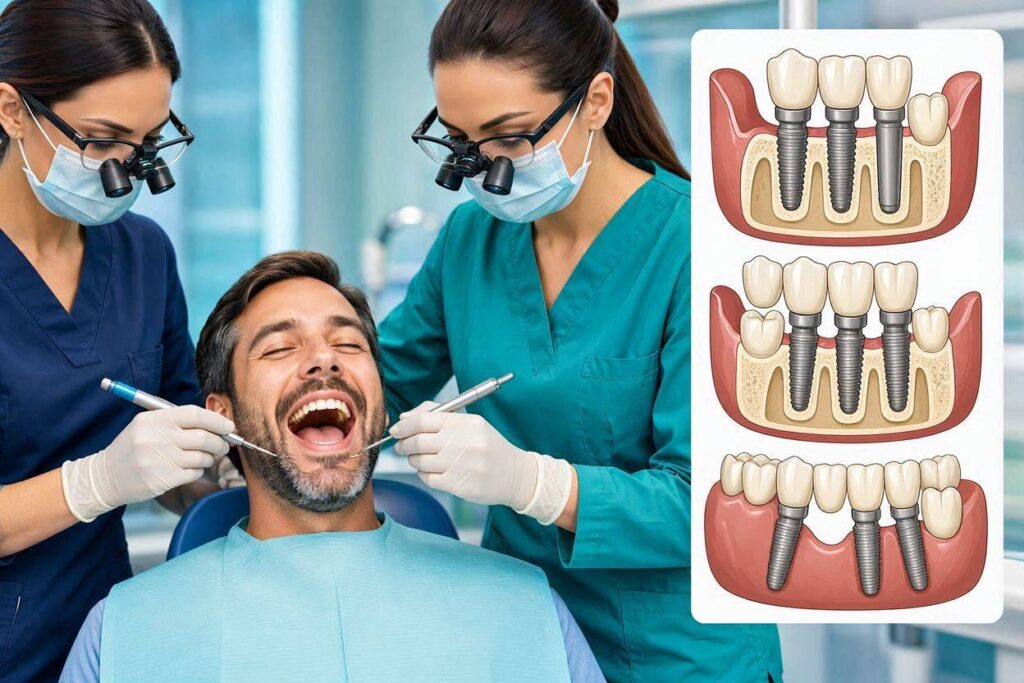
When two, three, or four teeth are missing in a row, adjacent implants can be placed to support a fixed bridge. Placing three adjacent implants in one quadrant is a moderately complex surgery. The surgeon must manage flap design, precise spacing to preserve the bone and papilla between implants, and the challenge of achieving primary stability in multiple sites simultaneously.
Full-Arch Rehabilitation: All-on-Four, All-on-Six, and Beyond
The most dramatic answer to “how many” is the full-arch immediate load procedure. Four to eight implants are placed in a single jaw in one surgery. A temporary fixed bridge is attached the same day. This approach transforms an entire arch of missing or hopeless teeth in hours. It is the maximum number of implants typically placed in a single session.
Factors Limiting the Number of Implants in One Surgery
Several biological and practical factors impose limits.
Surgical Duration and Patient Tolerance
Implant surgery is performed under local anesthesia, with or without sedation. A single implant may take 30 to 60 minutes of surgical time. Placing eight implants and extracting remaining teeth could take three to five hours. The patient must be able to remain comfortable and cooperative for that duration. Prolonged mouth opening strains the temporomandibular joints. The surgeon must balance efficiency with patient comfort.
Amount of Local Anesthetic
There is a maximum safe dose of local anesthetic, typically based on the patient’s weight. Multiple implant sites require large volumes of anesthetic, especially when combined with extractions. The surgeon calculates the maximum allowable dose and may need to stage the surgery if it cannot be safely achieved in one visit.
Bleeding and Surgical Trauma
Each osteotomy site bleeds. The collective surgical trauma from multiple implants induces a systemic inflammatory response. In a healthy patient, this is manageable. In a patient with compromised health or taking anticoagulants, the cumulative bleeding risk may favor staging.
Bone Volume and Quality at Each Site
Not every implant site is equal. One site may have abundant dense bone and achieve excellent primary stability easily. An adjacent site may have a bony defect requiring grafting. If bone grafting is extensive, the surgeon may choose to place implants in sites with good bone in one surgery and return for the grafted site after healing.
Need for Adjunctive Procedures
If a patient requires sinus lifts, ridge augmentation, or nerve repositioning, these procedures are often staged separately or combined with implant placement only if the surgeon deems it safe. Combining a major sinus lift with multiple anterior implant placements in one surgery increases operative time, swelling, and risk of complications.
The All-on-Four Concept: Maximum Implants in One Session
The All-on-Four treatment concept deserves detailed explanation as the extreme case of multiple implant placement.
The Surgical Protocol
Four implants are placed in an edentulous jaw. The two posterior implants are tilted to avoid anatomical structures and to increase the anteroposterior spread. The two anterior implants are placed axially. In many cases, failing teeth are extracted during the same surgery. The implants achieve high primary stability. A prefabricated or chairside-constructed temporary fixed bridge is attached immediately.
Why Four, Not More or Fewer?
Research and clinical experience have established that four implants, strategically positioned and splinted with a rigid prosthesis, can support a full arch of teeth predictably. Fewer than four implants risks overload and failure of the prosthesis. More than four implants adds surgical time, cost, and complexity with diminishing mechanical benefit, though some clinicians prefer five or six implants for added security.
The All-on-Six Variation
For patients with adequate bone, placing six implants distributes the load further and provides redundancy. If one implant fails, the remaining five can still support the prosthesis. This is a consideration for patients with risk factors for implant failure. The surgical appointment for six implants is longer but still well within the range of a single session.
Zygomatic Implants for Extreme Maxillary Resorption
In the severely resorbed maxilla where even tilted implants cannot achieve adequate anchorage, zygomatic implants anchor in the zygomatic bone. Typically, two zygomatic implants and two to four conventional anterior implants are placed in one surgery. This is advanced implant surgery requiring an experienced surgeon, often performed under general anesthesia. The number of implants in this scenario is four to six, with two being the specialized zygomatic fixtures.
Medical Considerations That Limit Multiple Implant Surgery
Systemic health factors influence how many implants can be safely placed.
Diabetes and Healing Capacity
Uncontrolled diabetes impairs wound healing and osseointegration. A diabetic patient with poor glycemic control should not undergo extensive implant surgery. Staging the procedures and optimizing blood glucose levels between surgeries improves outcomes. A well-controlled diabetic may tolerate full-arch surgery, but the surgeon exercises caution.
Bleeding Disorders and Anticoagulation
Patients taking warfarin, direct oral anticoagulants, or antiplatelet medications have a higher risk of bleeding. Multiple implant sites compound this risk. The surgeon consults with the patient’s physician to determine if medications can be safely paused and how many sites can be managed in one surgery.
History of Head and Neck Radiation
Irradiated bone heals poorly and has a reduced capacity for osseointegration. Implant surgery in irradiated jaws carries a risk of osteoradionecrosis. Surgeons are extremely cautious, typically limiting the number of implants placed and often recommending hyperbaric oxygen therapy preoperatively.
Immune Compromise
Patients on immunosuppressive medications or with immune disorders face increased infection risk and compromised healing. Extensive implant surgery in one session may overwhelm their capacity to heal.
The Surgical Experience: What Multiple Implant Placement Feels Like
For patients considering multiple implants, understanding the intraoperative experience reduces anxiety.
Anesthesia and Sedation Options
Local anesthesia is mandatory. Most patients undergoing placement of more than two implants opt for some form of sedation. Oral conscious sedation with benzodiazepines reduces anxiety. Intravenous moderate sedation provides deeper relaxation and amnesia. General anesthesia is available for extensive full-arch cases, particularly those involving zygomatic implants or anxious patients.
The Sequence of the Surgery
The surgeon begins with any necessary extractions. The extraction sockets are debrided thoroughly. Then implant osteotomies are prepared sequentially at each site using drills of increasing diameter under copious irrigation. The implants are placed and torqued to final seating. Cover screws or healing abutments are placed. The flap is sutured. If immediate loading is planned, abutments and the provisional prosthesis are attached. The patient is aware of pressure and vibration but not sharp pain.
Postoperative Recovery from Multiple Implants
Placing eight implants creates more swelling, bruising, and discomfort than placing one. The patient must prepare for a recovery period of several days to a week. Ice packs, pain medication, antibiotics if prescribed, and a liquid or soft diet are standard. The body heals all the surgical sites simultaneously. Adequate rest, nutrition, and hydration support this healing.
Table: Number of Implants Versus Surgical Characteristics
| Number of Implants | Typical Surgical Time | Sedication Recommended | Postoperative Discomfort | Typical Scenario |
|---|---|---|---|---|
| 1 | 30-60 minutes | None or minimal oral sedation | Mild | Single missing tooth |
| 2-3 | 60-120 minutes | Oral or IV sedation | Moderate | Multiple adjacent missing teeth |
| 4-6 | 120-180 minutes | IV sedation | Moderate to significant | Full-arch (All-on-Four/All-on-Six) |
| 7-8+ | 180-300 minutes | IV sedation or general anesthesia | Significant | Full-arch with additional implants |
| Zygomatic + conventional | 240-360 minutes | General anesthesia | Significant to major | Severe maxillary resorption |
The Balance Between Efficiency and Safety
A single long surgery is efficient in terms of total treatment time and number of anesthesia exposures. However, the surgeon must judge whether the patient is better served by one long procedure or two shorter ones.
Arguments for Staging
- Reduced postoperative pain and swelling per episode.
- The surgeon can assess healing and osseointegration of the first set before placing more.
- Complications such as infection at one site do not jeopardize all implants.
- The patient can financially plan for each stage.
Arguments for a Single Surgery
- Fewer episodes of anxiety and anesthesia exposure.
- Reduced total recovery time away from work.
- Immediate improvement in function and esthetics when immediate loading is used.
- Often lower total cost due to consolidated fees.
How Many Implants Can a Surgeon Place in a Lifetime Versus in One Day?
The question is sometimes about the long-term plan.
Cumulative Lifetime Implants
A patient with aggressive periodontal disease may lose teeth over decades. They may eventually receive eight, ten, or more implants over a lifetime, placed in multiple surgeries spaced years apart. There is no upper limit to how many implants a person can have over a lifetime, as long as each is placed in healthy bone and maintained properly.
Implants Per Jaw
An upper or lower jaw can accommodate six to eight implants comfortably in most patients. Beyond eight implants, spacing becomes problematic, and the prosthetic reconstruction becomes overly complex. More implants do not necessarily mean a better result. Strategic placement matters more than sheer number.
The Role of Computer-Guided Surgery in Multiple Implant Placement
Technology has made placing many implants in one session safer and more predictable.
Preoperative Virtual Planning
The surgeon uses CB-CT data and implant planning software to virtually place all implants before the surgery day. The positions are prosthetically driven, meaning the final tooth position dictates implant placement, not just bone availability. This virtual plan ensures adequate spacing and avoids anatomical hazards.
Surgical Guides
A 3D-printed surgical guide transfers the virtual plan to the patient’s mouth. The guide fits over the teeth or bone. It has metal sleeves that direct the drills into precisely planned positions. For full-arch cases, a guide can reduce surgical time, improve accuracy, and increase the likelihood of achieving adequate primary stability at all sites.
Dynamic Navigation
Some surgeons use dynamic navigation systems that track drill position in real-time on a screen, similar to GPS. This technology is especially useful for multiple adjacent implants where precise spacing is critical.
Financial Considerations for Multiple Implant Surgery
The number of implants directly impacts the cost.
Fee Structures
Surgeons typically charge a fee per implant placed. Some offer a package fee for full-arch procedures like All-on-Four, which may be lower than the sum of individual implant fees plus the prosthesis. Patients should request a detailed treatment plan with all surgical and restorative fees itemized.
Insurance and Annual Maximums
Dental insurance policies have annual maximum benefits, often $1,500 to $3,000. Placing six implants in one year will exceed that maximum. The patient pays the balance. Some plans may cover a portion of the implant or the crown. Staging implants across two calendar years can sometimes maximize insurance benefits.
Financing Options
Many practices offer third-party financing for extensive implant treatment. CareCredit, LendingClub, and similar companies provide extended payment plans. The total fee for full-arch rehabilitation can be substantial, and financing makes it accessible.
Realistic Healing Timelines After Multiple Implant Surgery
Healing after placing eight implants takes no longer biologically than healing after one. All sites heal simultaneously. However, the patient’s systemic response is larger, and the prosthesis may be more complex.
Immediate Postoperative Period: Days 1-7
Swelling peaks at 48 to 72 hours. Bruising may appear. Pain is managed with prescribed medications. A liquid diet is maintained. Oral hygiene is limited to prescribed rinses.
Early Healing: Weeks 2-8
Swelling resolves. Sutures dissolve or are removed. The patient transitions to a soft mechanical diet. The implants undergo osseointegration undisturbed. If a temporary prosthesis is in place, dietary restrictions remain strict.
Osseointegration Phase: Months 2-6
The implants become firmly integrated. The restorative phase begins. Impressions are taken. The final prosthesis is fabricated and delivered. The patient gradually returns to a normal diet.
Conclusion
The number of dental implants that can be placed in one surgical session ranges from a single fixture to a full arch of four to eight implants, with the All-on-Four and All-on-Six concepts representing the upper limit in routine practice. The decision balances surgical time, patient health status, bone quality, need for adjunctive grafting, and the patient’s tolerance for a longer procedure and recovery. Advances in imaging, surgical guides, and sedation have made extensive single-session implant surgeries safe and predictable for appropriate candidates. The goal is always a well-planned, prosthetically driven outcome that restores function and esthetics without compromising patient safety or long-term implant success.
Frequently Asked Questions
What is the maximum number of dental implants you can have in one day?
In routine practice, up to eight implants per arch can be placed in one surgical session. Full-arch procedures like All-on-Four place four to six implants. Extremely complex cases with zygomatic implants may involve four to six fixtures.
Is it painful to have multiple implants placed at once?
The procedure is performed under local anesthesia with sedation, so you should feel no pain during surgery. Postoperative discomfort increases with the number of implants placed but is well-managed with medications and resolves over several days.
Can I have implants placed in both upper and lower jaws on the same day?
Technically possible but rarely recommended. The surgical time, swelling, and recovery would be extreme. Most surgeons stage upper and lower arch surgeries separately, months apart.
How long does it take to place a full arch of implants?
A full-arch procedure like All-on-Four typically takes two to four hours of surgical time, including any necessary extractions and attachment of the temporary prosthesis.
Does insurance cover multiple implants in one surgery?
Dental insurance typically covers a portion of the implant or crown, subject to annual maximums that are quickly exhausted by multiple implants. Medical insurance may cover aspects of the surgery if there is a documented medical necessity.
Additional Resources
American College of Prosthodontists – Dental Implants
https://www.gotoapro.org
Information on implant treatment options, including full-arch rehabilitation, from the specialists in tooth replacement and restoration.