Will Face Repair After Dental Implants?
A patient looks in the mirror months after receiving dental implants. Something seems different about their face. The cheeks look fuller, or perhaps the lips sit differently. The jawline seems more defined. The question arises: Did the dental implants change my face? Will my face repair itself after years of tooth loss and bone resorption?
The relationship between dental implants and facial appearance is complex and often misunderstood. Implants do not directly lift sagging skin or erase wrinkles. However, by replacing missing teeth and the associated bone stimulation, they can create profound, positive changes in facial support and appearance. This guide explores the realistic effects of dental implants on facial structure, what patients can expect, and what implants cannot do.
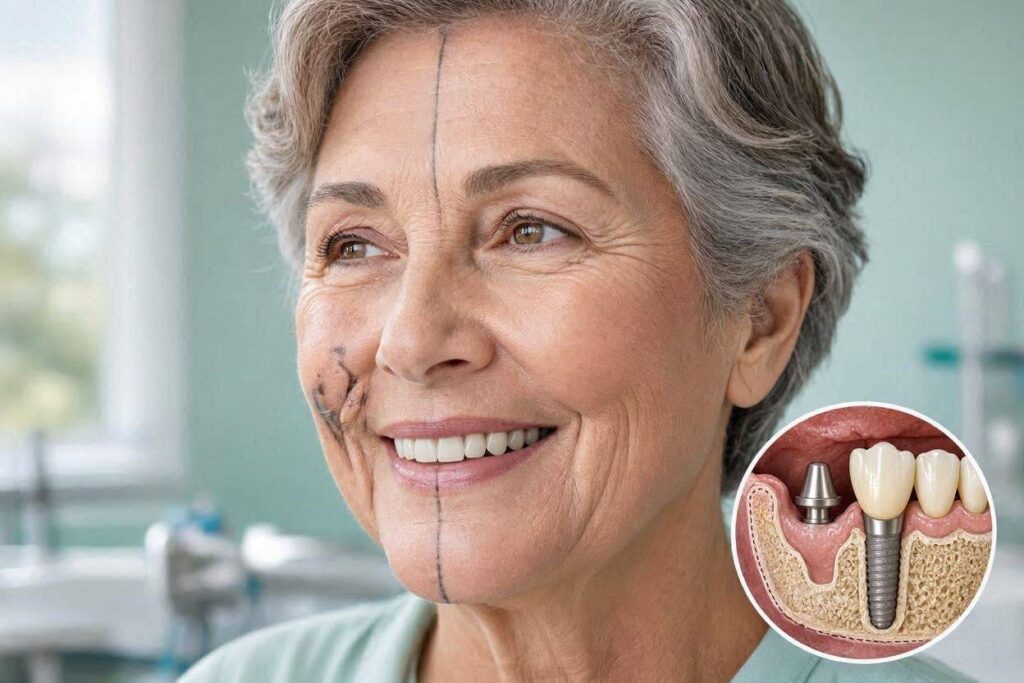
The Anatomy of Facial Collapse: What Tooth Loss Does to the Face
To understand how implants might repair the face, one must first understand how tooth loss damages it.
The Alveolar Bone and Facial Support
The alveolar bone is the portion of the jawbone that houses and supports the teeth. This bone provides the foundation for the lips and cheeks. It gives height to the lower third of the face. When teeth are present and healthy, the alveolar bone is full and robust, maintained by the constant mechanical stimulation of chewing forces transmitted through the teeth.
The Resorption Cascade
When teeth are lost, the mechanical stimulus disappears. The alveolar bone begins to resorb. The process is most rapid in the first year after extraction but continues throughout life. The width of the ridge shrinks. The height diminishes. The mandible and maxilla become progressively atrophic.
The Visible Consequences
As the alveolar bone disappears, the overlying soft tissue loses its support. The lips, which were once supported by the teeth and bone, collapse inward. The distance from the nose to the chin decreases, a phenomenon known as loss of vertical dimension. Deep nasolabial folds, the lines from the nose to the corners of the mouth, become more pronounced. Marionette lines, extending downward from the corners of the mouth, deepen. The chin rotates forward and upward, giving the face a prognathic appearance. The cheeks hollow. The entire lower face takes on a collapsed, aged appearance.
The Denture Acceleration
Wearing conventional complete dentures accelerates bone loss. The denture rests on the gum and transmits chewing forces to the surface of the ridge. This pressure, rather than the tensile and compressive forces within the bone that natural teeth provide, stimulates further resorption. Over decades, denture wearers lose so much bone that the ridge becomes flat or even concave.
How Dental Implants Affect Facial Structure
Implants address the root cause of facial collapse: the loss of bone stimulation.
The Root Replacement Effect
A dental implant replaces the missing tooth root. It transmits chewing forces into the bone, providing the mechanical stimulus that signals the body to maintain bone density. The bone around the implant is preserved. This preservation of alveolar bone is the primary mechanism by which implants contribute to facial repair.
Preservation, Not Regeneration
A critical distinction must be made. Dental implants preserve existing bone. They do not regenerate bone that has already been lost. If a patient has been edentulous for twenty years and has severe ridge atrophy, placing implants will stop further bone loss but will not restore the lost bone volume. The facial collapse that has already occurred is not reversed by the implants themselves. To restore lost bone volume, separate bone grafting procedures are required.
The Prosthetic Contribution
The implant-supported prosthesis, whether a fixed bridge, a full-arch restoration, or an implant-retained overdenture, replaces not only the teeth but also some of the volume previously occupied by bone and soft tissue. The prosthesis provides lip and cheek support. The artificial teeth restore the proper vertical dimension. The facial changes a patient sees after implant treatment are largely due to this prosthetic restoration of lost contours, rather than a biological reversal of aging.
What Dental Implants Can Do for Facial Appearance
Realistic, observable improvements occur.
Restoration of Lip Support
Missing teeth, especially anterior teeth, allow the upper lip to collapse. An implant-supported fixed restoration provides a scaffold that pushes the lip back into its proper position. The vermilion border, the edge of the lip, becomes more visible. The lip no longer inverts or disappears when smiling.
Improvement in Vertical Dimension
Years of tooth wear and tooth loss reduce the vertical height of the lower face. The chin and nose appear closer together. An implant-supported prosthesis restores the proper bite height. This lengthens the lower face slightly, creating a more youthful proportion between the upper, middle, and lower thirds of the face.
Filling of Buccal Corridors
The buccal corridors are the dark spaces between the teeth and the cheeks when a person smiles broadly. Tooth loss narrows the dental arch, increasing these corridors and giving the smile a dark, empty appearance. Full-arch implant restorations widen the arch and fill the buccal corridors, creating a fuller, more youthful smile.
Support of the Lower Third of the Face
By maintaining bone and providing prosthetic volume, implants prevent the progressive collapse of the lower face. A patient who receives implants relatively soon after tooth loss can maintain their facial contours for decades. The implant-supported restoration replaces the support that the natural teeth once provided.
What Dental Implants Cannot Do for the Face
Managing expectations is as important as delivering care.
They Cannot Tighten Loose Skin
Sagging jowls, loose neck skin, and deep wrinkles are the result of changes in the skin’s elasticity, loss of subcutaneous fat, and the effects of gravity over time. Dental implants do not tighten skin. A facelift addresses skin laxity. Implants address the underlying bony and dental support.
They Cannot Reverse Long-Standing Bone Loss Without Grafting
If the alveolar ridge has severely atrophied, the implants alone will not rebuild it. The patient will still have a deficient ridge. The prosthesis may need to be bulkier than ideal to compensate for the lost bone and soft tissue volume. In some cases, bone grafting or soft tissue grafting is required in conjunction with implants to achieve an optimal facial result.
They Cannot Correct Skeletal Deformities
A patient with a significant class II or class III skeletal jaw discrepancy will still have that discrepancy after implants. Orthognathic surgery corrects skeletal deformities. Implants replace teeth. The two can be combined in comprehensive treatment plans, but implants alone do not move jaws.
They Cannot Stop the Aging Process
The face continues to age. The skin continues to lose elasticity. Fat pads atrophy and descend. Implants slow the dental and bony component of facial aging but do not halt the soft tissue aging process.
Facial Changes After Specific Implant Treatments
Different implant treatments affect the face differently.
Single Tooth Implants
A single posterior implant has a negligible effect on facial appearance. A single anterior implant, especially in the maxillary arch, can have a noticeable positive effect on lip support and smile esthetics. The effect is localized to the area of the missing tooth.
Multiple Implant-Supported Bridges
Replacing several missing teeth with an implant-supported bridge restores more significant volume and support. The prosthetic teeth and pink ceramic or acrylic used to replace lost gum and bone tissue fill out the collapsed area.
Full-Arch Implant-Supported Fixed Prostheses
This is where the most dramatic facial changes occur. A patient who has been wearing a complete denture for years receives an All-on-Four or similar fixed prosthesis. The transformation can be remarkable. The lips are supported. The vertical dimension is restored. The smile is full. The patient looks younger and healthier. This transformation is primarily prosthetic, not biological. The implants themselves preserve the remaining bone, but the prosthesis provides the visible facial support.
Implant-Retained Overdentures
An overdenture snapped onto implants provides better retention than a conventional denture but does not support the face as fully as a fixed prosthesis because it is removable and has less bulk. However, it still provides significantly better support than a loose, unsupported denture.
Table: Facial Effects of Different Tooth Replacement Options
| Treatment | Lip Support | Vertical Dimension | Cheek Support | Bone Preservation |
|---|---|---|---|---|
| No replacement | Poor, progressive loss | Diminishing over time | Poor | None, ongoing resorption |
| Conventional denture | Moderate, deteriorates as bone resorbs | Maintained with relines | Moderate | None, denture accelerates loss |
| Implant-retained overdenture | Good | Maintained | Good | Preserves bone at implant sites |
| Implant-supported fixed bridge | Good to excellent | Restored and maintained | Good | Preserves bone at implant sites |
| Full-arch fixed prosthesis | Excellent | Restored and maintained | Excellent | Preserves bone at implant sites |
The Role of Bone Grafting in Facial Repair
When bone loss has already occurred, grafting can restore what implants cannot.
Alveolar Ridge Augmentation
Bone grafting to rebuild the width and height of the alveolar ridge restores the foundation for facial support. This grafting is performed before or at the time of implant placement. The regenerated bone provides the substrate for the implants and also restores facial contours lost to resorption.
Onlay Grafting for Severe Atrophy
In cases of severe ridge resorption, large block bone grafts harvested from the patient’s mandible, iliac crest, or tibia can rebuild the jaw. This is a significant surgical procedure. The restored bone allows for implant placement and dramatically improves facial support.
Zygomatic Implants as an Alternative to Grafting
For the severely resorbed maxilla, zygomatic implants that anchor in the zygomatic bone avoid the need for extensive grafting. The prosthesis can then be designed with adequate facial support, even though the alveolar bone was not rebuilt. The facial result is prosthetic, not biologic.
The Timeline: When Facial Changes Become Visible
Patients should understand when to expect changes.
Immediate Postoperative Period
After implant surgery, there is swelling. The face may look fuller, but this is temporary fluid and inflammation, not a true facial change. As swelling resolves over one to two weeks, the face returns to its preoperative appearance.
After Prosthetic Delivery
The moment the fixed prosthesis or overdenture is placed, the facial changes are immediately visible. The teeth are in position. The vertical dimension is set. The lips are supported. This is when the patient sees the result.
Long-Term Maintenance
Over the years, the implants preserve bone. The face does not undergo the progressive collapse seen with conventional dentures. The facial support provided by the prosthesis remains stable, assuming the prosthesis is maintained and adjusted as needed.
Case Study: The Denture Wearer’s Transformation
A 65-year-old patient has worn complete dentures for twenty years. Her face shows typical denture collapse: thin lips, deep nasolabial folds, and a shortened lower face. She receives four maxillary and four mandibular implants with fixed full-arch prostheses.
At the delivery appointment, the change is profound. The new teeth restore her vertical dimension by several millimeters. The fixed prostheses have buccal flanges that support her lips and fill her cheeks. She looks ten years younger. The implants will preserve her remaining bone and prevent further collapse. The initial bone loss she experienced during her two decades of denture wear is not reversed, but the prostheses compensate for it.
This case illustrates that the “repair” is a combination of bone preservation by the implants and facial support provided by the well-designed prostheses.
When Patients Are Unhappy with Facial Changes After Implants
Occasionally, a patient perceives a negative change.
The Overbuilt Prosthesis
If the prosthesis is too bulky in an attempt to compensate for bone loss, the patient may feel the face looks puffy or unnatural. Careful prosthetic design and a try-in appointment with wax mockup allow the patient and clinician to evaluate the esthetics before the final prosthesis is fabricated.
The Underbuilt Prosthesis
If the prosthesis does not provide adequate lip support, the patient may still look collapsed in the mouth area. The restorative dentist must balance functional needs with esthetic demands.
Unrealistic Expectations
Some patients expect implants alone to give them a facelift. When the jowls and wrinkles remain, they are disappointed. The preoperative consultation must include a frank discussion of what implants can and cannot do for facial esthetics. Showing before-and-after photos of similar cases helps calibrate expectations.
Conclusion
Dental implants contribute to facial repair primarily by preserving the alveolar bone that would otherwise resorb and by serving as anchors for prostheses that restore lip support, vertical dimension, and arch fullness. They do not regenerate lost bone without grafting, tighten loose skin, or reverse soft tissue aging. The most dramatic facial transformations occur with full-arch fixed implant prostheses, which replace not only teeth but also the facial support lost to years of resorption. The result is a biologically stable foundation and a prosthetically restored facial appearance that can take years off a patient’s appearance and maintain that support for decades.
Frequently Asked Questions
Will dental implants make me look younger?
Implants, combined with a well-designed prosthesis, can restore lost facial support and vertical dimension, which often creates a more youthful appearance. They do not tighten skin or eliminate wrinkles.
Can dental implants fix sagging jowls?
No. Jowls result from skin laxity and gravity. Implants address the bony and dental support, not the skin. Surgical procedures like a facelift address sagging jowls.
How soon after implant surgery will I see facial changes?
The permanent facial changes are visible when the final prosthesis is delivered, typically three to six months after implant placement. Postoperative swelling creates temporary facial fullness.
Will my face continue to change after I get implants?
The bone around the implants will be preserved. The facial aging process, including skin changes and fat pad atrophy, will continue. Implants arrest the dental component of facial aging, not the dermatologic component.
Do I need bone grafting to restore my facial shape before implants?
If significant bone loss has already occurred, bone grafting may be needed to restore adequate bone volume for both implant placement and facial support. The need for grafting is determined by clinical examination and cone-beam CT imaging.
Additional Resources
American College of Prosthodontists – Facial Effects of Tooth Loss
https://www.gotoapro.org
Information from prosthodontic specialists on how missing teeth affect facial appearance and how implant-supported restorations can restore facial support.