What Is a Full Size Dental Implant?
A patient sits in a dental consultation, hearing terms like “standard implant,” “full size implant,” and “conventional implant” used interchangeably. The dentist recommends a full size implant for a molar replacement. The patient nods but silently wonders what “full size” actually means. Is it the size of a natural tooth root? Is there a universal standard? How does it compare to mini implants?
This guide provides a comprehensive explanation of full size dental implants. We examine the dimensions that define a standard implant, the rationale behind these dimensions, the clinical applications, the comparison to mini and wide-diameter implants, and the factors that guide implant selection for specific teeth and bone conditions.
Defining the Full Size Dental Implant
The term “full size” is a clinical colloquialism, not a strict engineering designation. In implant dentistry, a full size or standard implant refers to a root-form endosseous implant with a diameter between approximately 3.5 millimeters and 4.5 millimeters, and a length typically between 8 millimeters and 14 millimeters.
The Dimensional Range
A full size implant generally falls within these parameters:
- Platform diameter: 3.5 mm to 4.5 mm at the implant platform where the abutment connects. The most common diameter for posterior teeth is 4.0 to 4.3 mm.
- Body diameter: The widest portion of the threaded body may be slightly wider than the platform.
- Length: 8 mm to 14 mm, with 10 mm and 11.5 mm being the most commonly placed lengths.
- Thread design: Variable among manufacturers, including tapered, parallel-walled, and hybrid designs.
Why This Size Range Exists
The dimensions of a full size implant are not arbitrary. They evolved from decades of clinical research, biomechanical analysis, and the practical constraints of human jaw anatomy. An implant of this size range has adequate surface area to achieve osseointegration predictably. It has sufficient structural strength to withstand masticatory forces without fracturing. It fits within the mesiodistal and buccolingual dimensions of the alveolar ridge for most tooth positions. It allows for a prosthetic platform that can support a natural-looking crown with a proper emergence profile.
The Anatomy of a Standard Implant
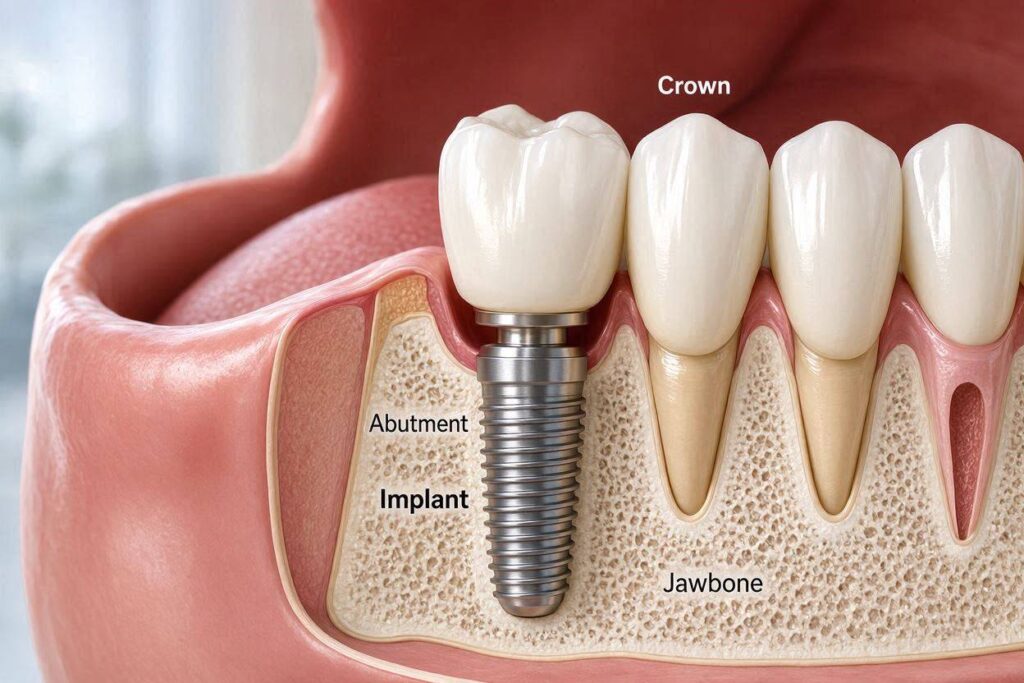
Understanding the components clarifies what “full size” encompasses.
The Implant Fixture
The fixture is the titanium or zirconia screw that is placed into the bone. A standard fixture has an internal connection, typically a hexagon, octagon, or conical connection, into which the abutment screw engages. The external threads are designed to engage bone and provide primary stability. The surface is roughened at the microscopic level to promote osseointegration.
The Abutment
The abutment is a separate component that connects to the implant fixture and protrudes through the gum. It provides the foundation for the crown. In a full size implant system, the abutment is a distinct piece, allowing for angulation correction, different cuff heights, and customization of the emergence profile. This modularity is a key advantage of standard implants over one-piece mini implants.
The Prosthetic Platform
The implant platform is the flat top of the fixture where the abutment seats. The platform diameter determines the size of the abutment and, ultimately, the emergence profile of the crown. A standard platform allows for a crown that mimics the size and shape of a natural tooth as it emerges from the gum.
Full Size Implants Across Different Tooth Positions
A standard implant is not one-size-fits-all. The specific diameter and length are selected based on the tooth being replaced.
Molar Replacement
Molars endure the highest chewing forces. A full size implant for a molar is typically at the larger end of the standard range, often 4.3 mm to 5.0 mm in diameter. Some clinicians consider a 5.0 mm implant a “wide diameter” rather than standard, but the boundary is fluid. The implant should be as wide as the bone safely allows to provide maximum surface area and structural strength. Length is maximized to the extent the anatomy permits, typically 10 mm or greater.
Premolar Replacement
Premolars bear moderate forces. A standard implant of 3.75 mm to 4.2 mm diameter and 10 mm to 12 mm length is common. The mesiodistal space for a premolar is narrower than for a molar, limiting the maximum implant diameter.
Canine Replacement
The canine is a cornerstone of the arch, bearing significant lateral forces during excursive movements. A standard implant with a diameter of 3.75 mm to 4.3 mm and a length of 10 mm to 13 mm provides the strength needed. The implant platform must be positioned to allow the crown to guide lateral excursions properly.
Incisor Replacement
Maxillary central incisors present esthetic challenges. The implant must be placed in the exact position to support a natural-looking crown. A standard implant for a central incisor might be 3.5 mm to 4.3 mm in diameter and 10 mm to 12 mm in length. The buccolingual bone dimension in the anterior maxilla is often narrow, limiting implant diameter.
Mandibular incisors are small. Even a standard narrow implant of 3.5 mm may be too wide for the mesiodistal space and buccolingual bone. In these cases, a narrow diameter or mini implant might be considered, though it is not a “full size” in the conventional sense.
Full Size Implants Versus Mini Implants
The comparison illuminates the definition.
Dimensional Differences
Mini dental implants typically have a diameter of less than 3.0 mm, often 1.8 mm to 2.9 mm. They are one-piece designs where the implant and abutment are a single unit. Their length is comparable to standard implants.
Strength and Fracture Resistance
The strength of a cylinder under bending load scales with the cube of its diameter. A 2.0 mm mini implant has a fraction of the bending resistance of a 4.0 mm standard implant. Full size implants resist fracture under the cyclic loads of mastication over decades. Mini implants are more vulnerable to fracture, particularly in posterior high-load locations.
Surface Area for Osseointegration
The surface area available for bone contact is proportional to the implant’s diameter and length. A standard implant provides substantially more surface area than a mini implant. More bone-to-implant contact means better force distribution, lower stress on the bone, and a higher tolerance for less-than-ideal bone quality.
Clinical Applications
Full size implants are the standard of care for single-tooth replacement in all positions and for supporting fixed bridges and full-arch prostheses. Mini implants are primarily used for denture stabilization, where multiple implants share the load and the demands on each implant are lower. They are also used in narrow ridges where bone grafting is not feasible or desired.
Full Size Implants Versus Wide Diameter Implants
Wide diameter implants represent an extension of the standard concept.
Defining Wide Diameter
Implants with a platform diameter of 5.0 mm or greater are generally considered wide diameter. Some systems go up to 7.0 mm or more.
Indications for Wide Diameter
Wide diameter implants are used in molar sites with abundant bone, in sites where a previous standard implant failed and the socket has widened, and in situations where the surgeon wants to achieve high primary stability in soft bone. They provide maximum surface area and structural strength.
Limitations
Wide diameter implants require correspondingly wide ridges. Inadequate buccal or lingual bone thickness around a wide implant increases the risk of bone resorption and thread exposure. The minimum bone thickness around any implant is generally considered to be 1.0 to 1.5 mm on all sides. A 5.0 mm implant thus requires a ridge width of at least 7.0 to 8.0 mm.
Table: Implant Size Classification
| Classification | Diameter Range | Typical Applications | Advantages | Limitations |
|---|---|---|---|---|
| Mini implant | 1.8 – 2.9 mm | Denture stabilization, narrow ridges | Minimally invasive, no grafting often needed | Lower strength, limited single-tooth use |
| Narrow diameter | 3.0 – 3.4 mm | Mandibular incisors, narrow spaces | Fits small spaces | Reduced strength compared to standard |
| Full size / Standard | 3.5 – 4.5 mm | Most single tooth replacements, bridges | Versatile, strong, well-documented | Requires adequate ridge width |
| Wide diameter | 5.0 mm and above | Molars, previously failed sites | Maximum strength and surface area | Requires wide ridge, risk of buccal bone loss |
Length Considerations for Full Size Implants
Length matters as much as diameter.
The 10 Millimeter Benchmark
An implant length of 10 mm is widely considered a standard benchmark. Implants shorter than 8 mm are considered short. Implants longer than 14 mm are available but are used less frequently due to anatomical constraints such as the inferior alveolar nerve in the mandible or the maxillary sinus.
Short Implants in the Modern Era
Advances in implant surface technology have improved the performance of short implants. A 6 mm or 8 mm implant with a modern roughened surface can achieve high success rates. However, a full size implant of 10 mm or longer remains the goal when anatomy permits. Longer implants provide greater resistance to lateral forces, more surface area for osseointegration, and a better crown-to-implant ratio.
The Crown-to-Implant Ratio
The crown-to-implant ratio compares the length of the clinical crown to the length of the implant in bone. A ratio of 1:1 or less is ideal. A ratio of 1.5:1 is acceptable. A ratio greater than 2:1 raises biomechanical concerns. A full size implant of adequate length helps maintain a favorable ratio.
The Surgical Placement of a Full Size Implant
The placement protocol reflects the implant’s dimensions.
Osteotomy Preparation
A full size implant requires a sequence of drilling steps to prepare the osteotomy. The surgeon uses progressively wider drills to reach the final diameter, avoiding overheating the bone. The implant is placed with a torque that achieves primary stability, typically 30 to 50 Ncm.
Healing Protocols
A full size implant can be placed with a one-stage or two-stage surgical approach. In a two-stage approach, the implant is buried under the gum during healing. In a one-stage approach, a healing abutment protrudes through the gum. The healing period before loading is typically three to six months.
Immediate Loading Considerations
Full size implants can be immediately loaded with a provisional crown if primary stability is excellent and the occlusion is carefully controlled. This is more predictable in the anterior mandible, where bone density is high, than in the posterior maxilla.
The Restorative Phase for Full Size Implants
The restoration takes advantage of the implant’s platform.
Standard Abutment Selection
The full size implant platform allows the use of stock or custom abutments. Stock abutments are prefabricated and less expensive. Custom abutments, milled specifically for the patient’s anatomy, provide optimal emergence profile and esthetics. The internal connection ensures a precise fit and resistance to screw loosening.
Cemented Versus Screw-Retained Crowns
A full size implant can receive either a cemented crown on an abutment or a screw-retained crown that threads directly into the implant. Screw-retained restorations are retrievable and eliminate the risk of retained cement. Cemented restorations offer greater flexibility in managing implant angulation and occlusion. The choice depends on clinical factors.
Long-Term Success of Full Size Implants
The standard implant has the longest and most robust body of evidence.
Survival Rates
Full size dental implants have documented survival rates exceeding 95 percent over ten years and 90 percent over twenty years in healthy patients. These statistics are derived from decades of clinical research on standard-dimension implants. The evidence base for mini implants and short implants is less extensive.
Mechanical Complications
Abutment screw loosening, abutment fracture, and implant fixture fracture are rare in full size implants when occlusion is properly managed. The larger cross-sectional area distributes stress effectively.
Biological Complications
Peri-implantitis and crestal bone loss can affect any implant. The larger surface area of a standard implant provides some biological reserve if crestal bone is lost. An implant with a 4.0 mm diameter can tolerate 1.5 mm of circumferential bone loss and still have a substantial bone-to-implant contact area remaining. A mini implant with a 2.0 mm diameter has far less reserve.
Conclusion
A full size dental implant is a root-form endosseous implant with a platform diameter typically between 3.5 and 4.5 millimeters and a length of 8 to 14 millimeters. This dimensional range represents the most versatile, well-documented, and biomechanically sound implant design for replacing teeth across all positions in the dental arch. Full size implants provide adequate surface area for predictable osseointegration, sufficient structural strength to withstand decades of masticatory forces, and a prosthetic platform that supports natural-looking restorations. They are the standard of care against which mini implants, narrow-diameter implants, and wide-diameter implants are compared, and they remain the default choice for single-tooth replacement and multi-unit fixed restorations in patients with adequate bone.
Frequently Asked Questions
What is the typical size of a standard dental implant?
A standard or full size dental implant typically has a diameter between 3.5 and 4.5 millimeters and a length between 8 and 14 millimeters, with 4.0 mm by 10 mm being a very common dimension.
Is a full size implant the same size as a natural tooth root?
In the posterior region, implant diameters approximate natural tooth root diameters. However, natural molars have multiple roots with a broader base than a single implant. The implant replaces the root function, not the exact root anatomy.
Can a full size implant be used for a small tooth like a lower incisor?
A lower incisor site often has limited mesiodistal space and thin bone. A narrow-diameter implant of 3.0 to 3.5 mm, which overlaps with the low end of standard, is typically the widest that can be placed safely.
What is the difference between a mini implant and a full size implant?
Mini implants have diameters less than 3.0 mm and are one-piece designs. Full size implants are 3.5 mm or wider, are typically two-piece systems, and provide greater strength, surface area, and prosthetic versatility.
Why does my dentist recommend a certain size implant?
Implant size is selected based on the tooth being replaced, the available bone measured on a cone-beam CT scan, the proximity to vital structures like nerves and sinuses, and the forces the implant will bear. The goal is the largest implant the anatomy safely permits.
Additional Resources
Academy of Osseointegration – Dental Implant Basics
https://www.osseo.org
Educational information on dental implant types, sizes, and the clinical decision-making process for selecting the appropriate implant for each patient.