Can You Shape a Dental Implant?
A patient runs their tongue over a new implant crown. The shape feels slightly different from the adjacent teeth. Another patient has an implant-supported bridge that seems bulky on the tongue side. A third wonders if the exposed metal abutment can be contoured to look more natural. The question arises in various forms: Can a dental implant be shaped?
The answer is nuanced and depends entirely on which component of the implant system is being considered. Some components can be shaped and customized extensively. Others cannot be altered without compromising their structural integrity or biological function. This guide explains what can and cannot be shaped, how customization is achieved, and what patients and clinicians should understand about modifying dental implant components.
The Three Components: Different Rules for Each
A dental implant restoration consists of three distinct components: the implant fixture, the abutment, and the crown. Each has different material properties and different allowances for shaping.
The Implant Fixture: Do Not Shape
The implant fixture is the titanium or zirconia screw placed into the jawbone. It is a precision-engineered medical device. Its shape, thread design, and surface characteristics are the result of extensive research and manufacturing precision.
Once placed in the bone and integrated, the implant fixture cannot be shaped or modified. Any attempt to grind, cut, or reshape the implant fixture would:
- Generate heat that could damage the surrounding bone.
- Remove the protective oxide layer on titanium, potentially triggering corrosion.
- Disrupt the precision-machined internal connection, making it impossible to seat an abutment properly.
- Introduce microscopic surface irregularities that attract plaque and compromise the soft tissue seal.
- Void any manufacturer warranty.
The implant fixture is off-limits for shaping. If the implant is malpositioned or protruding in an unacceptable way, the solution is not to reshape it but to consider removal and replacement.
The Abutment: Shaping Is Possible and Routine
The abutment is the connector that screws into the implant and supports the crown. Abutments can be shaped, and this is a routine part of the restorative process.
Stock abutments are prefabricated by the implant manufacturer in a range of sizes and angulations. The clinician selects the stock abutment that best fits the clinical situation. Some minor adjustment of a stock titanium abutment is possible. The clinician can reduce its height slightly or adjust its contour with a bur and then polish the modified surface. However, stock abutments offer limited customization.
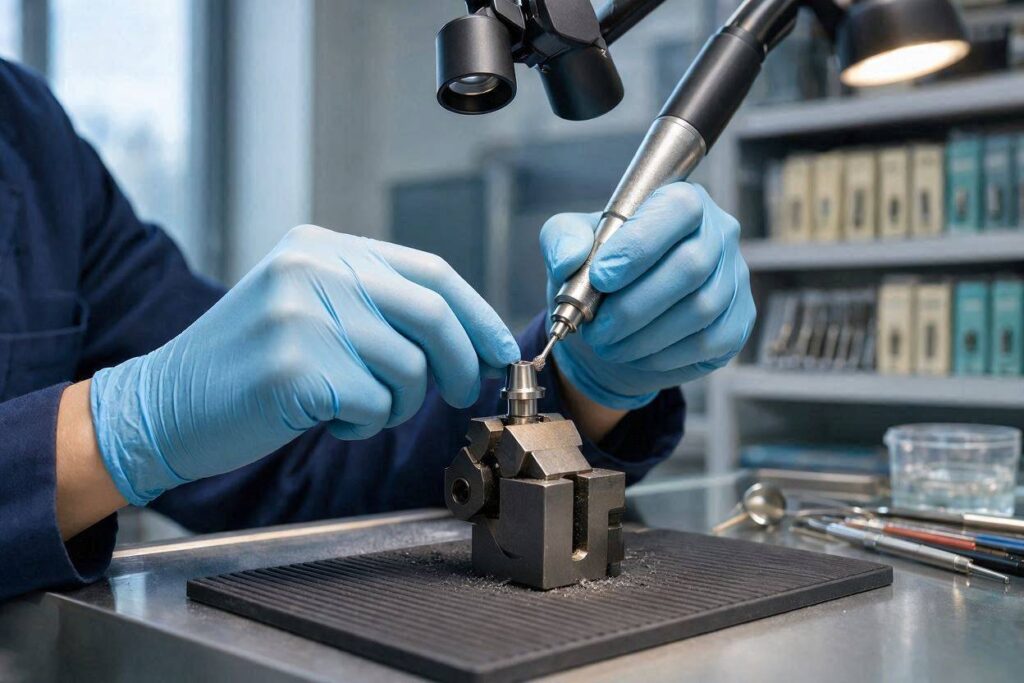
Custom abutments are milled specifically for the patient from a block of titanium or zirconia. The design is based on a digital or physical impression of the implant position and the surrounding soft tissue. A custom abutment can be shaped to virtually any contour that supports the planned crown and respects the biological requirements of the peri-implant tissues. The emergence profile, the height, the angulation correction, and the margin location are all customizable.
Custom abutments are the primary means by which the shape of the subgingival and transgingival portion of the implant restoration is controlled.
The Crown: Shaping Is the Purpose of Fabrication
The crown, or prosthesis, is the visible part of the restoration. It is shaped by design. The dental laboratory technician or the CAD/CAM software creates the crown to match the shape of a natural tooth, to fit harmoniously with the opposing and adjacent teeth, and to provide proper function.
After the crown is fabricated and tried in the mouth, minor adjustments to its shape are routine. The clinician can:
- Adjust the occlusal surface to refine the bite.
- Slightly reshape the interproximal contacts to achieve proper flossing resistance.
- Modify the contour at the gum line to improve cleansability or esthetics.
- Polish the adjusted areas to a smooth, plaque-resistant finish.
These adjustments are minor. Major reshaping of a ceramic crown risks fracture or perforation. If significant shape changes are needed, a new crown should be fabricated.
Table: Shaping Allowances by Implant Component
| Component | Can It Be Shaped? | How Shaping Is Achieved | Limitations |
|---|---|---|---|
| Implant fixture | No | N/A | Cannot be modified after placement |
| Stock abutment | Minor | Chairside adjustment with burs, polishing | Limited customization |
| Custom abutment | Yes, by design | Milled to specification in laboratory | Cannot be modified after fabrication except minor adjustments |
| Provisional crown | Yes | Chairside addition or reduction of acrylic/composite | Temporary material, easily adjusted |
| Final ceramic crown | Minor adjustments | Chairside polishing of small areas | Significant reshaping risks fracture |
The Custom Abutment: Where Shaping Happens
The custom abutment is the component where shaping and customization are most relevant.
The Emergence Profile
The emergence profile is the contour of the abutment and crown as they emerge from the gum. This is the most critical area for both esthetics and hygiene. A properly shaped emergence profile:
- Supports the gum papilla between the implant and adjacent teeth.
- Creates a natural scalloped gum line around the implant.
- Transitions smoothly from the circular implant platform to the tooth-shaped crown.
- Allows the patient to clean effectively with floss or interdental brushes.
The custom abutment is designed to create this ideal emergence profile. The laboratory technician uses software to sculpt the abutment digitally, or a wax pattern is created by hand and then milled. The result is an abutment that is unique to the patient’s anatomy.
Angulation Correction
Implants are sometimes placed at an angle due to bone availability or anatomical constraints. A custom abutment can correct this angle, bringing the screw access hole to a more favorable position, such as the occlusal surface rather than the buccal surface. The abutment is shaped to redirect the path of insertion for the crown.
Margin Placement
The margin of the abutment, where the crown seats, is positioned at or slightly below the gum line. This margin can be shaped circumferentially to follow the scalloped contour of the gum. A custom abutment allows the margin to be placed precisely where the clinician wants it for optimal esthetics and cement removal.
Adjusting the Crown: Chairside Shaping
Once the final crown is fabricated, the clinician evaluates it in the mouth and makes minor adjustments.
Occlusal Adjustment
The bite is checked with articulating paper. High spots are marked and gently reduced with a fine diamond bur. The adjusted surface is polished. This is routine and does not compromise the crown.
Contour Adjustment
If the crown feels bulky to the patient’s tongue or cheek, minor contour adjustments can be made. The clinician reduces the offending area slightly and polishes it. This is more common with full-arch implant prostheses, where the junction between the prosthesis and the gum can be a source of patient awareness.
Interproximal Contact Adjustment
The contact between the implant crown and the adjacent tooth should allow floss to pass with slight resistance. If the contact is too tight, it is gently relieved. If too loose, the crown may need to be remade, as adding ceramic to tighten a contact is not practical chairside.
The Provisional Crown: Maximum Flexibility for Shaping
The provisional or temporary crown, placed during the healing phase, offers the greatest opportunity for shaping and reshaping.
Material Properties
Provisional crowns are made of acrylic or composite resin. These materials can be easily added to or reduced chairside. The clinician can build up the contours with additional material and adjust the shape as the soft tissue heals.
Tissue Sculpting
The provisional crown is a powerful tool for shaping the gum tissue. The clinician can adjust the provisional’s emergence profile over several appointments, progressively molding the soft tissue into the desired contour. This is called tissue sculpting or soft tissue conditioning. It is a deliberate, staged process that creates an ideal soft tissue bed for the final crown.
Once the tissue is mature and stable, an impression is taken of the shaped tissue, and the final crown is fabricated to match the contours of the sculpted provisional.
When an Implant or Abutment Cannot Be Shaped: Problem-Solving
When a component cannot be shaped to solve a problem, other solutions must be found.
The Implant Is Too Buccal or Lingual
If the implant platform is too far toward the cheek or tongue, the abutment and crown will emerge at an unfavorable angle. A custom abutment can partially compensate for this, but there are limits. If the implant is severely malpositioned, bone and gum contours may be compromised regardless of the abutment design. The implant may need to be removed and replaced in the correct position.
The Abutment Margin Is Too Deep or Too Shallow
If the abutment margin is placed incorrectly, the crown may not seat properly, or cement removal may be difficult. Stock abutments come in fixed cuff heights. If the stock abutment does not match the tissue depth, a custom abutment solves the problem. Custom abutments can be designed with any margin location within the anatomical constraints.
The Crown Does Not Fit the Implant Platform
If the crown does not seat fully on the abutment or implant platform, the cause must be identified. It could be an open interproximal contact, a tight contact with the adjacent tooth, or binding of the abutment screw. Shaping the crown or abutment to resolve the fit issue is a clinical judgment call. Sometimes the crown must be remade.
The Biological Limits of Shaping
All shaping of implant components is constrained by biology.
The Minimum Abutment Wall Thickness
Custom abutments must have adequate wall thickness to resist fracture under occlusal forces. Zirconia abutments require a minimum thickness, typically around 0.5 to 0.7 millimeters, depending on the manufacturer. If the shaping required for esthetics would reduce the wall thickness below this minimum, the abutment should be made from a stronger material, or the implant position should be reevaluated.
The Biological Width
The soft tissue and bone around an implant require a minimum vertical dimension to form a healthy seal. This biological width is approximately 2 to 3 millimeters. Shaping the abutment or crown must not violate this space. If the restoration is overcontoured and presses against the tissue, inflammation and bone loss can result.
The Embrasure Space
The space between the implant crown and the adjacent tooth, the embrasure, must be open enough to allow cleaning. Shaping the crown to close an embrasure for esthetic reasons can create a hygiene trap. The clinician must balance esthetics and cleansability.
Conclusion
The implant fixture itself cannot and must not be shaped after placement. The abutment, particularly when custom-milled, offers extensive opportunities for shaping the emergence profile, correcting angulation, and optimizing the margin position. The crown is shaped by design during fabrication and can undergo minor chairside adjustments. The provisional crown is the most flexible component, used to sculpt the soft tissue and preview the final shape. All shaping is constrained by material requirements, biological limits, and the fundamental principle that the implant fixture is inviolable. Proper planning, including virtual implant placement and custom abutment design, ensures that the final restoration achieves the desired shape without the need to alter the implant itself.
Frequently Asked Questions
Can a dentist file down an implant post that is sticking out?
No. The implant fixture is a precision medical device that cannot be ground or filed. If the implant is protruding in a problematic way, removal and replacement may be necessary. An exposed implant platform can sometimes be covered by a custom abutment and crown with proper contour.
Can an implant crown be reshaped if it feels bulky?
Yes. Minor contour adjustments to the crown can be made chairside. The clinician reduces the bulky area slightly and polishes the surface. Significant reshaping may require a new crown.
What is a custom abutment and why would I need one?
A custom abutment is a connector piece milled specifically for your implant and tissue anatomy. It allows for optimal shaping of the emergence profile, correction of implant angle, and precise margin placement. It is often recommended for anterior implants where esthetics are critical.
Can the gum be shaped around an implant?
Yes. The gum tissue around an implant can be sculpted using a provisional crown during the healing phase. This creates a natural-looking gum contour for the final crown. Soft tissue grafting can also be used to augment deficient gum tissue.
Why can’t the implant be shaped if it is in the wrong position?
The implant is integrated into living bone. Any attempt to shape it would generate heat that could kill bone cells, damage the implant’s structural integrity, and compromise the precision connection needed for the abutment. An implant in the wrong position must be surgically removed and, if appropriate, replaced.
Additional Resources
Academy of Osseointegration – Restorative Considerations
https://www.osseo.org
Information on the restorative phase of implant treatment, including abutment selection and crown design, from the leading implant dentistry organization.