Can An Mri Mess Up A Dental Implant?
Medical technology often intersects in surprising ways. If you have a dental implant and you need a Magnetic Resonance Imaging (MRI) scan for a medical issue (like a knee injury or a brain scan), you might worry: “Will the magnet rip the implant out of my jaw?”
This is a very common fear. The short answer is: No, an MRI will not rip out or “mess up” a dental implant. However, there are some details you need to know to ensure the scan is safe and the images are readable.
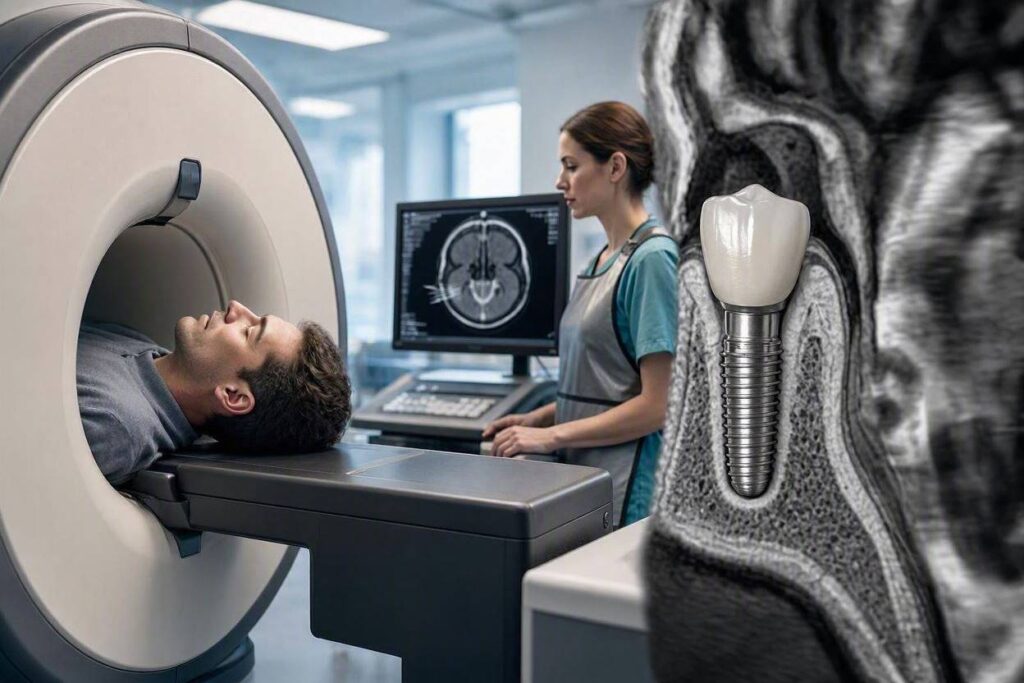
The Magnet vs. The Metal
The MRI machine is a massive, powerful magnet. It is thousands of times stronger than the earth’s magnetic field. We all know that magnets attract iron. So, what is your implant made of?
Titanium
Most dental implant posts are made of Titanium or a Titanium alloy.
- Is it magnetic? No. Titanium is paramagnetic. This means it interacts very weakly with magnetic fields. The force is so small that it cannot pull the implant out.
- Safety: It is completely safe.
Zirconia
Some modern implants are made of Zirconia (a white ceramic).
- Is it magnetic? No. It is a ceramic. The MRI machine does not even “see” it.
The Real Problem: Image Distortion (Artifacts)
While the implant is safe, it can still affect the MRI results. The metal in the implant interferes with the magnetic field in its immediate vicinity. This creates a “black hole” or a blurry distortion on the scan. This is called an artifact.
What it means for you
- If you need an MRI of your BRAIN: A dental implant in the lower jaw might cause a slight distortion in the image of the lower brain or neck. Usually, radiologists can adjust the settings to work around it.
- If you need an MRI of your KNEE: The implant in your head is far away. It will not affect the knee scan at all.
Other Metals in the Mouth
This is where it gets serious. You might not have a titanium implant, but you might have other dental work.
Magnetic Metals (Ferrous)
Older dental work, crowns, or retainers might be made of stainless steel or other alloys containing Iron or Cobalt.
- Risk: These metals are magnetic.
- The Danger: While they might not be pulled out (usually they are cemented in), they can move or heat up slightly during the MRI. More importantly, they cause massive distortions on the image.
- Safety Alert: If you have a removable partial denture with metal clasps, you must take it out before the MRI.
What to Tell the Radiologist
Always inform your doctor and the MRI technician that you have a dental implant.
- Be Specific: Tell them where the implant is (e.g., “Upper right molar”).
- Know the Material: If you have your implant card (the passport your dentist gave you), bring it. It states the brand and material. If it is Titanium, you have nothing to worry about.
- Do Not Lie: Some patients fear they will be rejected from the MRI, so they hide their dental history. This is dangerous. The technician needs to know.
Can the MRI Damage the Implant?
No. The MRI will not loosen the implant, break the screw, or damage the crown. The osseointegration (bone fusion) is stronger than the weak magnetic force of an MRI. You will not feel any pain or pulling sensation in your teeth.
Heating Concerns
The MRI machine uses radiofrequency waves. These waves can induce electrical currents in metals, causing them to heat up slightly.
- Titanium: Does not heat up significantly. The blood flow in your jaw also cools it down instantly.
- Amalgam Fillings: If you have old silver fillings, they might heat up a tiny bit, but usually not enough to cause harm.
Table: Dental Materials in an MRI
| Material | Magnetic? | MRI Safety | Image Quality |
|---|---|---|---|
| Titanium Implant | No | Safe | Minor artifacts if nearby |
| Zirconia Implant | No | Safe | No artifacts |
| Porcelain Crown | No | Safe | No artifacts |
| Amalgam Filling | Slightly | Safe (usually) | Moderate artifacts |
| Stainless Steel Crown | Yes | Caution | Severe artifacts |
Conclusion
An MRI will not rip out your dental implant. Titanium is non-magnetic. However, the implant can blur the image if it is in the scan area. Always inform the MRI technician about your implants, but do not let the fear of a scan prevent you from getting necessary medical care.
Additional Resource
For more information on MRI safety, visit www.radiologyinfo.org.