What Causes Pain With Dental Implants?
You expected some discomfort after surgery. The brochures mentioned it. Your surgeon warned you. But now, days, weeks, or even months later, you feel something that concerns you. Is this normal healing pain, or is something wrong? Should you call the dentist, or should you wait it out?
Pain with dental implants can arise from many sources, ranging from the expected post-surgical soreness to serious complications requiring immediate attention. This guide walks you through every possible cause of dental implant pain, organized by when it occurs, what it feels like, and what you should do about it.
Understanding Implant Pain: Normal vs. Concerning
The first distinction to make is between normal healing discomfort and pain that signals a problem.
Normal Post-Surgical Discomfort
After implant placement, some degree of discomfort is expected. The body is responding to surgical trauma. Tissue has been incised, bone has been prepared, and a foreign object has been introduced. Normal post-surgical discomfort follows a predictable pattern:
- Begins as anesthesia wears off (typically 2–4 hours after surgery)
- Peaks at 24–72 hours
- Gradually decreases over 5–7 days
- Is manageable with prescribed or over-the-counter pain medication
- Is accompanied by predictable swelling and possibly bruising
- Does not worsen after the third day
Pain That Signals a Problem
Pain that deviates from the normal pattern warrants attention:
- Pain that intensifies after day 3 instead of decreasing
- Severe pain that medication does not touch
- Sharp, electric, or shooting pain rather than dull soreness
- Pain accompanied by fever, pus, or foul odor
- Pain that begins weeks or months after uneventful healing
- Pain when biting or tapping on the implant
- Pain accompanied by implant mobility
Causes of Pain by Timing
Organizing potential causes by when they occur helps narrow down the source.
Immediate Post-Operative Pain (Days 1–7)
| Cause | Description | Expected or Concerning |
|---|---|---|
| Surgical trauma | Dull, aching pain from tissue incision and bone preparation | Expected; peaks day 2–3 |
| Swelling and inflammation | Pressure and throbbing from inflammatory fluid | Expected; managed with ice and medication |
| Sutures pulling | Mild tugging sensation as swelling decreases | Expected; resolves as sutures dissolve or are removed |
| Hematoma | Collection of blood under the tissue causing pressure | Usually self-limiting; large hematomas need evaluation |
| Infection (early) | Increasing pain, swelling, possibly pus or fever | Concerning; requires prompt treatment |
Early Healing Phase Pain (Weeks 2–4)
| Cause | Description | Expected or Concerning |
|---|---|---|
| Soft tissue healing | Mild residual soreness | Expected; should decrease steadily |
| Suture irritation | Loose sutures rubbing against cheek or tongue | Minor; resolves with suture removal or dissolution |
| Adjacent tooth sensitivity | Referred sensation from nearby teeth | Usually transient |
| Early infection | Persistent or worsening pain, possible discharge | Concerning |
| Failed osseointegration (early) | Persistent discomfort, possible mobility | Concerning |
| Overloading from temporary restoration | Pain when biting on temporary crown | Needs adjustment |
Late Healing Phase Pain (Months 1–6)
| Cause | Description | Expected or Concerning |
|---|---|---|
| Normal bone remodeling | Occasional mild aching as bone adapts | Can be normal |
| Peri-implantitis (early) | Inflammation, bleeding, possible pain | Concerning; needs treatment |
| Prosthetic issues | Pain from ill-fitting crown or bridge | Needs adjustment |
| Nerve impingement | Persistent numbness, tingling, or pain | Concerning; needs evaluation |
| Implant fracture (rare) | Sudden pain, possible mobility | Concerning; emergency evaluation |
Pain in Established Implants (After 6 Months)
| Cause | Description |
|---|---|
| Peri-implantitis | Infection causing bone loss; may be painful or painless |
| Overload | Pain from excessive biting forces |
| Screw loosening | Discomfort from loose abutment or prosthetic screw |
| Cementitis | Inflammation from retained cement under the crown |
| Adjacent tooth pathology | Pain from a neighboring tooth mistaken for implant pain |
| Implant fracture | Rare; sudden pain with function |
| Foreign body impaction | Food or debris trapped between implant and gum |
Detailed Exploration of Specific Pain Causes
Surgical Trauma
The most common and least concerning cause of implant pain is the surgery itself. Placing an implant involves:
- Incision through gum tissue
- Elevation of the periosteum (the membrane covering the bone)
- Drilling into bone to create the osteotomy
- Placement of the implant fixture
- Suturing of the tissue
All of these cause tissue injury, which triggers inflammation and pain. This pain is normal, expected, and transient.
Characteristics:
- Dull, aching, or throbbing
- Located at the surgical site
- Peaks within 48–72 hours
- Responds to pain medication
- Accompanied by swelling
Management:
- Prescribed or over-the-counter pain relievers
- Cold therapy for the first 48 hours
- Head elevation
- Rest
- Soft diet
Infection
Infection is a serious cause of implant pain that requires prompt treatment.
Types:
| Infection Type | Timing | Characteristics |
|---|---|---|
| Acute post-surgical infection | Days 3–10 | Increasing pain, swelling, pus, possible fever |
| Peri-implant mucositis | Any time after healing | Inflammation, bleeding, mild discomfort; reversible |
| Peri-implantitis | Months to years after placement | Bone loss, deepening pockets, bleeding, may or may not be painful |
Risk factors for infection:
- Poor oral hygiene
- Smoking
- Uncontrolled diabetes
- Immunocompromised status
- Previous periodontal disease
- Contamination during surgery
Management:
- Professional evaluation
- Antibiotics if bacterial infection confirmed
- Drainage of any abscess
- Debridement of the implant surface
- Surgical intervention for advanced peri-implantitis
Nerve Injury
Nerve damage during implant placement is a serious complication that can cause significant pain.
How it happens:
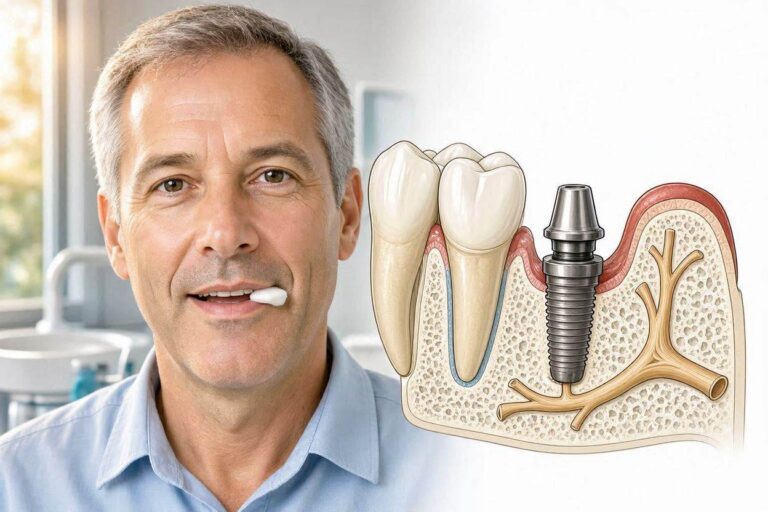
- The inferior alveolar nerve in the lower jaw runs through the mandibular canal
- Implants placed too close to this nerve can compress, stretch, or sever it
- The mental nerve, a branch of the inferior alveolar nerve, can be affected by implants in the premolar area
- In the upper jaw, the infraorbital nerve can be affected
Symptoms:
- Numbness or altered sensation in the lip, chin, gums, or tongue (paresthesia)
- Burning, electric, or shooting pain (dysesthesia or neuropathic pain)
- Constant or intermittent pain
- Pain triggered by light touch (allodynia)
What to do:
- Report any numbness or unusual sensation immediately after surgery
- Early removal of an implant compressing a nerve offers the best chance of recovery
- Nerve injuries that persist may require specialist evaluation
- Medications for neuropathic pain may help manage symptoms
Failed Osseointegration
When the implant fails to integrate with the bone, it may cause persistent discomfort.
Signs of failed osseointegration:
- Persistent dull pain or discomfort at the implant site
- Implant mobility (an integrated implant should be immobile)
- Radiolucency (dark area) around the implant on X-ray
- Lack of the typical “ringing” sound when the implant is tapped
Causes:
- Poor bone quality or quantity
- Surgical trauma (overheating bone during drilling)
- Infection
- Systemic factors (smoking, diabetes, medications)
- Premature loading
Management:
- Removal of the failed implant
- Debridement of the site
- Healing period
- Possible replacement implant after bone healing
Overload and Occlusal Trauma
Excessive forces on an implant can cause pain even in a successfully integrated fixture.
How it happens:
- The crown is too high, causing premature contact during biting
- The patient grinds or clenches (bruxism)
- The implant is asked to support more force than it can withstand
- The prosthesis design creates unfavorable leverage
Symptoms:
- Pain when biting or chewing on the implant
- Relief when not biting
- Possible screw loosening
- Gradual onset
Management:
- Occlusal adjustment to eliminate premature contacts
- Night guard for bruxism
- Evaluation of prosthesis design
- Possible replacement with different loading characteristics
Screw Loosening
The abutment screw or prosthetic screw can loosen over time, causing discomfort.
Symptoms:
- Sensation of movement or “give” in the crown
- Clicking or creaking sounds
- Pain or discomfort when chewing
- Bad taste or odor if bacteria enter the loosened connection
- Gum irritation around the implant
Management:
- Removal of the crown
- Inspection of the screw and implant connection
- Re-torquing or replacement of the screw
- Recementation or reattachment of the crown
- Evaluation of why loosening occurred (occlusal forces, fit issues)
Cementitis
When a crown is cemented onto an abutment, excess cement can be left below the gum line. This retained cement acts as an irritant and a bacterial haven.
Symptoms:
- Delayed onset of pain (weeks to months after crown placement)
- Gum inflammation, redness, and bleeding around the implant
- Possible bone loss visible on X-ray
- Dull, persistent discomfort
- Pain that does not respond to typical interventions
Management:
- Surgical or non-surgical removal of the retained cement
- Debridement of the implant surface
- Possible replacement of the crown
- Prevention through careful cementation techniques
Implant Fracture
Implant fracture is rare but catastrophic when it occurs.
Causes:
- Metal fatigue over years of function
- Manufacturing defect (rare)
- Excessive force (trauma, severe bruxism)
- Corrosion in older implant designs
- Small-diameter implants under heavy load
Symptoms:
- Sudden pain or change in sensation
- Mobility of the implant or its components
- Visible fracture on X-ray
- Inability to use the implant for chewing
Management:
- Removal of the fractured implant
- Site debridement and possible bone grafting
- Healing period
- Replacement implant placement
Pain from Adjacent Structures
Not all pain near an implant comes from the implant itself.
Adjacent Tooth Pain
A natural tooth next to an implant can develop decay, infection, or periodontal disease. The pain may feel like it is coming from the implant, especially if the implant itself is insensate (lacking a nerve supply).
How to distinguish:
- Tapping on the adjacent tooth reproduces the pain
- X-rays may show decay or infection in the natural tooth
- The implant appears healthy on examination and imaging
- Cold sensitivity suggests a vital natural tooth issue
Sinus Pain
Upper jaw implants, particularly in the posterior region, can be close to or extend into the maxillary sinus. Sinus issues can cause pain that mimics implant pain.
Causes:
- Sinusitis (sinus infection)
- Sinus membrane perforation during implant placement
- Implant protrusion into the sinus
Symptoms:
- Pressure or pain in the cheek area
- Pain that worsens when bending forward
- Nasal congestion or discharge
- Pain referred to upper teeth and implant area
Muscle Pain
The muscles of mastication (chewing) can develop trigger points or spasm, causing pain referred to the implant area. Temporomandibular joint disorders can also cause pain in the region of implants.
Diagnosing the Source of Implant Pain
Your dentist uses several tools to determine why an implant hurts.
Clinical Examination
| Assessment | What It Reveals |
|---|---|
| Visual inspection | Swelling, redness, pus, recession |
| Palpation (touching) | Tenderness, swelling, fluctuation |
| Percussion (tapping) | Pain response, sound quality |
| Mobility testing | Whether the implant is stable |
| Probing | Pocket depth, bleeding, suppuration |
| Bite evaluation | Premature contacts, occlusal issues |
Radiographic Evaluation
| Imaging Type | What It Shows |
|---|---|
| Periapical X-ray | Bone levels around the implant, radiolucency |
| Panoramic X-ray | Overall implant position, relationship to structures |
| Cone beam CT | Three-dimensional bone assessment, nerve proximity, sinus relationship |
Additional Tests
- Percussion test: Tapping the implant elicits a sharp, ringing sound if integrated; a dull sound suggests failure
- Reverse torque test: Applying torque to the abutment screw (rarely used; risks damaging integration)
- Microbiological testing: Culture of bacteria from the implant sulcus in cases of suspected infection
Treatment Approaches for Implant Pain
Treatment depends entirely on the cause.
Non-Surgical Treatments
| Cause | Treatment |
|---|---|
| Surgical trauma | Pain medication, cold therapy, time |
| Early infection | Antibiotics, improved hygiene, antimicrobial rinse |
| Occlusal overload | Bite adjustment |
| Screw loosening | Screw re-torquing or replacement |
| Cementitis | Non-surgical cement removal if accessible |
| Muscle pain | Muscle relaxants, physical therapy, occlusal splint |
Surgical Treatments
| Cause | Treatment |
|---|---|
| Advanced infection | Surgical debridement, bone grafting |
| Nerve compression | Implant removal or repositioning |
| Failed osseointegration | Implant removal, site preparation, replacement |
| Implant fracture | Implant removal and replacement |
| Severe peri-implantitis | Implant removal if bone loss is extensive |
Preventing Implant Pain
Many causes of implant pain are preventable.
Pre-Surgical Prevention
- Thorough evaluation including 3D imaging
- Careful treatment planning to avoid anatomical structures
- Selection of appropriate implant size and position
- Optimization of patient health (smoking cessation, diabetes control)
- Treatment of existing oral disease before implant placement
Surgical Prevention
- Atraumatic surgical technique
- Adequate cooling during bone preparation
- Sterile technique
- Achievement of primary stability
- Proper soft tissue management
Post-Surgical Prevention
- Patient compliance with post-operative instructions
- Excellent oral hygiene
- Regular professional maintenance
- Night guard for bruxism
- Prompt attention to any warning signs
When to Seek Immediate Care
Certain symptoms demand urgent attention.
Red Flags
| Symptom | Action |
|---|---|
| Heavy bleeding that will not stop | Emergency department or urgent dental care |
| Severe, uncontrolled pain | Contact surgeon immediately |
| Fever with swelling | Same-day evaluation |
| Difficulty breathing or swallowing | Emergency department |
| Sudden implant mobility | Prompt dental evaluation |
| Pus or foul discharge | Prompt dental evaluation |
| Numbness that develops after surgery | Report to surgeon immediately |
Conclusion
Pain with dental implants ranges from normal post-surgical discomfort to serious complications requiring intervention. The timing, character, and location of pain provide clues to its cause. Early post-operative pain is typically surgical in nature and resolves within days. Pain that develops weeks or months later suggests infection, overload, prosthetic issues, or, more rarely, nerve injury or implant fracture. Accurate diagnosis through clinical examination and imaging is essential, as treatment varies from simple bite adjustment to surgical implant removal. Prompt evaluation of concerning symptoms improves outcomes and preserves implant function.
Frequently Asked Questions
Is it normal to have pain after dental implant surgery?
Yes. Moderate pain, swelling, and discomfort are normal for 3–7 days after surgery. Pain should peak at 48–72 hours and then decrease. Pain that worsens after day 3 or persists beyond a week warrants evaluation.
Can dental implants cause pain years later?
Yes. Late pain can result from peri-implantitis, overload, screw loosening, cement residue, or adjacent tooth problems. Any new pain around an established implant should be evaluated.
How do I know if my implant is failing?
Signs of failure include persistent pain, implant mobility, bleeding or pus around the implant, progressive bone loss on X-rays, and discomfort when chewing. A healthy implant should be painless, stable, and free of inflammation.
Why does my implant hurt when I bite down?
Biting pain often indicates occlusal overload, a loose screw, or a cracked crown. It may also signal peri-implantitis or, less commonly, implant fracture. A bite adjustment is often the first intervention.
Can nerve damage from an implant heal?
Mild nerve injuries may recover over weeks to months. Severe injuries, particularly if the implant is left in place compressing the nerve, may result in permanent damage. Early removal of the offending implant offers the best chance of recovery.
Additional Resources
- American Association of Oral and Maxillofacial Surgeons: www.aaoms.org
- American Academy of Implant Dentistry: www.aaid.com
- International Team for Implantology: www.iti.org