Do They Charge Tax For Dental Implants?
You are reviewing your dental implant treatment plan. The total is a significant investment, and you are budgeting carefully, line by line. The surgeon’s fee, the implant materials, the laboratory costs for the crown, the facility charges. Then a thought crosses your mind, one that comes from years of paying for goods and services: is there tax on all of this? Will a sales tax be added to the final bill, pushing the cost even higher? The question is a smart one, and the answer lies at the complex intersection of healthcare services, physical goods, and tax law.
The simple, overarching answer is that the professional service of placing and restoring a dental implant is almost universally exempt from sales tax in the United States. However, the physical components—the implant post, the abutment, the crown, the bone graft material—exist in a grey area where taxability can vary. This article will clarify the tax landscape for dental implants, distinguishing between the non-taxable medical service and the tangible products that may, in some jurisdictions, be subject to sales tax. We will also explore the powerful income tax advantages of using an HSA or FSA.

The Core Principle: Healthcare Services Are Not Taxable Goods
The fundamental reason you do not see a standard state sales tax line added to your dental implant invoice is that state sales taxes are designed for the retail sale of tangible personal property. A toothbrush, a car, a piece of furniture. A dental implant procedure is overwhelmingly a professional healthcare service.
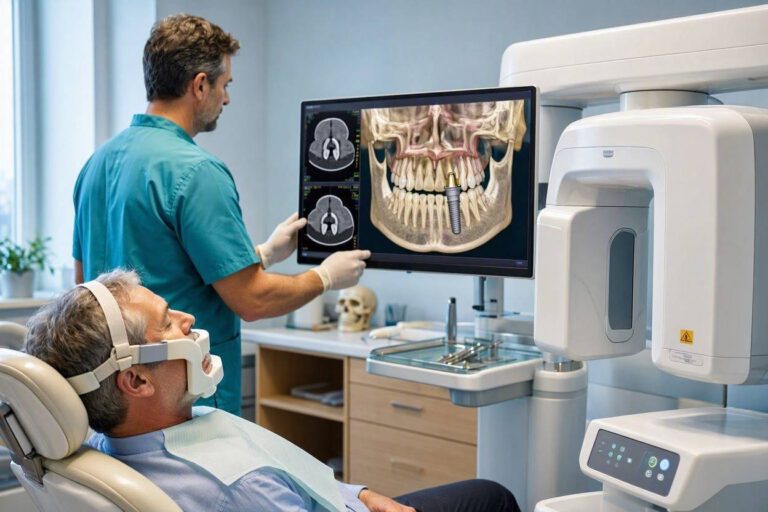
When you pay your oral surgeon or restorative dentist, you are primarily paying for their time, their diagnostic skill, their clinical judgment, and their surgical expertise. The act of diagnosing the edentulous space, taking a CBCT scan, interpreting the scan, planning the surgery, administering anesthesia, making an incision, preparing the bone, and placing the implant is a medical service. It is not the sale of a tangible product. Medical and dental services are exempt from state sales tax in every state.
This is why your invoice is typically structured as a professional fee, not as a retail receipt. The line items for “Surgical Placement of Implant, Tooth #30” or “Custom Abutment and Crown, Tooth #8” are billable services, represented by CDT dental procedure codes. These are not objects on a shelf. They are complex, regulated clinical acts performed by a licensed professional. The sales tax authority has no claim on this transaction.
The Tangible Property Grey Area: The Implant and the Crown
The complexity arises because a dental implant procedure includes tangible, physical objects that are transferred to the patient. The titanium implant post, the zirconia abutment, and the ceramic crown are manufactured products. They are shipped from a manufacturer to a distributor, from the distributor to a dental office or a dental laboratory, and ultimately, they are placed in the patient’s mouth.
The key legal question is whether the dentist is acting as a retailer selling these products to the patient, or as a healthcare provider using these products as incidental components of a non-taxable medical service. In the overwhelming majority of jurisdictions and dental practice scenarios, the tax code and legal precedent support the latter interpretation. The implant and crown are not sold to the patient in the same way a pair of eyeglasses is sold at an optometry shop. They are surgically placed and permanently integrated into the patient’s body as part of a medical procedure. The transfer of the physical object is incidental to the provision of the healthcare service.
However, there are specific scenarios where sales tax may apply. A dental laboratory that sells a custom crown directly to a dentist charges that dentist a sales tax on the laboratory invoice. The dentist then has a choice. They can absorb that tax as a cost of doing business, or they can pass it through to the patient as a separate, itemized line on the bill. This is more common in states with aggressive sales tax enforcement on dental laboratories. If you see a small line item for “sales tax” on your implant crown invoice, it is likely the pass-through of the laboratory tax, not a tax on the dentist’s service.
A dentist who sells a take-home product, such as a whitening kit or a night guard that you pick up and take home in a box, is more clearly engaged in a retail sale of tangible property, and sales tax may be charged. But an implant crown, which is cemented or screwed into your mouth, is a different legal entity.
The Medical Device Tax (Historical Note)
There was, for a period from 2013 to 2019, a 2.3% federal excise tax on the sale of certain medical devices by manufacturers and importers, which included some dental implant components. This tax was levied on the manufacturer, not the patient. It was embedded in the cost of the implant that the dentist paid, and thus indirectly increased the price to the patient. This tax has been permanently repealed. You are no longer paying this hidden embedded tax on your dental implant.
The Powerful Positive: Income Tax Benefits via HSA and FSA
The most significant tax conversation around dental implants is not about sales tax at all. It is about the favorable treatment of the expense under the federal income tax code. As we discussed in detail in Article 14, dental implants are a qualified medical expense under IRS Publication 502.
This means you can pay for your dental implant procedure using funds from your Health Savings Account (HSA) or your Flexible Spending Account (FSA). The dollars in these accounts are pre-tax. By using them, you are effectively paying for your implant with income that has never been subject to federal income tax, FICA tax, and, in most states, state income tax.
If you pay for the implant out of pocket, you can claim the expense as an itemized medical deduction on your federal income tax return, but only to the extent that your total medical and dental expenses exceed 7.5% of your adjusted gross income, and only if you itemize your deductions rather than taking the standard deduction. For many patients, the standard deduction is higher, and they do not receive a direct tax benefit from the medical expense deduction. The HSA and FSA route is far more accessible and powerful.
A $5,000 dental implant paid for with pre-tax HSA dollars, by a patient in a combined 30% federal and state tax bracket, effectively costs $3,500 in real, after-tax economic terms. This is a 30% discount, provided not by the dentist or the insurance company, but by the tax code itself. The tax system does not tax your implant as a purchase. It rewards you for treating it as a legitimate healthcare expenditure.
Conclusion
Sales tax is not typically charged on dental implant procedures. The core transaction is a professional healthcare service, which is exempt. The physical implant components are considered incidental to that service. The tax system’s major impact on your implant cost is positive, through the pre-tax HSA and FSA payment mechanisms that provide a substantial, legal reduction in your net economic cost. You should review your itemized treatment plan, understand each line, and use your tax-advantaged health accounts to their fullest potential.
Frequently Asked Questions
I saw a small tax line on my dental crown bill. What is it?
This is likely the pass-through of the state sales tax that the dental laboratory charged the dentist for the custom crown. Some dentists choose to itemize this small cost separately rather than bundling it into the total crown fee. It is not a tax on the dentist’s service.
Can I deduct the cost of traveling to Mexico for dental implants on my taxes?
Potentially, yes. The cost of travel primarily for and essential to medical care is a deductible medical expense. This includes transportation (airfare, mileage) and lodging, up to certain limits. The detailed rules are in IRS Publication 502. You cannot deduct the cost of a vacation disguised as a medical trip.
Do I pay sales tax on dental implant supplies if I buy them myself?
Patients do not buy implant components directly. The implant is a prescription medical device, ordered and placed by a licensed dentist. You are not the purchaser of the implant from the manufacturer; the dentist is. You are the recipient of a surgical service.
Additional Resource:
For the definitive, legally binding text on what constitutes a deductible medical and dental expense, read IRS Publication 502 directly from the source: https://www.irs.gov/pub/irs-pdf/p502.pdf