Can A Dental Implant Be Redone?
You run your tongue over the implant site, and something is not right. Maybe the implant feels loose. Maybe your dentist delivered the bad news: the implant has failed, or it was placed incorrectly, or the bone around it has deteriorated. The question that immediately follows is urgent and personal: can this be fixed? Can a dental implant be removed and replaced? Can it be redone?
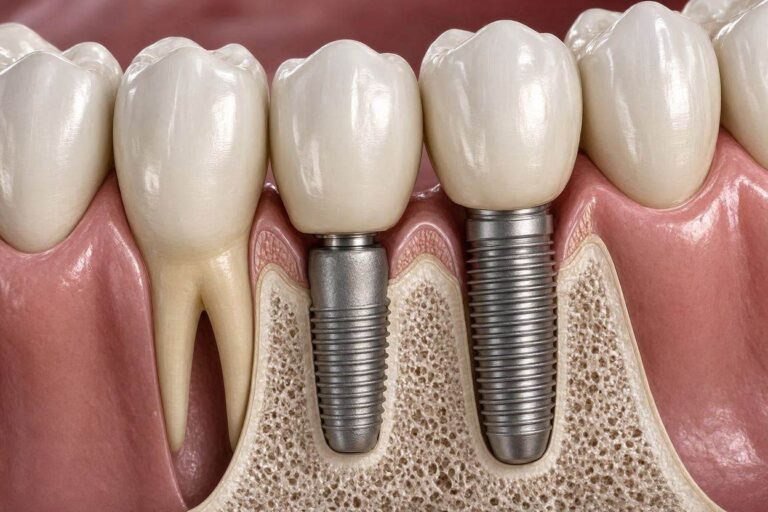
The answer, in most cases, is yes. A failed or problematic dental implant can be removed, the site can be prepared for a new implant, and a replacement can be placed. However, the process is not as simple as unscrewing a bolt and inserting a new one. This guide explains everything involved in redoing a dental implant, from the reasons implants need replacement to the surgical procedures, healing timelines, and success rates.
When a Dental Implant Needs to Be Redone
Dental implants can require replacement for several distinct reasons.
Early Implant Failure
Early failure occurs before or shortly after the implant is restored with a crown. The implant fails to integrate with the bone, a condition called failed osseointegration.
Signs of early failure:
- Persistent pain or discomfort at the implant site beyond the normal healing period
- Implant mobility (a successfully integrated implant should be absolutely immobile)
- Progressive bone loss visible on X-rays
- Infection at the implant site that does not resolve with treatment
Causes of early failure:
| Cause | Explanation |
|---|---|
| Surgical trauma | Overheating the bone during drilling damages bone cells |
| Infection | Bacterial contamination at placement |
| Poor bone quality | Insufficient density or volume for stability |
| Micromotion | Implant movement during healing |
| Premature loading | Forces applied before osseointegration is complete |
| Systemic factors | Smoking, uncontrolled diabetes, medications |
| Implant surface contamination | Compromised surface prevents bone attachment |
Late Implant Failure
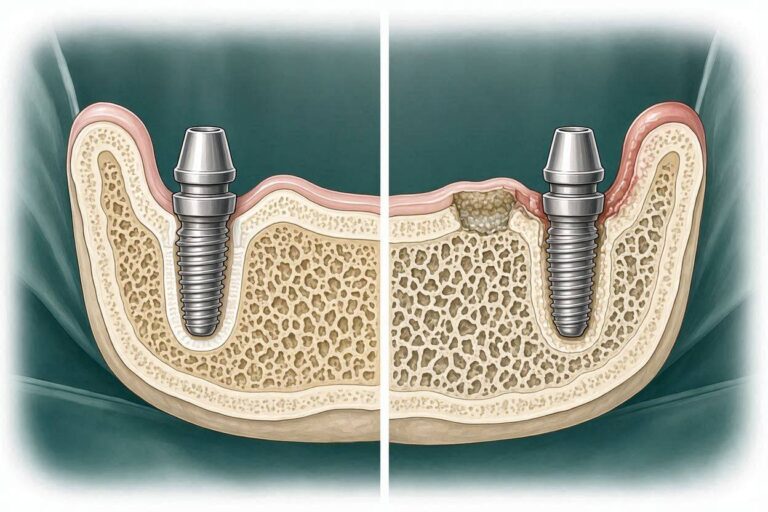
Late failure occurs after the implant has successfully integrated and functioned for months or years.
Signs of late failure:
- Progressive bone loss around the implant visible on X-rays
- Bleeding or pus when probing around the implant
- Gum recession exposing implant threads
- Implant mobility developing after a period of stability
- Pain or discomfort when chewing
- Persistent bad taste or odor
Causes of late failure:
| Cause | Explanation |
|---|---|
| Peri-implantitis | Bacterial infection causing progressive bone loss |
| Occlusal overload | Excessive biting forces damaging the bone-implant interface |
| Bruxism | Chronic grinding or clenching without protection |
| Implant fracture | Rare; due to metal fatigue, manufacturing defect, or extreme overload |
| Systemic health changes | New medications or medical conditions affecting bone metabolism |
| Prosthetic complications | Ill-fitting restoration causing chronic irritation |
Malpositioned Implants
An implant may be healthy and integrated but placed in a position that compromises the restoration or aesthetics.
Position problems:
- Implant placed at an angle that prevents proper crown fabrication
- Implant too close to adjacent tooth or implant
- Implant too far buccal (toward cheek) or lingual (toward tongue)
- Implant too deep or too shallow
- Implant compromising the inferior alveolar nerve (causing numbness or pain)
- Implant perforating the sinus or nasal cavity
Aesthetic Failures
Sometimes the implant is functional but the aesthetic result is unacceptable:
- Gum recession creating a visible metal margin
- Crown that does not match adjacent teeth and cannot be corrected with a new crown
- Poor emergence profile creating an unnatural appearance
- Loss of the papilla (the gum tissue between teeth) creating black triangles
The Process of Redoing a Dental Implant
Redoing an implant involves several distinct phases.
Phase 1: Evaluation and Diagnosis
Before any surgical intervention, the cause of the problem must be clearly identified.
Diagnostic steps:
| Step | Purpose |
|---|---|
| Clinical examination | Assess mobility, probing depths, bleeding, soft tissue condition |
| Periapical X-rays | Evaluate bone levels around the implant |
| Cone beam CT | Three-dimensional assessment of bone, implant position, nerve proximity |
| Review of medical history | Identify systemic factors contributing to failure |
| Occlusal analysis | Evaluate bite forces and loading patterns |
Phase 2: Implant Removal
The failed or problematic implant must be removed before a new one can be placed.
Removal techniques:
| Technique | Description | When Used |
|---|---|---|
| Reverse torque | Unscrewing the implant using the internal connection | For implants that have failed to integrate; often removes easily |
| Trephine bur | A hollow drill that cuts around the implant | For partially integrated implants |
| Piezoelectric surgery | Ultrasonic device that cuts bone while preserving soft tissue | For delicate removal near nerves or sinuses |
| Surgical troughing | Removing bone around the implant to create access | For well-integrated implants that must be removed |
What to expect during removal:
- Local anesthesia (the implant itself has no nerve supply, but surrounding tissue does)
- The removal process typically takes 30–60 minutes
- Some bone loss is inevitable; the surgeon removes as little bone as possible
- If infection is present, the surgeon will thoroughly debride the site
- Sutures are placed to close the tissue
Phase 3: Site Healing and Preparation
After implant removal, the site must heal before a new implant can be placed.
Healing considerations:
| Factor | Typical Timeline |
|---|---|
| Soft tissue healing | 2–4 weeks for initial closure |
| Bone fill of the defect | 2–4 months for significant fill |
| Complete site maturation | 3–6 months |
Phase 4: Bone Grafting (If Needed)
Implant removal inevitably removes some bone. Additionally, the reason for the original failure (peri-implantitis, for example) may have already caused significant bone loss. Bone grafting is often required before a new implant can be placed.
Grafting procedures:
| Procedure | Description | Healing Time |
|---|---|---|
| Socket grafting | Placing graft material in the implant removal site | 3–4 months |
| Ridge augmentation | Rebuilding bone width or height | 4–6 months |
| Sinus lift | Adding bone below the maxillary sinus | 6–9 months |
| Block grafting | Transplanting a block of bone from another site | 4–6 months |
Phase 5: New Implant Placement
After adequate healing and grafting maturation, a new implant can be placed.
Considerations for the new implant:
- The new implant may be a different size (often wider or longer than the original)
- The position may be adjusted to correct any original positioning errors
- The surgeon may choose a different implant brand or surface technology
- A two-stage (submerged) approach is often used for maximum predictability
- Healing time requirements are the same as for any new implant
Phase 6: Restoration
After the new implant has integrated (typically 3–6 months), the restorative phase proceeds normally:
- Implant uncovering (if two-stage approach used)
- Healing abutment placement
- Impression taking
- Abutment and crown fabrication
- Final restoration delivery
Success Rates for Redone Implants
Patients understandably want to know whether a second attempt is likely to succeed.
What the Research Shows
| Scenario | Reported Success Rate |
|---|---|
| Implant replacement at the same site | 71–94% depending on study and specific circumstances |
| Replacement after early failure | Generally higher success than replacement after late failure |
| Replacement after peri-implantitis | Lower success; ongoing risk of recurrence |
| Replacement with bone grafting | Comparable to primary implant placement with grafting |
Factors Affecting Success of Replacement
| Factor | Impact |
|---|---|
| Reason for original failure | Peri-implantitis has higher recurrence risk than surgical error |
| Bone quality and quantity | Better bone predicts better outcomes |
| Surgeon experience | More experienced surgeons achieve higher success |
| Patient compliance with hygiene | Critical for long-term success |
| Smoking cessation | Significantly improves outcomes |
| Systemic disease management | Well-controlled conditions improve prognosis |
| Use of different implant design | May improve outcomes in some cases |
The Emotional and Financial Dimensions
Redoing an implant carries burdens beyond the surgical.
The Emotional Impact
Implant failure can be emotionally difficult:
- Disappointment after investing hope in the original procedure
- Frustration with the additional time and procedures required
- Anxiety about whether the replacement will succeed
- Embarrassment if the failure affected appearance
- Loss of trust in the original provider
These feelings are valid and common. Many patients find it helpful to:
- Discuss concerns openly with their provider
- Seek a second opinion to confirm the treatment plan
- Understand that implant failure is often not anyone’s fault
- Focus on the high success rates of replacement procedures
The Financial Dimension
Redoing an implant involves additional costs. Financial considerations vary by situation.
Who bears the cost:
| Scenario | Typical Responsibility |
|---|---|
| Implant failed due to surgical error | Original surgeon may replace at reduced or no cost |
| Implant failed due to patient factors (smoking, hygiene) | Patient typically bears cost |
| Implant failed due to unknown biological factors | Varies; discussion between patient and provider |
| Implant failed and different provider is doing replacement | Patient typically bears full cost |
| Implant covered by warranty | Manufacturer may cover implant cost (not surgical fees) |
Cost components for replacement:
- Implant removal: $500–$2,000
- Bone grafting: $500–$3,000+
- New implant placement: $1,500–$3,000
- New abutment and crown: $1,000–$2,500
- Total: $3,500–$10,000+ depending on complexity
Choosing a Provider for Implant Replacement
The decision about who performs the replacement is important.
Staying with the Original Surgeon
Advantages:
- Familiarity with your case and anatomy
- May offer reduced fees for replacement
- Continuity of care
- Established relationship
Disadvantages:
- If the failure was due to surgical error, the same error could recur
- Trust may be damaged
- May be limited to the same implant system
Seeking a Different Provider
Advantages:
- Fresh perspective on the cause of failure
- May have different training and techniques
- May use different implant systems
- Can provide second opinion on necessity of replacement
Disadvantages:
- No financial accommodation for replacement
- New provider must reconstruct your treatment history
- May be more expensive
- Requires transfer of records
Questions to Ask a Potential Provider
- How many implant replacement procedures have you performed?
- What is your success rate with replacement implants?
- What do you believe caused the original implant failure?
- How will your approach differ from the original treatment?
- What implant system will you use, and why?
- What is the total expected cost and timeline?
- What can I do to improve the chances of success this time?
Preventing the Need to Redo an Implant
The best implant replacement is the one you never need.
Pre-Surgical Prevention
- Choose an experienced, qualified surgeon
- Obtain adequate imaging (cone beam CT) for treatment planning
- Address periodontal disease before implant placement
- Quit smoking at least 2 weeks before and 8 weeks after surgery
- Control systemic conditions (diabetes, immune disorders)
- Discuss all medications with your surgeon
Post-Surgical Prevention
- Follow all post-operative instructions meticulously
- Maintain excellent oral hygiene
- Attend all follow-up appointments
- Undergo regular professional maintenance (every 3–6 months)
- Wear a night guard if you have bruxism
- Avoid using teeth as tools or chewing extremely hard items
- Report any concerning symptoms immediately
Conclusion
A dental implant can be redone in most cases. The process involves removing the failed or problematic implant, allowing the site to heal, performing bone grafting if necessary, placing a new implant after adequate healing, and fabricating a new restoration. Success rates for replacement implants range from approximately 71% to 94%, depending on the reason for the original failure and individual patient factors. Replacement after peri-implantitis carries a higher risk of recurrence than replacement after early surgical failure. The total timeline for redoing an implant typically spans 6 to 12 months, and the cost ranges from $3,500 to $10,000 or more. Understanding the cause of the original failure and addressing contributing factors provides the best chance for a successful outcome.
Frequently Asked Questions
Can a failed dental implant be replaced immediately?
Sometimes. In cases where the implant has completely failed to integrate and can be removed with minimal bone loss, and there is no infection, the surgeon may place a new implant immediately. However, a delayed approach with site healing and grafting is more common and often more predictable.
How long after implant removal can a new implant be placed?
Timing varies from immediate placement to a delay of 4–6 months or longer. The decision depends on the reason for failure, the amount of remaining bone, the presence of infection, and whether bone grafting is needed.
Will the replacement implant be more successful than the original?
It can be, especially if the cause of the original failure is identified and addressed. For example, if failure resulted from premature loading and the replacement is allowed to heal fully before restoration, success rates improve.
Does insurance cover replacing a failed implant?
It depends on your plan and the circumstances. Some plans may cover replacement if the original implant was covered. Others may consider it a new major service with a new waiting period. Check your specific plan details.
Can I switch implant brands for the replacement?
Yes. The replacement implant does not need to be the same brand as the original. The surgeon will select an implant appropriate for the site and the clinical situation, potentially choosing a different design or surface technology.
Additional Resources
- American Academy of Implant Dentistry: www.aaid.com
- International Congress of Oral Implantologists: www.icoi.org
- Academy of Osseointegration: www.osseo.org