What Is A Short Dental Implant?
You review the treatment plan, and your surgeon mentions “short implants.” Your mind races. Does short mean less stable? Does it mean a compromise? Does it mean the implant will not last as long? The word “short” carries negative connotations in many contexts, but in implant dentistry, short implants represent a sophisticated solution to a specific problem: insufficient bone height.
A short dental implant is precisely what the name suggests: an implant with a shorter length than conventional implants. However, the engineering, clinical applications, and outcomes of short implants are anything but simple. This guide explains everything about short dental implants, from their definition and design to their advantages, limitations, and long-term performance.
Defining the Short Dental Implant
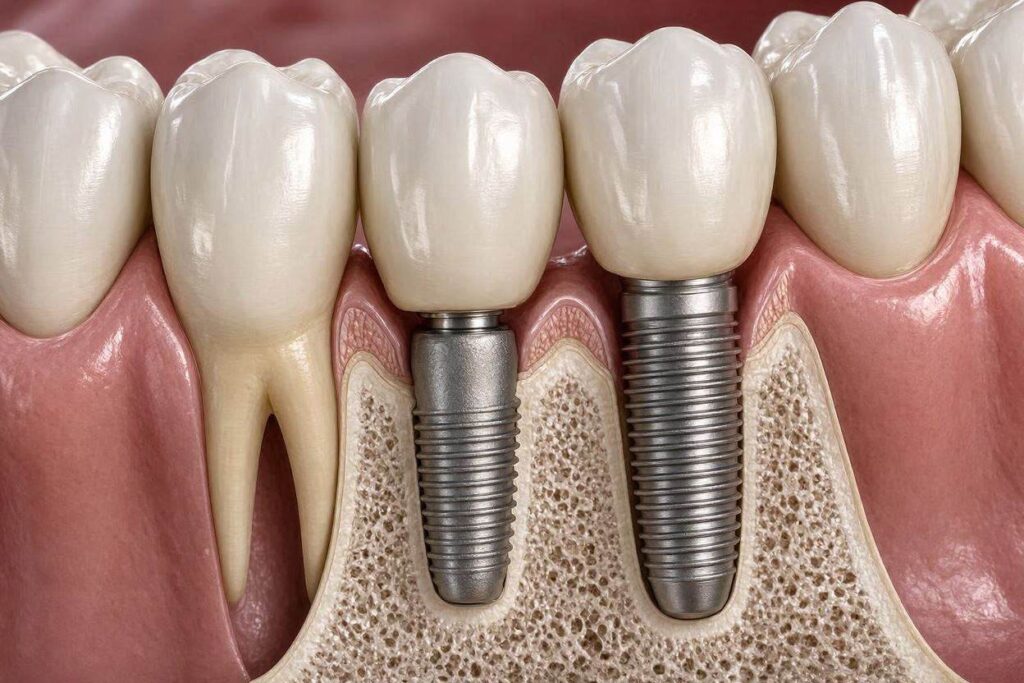
A short dental implant is typically defined as an implant with a length of 8 millimeters or less. Some definitions consider implants of 6 millimeters or less as “ultra-short.” The key distinction is that short implants are designed to be placed in areas of reduced bone height where placement of a conventional-length implant (10 millimeters or greater) would require bone augmentation procedures.
Length Classifications
| Classification | Implant Length | Clinical Context |
|---|---|---|
| Conventional | 10 mm and longer | Standard implant placement |
| Short | 6–8 mm | Reduced bone height |
| Ultra-short | Less than 6 mm | Severely limited bone height |
Beyond Length: The Complete Design
Short implants are not simply conventional implants cut shorter. They incorporate specific design features to compensate for their reduced length:
| Design Feature | Purpose |
|---|---|
| Wider diameter | Compensates for reduced length by increasing surface area |
| Aggressive thread design | Maximizes primary stability in limited bone |
| Platform switching | Preserves crestal bone around the implant neck |
| Advanced surface technology | Enhances osseointegration to maximize bone-to-implant contact |
| Tapered body | Improves stability in soft bone |
Why Short Implants Exist: The Clinical Problem
Short implants address a common clinical challenge: insufficient vertical bone height for conventional implants.
The Problem of Bone Loss
After tooth loss, the alveolar bone that once supported the tooth resorbs over time. In the posterior regions of both jaws, this bone loss creates particular problems:
- Posterior maxilla: The maxillary sinus expands downward as bone resorbs, leaving minimal bone between the ridge and the sinus floor
- Posterior mandible: The inferior alveolar nerve runs through the mandibular canal, limiting the depth available for implant placement
The Traditional Solution: Bone Augmentation
Before short implants became widely accepted, the standard approach to insufficient bone height was bone augmentation:
- Sinus lift procedures to add bone below the maxillary sinus
- Vertical ridge augmentation to increase bone height
- Nerve lateralization to reposition the inferior alveolar nerve
These procedures add significant complexity, cost, healing time, and morbidity to implant treatment.
The Short Implant Alternative
Short implants bypass the need for vertical bone augmentation by using the available bone as it exists. If you have 6–8 millimeters of bone height above the inferior alveolar nerve or below the maxillary sinus, a short implant can be placed directly without grafting.
The Biomechanics of Short Implants
The primary concern with short implants is whether they can withstand the forces of chewing over the long term.
The Crown-to-Implant Ratio
In conventional implant dentistry, a crown-to-implant ratio of 1:1 or less is considered ideal. The implant should be at least as long as the crown is tall. Short implants often have a crown-to-implant ratio greater than 1:1, meaning the visible crown is longer than the implant in the bone.
Traditional thinking: High crown-to-implant ratios create unfavorable leverage, increasing stress on the bone-implant interface and risking failure.
Modern understanding: Research has demonstrated that short implants with appropriate design features can tolerate crown-to-implant ratios significantly greater than 1:1 without increased failure rates.
How Short Implants Compensate
| Challenge | Design Solution |
|---|---|
| Reduced bone-implant contact area | Wider diameter increases surface area for osseointegration |
| Higher crown-to-implant ratio | Advanced thread design distributes forces more favorably |
| Greater bending stress | Stronger materials (titanium alloys, zirconia) resist fracture |
| Less primary stability in poor bone | Tapered design with aggressive threads engages cortical bone |
The Role of Implant-Abutment Connection
The connection between the implant and the abutment is particularly important in short implants:
- Conical (Morse taper) connections provide superior stability and bacterial seal
- Platform switching preserves crestal bone, maximizing the effective implant length
- Internal connections are preferred over external hex designs for force distribution
Clinical Applications of Short Implants
Short implants are used in specific clinical situations.
Primary Indications
| Indication | Description |
|---|---|
| Posterior maxilla with sinus proximity | Bone height insufficient for conventional implant; short implant avoids sinus lift |
| Posterior mandible with nerve proximity | Bone above inferior alveolar nerve is adequate for short implant but not conventional |
| Atrophic ridges | Generalized bone loss limiting implant length throughout the arch |
| Patients who cannot undergo grafting | Medical or personal reasons to avoid bone augmentation surgery |
| Elderly or medically compromised patients | Benefit from less invasive treatment with shorter recovery |
Less Suitable Applications
| Situation | Concern |
|---|---|
| Anterior aesthetic zone | Short implants may not provide ideal emergence profile |
| Single molars with high occlusal forces | Greater demands on the implant; splinting to additional implants may be advisable |
| Poor bone quality (very soft bone) | Reduced length provides less primary stability |
| Severe bruxism | High forces may overload short implants |
The Surgical Procedure
Placement of short implants follows the same general principles as conventional implant placement, with specific considerations.
Pre-Surgical Planning
Careful imaging is essential:
- Cone beam CT to precisely measure bone height above the nerve or below the sinus
- Identification of the exact position of vital structures
- Virtual implant placement to confirm adequate bone for the planned implant
Surgical Considerations
| Consideration | Detail |
|---|---|
| Osteotomy preparation | Shallower than for conventional implants; precise depth control critical |
| Under-preparation | May be used in soft bone to enhance primary stability |
| Implant placement | Platform should be at or slightly below bone crest |
| Primary stability | Should be achieved despite shorter length |
| Two-stage protocol | Often preferred to protect the implant during healing |
Immediate vs. Delayed Loading
Short implants are typically allowed to heal for the full osseointegration period before loading. Immediate loading is less common with short implants due to the reduced surface area for initial stability.
Success Rates of Short Implants
The evidence supporting short implants has grown substantially.
What the Research Shows
| Study Focus | Finding |
|---|---|
| Short implants (6–8 mm) vs. conventional implants | Comparable survival rates (90–98%) in systematic reviews |
| Short implants vs. implants in grafted bone | Short implants often show equal or better survival with fewer complications |
| Ultra-short implants (≤6 mm) | Higher failure rates than short implants (6–8 mm); more limited data |
| Long-term data (10+ years) | Growing body of evidence supports durability |
Factors Influencing Success
| Factor | Impact |
|---|---|
| Implant diameter | Wider diameter improves success |
| Implant surface | Modern surfaces outperform older machined surfaces |
| Bone quality | Better bone quality predicts better outcomes |
| Occlusal scheme | Careful management of biting forces is essential |
| Splinting vs. single | Splinting multiple short implants improves outcomes in some studies |
| Surgeon experience | More experienced surgeons achieve better results |
Advantages of Short Implants
Avoidance of Bone Grafting
This is the primary advantage. Short implants eliminate:
- Sinus lift surgery
- Vertical ridge augmentation
- Nerve lateralization
- Associated surgical morbidity, cost, and healing time
Reduced Treatment Time
| Procedure | Typical Timeline |
|---|---|
| Sinus lift + implant placement | 6–12 months |
| Vertical ridge augmentation + implant placement | 6–12 months |
| Short implant without grafting | 3–6 months |
Less Morbidity
Short implant placement is a single surgical procedure. Bone grafting procedures add:
- Additional surgical sites (donor sites for autogenous bone)
- Greater post-operative discomfort
- Longer recovery periods
- Additional risk of complications
Cost Reduction
Eliminating bone grafting significantly reduces the total cost of treatment, even if the short implant itself costs the same as or slightly more than a conventional implant.
Accessibility for More Patients
Patients who are not candidates for extensive bone grafting due to age, medical conditions, or personal preference may be candidates for short implants.
Limitations and Risks of Short Implants
Higher Failure Rate Than Conventional Implants in Some Studies
While success rates are generally comparable, some studies show slightly higher failure rates for short implants compared to conventional-length implants, particularly ultra-short implants.
Greater Sensitivity to Technical Errors
With less implant length to work with, surgical errors in angulation or depth have proportionally greater consequences. Precision is critical.
Prosthetic Considerations
- Higher crown-to-implant ratios require careful occlusal management
- Cantilevers should be avoided on short implants
- Splinting to additional implants may be advisable in some cases
- Screw-retained restorations may be preferred over cement-retained
Limited Long-Term Data for Ultra-Short Implants
While short implants (6–8 mm) have substantial long-term data, ultra-short implants (less than 6 mm) have less extensive follow-up.
Short Implants vs. Bone Grafting: Decision Factors
The choice between short implants and bone grafting depends on multiple factors.
| Factor | Favors Short Implant | Favors Bone Grafting |
|---|---|---|
| Available bone height | 6–8 mm | Less than 5 mm |
| Bone quality | Good density | Poor density |
| Patient age/health | Older, medically compromised | Young, healthy |
| Patient preference | Avoid grafting | Maximum predictability |
| Number of implants | Fewer | Full arch reconstruction |
| Aesthetic demands | Non-aesthetic zone | High aesthetic zone |
| Cost sensitivity | Cost-conscious | Cost less important |
| Time sensitivity | Need faster treatment | Can accept longer timeline |
Conclusion
A short dental implant is an implant with a length of 8 millimeters or less, specifically designed to be placed in areas of reduced bone height without the need for vertical bone augmentation procedures. Short implants incorporate wider diameters, aggressive thread designs, and advanced surface technologies to compensate for their reduced length and achieve success rates comparable to conventional implants in appropriate applications. They offer a less invasive, faster, and more cost-effective alternative to bone grafting for patients with limited bone height, particularly in the posterior maxilla and mandible. While success rates are generally excellent (90–98% survival), careful case selection, precise surgical technique, and appropriate prosthetic management are essential for optimal outcomes.
Frequently Asked Questions
Are short dental implants as good as regular implants?
In appropriate clinical situations, short implants demonstrate success rates comparable to conventional implants. They are not inferior when used correctly; they are a different solution for a different anatomical situation.
What is the minimum bone height needed for a short implant?
Most short implant systems require a minimum of 6–8 millimeters of bone height. Ultra-short implants of 4–5 millimeters exist but have less long-term data supporting their use.
How long do short dental implants last?
With proper care, short implants can last as long as conventional implants. Studies report survival rates of 90–98% at 5–10 years, comparable to conventional implants.
Can short implants be used for front teeth?
Short implants are primarily designed for posterior regions where bone height is limited by anatomical structures. The aesthetic zone typically has different requirements, and conventional-length implants are generally preferred for anterior teeth.
Do short implants cost less than conventional implants?
The implant itself may cost similarly. The total treatment cost is often lower because short implants eliminate the need for bone grafting procedures, which can add $1,500 to $4,000 or more to treatment.
Additional Resources
- International Team for Implantology: www.iti.org
- American Academy of Implant Dentistry: www.aaid.com
- Academy of Osseointegration: www.osseo.org