Do People With Implants Feel Tooth Pain?
You bite into something cold. A sensation shoots through your mouth, but it does not quite feel like it used to. Something is different. The implant. You wonder: should you feel anything from that tooth at all? Can an implant feel pain the way a natural tooth does? And if you do feel something from the implant area, what does that mean?
These questions touch on the fundamental neurological difference between natural teeth and dental implants. Understanding the answer requires exploring how teeth sense the world, what an implant lacks, and what types of sensation can still occur around implants.
The Short Answer
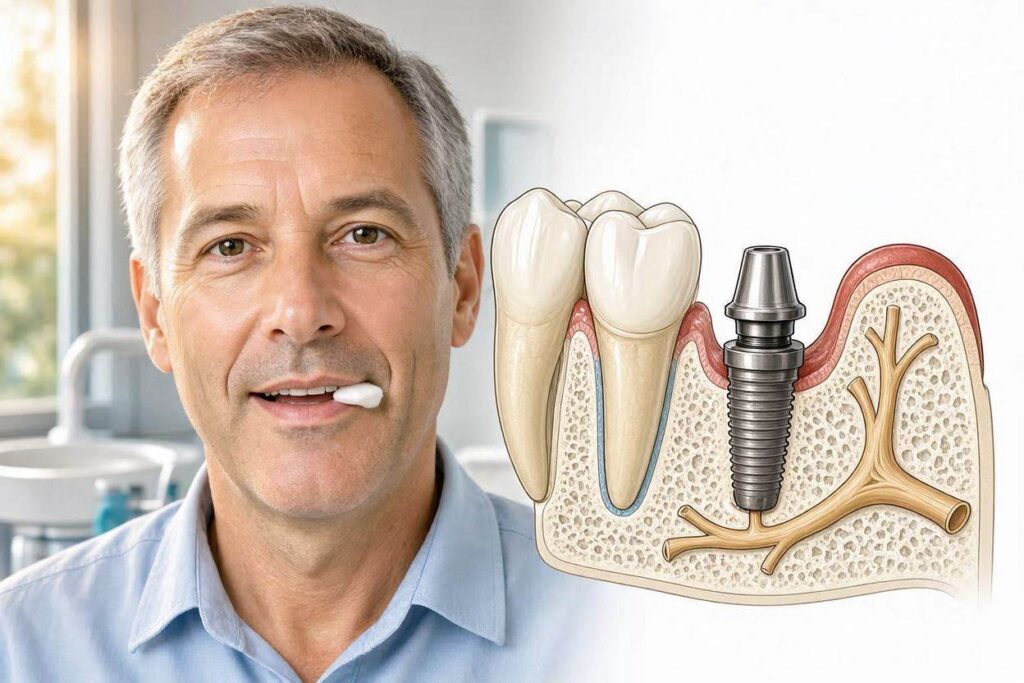
People with dental implants do not feel tooth pain from the implant itself in the way they feel pain from a natural tooth. A dental implant has no nerve supply, no pulp tissue, and no periodontal ligament. It cannot feel hot, cold, or the specific sharp sensation of tooth decay. However, people with implants can feel pain from the tissues surrounding the implant: the gum, the bone, and the nerves in the vicinity. Pain from around an implant is real and clinically significant, but its character and causes differ from natural tooth pain.
Why Natural Teeth Feel Pain
To understand what implants lack, you must first understand what makes natural teeth sensitive.
The Sensory Apparatus of a Natural Tooth
| Structure | Function |
|---|---|
| Pulp | The living core of the tooth containing nerves, blood vessels, and connective tissue |
| Dentin | The layer beneath enamel; contains microscopic tubules that transmit sensation to the pulp |
| Enamel | The outer layer; not innervated |
| Periodontal ligament | The connective tissue between root and bone; rich in nerve endings |
| Cementum | The outer layer of the root; not innervated |
Types of Sensation in Natural Teeth
| Sensation | Origin |
|---|---|
| Sharp pain with cold or hot | Fluid movement in dentinal tubules stimulating pulp nerves |
| Dull ache | Inflammation in the pulp or periodontal ligament |
| Pain on biting | Pressure on an inflamed periodontal ligament or cracked tooth |
| Sharp pain with sweets | Osmotic changes in dentinal tubules stimulating pulp |
| Throbbing pain | Pulp inflammation (pulpitis) |
All of these sensations depend on the presence of the pulp and the periodontal ligament. The implant has neither.
What an Implant Lacks
A dental implant is fundamentally different from a natural tooth in its relationship with the body.
Structures Absent in an Implant
| Natural Tooth Structure | Implant Equivalent | Sensory Function |
|---|---|---|
| Pulp | None | Major sensory organ of the tooth |
| Periodontal ligament | None; direct bone-to-implant contact | Rich in mechanoreceptors and pain fibers |
| Dentin | None | Transmits sensation to pulp |
| Cementum | None | Covers root surface |
What This Means for Sensation
- An implant cannot feel temperature (hot coffee, ice cream)
- An implant cannot feel decay (because there is nothing to decay)
- An implant cannot feel the sharp, localized pain of a damaged tooth
- An implant lacks the proprioceptive feedback that tells you how hard you are biting
What People with Implants Can Feel
The absence of tooth-specific sensation does not mean the implant area is numb or without sensation.
Sensations That Can Occur Around Implants
| Sensation | Possible Cause |
|---|---|
| Pressure or awareness of contact | Stimulation of bone and gum tissue around the implant |
| Pain when biting | Overload, peri-implantitis, loose components, or adjacent tooth problem |
| Dull ache or throbbing | Infection or inflammation in surrounding tissues |
| Sharp, localized pain | Food impaction, gum irritation, or adjacent tooth issue |
| Burning or tingling | Nerve involvement (neuropathy or nerve proximity) |
| Temperature-related discomfort | Inflammation in surrounding gum tissue; not the implant itself |
The Bite Sensation: What Patients Experience
Patients with implants report that they can “feel” the implant when they bite, but the sensation differs from a natural tooth:
| Aspect | Natural Tooth | Implant |
|---|---|---|
| Sense of bite force | Graded; can tell how hard they are biting | Reduced; less precise feedback |
| Sense of contact | Immediate and localized | More diffuse; felt more in the bone |
| Threshold for detecting contact | Lower (more sensitive) | Higher (less sensitive) |
| Ability to discriminate thickness | Better | Reduced |
This reduced proprioception is due to the absence of the periodontal ligament, which contains specialized mechanoreceptors that provide fine feedback about biting forces. Implant patients compensate through receptors in the jaw muscles, the temporomandibular joint, and the periosteum (bone covering).
Pain That Originates from Implant Problems
When someone with an implant experiences pain, it should not be ignored. Several implant-specific problems can cause discomfort.
Pain from Peri-Implant Disease
| Condition | Pain Characteristics |
|---|---|
| Peri-implant mucositis | Mild tenderness; bleeding when brushing; gum redness |
| Peri-implantitis | Dull ache; possible throbbing; pain when chewing; deep pockets around implant |
Peri-implantitis pain is often less intense than the pain from a comparable periodontal infection around a natural tooth, because the implant lacks the richly innervated periodontal ligament. This is actually a disadvantage: the reduced feedback can allow disease to progress further before the patient notices.
Pain from Mechanical Problems
| Problem | Pain Characteristics |
|---|---|
| Loose abutment screw | Pain or discomfort when chewing; relief when not biting |
| Loose crown | Movement sensation; possible discomfort |
| Fractured crown or abutment | Sharp pain on biting; possible sensitivity |
| Implant fracture (rare) | Sudden pain; possible mobility |
| Cementitis (retained cement) | Dull ache; gum inflammation; possible pus |
Pain from Overload
When an implant receives excessive biting forces:
- Pain typically occurs when chewing and resolves when not biting
- The pain is felt in the bone and gum around the implant
- Adjacent muscles may become sore from compensating
- The pain is often described as a deep ache rather than sharp pain
Pain from Nerve Involvement
| Scenario | Symptoms |
|---|---|
| Implant placed too close to a nerve | Persistent numbness, tingling, burning, or shooting pain |
| Nerve compression during surgery | Immediate sensory changes post-surgery |
| Delayed nerve symptoms | May develop as scar tissue forms around the implant |
Nerve-related pain from an implant is serious and requires prompt evaluation.
Pain Referred from Other Sources
Pain felt near an implant may not originate from the implant at all.
Adjacent Natural Tooth Problems
The most common source of “implant pain” is actually a problem with an adjacent natural tooth:
- Decay: A cavity in the tooth next to the implant can cause pain that feels like it comes from the implant
- Cracked tooth: Pain on biting that is difficult to localize
- Periodontal disease: Gum and bone pain around the adjacent tooth
- Pulpitis: Inflammation of the pulp of an adjacent tooth
Other Sources of Referred Pain
| Source | Characteristics |
|---|---|
| Sinus infection (upper implants) | Pressure, pain in the cheek area, worsens when bending forward |
| Temporomandibular joint disorder | Pain in the jaw joint radiating to the implant area |
| Muscle pain (myofascial) | Trigger points in chewing muscles referring pain to the teeth |
| Neuropathic pain | Burning, tingling unrelated to a specific tooth problem |
The Diagnostic Challenge
Because implants lack the specific sensory mechanisms of natural teeth, diagnosing pain around implants can be challenging.
Why Diagnosis Is Harder
| Challenge | Explanation |
|---|---|
| Implant does not respond to cold or heat testing | The most common diagnostic tests for natural teeth do not work on implants |
| Implant cannot be percussed like a natural tooth | Tapping an implant produces different information than tapping a natural tooth |
| Pain localization is less precise | The absence of the periodontal ligament makes it harder to identify exactly where pain originates |
| Radiographic changes may be subtle | Early peri-implantitis may not be obvious on X-rays |
Diagnostic Methods for Implant Pain
| Method | What It Evaluates |
|---|---|
| Clinical probing | Pocket depth, bleeding, suppuration around the implant |
| Percussion testing | Whether tapping causes pain; stability assessment |
| Mobility testing | Implant should be immobile |
| Radiographs (periapical, CBCT) | Bone levels, radiolucency, component integrity |
| Bite evaluation | Occlusal contacts, premature loading |
| Screw torque check | Whether abutment or prosthetic screws are loose |
| Selective anesthesia | Numbing suspected sources to identify the pain origin |
The Phantom Tooth Phenomenon
Some patients report feeling sensation from an implant as if it were a natural tooth, including temperature sensitivity. This is not a true neurological phenomenon but rather a learned association.
Explanation
The brain has decades of experience interpreting sensations from the mouth. When the implant crown contacts hot or cold substances, the surrounding gum tissue does experience temperature change. The brain, accustomed to associating that location with tooth sensation, may interpret the gum sensation as coming from the “tooth.”
This is not pathological. It is a normal adaptation of sensory perception.
When to Be Concerned About Implant Pain
Not all discomfort around an implant is alarming, but certain presentations warrant prompt attention.
Normally Expected Sensations
- Mild tenderness for a few days after implant surgery or crown delivery
- Awareness of pressure when the crown is new
- Slight discomfort when food impacts between the implant and adjacent tooth
Concerning Symptoms
| Symptom | Possible Significance |
|---|---|
| Pain that persists beyond the normal healing period | Infection, failed osseointegration |
| Pain that develops after years of comfort | Peri-implantitis, overload, component failure |
| Pain with mobility | Implant failure or fracture |
| Pain with swelling or pus | Active infection |
| Numbness or burning | Nerve involvement |
| Pain that worsens when chewing and does not resolve | Overload or structural problem |
Any of these symptoms warrant evaluation by your implant dentist.
Conclusion
People with dental implants do not feel tooth pain from the implant itself because implants lack the pulp tissue and periodontal ligament that provide natural teeth with their rich sensory innervation. Implants cannot feel temperature, decay, or the specific sharp sensations of dental disease. However, people with implants can and do feel pain from the surrounding tissues: gum inflammation, bone infection (peri-implantitis), nerve irritation, mechanical problems like loose screws, and occlusal overload. Pain felt near an implant may also originate from adjacent natural teeth or other structures. The absence of normal tooth sensation means that implant problems can progress further before being noticed, making regular professional monitoring essential for long-term implant health.
Frequently Asked Questions
Can a dental implant feel cold?
No. The implant itself has no nerve supply and cannot feel temperature. Any sensation of cold near the implant comes from the surrounding gum tissue, not the implant or crown.
Why does my implant hurt when I bite down?
Biting pain on an implant usually indicates a mechanical problem (loose screw, loose crown), occlusal overload (the bite is too high), or inflammation in the surrounding bone (peri-implantitis). It is not the same as the biting pain from a cracked natural tooth.
Can an implant get a cavity?
No. Implant crowns are made of ceramic, porcelain, or metal, none of which can decay. However, the gum and bone around the implant can become infected (peri-implant disease), which is the implant equivalent of decay-related problems.
Why does my implant feel different from my natural teeth?
Implants lack the periodontal ligament that provides natural teeth with fine sensory feedback. The sensation of biting is less precise, and you may not feel light contact as acutely as with natural teeth.
Is it normal for an implant to hurt years after placement?
No. Pain that develops in an implant that has been comfortable for years is abnormal and should be evaluated. It may indicate peri-implantitis, overload, a loose component, or a problem with an adjacent tooth.
Additional Resources
- American Academy of Implant Dentistry: www.aaid.com
- International Congress of Oral Implantologists: www.icoi.org
- Academy of Osseointegration: www.osseo.org