Claremont, California Dental Implants: What Are They?
For residents of Claremont, California, the decision to replace missing teeth is a significant one. It affects daily quality of life, from enjoying meals at local restaurants to feeling confident in professional and social interactions. Dental implants have become the preferred solution because they offer something no other tooth replacement can: a complete restoration of the tooth’s root, not just its visible crown. The term “Claremont, California dental implants” refers to the delivery of this advanced, multi-phase restorative therapy by skilled local clinicians who combine surgical expertise with aesthetic restorative artistry.
This comprehensive guide is written for the Claremont community. It will provide a thorough, patient-focused understanding of what a dental implant is, the materials and biological principles that make it work, the detailed step-by-step clinical process, the types of restorations available, and the unique health benefits that have established implants as the definitive standard of care for tooth replacement.
The Biological Consequence of Tooth Loss
A tooth is an organ composed of two distinct parts: the clinical crown, which is the hard, enamel-covered structure visible in the mouth, and the root, which is firmly housed within the alveolar bone of the jaw. The root is not a passive stake. It is a living, functional component of the skeletal system. The periodontal ligament and the root cementum transmit the forces of mastication—chewing—deep into the trabecular bone that surrounds the tooth socket.
This mechanical load is a vital physiological signal. The bone cells, through a process of mechanotransduction, sense this pressure and respond by maintaining a state of constant, healthy remodeling. The bone is preserved because it is being used. When a tooth is extracted or lost, this signal is permanently lost. The body, ever efficient, begins a process of disuse atrophy. The alveolar ridge, the bony arch that holds the teeth, begins to resorb. It shrinks in vertical height and narrows in horizontal width. Over a period of years, this bone loss can become severe, altering the foundational support for the lips and cheeks and creating a prematurely aged, collapsed facial profile. A dental implant is the only prosthetic device that re-establishes this lost biological connection to the bone.
The Dental Implant System: A Three-Component Device
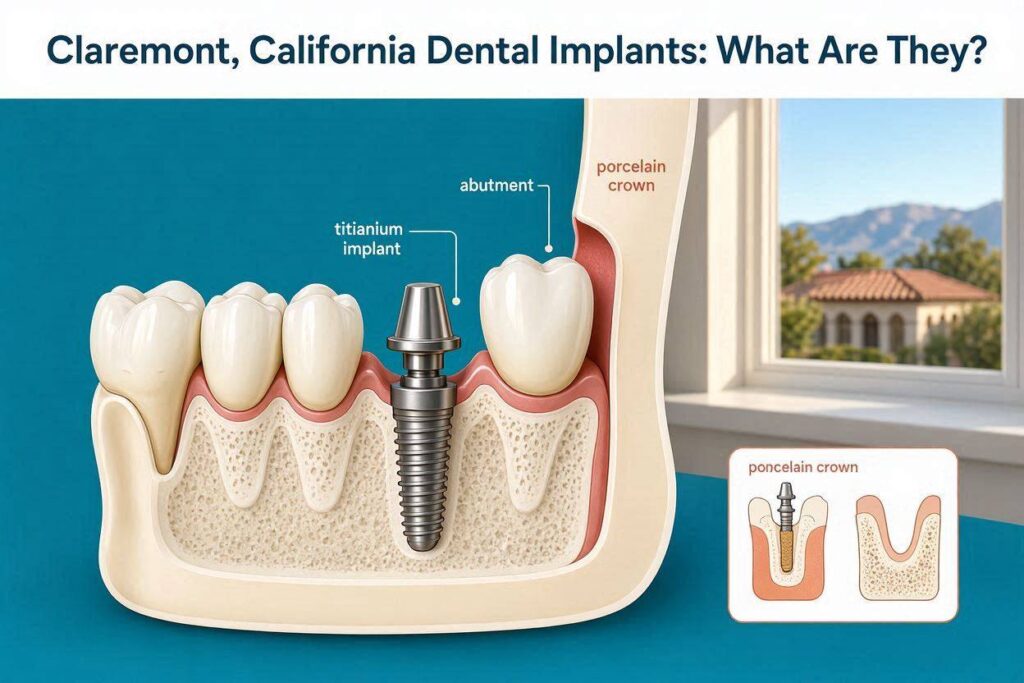
A dental implant is a highly engineered, three-part medical device system that replaces the entire anatomical structure of a missing tooth.
The Implant Fixture (The Synthetic Root)
The implant fixture is the component that is surgically placed into the prepared site in the jawbone. It is a precision-manufactured post, typically cylindrical and threaded. It is fabricated from medical-grade titanium alloy (Ti-6Al-4V ELI) or, in specific clinical situations, from a high-strength zirconia ceramic. Titanium alloy is the material of choice for the vast majority of cases due to its unique and well-documented property of osseointegration. This is the biological process where living bone cells (osteoblasts) migrate to the implant surface and form a direct, structural, and functional fusion with the titanium oxide layer. There is no intervening soft tissue scar. The implant becomes, for all biological and mechanical purposes, a synthetic tooth root locked permanently within the skeleton.
The Abutment (The Precision Connector)
After the completion of the osseointegration healing phase, a second small component is attached. The abutment is a connector post that is secured to the internal connection of the implant fixture. It passes through the soft tissue of the gum and emerges into the oral cavity. Its function is to provide a stable, precisely machined platform upon which the visible crown will be anchored. In a state-of-the-art restoration, this abutment is a custom-milled component, designed using CAD/CAM software to perfectly manage the soft tissue contours and provide an ideal restorative emergence profile.
The Implant Crown (The Visible Prosthetic)
The final component is the prosthetic crown. This is the part that restores function and aesthetics. It is not a pre-made, mass-produced tooth. It is a custom work of dental art, designed and milled by a master ceramist. The crown is typically fabricated from a solid block of high-performance ceramic, most commonly a monolithic lithium disilicate (such as IPS e.max) or a layered yttria-stabilized zirconia. These materials are selected for their ability to withstand high occlusal forces and for their exceptional optical properties, which allow them to closely mimic the translucency, opalescence, and color of natural human enamel.
The Structured Clinical Process for Claremont Patients
The path from a missing tooth to a fully integrated and functional implant restoration is a deliberate, multi-phase medical process governed by biological healing timelines.
Phase 1: 3D Diagnostic Imaging and Virtual Planning
The first appointment is a comprehensive diagnostic session. The foundational technology is a Cone Beam Computed Tomography (CBCT) scan. A two-dimensional periapical or panoramic X-ray is insufficient for safe, modern implant planning. The CBCT produces a high-resolution, three-dimensional digital model of the maxillofacial skeleton. The clinician uses this model to evaluate the volume and density of the available bone, precisely map the course of the inferior alveolar nerve and the boundaries of the maxillary sinuses, and perform a complete virtual implant surgery on a computer screen prior to any physical intervention.
Phase 2: Alveolar Ridge Augmentation (Bone Grafting)
If the CBCT scan reveals a deficiency in bone volume, a preparatory bone graft is required. This is a routine and highly predictable procedure. The surgeon places a sterile, biocompatible osteoconductive grafting material into the atrophic site. This material serves as a scaffold, guiding the patient’s own osteoblasts to migrate into the area and regenerate new, vital, vascularized bone. In the posterior maxilla, a sinus floor elevation (sinus lift) may be necessary to establish an adequate vertical dimension of bone. This foundational phase requires its own undisturbed healing period of several months.
Phase 3: Implant Placement Surgery
The surgery is performed under profound local anesthesia. Patient comfort is augmented with the selected mode of sedation. The surgeon makes a precise crestal incision, elevates a full-thickness flap, and prepares an osteotomy—a precisely sized channel in the bone—using a sequential series of drills under copious irrigation. The titanium implant fixture is then threaded into the osteotomy to a specific insertion torque value. The gingival tissue is sutured closed, and the implant is left to heal.
Phase 4: The Osseointegration Period
Over the next 3 to 6 months, the patient wears a temporary, non-load-bearing prosthesis. The body’s natural healing processes dominate this phase. Osteoblasts deposit woven bone, which then remodels into mature lamellar bone, creating an intimate, rigid interface with the titanium surface. This osseointegration provides the implant with its long-term anchorage.
Phase 5: Prosthetic Restoration
Once the surgeon has confirmed successful integration, the implant is uncovered, and the custom abutment is placed. The restorative dentist captures a digital impression using an intraoral optical scanner. A dental laboratory uses this scan to design and mill the final ceramic crown. The crown is delivered and secured, completing the process.
Types of Implant Restorations
- Single Unit Implant: One fixture, one crown. The ideal, self-supporting replacement for a single tooth.
- Implant-Supported Fixed Partial Denture (Bridge): Two or more implants support a multi-unit span of ceramic teeth.
- Full-Arch Implant-Supported Fixed Prosthesis (All-on-4): A complete arch of non-removable teeth supported by a minimal number of implants.
- Implant-Retained Removable Overdenture: A denture with precision attachments that snaps onto implants for vastly improved stability.
The Definitive Biological and Functional Advantages
Dental implants are the superior treatment modality because they address the root cause of post-extraction bone loss.
- Alveolar Bone Preservation: Only an implant delivers the mechanical load required to maintain bone density and volume, preventing facial collapse.
- Preservation of Intact Tooth Structure: A conventional bridge requires the irreversible preparation and weakening of the adjacent, healthy abutment teeth. An implant is a stand-alone restoration that does not compromise any natural tooth structure.
- Complete Functional Rehabilitation: The implant restores masticatory function to a level comparable to the natural dentition. It eliminates the movement, discomfort, and dietary restrictions associated with removable prosthetics.
Candidacy and Medical Considerations
Most systemically healthy adults are candidates for dental implants. Adequate bone volume is the primary local requirement, and modern regenerative techniques can establish this for nearly all patients. Medical conditions that impair wound healing, such as poorly controlled diabetes mellitus, and lifestyle factors, particularly tobacco smoking, are significant risk factors for implant failure and must be addressed comprehensively before initiating treatment.
Selecting a Qualified Implant Provider in Claremont
The provider’s training and experience are the most critical determinants of a successful outcome. Look for a board-certified specialist—an oral and maxillofacial surgeon, a periodontist, or a prosthodontist—or a general dentist who has earned advanced, verifiable credentials such as a Diplomate from the American Board of Oral Implantology/Implant Dentistry (ABOI/ID) or a Fellowship in the American Academy of Implant Dentistry (AAID). The practice must utilize in-office 3D CBCT imaging for every case. The consultation must be thorough, data-driven, and include a transparent, all-inclusive written treatment plan and financial estimate.
Conclusion
Claremont, California dental implants are a complete, three-component tooth replacement system: a titanium alloy root fixture, a precision custom abutment, and a high-performance ceramic crown. The treatment follows a structured sequence of 3D virtual planning, any necessary bone grafting, precise surgical placement, a critical biological healing phase of osseointegration, and a final digital restoration. Implants are the only modality that halts post-extraction jawbone resorption, preserves the integrity of adjacent natural teeth, and provides a permanent, fully functional, and aesthetically indistinguishable replacement tooth.
FAQ
1. Is the implant placement procedure painful?
No. The procedure is performed under local anesthesia and is painless. Post-operative discomfort is typically mild and resolves within a few days with standard analgesics.
2. How long does a dental implant last?
With consistent daily hygiene and professional recall maintenance, the implant fixture can last a lifetime. The prosthetic crown is subject to normal wear and may require replacement at some point over decades.
3. How do I properly care for my implant?
Oral hygiene for an implant must be meticulous. Brush the crown twice daily, and clean the peri-implant sulcus daily using implant-specific floss, interdental brushes, or a water flosser. Professional maintenance visits every 3-6 months are essential.
4. What is the success rate of dental implants?
The long-term, 10-year survival rate for dental implants in patients with good oral hygiene and systemic health is documented at over 95%.
5. Will insurance cover the cost?
Dental insurance may contribute to the cost of the final crown. The surgical phases are often not covered. Your provider’s financial coordinator will perform a detailed breakdown of your benefits and out-of-pocket investment.
Additional Resource
For comprehensive, evidence-based patient education on all aspects of implant dentistry, visit the official website of the American Academy of Implant Dentistry (AAID).