Can Braces Be Worn with a Tooth Implant?
You have a dental implant or are planning to get one, and now you are considering orthodontic treatment to straighten your teeth. Or perhaps you already have braces and are facing the prospect of a needed implant. This creates a complex clinical intersection. The central question you are asking is a critical one: can braces be worn with a tooth implant? The short answer is yes, but with a very important caveat that dictates the entire treatment strategy. This guide will explain the fundamental biological reason why an implant behaves so differently from a natural tooth during orthodontics. We will walk through the correct sequence of treatment, the challenges of moving teeth around an existing implant, and the specialized techniques an orthodontist and implant surgeon must use to achieve a successful outcome. This is your in-depth resource for understanding this complex interdisciplinary dental scenario.
The Fundamental Difference: Why an Implant Cannot Be Moved
The entire strategy of combining braces and an implant rests on one immovable biological fact: a dental implant is ankylosed to the bone. It is fused. When a natural tooth is moved by braces, the orthodontic wire and bracket apply a gentle, sustained pressure. This pressure compresses the periodontal ligament on one side of the tooth. The body responds by activating osteoclasts, specialized cells that resorb bone on the pressure side, while osteoblasts lay down new bone on the tension side. This biological process allows the tooth to move slowly through living bone.
A dental implant has no periodontal ligament. The titanium surface is in direct contact and biologically bonded to the jawbone. When force is applied to an implant, no ligament compression occurs, no osteoclasts are activated, and no bone remodeling takes place. The implant will not move. If a heavy, sustained orthodontic force is mistakenly applied to an implant, it will not glide through the bone. One of three things will happen: nothing, the bone around the implant will remain resolutely intact and the implant will act as an immovable anchor; the force will cause the screw attaching the crown to the implant to loosen; or, in the worst case, the force will exceed the bone’s capacity and the implant itself will lose osseointegration and fail. The implant is a fixed pillar in the jaw. This is why the implant can be an extraordinary advantage as a stable orthodontic anchor, but it cannot be a tooth to be moved.
The Ideal Sequence: Orthodontics First, Implant Second
Because an implant cannot be moved, the standard of care for a patient who needs both tooth straightening and a missing tooth replaced is to complete all orthodontic tooth movement first. You wear braces or clear aligners. Your orthodontist moves all your natural teeth into their ideal, final positions. Then, after your braces are removed and you are wearing retainers to stabilize your teeth in their new positions, the implant surgeon places the dental implant. This sequence ensures that the implant is positioned in the exact, final ideal location within a stable, unmoving dental arch. The final implant crown is designed to fit perfectly into a bite that has already been corrected and will not change.
If your orthodontist knows you are planning an implant, they can create the perfect amount of space for the future implant crown. They will carefully align the roots of the adjacent teeth to leave a precise, parallel-sided edentulous space. The orthodontist’s role is to build the stage. The implant surgeon’s role is to place the perfect restoration on that stage. When treatment is sequenced this way, the outcome is predictable, the biomechanics are correct, and the risk of a misaligned implant is virtually eliminated. This is the gold-standard, interdisciplinary treatment plan.
The Challenging Scenario: Wearing Braces with an Existing Implant
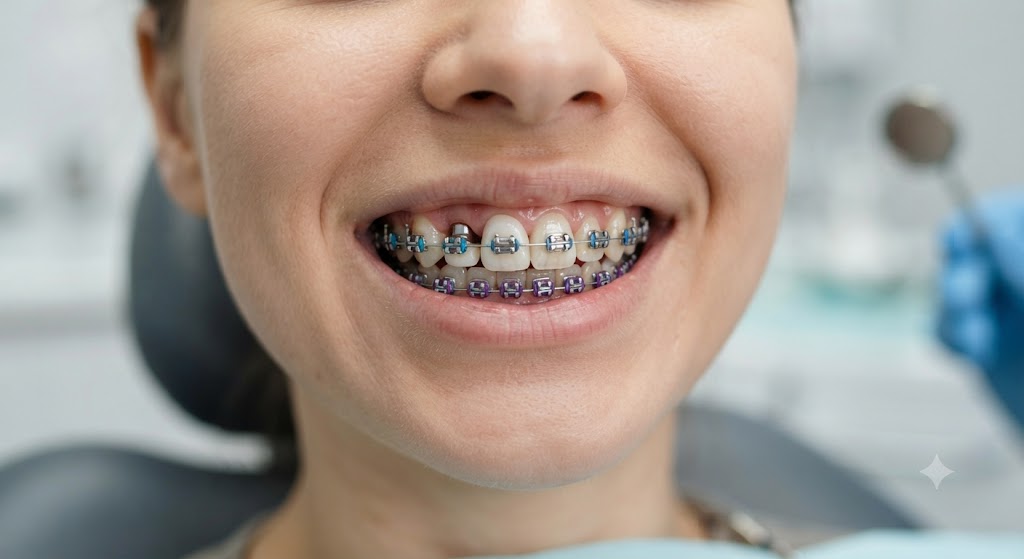
What if you already have an implant and now want or need orthodontic treatment? This is a far more complex scenario, but it is manageable. The orthodontist must design a force system that moves all your natural teeth around the immovable implant. The implant acts as a fixed reference point. The braces are placed on your natural teeth. The orthodontic archwire is designed to bypass the implant crown, or a bracket is placed on the implant crown, but with a completely different strategy. The bracket on the implant crown is not used to apply force to the implant. Instead, the implant crown is connected to the orthodontic wire as a rigid, passive anchor unit. The force system is applied to the natural teeth, using the implant as a stable, stationary anchorage to pull or push the natural teeth into alignment.
In some cases, the orthodontist may not even bond a bracket to the implant crown. The crown is simply left untouched, and the natural teeth are moved around it. The restorative dentist must understand that after orthodontics, the existing implant crown may no longer fit harmoniously with the new bite and the new positions of the adjacent teeth. The implant crown may need to be replaced with a new one that is aligned with the corrected smile. The implant body itself is perfectly fine, but the prosthetic tooth on top of it may be obsolete. This must be factored into the cost and timeline.
Using Implants as Temporary Orthodontic Anchorage Devices (TADs)
There is a fascinating reversal of this relationship. In complex orthodontic cases, a specialist may intentionally place a small, temporary implant, called a Temporary Anchorage Device or TAD. This is not a dental implant for a tooth replacement; it is a miniature, temporary titanium screw placed into the jawbone to act as an absolute anchorage point. The orthodontist attaches elastic chains or springs to this TAD and uses it to pull teeth in a specific direction with forces that would be impossible to achieve with natural teeth or headgear. The TAD is a brilliant application of the immovability of an implant. Once the orthodontic movement is complete, the TAD is simply unscrewed and removed. This is a powerful tool for a skilled orthodontist and is a testament to the unique property of an implant’s ankylosis. A dental implant, a TAD, and a zygomatic implant all share this fundamental biological property: once integrated, they are immovable anchors.
Team Communication: The Orthodontist, the Surgeon, and the Restorative Dentist
A case involving braces and an implant is a true team sport. The patient’s journey must be managed by a triad of professionals in constant communication. The orthodontist identifies the desired final tooth positions and the necessary space for the implant. They provide the restorative dentist and the surgeon with a final setup, often a digital simulation. The surgeon uses a 3D CBCT scan and a surgical guide—which can be fabricated based on the orthodontically planned final tooth positions—to place the implant with absolute precision in three dimensions. The restorative dentist then creates the final implant crown that fits into the orthodontically perfect arch.
If you are a patient, you must choose providers who are willing and experienced in this collaborative model. A general dentist who places an implant in a patient who is in braces without consulting the orthodontist is committing a serious error. A team that meets, digitally plans, and sequences the treatment is the hallmark of excellence. This coordinated care is your guarantee that the final result will be functional, aesthetic, and biologically sound.
Conclusion
Yes, braces can be worn with a tooth implant, but the implant’s fundamental ankylotic fusion to the jawbone means it is an immovable fixture, a property that makes it a powerful orthodontic anchor but impossible to shift like a natural tooth. The standard of care for a patient needing both treatments is a clearly sequenced plan: complete all orthodontic movement first, then place the implant into the stable, corrected dental arch. If braces are needed with an existing implant, a highly skilled orthodontist can design a force system that moves the natural teeth around the implant, often using it as a fixed anchor, with the understanding that the existing implant crown may need to be remade to match the new smile.
Frequently Asked Questions
Can I get Invisalign instead of braces if I have a dental implant?
Yes. Clear aligner therapy works on the same biological principle. The aligners will apply force to your natural teeth. Your implant will not move. The aligners can be designed to passively cover the implant crown while moving the other teeth.
Will the orthodontic force loosen my dental implant?
If the orthodontist applies force incorrectly and directly tries to move the implant, yes, the prosthetic screw can loosen or the implant can fail. An expert orthodontist will design the force system so the implant receives passive, minimal, or purely anchorage-based forces, which are safe.
If an implant is used as an anchor, does that hurt the implant?
No. Using an implant as an anchor applies light, physiologically acceptable forces that are well within the tolerance of the bone-implant interface. The bone is loaded, but not beyond its capacity to bear force.
Can a dental implant be placed while I am still wearing braces?
In very rare, carefully planned situations, yes, but it is generally avoided. The position of the teeth is still in flux. The implant risks being placed in a position that will be incorrect once the final tooth movements are complete. Placing the implant after braces is the safest, most predictable protocol.
Is it possible to have a tooth extracted, an implant placed, and braces started all at the same time?
No. If a tooth is extracted and an implant is needed, the orthodontic treatment must come first. You would have braces placed, the space for the missing tooth would be opened or closed as needed, and only after the braces are finished would the implant be placed. Rushing the implant before the orthodontics is a recipe for a malpositioned result.
Additional Resource
For more information on the relationship between orthodontics and restorative dentistry, you can visit the American Association of Orthodontists’ patient information portal. Visit the AAO Patient Page