Can I Get Dental Implants in China?
The prospect of combining a trip to China with significantly lower-cost dental implant treatment is an attractive one for many people facing high quotes at home. You might be an expatriate living in China, a business traveler, or a dedicated dental tourist considering the journey. The question “Can I get dental implants in China?” is deceptively simple. The answer is yes, you can find both world-class, state-of-the-art implantology and dangerously substandard care. This guide will walk you through the reality of seeking dental implant treatment in China as a foreigner. We will explore the two-tiered system of care, what to look for in a legitimate international clinic, the true costs, the critical material quality issues you must investigate, and the legal and practical risks you assume when you leave your home country’s regulatory framework.
The Two-Tiered Reality of Chinese Dentistry
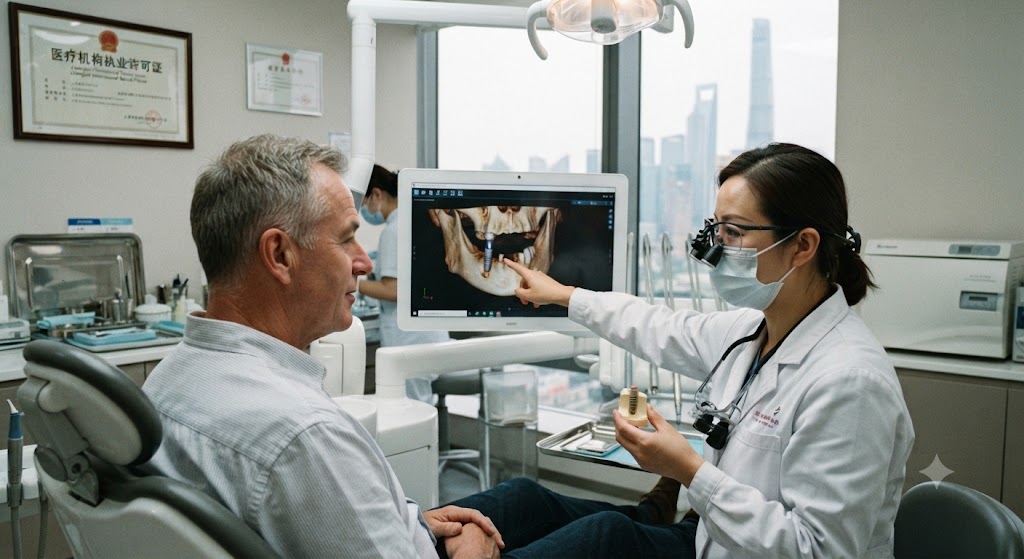
It is a mistake to think of Chinese dentistry as a monolith. The market is starkly divided into two tiers. The first tier is the world-class, internationally accredited private dental hospitals and clinics located in the expatriate hubs of Beijing, Shanghai, Guangzhou, and Shenzhen. These are facilities that rival or exceed the standards of a high-end private practice in New York or London. They are often affiliated with international hospital groups like United Family Healthcare or ParkwayHealth, or they are stand-alone dental specialty centers designed specifically to serve the expatriate and affluent Chinese market. The dentists in these clinics frequently hold degrees and postgraduate qualifications from the United States, Europe, Japan, or Australia. They speak fluent English. They use premium, traceable implant systems from manufacturers like Straumann, Nobel Biocare, or Zimmer Biomet. They follow strict, international sterilization and infection control protocols. They use 3D CBCT imaging for planning and often employ computer-guided surgery. This is a safe, modern, and professionally excellent environment for receiving a dental implant.
The second tier is the vast, mass-market Chinese dental hospital and the small, unregulated private clinic. The quality here is a complete unknown and varies wildly. Some large university-affiliated hospitals in major cities have specialized implant departments that provide excellent care, though often with a language barrier. However, many smaller private clinics operate with far less rigorous oversight. The risk lies in the use of cloned, non-branded implant systems of unknown origin and quality. The sterilization standards may be inadequate. The dentist’s training may be limited to a short course. The use of 3D imaging may be absent, and the surgery may be performed blind. The price is astonishingly low, but the long-term risk of infection, implant failure, nerve damage, and an unrestorable prosthetic tooth is exceptionally high. As a foreigner, your challenge is to navigate this landscape and ensure you end up in a first-tier facility.
What to Look for in a Safe, International-Standard Clinic
Your selection criteria in China must be rigorous and non-negotiable. First, demand that the lead implant surgeon speaks professional, fluent English. Your consultation, the informed consent process, and the intraoperative communication must be in a language you understand perfectly. Nuances about medical history, pain, and post-operative instructions cannot be lost in translation. Second, verify the surgeon’s qualifications. Ask directly, “Where did you complete your specialty training in implantology? Do you hold a degree or certification from an internationally recognized program?” Acceptable answers are a postgraduate degree from an accredited US, European, Australian, Japanese, or Hong Kong university.
Third, inspect the implant brand. The surgeon must be able to name the exact implant system they will use. Insist on a globally recognized, premium brand with a long scientific track record. Avoid any clinic that uses a generic “Chinese implant” or cannot provide a brand name and a sealed, traceable vial for your implant. Fourth, the clinic must have an on-site Cone Beam CT scanner and use it for your case. A clinic that places implants based only on a panoramic X-ray is not meeting the standard of care. Fifth, observe the clinic’s hygiene and sterilization protocols. Instruments must be in sealed, sterilized pouches. The surgical team must wear full sterile gowns and gloves. The clinic should be spotless and operate with an atmosphere of professional, calm precision. If you have any doubt, do not proceed.
The Real Cost of a Dental Implant in a First-Tier Chinese Clinic
The primary driver for a foreigner to seek care in China is cost savings. In a top-tier international clinic in Shanghai or Beijing, you will indeed save money, but the savings are not as dramatic as the tourism marketing often claims. An all-inclusive single dental implant, using a premium Swiss or Swedish implant system, a custom zirconia abutment, and a hand-layered porcelain crown by a skilled technician, will cost between 15,000 RMB and 30,000 RMB. This translates to approximately $2,100 to $4,200 USD. This represents a savings of 30% to 50% compared to a similar clinic in a major US city, but it is not a $500 implant.
The quoted fee in an international clinic should be fully itemized and all-inclusive. It must cover the consultation, the 3D CBCT scan, the surgical placement, the implant hardware, the abutment, and the crown. If you need a bone graft or a sinus lift, this will be a significant additional cost, which can add 10,000 RMB ($1,400) or more to the total. The savings are real and substantial on a full-mouth rehabilitation case. A full-arch, screw-retained bridge on four to six implants might cost $12,000 to $18,000 USD in a premier Chinese clinic, compared to $25,000 to $35,000 in the US. The key is that you are paying for premium, safe care at a Chinese labor and overhead rate, not paying for cheap care.
The Material Quality Question: The Risk of Clone Implants
This is the single greatest risk in the Chinese dental market. The prevalence of “clone” or “copycat” implants is a well-documented problem. A clone implant is a visually identical copy of a premium implant, but it is manufactured from an unknown titanium alloy with an unknown surface treatment and unknown quality control. It may not integrate properly, it may have a higher risk of peri-implantitis, and it may fracture. The most catastrophic risk for a foreign patient is that the clone system’s prosthetic connection is slightly different from the original. In five years, when you need a new crown or a replacement screw, a dentist in your home country will not be able to source a compatible component. The implant will be unrestorable and must be surgically removed, a costly and destructive process.
You can protect yourself. Ask the surgeon to show you the sealed, sterile implant vial before the surgery. The vial should have the manufacturer’s name, the lot number, and the exact reference code. You have the right to inspect it. Do not accept an implant that comes from a bulk tray or an unmarked package. A legitimate international clinic will be proud of its implant inventory and will transparently show you the material. If a clinic is evasive about the implant brand, or if the price seems too good to be true, you are almost certainly being offered a clone implant. Walk away.
Dental Tourism Logistics: Treatment Timelines and Travel
An implant is not a one-visit procedure. You cannot fly to China, get an implant in a day, and fly home with a permanent tooth. Even with a good candidate for an immediate implant placement and an immediate temporary crown, the final permanent crown is still months away. A standard implant protocol requires two surgical visits and at least one restorative visit. The timeline is a minimum of 4 to 6 months, and often longer if bone grafting is needed. For a foreign, non-resident patient, this means multiple trips to China. You must factor the cost of flights, hotels, and time off work into your total cost calculation.
A common and workable model is to have the initial surgery—extraction, bone graft, and implant placement—performed in China at a top-tier clinic. After the implant has integrated over the next 4 to 6 months, you have the abutment and final crown placed by a local dentist in your home country. This hybrid approach saves you the cost of an extra trip and keeps your restorative care local. The critical requirement is that the implant must be a globally recognized brand. You must leave China with a complete surgical record and the implant’s passport, which specifies the exact implant system, diameter, length, and platform. Your home dentist can then order the matching restorative components. The Chinese clinic must agree to this model and provide the necessary export documentation.
Regulatory Protections and Legal Recourse for Foreigners
When you step onto a plane and leave your home country, you leave behind its regulatory protections. The US FDA, the UK’s General Dental Council, and the Canadian Dental Association have no jurisdiction over a clinic in China. The Chinese healthcare system operates under its own set of laws and oversight bodies, which are difficult for a foreigner to navigate. If you suffer a malpractice injury—a severed nerve, a failed implant due to a clone component, a life-threatening infection—your legal recourse is extraordinarily complex and expensive. You would need to hire a Chinese attorney and pursue a claim under Chinese medical malpractice law. The burden of proof is on you, and the legal process is long and conducted entirely in Chinese.
Your practical recourse is the international reputation of the clinic. A well-known, accredited international hospital group has a brand and a global patient base to protect. They are far more likely to have robust internal complaint and resolution mechanisms. The small, unregulated private clinic has no such reputation and no accountability. By choosing a brand-name international clinic, you are purchasing a layer of soft accountability that is your only real protection. Before committing to treatment, have an explicit conversation about what happens if a complication occurs and you are back in your home country.
Conclusion
Yes, a foreigner can receive excellent, safe, and modern dental implant treatment in China by carefully selecting a top-tier, internationally accredited clinic in a major expatriate hub, where the surgeons speak fluent English and use premium, traceable implant systems. The cost savings compared to the US or UK are real, typically 30% to 50% for premium care, but the risk of encountering a low-quality clinic using dangerous clone implants requires rigorous, personal vetting of the facility, the surgeon, and the actual implant hardware. The dental tourism model demands multiple trips or a hybrid approach with your local dentist, and you must understand that you are leaving your home country’s legal protections behind, making the clinic’s brand and reputation your primary safeguard.
Frequently Asked Questions
Can I trust a Chinese dental clinic that advertises heavily on social media?
Marketing is not a reliable indicator of quality. Many aggressively advertised clinics target the domestic mass market and dental tourists with low prices and clone implants. A quiet, professionally staffed clinic in an international medical district with a track record of treating expatriates is a far safer bet.
Is it safe to get a full-mouth All-on-4 in China?
It can be, in the right hands. A full-arch rehabilitation is a complex surgical and restorative case. It is only safe in a first-tier international hospital with an experienced oral surgeon and prosthodontist team, an in-house laboratory using premium materials, and a comprehensive plan for follow-up. Do not pursue a quick, cheap full-arch fix in an unaccredited clinic.
What if I have a complication after returning to my home country?
Your first call is to your local dentist or oral surgeon to diagnose the problem. You then contact the Chinese clinic. A reputable international clinic will have a clear post-operative care protocol, will request records, and will often work with your local dentist to provide guidance. They cannot perform direct treatment remotely, but they should support your care.
Will my travel insurance cover a botched dental implant from China?
Standard travel insurance almost never covers the cost of medical tourism procedures or the cost of correcting a botched elective procedure. You would need a specialized medical tourism insurance policy, which is rare and expensive. Assume you are financially self-insuring against a complication.
Can I get a zirconia implant instead of titanium in China?
Yes, many top-tier clinics offer one-piece ceramic implants as a metal-free alternative. You must ensure it is a premium, certified ceramic implant system from a reputable manufacturer, not a no-name ceramic product, as the risk of fracture in a low-quality ceramic implant is significant.
Additional Resource: Link
For information on internationally accredited healthcare facilities, you can check the Joint Commission International (JCI) directory, which accredits hospitals and clinics worldwide. Visit the JCI Website
Meta Description
Can you get dental implants in China? A complete guide for expats and dental tourists on cost, safety, avoiding clone implants, top-tier international clinics, and the truth about legal recourse for foreign patients.
Short Dental Implants: What Are They? A Complete Guide to a Minimally Invasive Solution
You have been told you need dental implants, but there is a problem: you have significant bone loss, and the idea of a major bone graft surgery is daunting or medically risky. This is where a remarkable, evidence-based solution comes into play: the short dental implant. This guide will provide a comprehensive, clear explanation of what short dental implants are, how they work, who they are for, and the distinct advantages they offer over traditional longer implants combined with extensive grafting. We will explore the engineering, the clinical indications, the surgical process, and the success rates, giving you the knowledge to have an informed conversation with your implant surgeon about this minimally invasive alternative.
Defining a Short Dental Implant: More Than Just a Shorter Screw
A short dental implant is precisely what its name suggests: an endosseous implant with a reduced length. However, this is not simply a standard implant cut in half. The formal definition in the implant dentistry literature is an implant with an intrabony length—the portion actually placed within the jawbone—of 8 millimeters or less. The most commonly used short implants are typically 6mm or 8mm in length. To understand why this is significant, a standard dental implant placed in the posterior (back) region of the mouth is usually 10mm, 12mm, or longer. The short implant is half the length of a conventional implant. To compensate for the reduced length and achieve sufficient surface area for osseointegration, short implants are often designed with a wider diameter. A wider, shorter cylinder provides the necessary bone-to-implant contact surface. The engineering of the implant’s surface technology—specifically the microrough, chemically-treated surface—is even more critical on a short implant to accelerate and maximize bone healing.
Short implants should not be confused with mini implants. A mini implant is a one-piece, very narrow-diameter device (less than 3mm) that is often used for temporary anchorage or to stabilize a denture. A short implant is a standard, two-piece, restorative dental implant with a full-diameter prosthetic platform that accepts a conventional crown or bridge abutment. It is a definitive, long-term tooth replacement device, not a transitional or limited-use product. The FDA and international regulatory bodies have cleared specific short implant systems as safe and effective for their intended use, and they are backed by long-term peer-reviewed studies showing high survival rates when used under the correct clinical protocols.
The Primary Clinical Indication: Avoiding a Complex Bone Graft
The single most powerful and common reason a surgeon chooses a short implant is to avoid a major bone augmentation procedure. When teeth are lost in the posterior upper or lower jaw, the alveolar bone resorbs, and specific anatomical structures limit the available vertical bone height. In the lower jaw, the inferior alveolar nerve runs through a bony canal. If the bone above this nerve is only 6mm to 8mm high, a standard implant would either fracture into the nerve canal, causing permanent numbness, or cannot be placed. The traditional solution is a complex nerve lateralization surgery or a large vertical block bone graft, both of which carry significant surgical risk, morbidity, and cost.
In the upper back jaw, the maxillary sinus pneumatizes, or expands, after teeth are lost, leaving a thin floor of bone. If there is only 5mm to 7mm of bone below the sinus, a standard implant would penetrate the sinus membrane. The conventional approach is a sinus lift graft, a highly successful but invasive procedure that adds substantial cost and six to nine months to the treatment timeline. In both these scenarios, a short, wide-diameter implant can be placed directly into the available native bone, completely avoiding the need for the nerve surgery or the sinus lift. The patient undergoes a single, less invasive surgery, has less post-operative discomfort, and the total treatment time is slashed. This is not a compromise; it is a strategically superior, minimally invasive path for a specific anatomical situation.
The Engineering and Science Behind Their Success
The success of short implants is not magic; it is biomechanics and surface science. Older implant systems with a machined, smooth surface had high failure rates in short lengths because they could not achieve adequate bone contact. Modern short implants use a highly roughened, hydrophilic surface created by sandblasting and acid-etching. This microroughness dramatically increases the surface area for osteoblasts (bone-forming cells) to attach, allowing a 6mm implant to have the effective bone-contacting surface of a much longer, smooth implant from a previous generation.
Furthermore, the prosthetic design minimizes detrimental lateral forces. The crown-to-implant ratio in a short implant is physiologically high, which means the biting forces create a significant lever arm. Surgeons manage this by using a wider-diameter platform to distribute the force, carefully designing the occlusion (bite) to eliminate heavy lateral or cantilever forces, and by splinting multiple short implants together with a connected bridge. When two or three short implants are joined by a rigid prosthetic bar, the biomechanical load is distributed across all of them, dramatically reducing the stress on any single bone-implant interface. The clinical literature now supports short implants with survival rates comparable to standard implants in native bone, when these principles of surgical and prosthetic protocol are rigorously followed.
The Surgical Process: Less Invasive, Faster Healing
The placement of a short implant is a more conservative surgery. Because the osteotomy (the drilled channel) is shallower, the risk of overheating the bone, a major cause of implant failure, is reduced. The surgeon uses a series of precise, sharp drills and copious irrigation to prepare a wide, short bed for the implant. The surgery is often flapless, meaning the surgeon drills through the gum tissue without making a large incision and reflecting a flap of tissue. This minimizes trauma, reduces bleeding, and results in significantly less post-operative pain and swelling.
For the patient, the experience is akin to a straightforward, simple extraction. The healing is faster. There is no second surgical site, as there would be if bone were harvested from the chin or the back of the jaw for an autogenous block graft. The total number of surgeries is reduced, and the overall treatment time from implant placement to final crown is often shortened from over a year to a standard four to six months. For an older patient, a medically compromised patient, or an anxious patient, this reduction in surgical magnitude is a profound medical and psychological benefit.
Who is an Ideal Candidate for a Short Implant?
The ideal candidate is a patient with insufficient bone height in the posterior jaws who wants to avoid a bone graft. You must have adequate bone width, as the short implant will be wider-diameter. Your overall bone density must be good. Short implants placed in very soft, Type IV bone have a higher risk profile. You must be able to accept a restorative plan that minimizes heavy lateral forces on the tooth, which often means your dentist must meticulously adjust your bite. Patients who have uncontrolled bruxism, meaning they grind or clench their teeth with extreme force, are not ideal candidates for a single, isolated short implant, as the parafunctional forces dramatically increase the risk of mechanical overload and failure. In such a patient, the short implants should be splinted together.
Short implants are also an excellent solution for elderly patients with atrophied jaws who are struggling with a loose lower denture. A bar connecting two to four short implants can provide a secure, snap-on overdenture base, transforming a patient’s ability to eat and speak, without the need for complex bone grafting that might be medically inadvisable at an advanced age.
Success Rates and Long-Term Prognosis
The initial skepticism about short implants has been overturned by robust, long-term scientific evidence. Systematic reviews of the published literature, which combine data from dozens of high-quality studies, now report 5-year and 10-year survival rates for short implants that are consistently above 95%, comparable to standard implants placed in native bone. A key finding is that the primary mode of failure for a short implant is not a slow, progressive bone loss, but an early failure to integrate, which is a surgical event. If a short implant successfully integrates and is loaded with a well-designed prosthesis, it demonstrates excellent long-term stability.
The critical factors for success are a surgeon who is experienced in the specific placement protocol for short implants, the use of a premium implant system with a documented micro-rough surface, and a restorative dentist who understands the occlusal scheme required to protect the implant from overload. When these three factors are present, a short implant is not a risky shortcut; it is a scientifically validated, predictable standard of care for the atrophied posterior jaw.
Conclusion
Short dental implants are a scientifically proven, minimally invasive alternative defined by a length of 8mm or less and a wider, engineered design that compensates for reduced vertical bone, allowing them to anchor securely in atrophied jawbone without the need for complex and time-consuming bone graft surgeries. Their primary purpose is to overcome the anatomical limitations of the inferior alveolar nerve and the maxillary sinus, providing a treatment path that is less traumatic, heals faster, and dramatically shortens the overall timeline. When placed by an experienced surgeon and restored with a carefully managed bite, short implants deliver long-term success rates equivalent to standard implants, making them a life-changing, not compromising, option for patients who have been told they have “insufficient bone.”
Frequently Asked Questions
Is a short implant more likely to fail than a standard implant?
When placed following the correct surgical protocol and in appropriate bone density, a modern, micro-rough short implant has a 5-year survival rate of over 95%, which is statistically equivalent to standard implants placed in native bone. Early failure is rare and usually related to poor bone quality, not the length itself.
Can a short implant be used for a single molar?
Yes. Short, wide-diameter implants are commonly used to replace a single molar. The key is that the crown must be carefully designed to avoid heavy lateral chewing forces. The occlusal table, or the biting surface, is often made narrower to reduce the force on the implant.
How much shorter is the treatment time with a short implant?
If the short implant allows you to avoid a major bone graft or sinus lift, you eliminate the 4 to 9 months of graft healing time before the implant can even be placed. The overall treatment time can be reduced from over a year to approximately 4 to 6 months.
Does the short implant feel different in my mouth?
No. The sensation of a dental implant comes from the crown, which is the visible part of the tooth. The implant itself is fully embedded in the bone and has no sensation. A properly restored short implant feels identical to a standard implant or a natural tooth.
Are short dental implants more expensive?
The surgical fee for placing a short implant is generally similar to or slightly less than a standard implant, as the hardware cost is comparable and the surgery is often simpler. The major cost savings come from avoiding the separate, expensive bone graft or sinus lift surgery and its associated fees.
Additional Resource
To read peer-reviewed scientific literature on short dental implants, you can explore the PubMed database, which is a free resource from the National Library of Medicine. Search PubMed for Short Dental Implant Studies