Can You Get Veneers With An Implant?
The pursuit of a perfect smile often involves combining different cosmetic and restorative dental procedures. Two of the most popular treatments are dental implants, for replacing missing teeth, and porcelain veneers, for transforming the appearance of existing teeth. A very common question at the intersection of these two worlds is: “Can I get veneers on my dental implant?” The short answer is no, not in the traditional sense. But the complete, nuanced answer reveals a crucial understanding of how these two powerful tools work together in a full smile makeover.
This article provides a comprehensive, clear explanation of the relationship between veneers and dental implants. You will learn why a veneer cannot be placed on an implant crown, how a skilled cosmetic dentist achieves a perfectly matched, uniform aesthetic result across both natural teeth and implants, and the correct treatment sequence for a smile that combines both.
The Fundamental Material Difference: Why Veneers and Implants Don’t Mix
To understand why you cannot put a porcelain veneer on a dental implant, you must first understand what each of these components is at a material level.
What a Porcelain Veneer Is
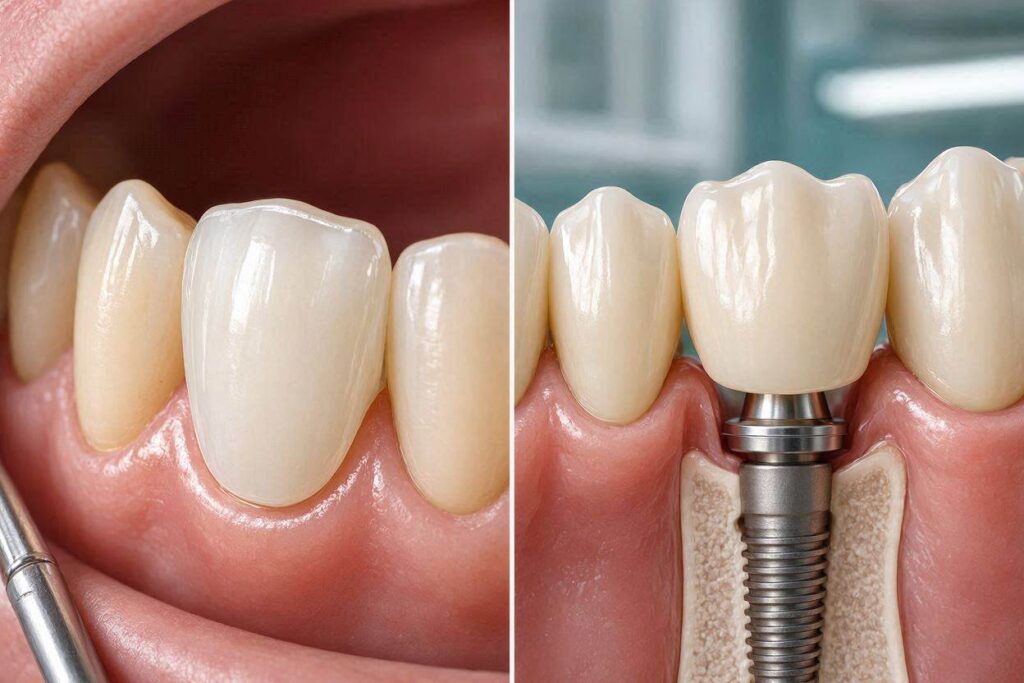
A porcelain veneer is a thin, custom-crafted shell of high-strength ceramic. It is approximately 0.5 to 0.7 millimeters thick, similar to a contact lens or a false fingernail. It is designed to be bonded exclusively to the front surface of a prepared natural tooth. The tooth’s enamel is etched with a mild acid, and the veneer is fused to this microscopically roughened surface using a light-cured resin bonding cement. This bond is one of the strongest in dentistry, but it is a chemical and micromechanical bond to enamel, a living, organic-mineral tissue.
What an Implant Crown Is
An implant crown is a full-coverage restoration. It is a complete, three-dimensional replacement tooth, milled from a solid block of ceramic (like zirconia or lithium disilicate) or a metal base fused with porcelain. It replaces the entire clinical crown of a missing tooth. It is not bonded to a natural tooth. It is either cemented onto a titanium abutment or secured with a small screw. The underlying structure is a metal or ceramic abutment that is itself screwed into the titanium implant fixture in the bone.
You cannot bond a thin porcelain veneer to the surface of an existing implant crown. The resin bonding agent will not form a durable, long-term chemical bond to the surface of a finished, glazed ceramic crown in the way it does to etched natural enamel. More fundamentally, there is no clinical reason to do so. The implant crown is already a complete, custom-made tooth designed from the start to achieve the desired shape and color. If you want the implant tooth to look different, you do not veneer it; you fabricate a new implant crown.
The Correct Terminology: A Crown is the “Veneer” for an Implant
When a patient with an implant says they want a “veneer” for that tooth, what they are almost always expressing is a desire for that tooth to have the same beautiful, bright, perfectly shaped aesthetic as the veneers they are getting on their natural teeth. The correct restorative solution for an implant is not a veneer, but a new, custom-crafted, all-ceramic implant crown. This crown acts as the complete cosmetic makeover for that single implant tooth. The cosmetic dentist designs this crown to precisely match the shape, color, translucency, and surface texture of the new porcelain veneers being placed on the adjacent natural teeth.
The Critical Clinical Scenario: The Combined Smile Makeover
The most common real-world scenario is a patient who has a single missing tooth replaced by an implant and also wants to improve the appearance of the surrounding natural teeth. The goal is a completely seamless, uniform smile.
The correct clinical sequence for a combined case is as follows:
- Design the Veneers First (or Simultaneously): The cosmetic dentist works with the master ceramist to design the new smile. They determine the ideal shape, length, proportion, and color for the porcelain veneers that will go on the natural teeth.
- Fabricate the Veneers and a New Implant Crown Together: Once the aesthetic blueprint is set, the dentist orders the custom veneers for the natural teeth and, at the same time, a brand-new, custom implant crown for the implant. The same master ceramist fabricates all the restorations in the same batch.
- The “Match” is in the Ceramist’s Hands: The ceramist layers the porcelain and applies the surface stains and glazes to the implant crown so that it perfectly replicates the optical properties of the adjacent veneers. They use the same ceramic material ingot or block, the same shade, and the same level of translucency. The goal is for the implant crown to be visually indistinguishable from the veneered natural teeth.
You do not place a veneer on an old, existing, generic implant crown and hope it matches. You replace the implant crown with a new, purpose-built restoration that is part of the comprehensive aesthetic treatment plan.
Special Case: Using an Implant to Support a Row of Veneers
Another way implants and “veneers” work together is when an implant-supported bridge is used. If a patient is missing two back teeth and an implant is placed, the final restoration is an implant-supported bridge, which is a span of connected crowns. These crowns can be made of the same high-aesthetic ceramic as a veneer. The visual result is identical.
Conclusion
You cannot place a traditional porcelain veneer on a dental implant crown because a veneer requires a bond to natural tooth enamel, not a pre-existing ceramic restoration. However, an implant tooth can be fully integrated into a cosmetic smile makeover by fabricating a brand-new, custom implant crown that is designed and milled by the same master ceramist to perfectly match the color, shape, and translucency of the new veneers on the adjacent natural teeth. The treatment is a coordinated restoration, not a modification of the old implant crown, resulting in a flawless, unified smile.
FAQ
1. Can a dentist bond a composite veneer to my implant crown?
No, not reliably. Composite bonding resin does not form a durable, long-term bond to a glazed porcelain or zirconia crown surface. It will chip off. A new crown is the correct solution.
2. I want to brighten my smile. Can my implant crown be whitened with the rest of my teeth?
No. Ceramic crowns cannot be bleached. If you want to whiten your smile, you must do the whitening first, then replace the implant crown to match the new, brighter shade.
3. What if my existing implant crown doesn’t match the new veneers on my other teeth?
The solution is to have a new implant crown fabricated. The new crown is made to the exact specifications of the new smile design, ensuring a perfect match.
4. Is it better to get the implant or the veneers first?
In a combined case, the cosmetic design phase happens first. The veneers and the implant crown are often planned and fabricated at the same time so they match perfectly upon final delivery.
5. Can I have a full set of veneers if I have an implant?
Yes. You can have porcelain veneers placed on all your healthy natural teeth, and a matching custom crown placed on your implant. The result is a complete, seamless smile makeover.
Additional Resource
To understand the artistry and technical process of creating matching cosmetic restorations, explore the patient information available through the American Academy of Cosmetic Dentistry (AACD).