Same Day Tooth Extraction And Dental Implant
Losing a tooth can feel unsettling. You might worry about your smile, your ability to chew, or even the shape of your face over time. But for many people, the thought of walking around with a missing tooth for months while waiting for a traditional implant is just as stressful.
That is where the concept of a same day tooth extraction and dental implant comes into play.
The idea sounds almost magical. You go to the dentist with a problematic tooth. You leave a few hours later with a brand new, permanent-looking tooth in its place. No awkward healing period with a gap. No temporary partial denture.
But how realistic is this procedure? Is it right for everyone? And what should you genuinely expect?
This guide walks you through everything you need to know. We will cover the step-by-step process, candidacy requirements, costs, risks, recovery, and long-term success rates. The goal is simple: to give you clear, honest, and practical information so you can make an informed decision with your dentist.
What Exactly Is a Same Day Tooth Extraction and Dental Implant?
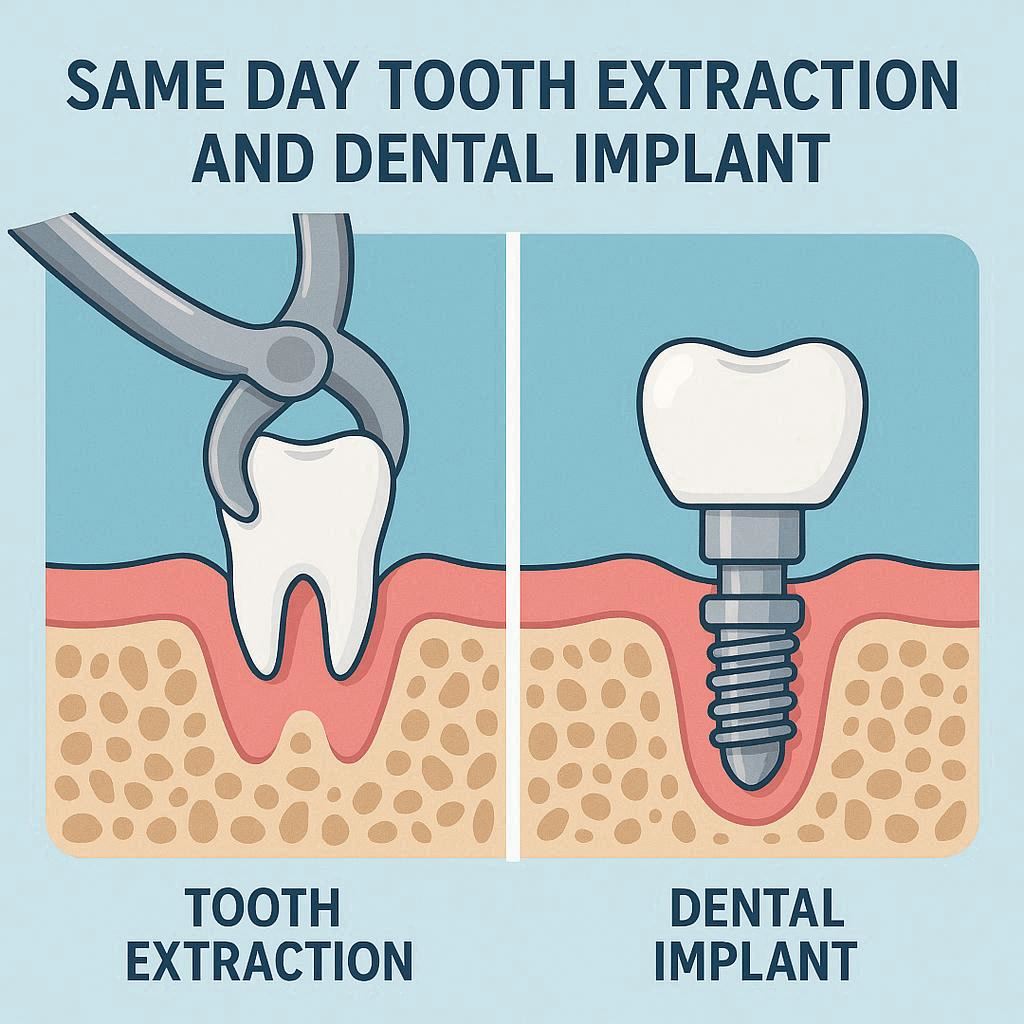
A same day tooth extraction and dental implant is a streamlined dental procedure where a damaged or decaying tooth is removed, and a titanium implant post is placed into the jawbone immediately afterward. In many cases, a temporary or permanent crown is attached to that implant on the very same day.
This is different from the traditional approach.
In a conventional dental implant process, a dentist removes a problematic tooth. Then you wait. The bone needs to heal for several months. Only after that healing period does the dentist place the implant. Then you wait again for the implant to fuse with the bone. Finally, you receive your crown. The entire journey often takes six to twelve months.
With same day treatment, collapse those long waiting periods into a single appointment. The extraction socket is used as the placement site for the implant immediately. This is often called “immediate implant placement.”
Sometimes, dentists also attach a temporary crown right away. That specific version is known as “immediate loading” or “teeth in a day” for a single tooth.
Important note: Same day does not always mean the final, permanent crown is placed on day one. In many cases, you receive a temporary crown. The final, custom-made permanent crown is placed weeks or months later after your gum and bone have healed properly.
How It Differs from All-on-4 or Full Mouth Reconstruction
Many people confuse single-tooth same day implants with full-arch solutions like All-on-4.
- Single same day implant: Replaces one missing tooth. One extraction. One implant. One temporary crown.
- All-on-4 or full mouth reconstruction: Replaces all teeth in an arch using four or more implants. Permanent fixed bridge attached the same day.
This article focuses on the single-tooth scenario. While the principles are similar, the risks, costs, and recovery differ significantly when dealing with multiple teeth.
The Step-by-Step Procedure: What Happens on the Day
Understanding the actual process helps reduce anxiety. You will know what to expect from the moment you walk into the dental clinic to the moment you walk out.
Step 1: Comprehensive Examination and Imaging
Before any extraction happens, your dentist needs to see what is going on beneath the surface. This is not a procedure you can decide on in five minutes.
A modern dental clinic will take:
- Digital X-rays: To assess the shape and health of the root and surrounding bone.
- CBCT scan (Cone Beam Computed Tomography): This is crucial. A CBCT scan provides a 3D image of your jawbone, nerves, sinuses, and adjacent teeth. Your dentist uses this to measure bone density, bone volume, and exact distances to critical structures like the inferior alveolar nerve.
If the imaging shows insufficient bone quantity or quality, your dentist may recommend against same day treatment. In those cases, a bone graft and delayed implant might be a better choice.
Step 2: Discussion of Options and Consent
Your dentist will explain what the scan shows. They will tell you if you are a good candidate for immediate implant placement. They will also discuss whether immediate loading (placing a temporary crown) is safe for your specific case.
This is your moment to ask questions. Write them down beforehand. A good dentist will never pressure you into same day treatment if the conditions are not ideal.
Step 3: Anesthesia and Sedation
Comfort is a priority. Most same day implant procedures are performed under local anesthesia. This numbs the entire area completely. You remain awake but feel no pain.
For anxious patients, options include:
- Oral sedation (a pill taken before the procedure)
- Nitrous oxide (laughing gas)
- IV sedation (you are conscious but deeply relaxed)
Discuss your anxiety level with your dentist. Many people do perfectly fine with just local numbing.
Step 4: Atraumatic Tooth Extraction
The dentist begins by carefully removing the damaged tooth. The key word here is “atraumatic.” Unlike a simple extraction where the tooth is often gripped and pulled, an atraumatic extraction preserves as much bone and gum tissue as possible.
Special instruments called periotomes are used to gently cut the tiny ligaments that attach the tooth to the bone. The tooth is then lifted out with minimal force.
Preserving the surrounding bone is critical for implant success. If the extraction cracks or damages the socket walls, immediate implantation becomes risky.
Step 5: Socket Evaluation and Debridement
Once the tooth is out, the dentist inspects the empty socket. They look for:
- Any remaining infection or cyst tissue
- Bone fragments
- The integrity of the socket walls
The socket is thoroughly cleaned (debridement) to remove any infected tissue or debris. If there was an abscess or active infection, your dentist might decide to abort the same day implant and place a bone graft instead. Placing an implant into an actively infected socket significantly increases failure rates.
Step 6: Implant Site Preparation
Using the CBCT scan as a guide, the dentist drills a precise pilot hole into the jawbone at the exact location and angle needed. Multiple drills of increasing diameter are used to create the final osteotomy (the hole for the implant).
This step requires skill and experience. The dentist must avoid damaging adjacent tooth roots, nerves, or the sinus cavity.
Step 7: Implant Placement
The titanium implant post is screwed into the prepared hole. The dentist checks for:
- Primary stability: This is the mechanical grip of the implant in the bone. It is measured by how much the implant resists movement when torque is applied. For same day loading, a minimum of 35-45 Ncm (Newton centimeters) of torque is typically required. Lower than that, and your dentist will likely postpone placing a crown.
- Proper positioning: The implant should be aligned correctly to support a natural-looking crown.
If primary stability is poor, a responsible dentist will still place the implant but will NOT attach a crown on the same day. Instead, they will suture the gum closed and allow the implant to heal for several months before loading it. This is still a same day extraction and implant placement, just without same day loading.
Step 8: Healing Abutment or Temporary Crown Placement
Two options exist here:
- Healing abutment only: A small metal cap is screwed into the implant. It protrudes slightly through the gum. The gum heals around it, creating a nice collar for the future permanent crown. No tooth is visible. You leave with a gap but with the implant already working beneath the surface.
- Temporary crown: A prefabricated or same-day milled temporary crown is attached to the implant. This crown is designed to be slightly out of contact with the opposing teeth. It will not be used for heavy chewing. Its main job is aesthetics and maintaining space.
Step 9: Bite Adjustment and Instructions
If a temporary crown was placed, your dentist will check your bite carefully. The crown should not touch the opposing tooth when you bite down naturally. Any contact can transmit excessive forces to the healing implant, leading to failure.
You will receive detailed post-operative instructions. These are not suggestions. They are essential for success.
Who Is a Good Candidate? (Realistic Criteria)
Not everyone qualifies for same day tooth extraction and implant placement. Honest dentists perform a thorough evaluation before promising anything.
Ideal Candidate Profile
You are likely a good candidate if:
| Criterion | Why It Matters |
|---|---|
| Good general health | Conditions like uncontrolled diabetes, autoimmune diseases, or osteoporosis can impair bone healing. |
| Healthy gums | Active periodontal disease increases infection risk around the new implant. |
| Sufficient bone volume | You need at least 1-2 mm of bone around the implant on all sides. The CBCT scan confirms this. |
| No active infection at the extraction site | A severe abscess or pus indicates ongoing infection that should be treated first. |
| Non-smoker or willing to quit | Smoking dramatically reduces blood flow to the gums and bone. It is one of the leading causes of early implant failure. |
| Good oral hygiene habits | Implants can fail from peri-implantitis (inflammation and bone loss around the implant) just like natural teeth can fail from gum disease. |
| Realistic expectations | Understand that same day does not mean final crown in all cases. Understand that some discomfort and dietary restrictions are normal. |
When Same Day Extraction and Implant Is NOT Recommended
Candidacy is not just about ideal scenarios. There are clear red flags.
- Insufficient bone height or width: If the CBCT scan shows less than 10 mm of bone height or the socket walls are fractured, immediate placement is risky.
- Active uncontrolled infection: Some studies show a 20-30% higher failure rate when implants are placed into infected sockets.
- Heavy clencher or grinder: Parafunctional habits (bruxism) place extreme forces on a healing implant. A nightguard can help, but many dentists still prefer delayed loading.
- Pregnancy: Elective dental implant surgery is generally postponed until after delivery.
- Recent radiation therapy to the jaw: This significantly impairs bone healing.
- Bisphosphonate medication use (oral or IV): These drugs (often for osteoporosis or cancer) increase the risk of osteonecrosis of the jaw. IV bisphosphonates are an absolute contraindication.
A critical note from experienced implant dentists: Even if you meet all the ideal criteria, some implant positions are still not suitable for immediate loading. Back molars that withstand high chewing forces are often better candidates for delayed loading. Front teeth (incisors and canines) with lower biting forces are more predictable for same day crowns.
Advantages of Same Day Treatment
Why would anyone choose this approach over the traditional, slower method? The benefits are significant for the right patient.
Psychological Comfort
You do not have to walk around with a missing front tooth for months. For many people, the social and professional embarrassment of a gap is worse than any surgical discomfort. Same day treatment restores your smile immediately.
Fewer Surgical Appointments
Traditional implant treatment requires at least three separate surgical visits: extraction, implant placement, and abutment/crown placement. Same day extraction and implant combines the first two into one. Sometimes it combines all three.
Less time off work. Less travel. Less anxiety over repeated procedures.
Better Soft Tissue Preservation
When you extract a tooth and leave the socket empty, the gum tissue collapses inward slightly. By placing an implant immediately, you support the gum architecture. This often results in a more natural-looking final gum line around the crown.
Shorter Overall Treatment Time
Even if you only receive a temporary crown on day one, you are still months ahead of the traditional timeline. The implant begins integrating immediately. The final permanent crown can often be placed in four to six months instead of nine to twelve.
Reduced Bone Resorption
When a tooth is removed without implant placement, the surrounding bone begins to shrink (resorb). Placing an implant immediately stimulates the bone and helps preserve its volume and shape.
Disadvantages and Realistic Risks
Honesty matters. Same day treatment is not superior in every case. Sometimes, the traditional approach yields a higher long-term success rate.
Higher Risk of Implant Failure
This is the most important risk to understand. Studies consistently show that immediate implant placement and immediate loading have slightly lower success rates compared to delayed protocols. The difference is not enormous for experienced clinicians (around 90-95% success for immediate vs 95-98% for delayed), but it exists.
The main cause of early failure is failure of osseointegration. The bone does not grow firmly around the implant because of micro-movement during healing.
Risk of Crown Fracture
Temporary crowns placed on same day implants are not designed for normal chewing. If you accidentally bite into a piece of hard bread or a carrot, the crown can crack or fracture. Some patients also experience the temporary crown coming loose.
Not Suitable for High Bite Force Areas
Premolars and molars generate significant chewing forces. Many implant dentists will only place a temporary crown on a single-rooted tooth (incisor or canine) or will place the implant but leave it unloaded (no crown) for back teeth.
Higher Cost Upfront
Same day treatment requires more advanced equipment (CBCT scanner, same day crown milling machine, surgical guides) and a dentist with advanced training. This is reflected in the fee. You are paying for convenience and technology.
Gum Recession Over Time
Some research suggests that immediate implant placement with a temporary crown can lead to minor gum recession around the crown margin over the first year. This is usually cosmetic and minor, but it can be noticeable on front teeth.
What the Research Says
A large systematic review published in the Journal of Clinical Periodontology analyzed 46 studies on immediate implant placement and loading. The key findings:
- Survival rates for immediately placed implants (without immediate crown) were 98.4% after one year.
- Survival rates for immediately placed AND immediately loaded implants were 95.2% after one year.
- Smokers had nearly double the failure rate of non-smokers.
- Implants placed in the front of the mouth (anterior region) had higher success than molars.
These numbers are good, but they are not perfect. One in twenty immediately loaded implants may fail in the first year.
Same Day Extraction and Implant: Step-by-Step Timeline (Realistic)
The phrase “same day” can be misleading if you expect a completely finished, permanent tooth in one afternoon. Here is what a realistic timeline looks like for most patients.
Day One: The Procedure Day
- Arrive at the clinic (plan for 2 to 4 hours total)
- CBCT scan and final treatment planning
- Extraction and implant placement (30 to 60 minutes)
- Healing abutment or temporary crown placement (15 to 30 minutes)
- Bite adjustment and post-op instructions
- You leave with a functional (temporary) tooth or a healing cap
Days 2 to 14: Early Healing Phase
- Swelling and mild discomfort peak at day two or three, then subside.
- Soft food diet only. No chewing on the implant side.
- Salt water rinses and prescribed medications as directed.
- Follow-up appointment at day 7 to 10 for suture removal (if non-dissolving sutures were used).
Weeks 3 to 12: Osseointegration Phase
- The bone grows around the implant surface. This is the most critical period.
- If you have a temporary crown, you still avoid hard or sticky foods on that side.
- Maintain meticulous oral hygiene. Brush gently around the temporary crown.
Month 4 to 6: Final Crown Delivery
- Your dentist confirms osseointegration with a final X-ray.
- The temporary crown or healing abutment is removed.
- An impression or digital scan is taken for the permanent crown.
- The permanent crown (custom-shaded and shaped) is fabricated in a dental lab (1 to 3 weeks).
- Final crown is screwed or cemented onto the implant.
- Bite is adjusted one last time.
Total time to permanent restoration: 4 to 7 months.
Notice that the permanent crown is NOT ready on day one. Only the implant and temporary restoration are placed on the extraction day.
What About Pain and Recovery? An Honest Look
One of the most common questions is: “Does this hurt?”
During the procedure
No. With effective local anesthesia, you should feel pressure but not sharp pain. If you feel any pain at any point, raise your hand. Your dentist can administer more anesthetic.
After the procedure (first 24 to 72 hours)
Yes, you will feel some discomfort. Expect:
- Swelling: Mild to moderate swelling around the surgical site. Peaks at 48 hours.
- Bruising: Possible on the cheek or gum tissue.
- Soreness: Similar to a difficult tooth extraction. Over-the-counter ibuprofen (Advil, Motrin) is usually sufficient. Some patients require a prescription painkiller for the first two days.
- Bleeding: Minor oozing is normal for the first 12 hours. Significant bleeding is not.
Most patients describe the pain as a 3 or 4 out of 10. By day four or five, you feel mostly normal aside from chewing restrictions.
Recovery comparison table
| Time Period | Pain Level (0-10) | Swelling | Diet |
|---|---|---|---|
| Day of procedure (after numbing wears off) | 3-4 | Mild | Cold soft foods (yogurt, smoothie, ice cream) |
| Day 2 | 4-5 (peak) | Moderate | Warm soft foods (soup, mashed potatoes, scrambled eggs) |
| Day 3 | 3-4 | Moderate | Same soft foods |
| Day 4 to 7 | 1-2 | Mild to none | Transition to semi-soft (pasta, soft bread, fish) |
| Week 2 | 0-1 | None | Normal soft diet, avoid hard/chewy |
| Month 1+ | 0 | None | Avoid only very hard items on implant side |
Important: If you experience severe pain, worsening swelling after day three, fever, or a foul taste, contact your dentist immediately. These could be signs of infection or implant failure.
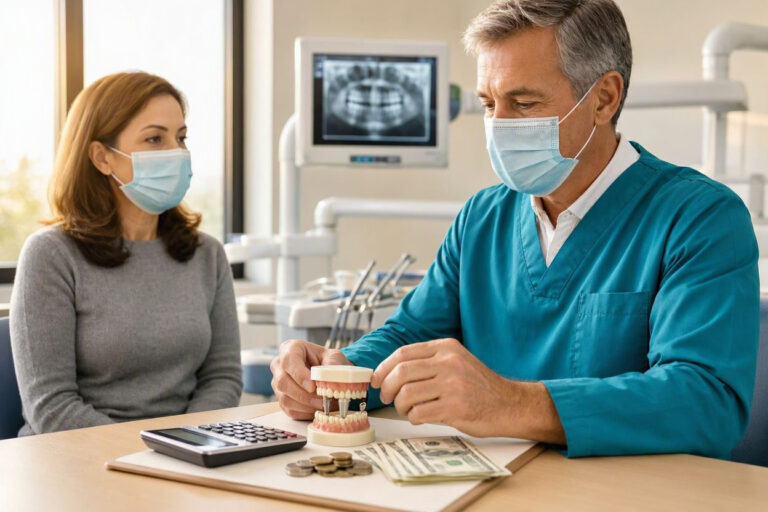
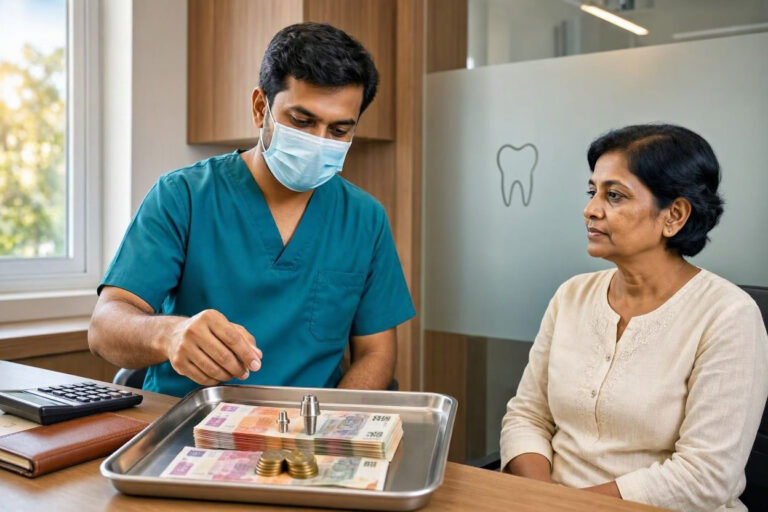
Cost Breakdown: What Should You Expect to Pay?
Same day tooth extraction and dental implant is an investment. Pricing varies widely based on location, dentist expertise, and what exactly is included.
Typical cost components
| Service | Estimated Range (USD) |
|---|---|
| Consultation and CBCT scan | 200−500 |
| Atraumatic tooth extraction | 200−500 |
| Implant placement (surgical fee) | 1,500−3,000 |
| Implant components (abutment, etc.) | 300−600 |
| Temporary crown (same day) | 300−800 |
| Permanent crown (lab fabricated) | 1,000−2,500 |
| Sedation (optional) | 300−800 |
Total out-of-pocket estimate:
- Without insurance and without permanent crown: 2,500to5,000
- With permanent crown (complete treatment): 3,500to7,500
Dental insurance typically covers the extraction and sometimes a portion of the crown. Most insurance plans consider implants a “major service” with 50% coverage after a waiting period. Some do not cover implants at all.
Ways to reduce cost:
- Dental schools (supervised students perform the procedure at 50-60% lower cost)
- Dental discount plans
- In-house membership plans (some clinics offer annual plans with discounted implant fees)
- Flexible spending account (FSA) or health savings account (HSA) funds
Note of caution: Be very skeptical of “too good to be true” pricing. If a clinic offers same day extraction and implant for $1,999 all-inclusive, ask questions. What type of implant are they using? Is a permanent crown included? What happens if the implant fails? Cheap implants from no-name manufacturers have higher failure rates.
Food and Diet: What You Can and Cannot Eat
Your diet directly impacts healing. Ignoring these guidelines is the fastest way to break a temporary crown or cause implant failure.
First 24 hours (liquid to cold soft)
- Smoothies (no seeds or straws – suction dislodges blood clots)
- Greek yogurt
- Pudding
- Ice cream or frozen yogurt
- Cold soup (not hot – heat increases bleeding)
- Protein shakes
Days 2 to 7 (warm soft foods)
- Mashed potatoes
- Scrambled eggs
- Oatmeal or cream of wheat
- Cottage cheese
- Well-cooked pasta (cut into small pieces)
- Applesauce
- Hummus
- Soft fish (tilapia, cod)
Days 8 to 21 (transition to semi-soft)
- Soft bread (no hard crusts)
- Rice and beans
- Ground meat (meatballs, soft burgers without a hard bun)
- Pancakes
- Avocado
- Soft cooked vegetables (carrots, zucchini)
Foods to avoid for at least 3 months
| Category | Specific foods |
|---|---|
| Hard | Nuts, chips, hard candies, ice cubes, popcorn kernels |
| Chewy | Caramel, taffy, gummy candies, bagels, steak |
| Sticky | Peanut butter, dried fruit |
| Crunchy | Raw carrots, apples (unless grated or cooked), crusty bread |
| Hot | Pizza fresh from the oven (can burn gums) |
| Alcoholic | Beer, wine, spirits (interferes with healing and interacts with pain meds) |
When can you eat normally?
Most patients can gradually return to a normal diet around month three. However, you should never use your implant crown (even the permanent one) to open packages, crack nuts, or chew ice. Implants do not have the same ligament shock absorbers as natural teeth. They can fracture under extreme forces.
How to Care for Your Same Day Implant (Short and Long Term)
Good home care is non-negotiable. Implants fail from neglect just like natural teeth.
First two weeks
- Do not spit, use straws, or smoke for 72 hours (prevents dry socket or implant disturbance).
- Brush very gently around the temporary crown with an extra-soft toothbrush. Do not floss around the implant yet.
- Rinse with warm salt water (1 teaspoon salt in 8 oz water) 3-4 times daily, especially after eating.
- Take all prescribed antibiotics exactly as directed, even if you feel fine.
Weeks 2 to 6
- Begin gentle flossing using implant-specific floss or superfloss. Do not snap the floss down against the gum.
- Use a water flosser on the lowest setting to clean around the abutment or temporary crown.
- Avoid electric toothbrushes directly on the implant area (the vibration can disturb healing).
After permanent crown placement (month 4+)
- Brush twice daily paying special attention to the gum line around the crown.
- Floss daily using a floss threader or implant floss to clean the space between the crown and adjacent teeth.
- Use an interdental brush if the space between the implant crown and natural tooth is wide enough.
- Visit your dentist every 6 months for professional cleanings and implant evaluation.
- Wear a nightguard if you grind your teeth (even if you never did before – some patients develop bruxism after an implant).
Signs of trouble to watch for (long term)
- Bleeding or pus around the implant
- The implant feels loose (any movement is abnormal)
- The crown changes color or chips
- Persistent bad taste or odor from the area
- Receding gum line around the crown
Any of these symptoms warrants a prompt dental visit. Peri-implantitis (the implant version of gum disease) is treatable if caught early.
Same Day Extraction and Implant vs. Traditional Implant: Comparison Table
| Feature | Same Day (Extraction + Implant + Temporary Crown) | Traditional (Extraction → Heal → Implant → Heal → Crown) |
|---|---|---|
| Number of surgical appointments | 2 (implant placement + final crown) | 3 or 4 (extraction, implant, abutment/crown) |
| Aesthetic gap period | None (temporary crown same day) | 3-6 months (healing cap or empty space) |
| Total treatment time | 4-7 months | 6-12 months |
| Success rate (1 year) | ~95% | ~97-98% |
| Risk of implant failure | Slightly higher | Lower |
| Diet restrictions | Strict for 3 months | Moderate for 4-6 weeks after each surgery |
| Cost | Typically higher upfront | May be lower if spaced over time |
| Best for | Front teeth, good bone, non-smoker | Molars, smokers, poor bone quality |
Common Myths About Same Day Dental Implants
Let us clear up some persistent misinformation.
Myth 1: “Any dentist can do same day implants.”
Not true. Immediate implant placement and loading require advanced surgical training. Many general dentists refer these cases to prosthodontists, oral surgeons, or periodontists. Ask about your dentist’s experience. How many same day single-tooth implants have they placed? What is their success rate?
Myth 2: “The implant is fully healed and ready in one day.”
Absolutely false. The implant is PLACED in one day. Healing (osseointegration) takes several months. Do not mistake “same day placement” for “same day completion.”
Myth 3: “You can chew normally immediately.”
No. The temporary crown is for looks, not function. Heavy chewing on a healing implant can cause micro-movement and failure. You are on a soft food diet for weeks.
Myth 4: “Same day implants always cost more.”
Sometimes they cost less overall because you avoid bone graft procedures and multiple anesthesia fees. However, same day loading with a custom temporary crown often adds 300−800 to the bill.
Myth 5: “If the implant fails, you lose the bone and cannot try again.”
Not necessarily. Many failed implants can be removed, the bone grafted, and a new implant placed after healing. Failure is not the end of the road.
Real Patient Scenarios: When Same Day Works and When It Does Not
Scenario A: The Ideal Candidate (Works Well)
Sarah, 34 years old. Non-smoker. Healthy. Her upper lateral incisor (front tooth) fractured below the gum line from an old injury. CBCT scan shows excellent bone volume. No active infection. Her dentist has placed over 200 same day implants. Extraction is atraumatic. Primary stability measures 50 Ncm. A temporary crown is placed. Sarah eats soft foods for 6 weeks. At month 4, a beautiful permanent crown is placed. Sarah is thrilled.
Scenario B: Poor Candidacy (Should Not Do Same Day)
Mark, 55 years old. Smoker (one pack per day). His lower first molar has a large abscess. CBCT shows only 8 mm of bone height (needs 10 mm). The dentist explains the high risk of failure. Mark insists on same day treatment anyway. The extraction is difficult. The socket wall fractures. The implant is placed but primary stability is only 20 Ncm. No temporary crown is placed. At the 3-month check, the implant has failed to integrate. Mark needs a bone graft and a new implant. Total cost and time double.
Scenario C: Partial Same Day (Most Common)
Lisa, 45 years old. Occasional smoker (quit for 2 weeks before procedure). Her lower premolar needs extraction. Bone volume is acceptable, but there is minor infection in the socket. The dentist cleans thoroughly and places the implant same day. However, because of the prior infection and lower primary stability (28 Ncm), the dentist chooses NOT to place a temporary crown. A healing abutment is placed instead. Lisa leaves with a gap but with the implant already in the bone. After 4 months of healing, she receives her permanent crown. Total time: 4.5 months. This is still called same day extraction and implant, just without same day loading.
Questions to Ask Your Dentist Before Committing
Walk into your consultation prepared. Ask these exact questions.
- “How many same day single-tooth implants have you placed in the past year?”
- “What is your personal success rate with immediate loading?”
- “Based on my CBCT scan, what is my primary stability likely to be?”
- “Will you place a temporary crown on the same day, or just the implant?”
- “If the implant fails, what is your policy on replacement? Do you charge again?”
- “What brand of implant do you use? Has it been on the market for more than 10 years?”
- “Do you have before-and-after photos of similar cases?”
- “What is the total all-inclusive cost from extraction to permanent crown?”
- “How long will I need to eat a soft food diet?”
- “Are you available for emergency follow-up if I have problems over the weekend?”
A confident, ethical dentist will answer each question directly. If they become defensive or vague, consider a second opinion.
Preparing for Your Same Day Appointment
Good preparation reduces stress and improves outcomes.
One week before
- Stop smoking. If you cannot quit permanently, at least stop for 1 week before and 2 weeks after surgery.
- Arrange for a driver if you are using sedation (most patients drive themselves with local anesthesia only).
- Stock your kitchen with soft foods (see the food list above).
- Fill any prescribed antibiotics or pain medication ahead of time.
The night before
- Get a full night of sleep. Fatigue increases pain perception.
- Brush and floss thoroughly (but avoid flossing near the tooth to be extracted if it is painful).
- Do not drink alcohol.
The morning of
- Eat a normal breakfast unless instructed otherwise (local anesthesia does not require fasting).
- Take any pre-medication as directed (sometimes antibiotics or anti-anxiety medication).
- Brush your teeth normally but gently.
- Wear comfortable, loose clothing with short sleeves (easier for blood pressure monitoring).
What to bring
- Your insurance card and ID
- A list of current medications (including over-the-counter and supplements)
- Earbuds and music if you want to relax during the procedure
- A small ice pack in an insulated bag (your dentist will provide one, but having your own helps)
Long-Term Success: What the Data Says at 5 and 10 Years
Short-term success is great. But you want an implant that lasts decades.
Five-year survival rates
- Immediate implant placement (without immediate loading): 96.5%
- Immediate implant placement with immediate loading (temporary crown): 93.8%
- Conventional delayed implant placement: 97.2%
Source: Clinical Oral Implants Research, 2023 systematic review of 12,000+ implants.
Ten-year survival rates
- Immediate implants (any protocol): 91.2%
- Conventional implants: 94.5%
The gap narrows over time. Most failures occur in the first year. If your same day implant survives 12 months, your ten-year outlook is excellent.
Factors that predict long-term success
| Positive factors | Negative factors |
|---|---|
| Good oral hygiene | Smoking |
| Regular dental maintenance | Uncontrolled diabetes |
| Implant diameter ≥ 3.5 mm | Bruxism (grinding) |
| Adequate keratinized gum tissue | Previous implant failure |
| Crown cemented or torqued correctly | Poor bone density (D3 or D4 bone) |
Conclusion
A same day tooth extraction and dental implant offers a genuinely transformative option for eligible patients. You can have a failing tooth removed and an implant placed in a single visit, often with a temporary crown attached the same day. This eliminates the visible gap, preserves your natural gum shape, and shortens overall treatment time from nearly a year to just a few months.
However, honesty matters. Same day treatment has a slightly higher risk of early failure compared to traditional delayed implants. It requires excellent bone quality, healthy gums, and a commitment to soft food diets and meticulous cleaning. Not everyone qualifies, and a responsible dentist will tell you when immediate loading is unsafe.
If you are a non-smoker with good bone volume and realistic expectations, same day extraction and implantation is a safe, effective, and life-changing procedure. Work with an experienced implant dentist, follow all post-operative instructions, and you can expect a beautiful, functional replacement tooth that lasts for decades.
In three lines: Same day extraction and implant combines two surgeries into one. It offers immediate aesthetics with a temporary crown but requires strict diet and care. Success rates are high for good candidates, though slightly lower than traditional methods.
Frequently Asked Questions (FAQ)
1. Is a same day dental implant painful?
The procedure itself is not painful due to local anesthesia. Afterward, most patients experience mild to moderate discomfort (3-4 out of 10) for 2-3 days, easily managed with ibuprofen.
2. Can I get a same day implant on any tooth?
No. Front teeth (incisors and canines) are best. Molars and premolars with high chewing forces are often not suitable for same day loading. Your dentist will decide based on bone quality and bite forces.
3. How long does the entire same day procedure take?
Plan for 2 to 4 hours from start to finish, including consultation, extraction, implant placement, and temporary crown fabrication.
4. Will my insurance cover same day extraction and implant?
Most dental insurance covers the extraction and possibly half of the crown, but rarely covers the implant itself. Call your provider before scheduling.
5. What happens if the same day implant fails?
Your dentist will remove the failed implant, place a bone graft if needed, wait 4-6 months for healing, and place a new implant. Some dentists offer a warranty or reduced fee for replacement.
6. Can I get a same day implant if I have gum disease?
No. Active gum disease (periodontitis) must be treated and stabilized before any implant placement. Your dentist will refer you for periodontal therapy first.
7. How soon can I return to work?
Most patients return to desk jobs the next day. Physically demanding jobs may require 3-5 days off. Avoid heavy lifting or strenuous activity for one week.
8. Will the temporary crown look natural?
Yes, modern same day crowns are milled from tooth-colored resin or ceramic. They match the shape and shade of your adjacent teeth very well, though they are not as durable as final crowns.
9. Can I brush the same day implant?
Avoid brushing the surgical site for the first 24 hours. After that, brush extremely gently with an extra-soft toothbrush. Do not use floss or water flossers for the first two weeks.
10. Is age a barrier for same day implants?
No. Healthy older adults (even into their 80s and 90s) can receive same day implants successfully if bone quality is adequate and medical conditions are well-controlled.
Additional Resource
For a deeper dive into implant brands, scientific studies, and finding a qualified implant dentist near you, visit the American Academy of Implant Dentistry (AAID) patient education library:
👉 AAID Public Resources on Dental Implants – Free, non-commercial guides, dentist locator tool, and answers to common patient questions.
Disclaimer: This article is for informational purposes only and does not constitute medical advice. Always consult with a licensed dental professional to determine if same day tooth extraction and dental implant is appropriate for your specific health situation. Individual results vary.