How Many Implants For Full Dentures?
You have lost all your teeth on one or both arches, or you are about to lose them, and you want a solution that restores function and confidence. You have heard about dental implants for supporting dentures, but the numbers confuse you. Some people talk about two implants. Others mention four, six, or even eight. You see advertisements for “All-on-Four” and “Teeth in a Day,” and you wonder how many implants you actually need.
The answer depends on several factors: the type of denture you want, the quality and quantity of your jawbone, your budget, your tolerance for surgery, and your long-term expectations for stability and maintenance. This guide provides a comprehensive breakdown of the implant numbers for full dentures. We will examine every configuration, from a simple two-implant overdenture to a sophisticated full-arch fixed prosthesis on eight implants. You will understand the tradeoffs between cost, stability, and complexity, and you will be equipped to have an informed conversation with your implant dentist.
This is not a decision to make lightly. The number of implants you receive determines the stability of your denture, the health of the bone over time, and the total cost of your treatment. Understanding the options empowers you to choose the right balance for your life.
The Two Basic Categories of Implant Dentures
Before discussing specific numbers, you must understand the fundamental distinction between the two types of implant-supported full dentures. The number of implants needed differs dramatically between these categories.
Implant-Retained Removable Overdentures
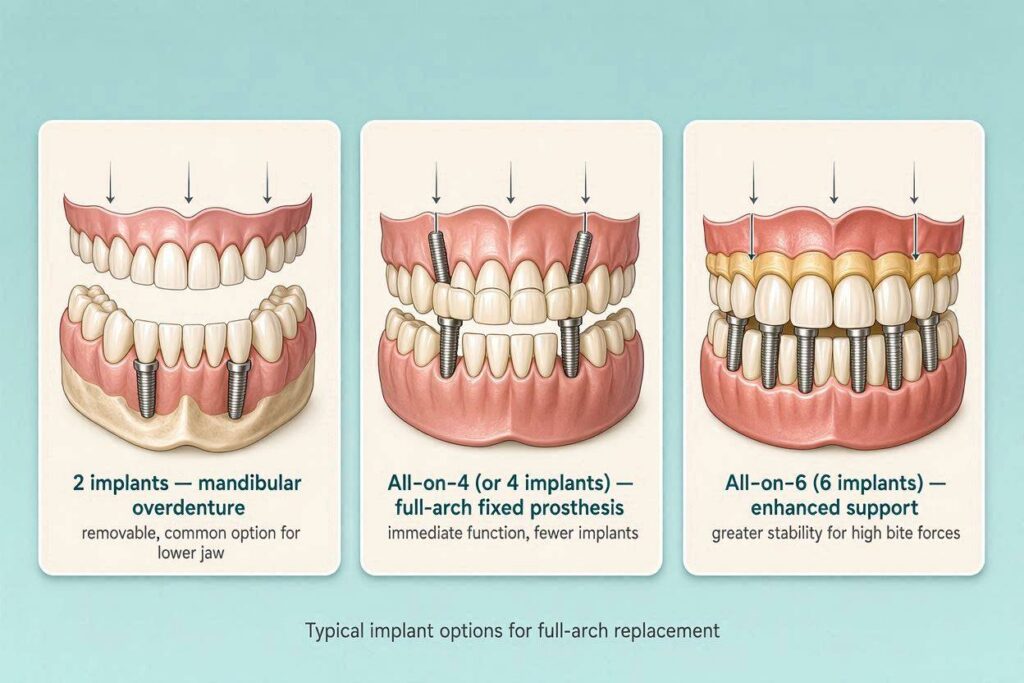
A removable overdenture is a denture that snaps onto implants but can be removed by the patient for cleaning. The implants provide retention and stability, preventing the denture from moving during eating and speaking, but the denture still rests partially on the gums. The implants are primarily anchors that hold the denture in place.
This type of restoration requires fewer implants, typically two to four per arch. It is less expensive than a fixed prosthesis and is a significant improvement over a conventional denture that relies on suction and adhesive. However, it is still removable. Some patients prefer this for ease of cleaning. Others dislike the daily ritual of removing their teeth.
Implant-Supported Fixed Prostheses
A fixed prosthesis, often called a fixed hybrid denture or a fixed bridge, is screwed or cemented onto the implants and can only be removed by a dentist. It replaces the teeth and a portion of the gum tissue. It does not rest on the gums; all chewing forces are borne entirely by the implants.
This type of restoration requires more implants, typically four to eight per arch. It is more expensive but feels more like having natural teeth. You clean it in your mouth, as you would natural teeth, using brushes and water flossers. You never take it out. For most edentulous patients, a fixed prosthesis represents the closest possible experience to having their own teeth back.
The Two-Implant Overdenture
The minimum number of implants to support a full denture is two. This configuration is for a removable overdenture on the lower arch.
How It Works
Two implants are placed in the front of the lower jaw, typically in the canine positions. Abutments with ball attachments, locator attachments, or a bar connecting the two implants are placed onto the implants. The denture has corresponding housings that snap onto these attachments.
The implants prevent the denture from lifting, tilting, and shifting forward. The back of the denture still rests on the gum ridge. The patient removes the denture at night, cleans it, and snaps it back into place in the morning.
Advantages and Limitations
The two-implant overdenture is the most economical implant option for the edentulous lower jaw. It is a well-studied, predictable treatment with high success rates. The surgery is relatively minor, and the cost is a fraction of a fixed prosthesis.
The limitation is that the denture is still a denture. It still rests on the gums, and the posterior ridge may still experience some pressure and bone resorption over time. The patient must still remove it for cleaning. The attachments require periodic replacement, as the retention inserts wear out and must be changed. For the upper jaw, two implants are generally insufficient to retain an overdenture because the upper denture covers the palate and has different retention dynamics.
Who Is a Candidate
The two-implant overdenture is appropriate for patients with adequate bone in the anterior mandible, a limited budget, and a tolerance for a removable appliance. It is often the first step for patients who cannot afford a fixed prosthesis but want relief from an unstable lower denture.
The Three-Implant Overdenture
Three implants represent an intermediate option between two and four implants for a lower overdenture. This configuration is less common but can be useful in specific situations.
The Tripod Configuration
Three implants arranged in a tripod pattern provide greater stability than two. The additional implant reduces the rocking of the denture and distributes forces more evenly. This can be helpful when bone quality is marginal and two implants might not provide sufficient stability.
The three-implant overdenture is still removable and still rests partially on the gums. It is a compromise option when four implants are not feasible due to bone constraints or budget but two implants might be insufficient for the patient’s functional demands.
The Four-Implant Overdenture
Four implants for a removable overdenture provide excellent stability and are considered by many clinicians to be the optimal configuration for a removable implant denture.
Lower Overdenture on Four Implants
With four implants in the lower jaw, the denture is very stable. The implants are typically placed between the mental foramina, the bony openings through which the mental nerve passes, in the front of the jaw. A bar is often fabricated to connect all four implants, and the denture clips onto the bar. Alternatively, individual locator attachments can be used.
A four-implant overdenture distributes forces well and provides long-term protection against bone resorption. The patient can chew most foods with confidence, and the denture does not move during speech or laughing. The attachments and the bar do require maintenance and eventual replacement.
Upper Overdenture on Four Implants
The upper jaw is different from the lower jaw. The bone is softer, and the presence of the maxillary sinuses limits implant placement in the back of the jaw. An upper removable overdenture on four implants typically requires that the palate be removed from the denture, creating a horseshoe-shaped prosthesis that does not cover the roof of the mouth.
Without palatal coverage, the upper overdenture relies entirely on the implants for retention. Four implants arranged in a broad distribution across the arch can support this configuration successfully. The patient gains improved taste sensation and comfort because the palate is uncovered. The tradeoff is that the denture is less inherently stable than a fixed prosthesis and the implants must be strategically placed to resist the forces of chewing.
The All-on-Four Concept
All-on-Four is a specific, trademarked treatment concept that uses four implants to support a fixed full-arch prosthesis. It has become widely known and has influenced implant dentistry for edentulous patients worldwide.
The Four-Implant Fixed Solution
In the All-on-Four concept, four implants are placed in the jaw. The posterior two implants are angled, typically at 30 to 45 degrees, to avoid the maxillary sinuses in the upper jaw or the inferior alveolar nerve in the lower jaw. This angulation allows the implants to be placed in available bone without the need for bone grafting. It also increases the distance between the front and back implants, improving the biomechanical support for the prosthesis.
A fixed prosthesis, usually made of acrylic or composite with a titanium framework, is attached to the four implants. The prosthesis is not removable by the patient. It is cleaned in the mouth with brushes and water flossers. The All-on-Four provides a fixed solution without the need for the six or eight implants traditionally considered necessary for a fixed full-arch restoration.
Advantages of the All-on-Four Approach
The primary advantage is that many patients who lack sufficient bone for traditional axial implants can receive a fixed prosthesis without bone grafting. The angled posterior implants make maximum use of available bone. This reduces surgical complexity, healing time, and cost.
The All-on-Four can often be completed with immediate loading, meaning a temporary prosthesis is attached on the day of surgery. The patient leaves the office with fixed teeth, avoiding the experience of being completely toothless during the healing period.
Limitations and Considerations
Four implants support the entire arch, which means each implant bears a significant load. If one implant fails, the prosthesis is compromised. The prosthesis itself, typically an acrylic hybrid, is less durable than a zirconia or porcelain prosthesis on more implants and may require replacement or significant maintenance over time.
Hygiene around an All-on-Four prosthesis requires diligence. The prosthesis has a ridge lap that contacts the gum tissue, and the space underneath must be cleaned daily. Patients who are not committed to this maintenance routine may develop problems with the soft tissues and the implants.
The Five-Implant Configuration
Five implants represent a slightly more robust version of the fixed full-arch concept, adding a margin of safety.
When Five Implants Are Used
Five implants are sometimes used when the bone quality is marginal and the clinician wants additional support beyond what four implants can provide. The fifth implant adds redundancy. If one implant fails, four remain, and the prosthesis may still function without immediate revision.
Five implants are also used when the arch form is broad and the cantilever forces on a four-implant prosthesis would be excessive. Adding an implant reduces the cantilever and distributes forces more evenly.
The Six-Implant Fixed Prosthesis
Six implants for a fixed full-arch prosthesis represent a more traditional approach that some clinicians consider the minimum for a truly robust, long-term fixed restoration.
The Standard Six-Implant Configuration
Six implants are distributed across the arch, typically with four implants in the front and two in the back. This configuration provides excellent biomechanical support, reduces the cantilever on the prosthesis, and offers redundancy. The failure of one implant does not necessarily compromise the entire prosthesis.
A six-implant fixed prosthesis can be fabricated from higher-quality materials, including porcelain-fused-to-metal or monolithic zirconia. These materials are more durable and aesthetic than acrylic hybrids and have a longer expected lifespan.
Candidate Considerations
Six implants require adequate bone volume across the entire arch. Bone grafting may be needed if the posterior bone is deficient. The surgery is more extensive and the cost is higher than for a four-implant solution. The patient must be medically fit for a longer surgical procedure.
The Seven-Implant Configuration
Seven implants are uncommon because even numbers allow for symmetric distribution. However, in a patient with an unusual arch form or a missing tooth position that creates an awkward gap, an odd number of implants may be placed.
Seven implants are used when anatomy precludes the placement of an eighth implant but the clinician wants maximum support. The additional implant beyond six adds further redundancy and reduces the load on each individual implant, which can be beneficial in patients with risk factors for implant failure such as smoking or controlled diabetes.
The Eight-Implant Full-Arch Restoration
Eight implants represent the maximum number typically placed for a single-arch fixed prosthesis. This configuration approaches the ideal of one implant per tooth.
Maximum Support and Redundancy
Eight implants distributed across the arch provide biomechanical support that approaches that of natural teeth. Each implant bears a small share of the chewing load. The prosthesis can be segmented into smaller bridges rather than a single full-arch prosthesis, which facilitates repair and replacement of individual sections if problems arise.
The failure of one or even two implants in an eight-implant configuration may not require complete removal of the prosthesis. Individual implants can be replaced, and the prosthesis can be modified or sectioned. This redundancy is valuable for patients who want to maximize the longevity of their restoration.
Cost and Surgical Considerations
Eight implants require abundant bone volume, which often necessitates bone grafting. The surgery is lengthy and the cost is high. This option is typically reserved for patients with excellent bone, sufficient budget, and a desire for the most robust possible restoration.
Upper Arch versus Lower Arch Considerations
The jaw you are restoring matters. The upper and lower jaws present different challenges that influence implant number decisions.
The Lower Jaw
The lower jaw bone is typically denser than the upper jaw, particularly in the front. Implants in the lower jaw achieve good primary stability and integrate predictably. The main anatomical limitation is the inferior alveolar nerve, which runs through the back of the mandible and limits implant length and position in the posterior region.
For lower full-arch restorations, four implants are often sufficient for a fixed prosthesis. Six implants provide additional security. Two to four implants are adequate for a removable overdenture.
The Upper Jaw
The upper jaw bone is less dense, particularly in the posterior region. The maxillary sinuses occupy much of the posterior bone volume, limiting implant placement without sinus grafting. The anterior upper jaw often has adequate bone, but the posterior region is challenging.
For upper full-arch restorations, four implants with angled posterior implants can often avoid the sinuses and provide support for a fixed prosthesis. Six or more implants provide greater security but often require sinus grafting or other advanced procedures. A removable upper overdenture on four implants requires removal of the palatal coverage for maximum patient comfort.
The Role of Bone Quality and Quantity
The number of implants you can receive is not simply a matter of choice. Your anatomy dictates what is possible.
Bone Atrophy After Tooth Loss
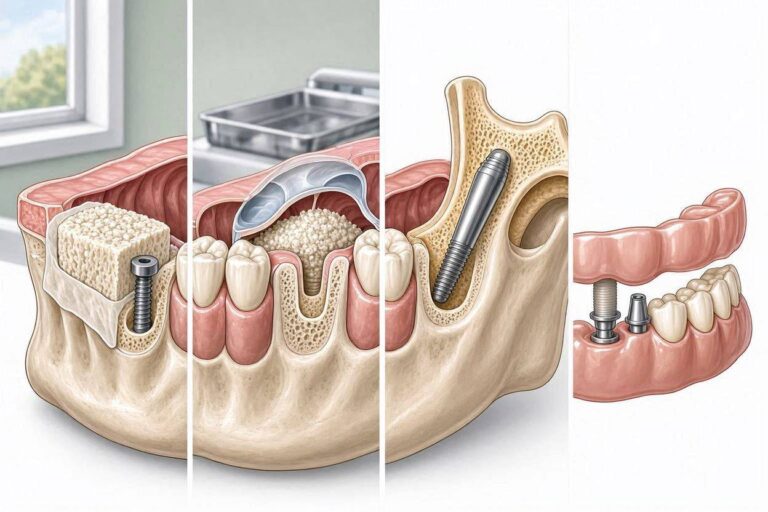
When teeth are lost, the jawbone resorbs. The body senses that the bone is no longer needed to support teeth, and it gradually dissolves the alveolar ridge. This process accelerates over time. A patient who has been edentulous for many years may have very little bone remaining, particularly in the posterior mandible and maxilla.
Severe bone atrophy limits the number and length of implants that can be placed. Bone grafting can rebuild lost bone, but grafting adds surgical complexity, healing time, and cost. Some patients are unwilling or unable to undergo extensive grafting.
Bone Density and Implant Stability
Bone density affects the primary stability of implants at placement and the long-term success of osseointegration. Low-density bone, common in the posterior maxilla, provides less mechanical engagement for the implant threads. More implants may be indicated to distribute forces and compensate for the reduced density.
The Role of CT Imaging
Cone beam computed tomography is essential for evaluating bone quantity and quality before implant planning. The three-dimensional image reveals the exact height, width, and density of available bone, the location of nerves and sinuses, and the optimal positions for implants. Your dentist should review the CT scan with you and explain how your anatomy influences the recommended number of implants.
Financial Considerations
The number of implants directly affects the cost of treatment. Understanding the cost implications helps you make a decision that fits your budget.
| Implant Configuration | Relative Cost | Type of Restoration | Key Benefit |
|---|---|---|---|
| 2 Implants (Lower) | Lowest | Removable Overdenture | Most economical, improved lower denture stability |
| 4 Implants | Moderate | Removable Overdenture | Excellent stability for removable denture |
| 4 Implants (All-on-Four) | High | Fixed Full-Arch Prosthesis | Fixed teeth without bone grafting |
| 6 Implants | Higher | Fixed Full-Arch Prosthesis | Greater redundancy, better materials |
| 8 Implants | Highest | Fixed Full-Arch or Segmented | Maximum support, ideal biomechanics |
Each additional implant adds the cost of the implant fixture, the surgical placement, and the restorative components. A patient choosing between four and six implants for a fixed prosthesis must weigh the additional cost against the benefits of redundancy and potentially longer prosthesis lifespan.
Does Insurance Cover More Implants?
Dental insurance typically caps implant benefits at a fixed annual maximum, often $1,500 to $3,000 per year, regardless of the number of implants placed. Some medical insurance may cover implants in specific circumstances, such as reconstruction after cancer surgery or trauma. The number of implants covered by insurance rarely influences the clinical decision, as insurance reimbursement covers only a fraction of the total cost.
Financing Multi-Implant Treatment
For patients paying out of pocket, the number of implants is often a budget-driven decision. Many dental practices offer payment plans or work with third-party medical finance companies. The total cost of four implants with a fixed prosthesis can range from $15,000 to $30,000 per arch, depending on the region and the materials used. Six or eight implants increase the cost proportionally.
Long-Term Outcomes by Implant Number
Research on full-arch implant restorations provides guidance on the expected long-term performance of different implant configurations.
Survival Rates
The survival rate of individual implants in full-arch restorations is high, typically above 95 percent over ten years. The survival rate of the prosthesis itself is lower; acrylic hybrid prostheses often require replacement or significant repair after 5 to 10 years, while zirconia or porcelain prostheses on more implants last longer.
Prosthesis Complications
The most common complications with full-arch implant prostheses are fracture of the acrylic, wear of the denture teeth, and loosening or fracture of prosthetic screws. These complications are more common with prostheses on fewer implants because the forces are concentrated on fewer supporting components.
Maintenance Requirements
All implant restorations require maintenance. Removable overdentures require periodic replacement of attachment inserts, relining of the denture base, and eventual replacement of the denture itself. Fixed prostheses require professional cleaning around the implants and the prosthesis, monitoring of screw torque, and eventual replacement of worn or fractured components.
Making Your Decision
Choosing the number of implants for your full denture involves balancing multiple factors. Here is a structured approach to the decision.
Clarify Your Goals
Do you want a removable denture that is stable, or do you want fixed teeth that never come out? If you can tolerate a removable appliance and want to minimize cost, a two-implant or four-implant overdenture is appropriate. If you want fixed teeth and are willing to pay for them, a four-implant, six-implant, or eight-implant fixed prosthesis is the goal.
Assess Your Anatomy
What does your cone beam CT scan show? Do you have adequate bone for the number of implants you want, or will you need bone grafting? Are you willing to undergo grafting if necessary? Your anatomy may limit your options.
Evaluate Your Budget
What can you afford to spend? Are you willing to finance the treatment? Does the additional cost of more implants justify the benefits of redundancy and potentially longer prosthesis lifespan? Be honest with yourself about your financial constraints and discuss them openly with your dentist.
Consider Your Maintenance Commitment
Are you willing to perform daily hygiene around a fixed prosthesis? Are you comfortable removing a denture each night? Your lifestyle and preferences matter. The best implant configuration is the one you will maintain properly over the long term.
Conclusion
The number of implants needed for full dentures ranges from two for a basic lower overdenture to eight for a maximally supported fixed full-arch prosthesis. The choice depends on whether you want a removable or fixed restoration, the quality and quantity of your jawbone, your budget, and your long-term expectations for stability and maintenance. A two-implant or four-implant overdenture provides a significant improvement over conventional dentures at a moderate cost, while the All-on-Four concept offers a fixed solution without bone grafting. Six to eight implants provide greater redundancy, enable the use of more durable prosthetic materials, and offer the closest approximation to natural dentition, at a correspondingly higher cost.
Frequently Asked Questions
Can I have just one implant for a full denture?
One implant is insufficient to retain a full denture. The minimum is two implants for a lower overdenture. A single implant cannot resist the rotational and tipping forces that a full denture generates during function.
Is All-on-Four better than a six-implant bridge?
Neither is universally better. All-on-Four avoids bone grafting and is less expensive. A six-implant bridge provides greater redundancy and allows for more durable prosthetic materials. The best choice depends on your anatomy, budget, and preferences.
Do more implants mean less bone loss over time?
Yes, generally. Implants transmit chewing forces to the bone, which stimulates bone maintenance. More implants distribute forces more evenly and may reduce the rate of bone resorption compared to fewer implants or a conventional denture.
Can I upgrade from an overdenture to a fixed prosthesis later?
In many cases, yes. If the implants are positioned appropriately, an overdenture can be converted to a fixed prosthesis. This requires that the implants are sufficient in number and distribution to support a fixed restoration, and that the implants remain healthy.
How long do full-arch implant restorations last?
The implants themselves can last a lifetime with proper care. The prosthesis, whether removable or fixed, has a finite lifespan. Acrylic hybrid prostheses may last 5 to 10 years, while zirconia or porcelain prostheses may last 10 to 20 years or longer before requiring replacement.
Additional Resource:
For information on full-arch implant treatment options and to find a qualified provider, visit the American College of Prosthodontists at https://www.gotoapro.org.