Can a Sore Gum Cause an Ear Pain?
You wake up with a dull ache in your jaw. You press your finger against your cheek, and the pain radiates up toward your temple. Then, a sharp throb starts deep inside your ear.
You assume you have an ear infection. You reach for ear drops. You tilt your head to relieve the pressure.
But nothing changes.
Meanwhile, you notice something else. Your gums feel tender when you brush your molars. You might even see a little swelling near your back teeth.
This is when the confusing question pops into your head: can a sore gum cause an ear pain?
The short answer is yes. Absolutely.
But the long answer is more important. It could save you from unnecessary medication, wrong treatments, and even serious dental problems.
Let me walk you through everything you need to know. No complex medical jargon. No fluff. Just clear, honest, and useful information.
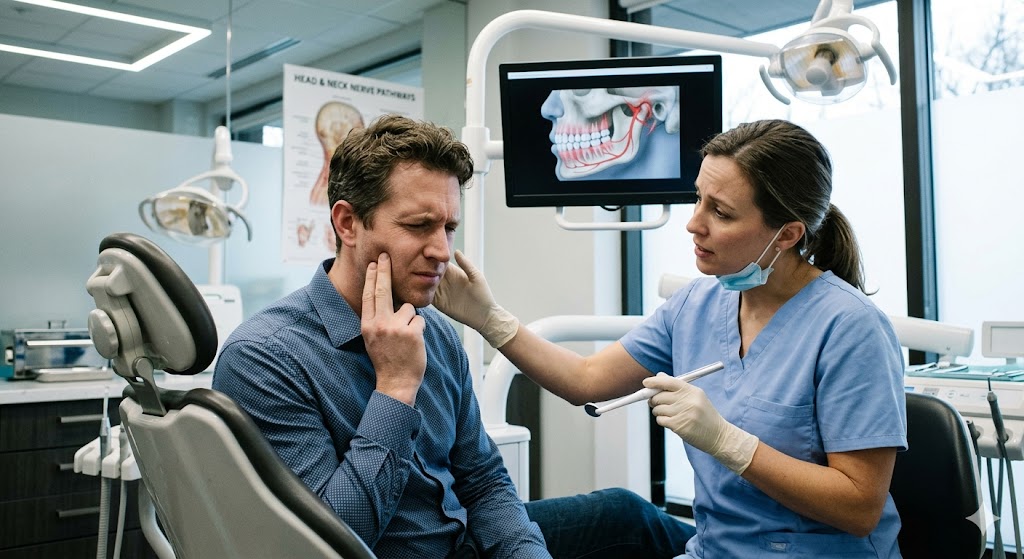
Understanding the Anatomy: Why Your Mouth and Ear Share Nerves
To understand why a sore gum can trigger ear pain, you need to look at a simple map of your nerves.
Your face is not a collection of separate parts. Your teeth, gums, jaw, and ears are connected by a complex network of nerves. The main player here is the trigeminal nerve.
This is the largest cranial nerve in your body. It carries sensory information from your face to your brain. And here is the critical detail: the trigeminal nerve has three major branches.
- Ophthalmic branch: Eyes and forehead.
- Maxillary branch: Upper teeth, upper gums, cheeks, and parts of the nasal cavity.
- Mandibular branch: Lower teeth, lower gums, jaw, and parts of the ear.
Notice that both the maxillary and mandibular branches sit very close to the nerves that serve your ear. In fact, the mandibular branch shares nerve pathways with the auriculotemporal nerve, which directly supplies sensation to your outer ear and temple.
Think of it like a busy highway system. A traffic jam on one road (your gum) creates congestion on a nearby road (your ear). Your brain receives signals from both areas. But because the nerves overlap, it cannot always tell exactly where the problem started.
This phenomenon has a medical name: referred pain.
How Referred Pain Works in Real Life
Referred pain means you feel discomfort in a different location than the actual source of the problem.
For example, a heart attack often causes pain in the left arm or shoulder, not the chest. Similarly, a sore gum in your lower back molar area can send pain signals directly to your ear.
Your brain gets confused. It interprets the signal as coming from your ear because that area has historically been sensitive for you. You might have had ear infections as a child, so your brain defaults to that memory.
But the root cause—pun intended—is sitting right there in your gum tissue.
Important note: Referred pain does not mean the pain is imaginary. It is very real. You genuinely feel an earache. But treating your ear will not solve the problem. You must address the original source: the sore gum.
Common Dental and Gum Issues That Cause Ear Pain
Not every sore gum leads to ear pain. The location and severity of the gum problem matter enormously.
Let me break down the most common scenarios where you will likely feel that annoying ear ache.
1. Impacted Wisdom Teeth
Wisdom teeth are the last molars at the back of your mouth. They usually appear between ages 17 and 25.
When a wisdom tooth does not have enough room to emerge properly, it becomes impacted. This means it grows at an angle, pushes against the neighboring tooth, or remains trapped under the gum.
The gum tissue around an impacted wisdom tooth often becomes sore, swollen, and infected. This condition is called pericoronitis.
Because the wisdom tooth sits extremely close to your jaw joint and ear canal, pericoronitis frequently produces severe ear pain. You might also experience:
- Difficulty opening your mouth fully.
- A bad taste from pus drainage.
- Swelling in the jaw that spreads to the side of your face.
2. Gum Disease (Periodontitis)
Early gum disease is called gingivitis. It causes red, swollen, and bleeding gums. In this stage, ear pain is rare.
But advanced gum disease—periodontitis—is different.
As the infection spreads deeper into the tissues supporting your teeth, it creates pockets of bacteria. These pockets can form near the roots of your molars. The inflammation irritates the surrounding nerves. And because those nerves connect to your ear, you start feeling a deep, dull ache.
Periodontitis does not always cause sharp pain. Many people ignore it because the discomfort feels mild. But the ear pain often becomes the first noticeable symptom that drives them to seek help.
3. Dental Abscess
A dental abscess is a pocket of pus caused by a bacterial infection. It can form at the tip of a tooth’s root (periapical abscess) or in the gum tissue next to a tooth (periodontal abscess).
This is the most painful condition on our list.
An abscess creates intense, throbbing pain that can radiate to your ear, jaw, and neck. You might also have:
- Fever.
- Swollen lymph nodes under your chin or in your neck.
- Sensitivity to hot or cold drinks.
- A pimple-like bump on your gum that releases foul-tasting fluid.
If you have an abscess, do not wait. This is a dental emergency. The infection can spread to your jawbone, sinuses, or even your bloodstream.
4. Gum Recession and Exposed Roots
When your gums recede, they pull away from your teeth. This exposes the sensitive root surfaces underneath.
Exposed roots are not protected by enamel. They contain tiny tubes called dentinal tubules that connect directly to the tooth’s nerve.
Cold air, hot coffee, sweet foods, or even a stiff toothbrush can trigger sharp pain in the root. That pain travels along the nerve pathways straight to your ear. You might think you have an ear sensitivity to temperature, but the real issue is your receding gum line.
5. Bruxism (Teeth Grinding)
Bruxism is the habit of grinding or clenching your teeth, usually during sleep.
This does not directly cause sore gums. But it does cause sore jaw muscles, worn teeth, and gum inflammation from the excessive pressure.
The muscles involved in grinding—your masseter and temporalis muscles—attach near your ear. When these muscles become overworked and inflamed, they create a type of ear pain that feels like a deep ache inside the ear canal.
Many people with bruxism visit an ear specialist first. They describe a feeling of fullness or pressure in the ear, not a sharp pain. But the real culprit is the grinding habit.
6. Post-Dental Procedure Inflammation
Have you ever had a deep cleaning, a root canal, or a tooth extraction?
The days following these procedures can leave your gums sore and tender. This is normal. But if the soreness spreads to your ear, do not panic.
Inflammation from dental work often travels to nearby areas. Your ear might ache for two to three days after a procedure. This usually resolves on its own with ice packs and anti-inflammatory medication.
However, if the ear pain gets worse after 48 hours or comes with a fever, call your dentist. It could signal a developing infection.
Comparative Table: Gum Issue vs. Ear Pain Characteristics
Not sure whether your ear pain comes from your gums or a true ear problem? This table will help you tell the difference.
| Symptom or Feature | Gum-Related Ear Pain | True Ear Infection (Otitis) |
|---|---|---|
| Location of primary discomfort | Back molars, gums near jaw joint | Inside ear canal or eardrum |
| Quality of pain | Dull, aching, throbbing that spreads | Sharp, stabbing, or constant pressure |
| Triggers | Chewing, biting, brushing teeth | Pulling on earlobe, lying down, yawning |
| Associated oral signs | Swollen gums, bleeding, bad breath, loose tooth | No oral signs |
| Ear discharge | Rare | Common (yellow or clear fluid) |
| Fever | Only with severe abscess | Common, especially in children |
| Hearing changes | Usually none | Muffled hearing, crackling sounds |
| Response to painkillers | Partial relief; pain returns when medication wears off | Good relief with ear-specific drops or oral meds |
| Dental exam finding | Tenderness when tapping a specific tooth or gum area | Normal dental exam |
A quick self-test: Gently press on your gums near the sore area. If the pain in your ear increases, the problem likely comes from your mouth. Also, try pulling your earlobe. If that hurts more than pressing your gums, suspect an ear infection instead.
The Role of the Temporomandibular Joint (TMJ)
We cannot talk about gum pain and ear pain without discussing the temporomandibular joint.
Your TMJ connects your jawbone to your skull, just in front of each ear. It is one of the most complex joints in your body. It allows you to talk, chew, yawn, and swallow.
When your gums are sore, you might change the way you chew. You might favor one side of your mouth. You might clench your jaw to avoid touching the sore area.
This altered behavior puts extra stress on your TMJ. The joint becomes inflamed. And because the TMJ sits right next to your ear canal, the inflammation feels exactly like an earache.
In some cases, people develop a condition called referred otalgia (ear pain from a non-ear source). The TMJ is a leading cause of this phenomenon.
Signs Your TMJ Is Involved
- Clicking or popping sounds when you open your mouth.
- Difficulty chewing or a feeling that your bite is “off.”
- Headaches, especially in the temples.
- Pain that gets worse when you yawn widely.
- Tenderness in the jaw muscles when you press on them.
If you have these symptoms along with sore gums, your ear pain likely comes from a combination of dental irritation and TMJ strain.
Less Common Causes: When Gums and Ears Overlap
Let me cover a few less frequent but still important scenarios.
Sinusitis
Your sinuses are air-filled cavities in your facial bones. The maxillary sinuses sit right above your upper teeth roots.
When you have a sinus infection, the pressure can make your upper gums feel sore. This is called sinusitis-induced dental pain. And because the sinuses also connect to your ears via the Eustachian tubes, you might feel ear pain too.
In this case, your gums are not the original problem. But they feel sore as a result of sinus pressure. And your ear hurts from Eustachian tube dysfunction.
Treating the sinuses with decongestants, saline rinses, or antibiotics (if bacterial) usually resolves both the gum soreness and the ear pain.
Trigeminal Neuralgia
This is a chronic pain condition affecting the trigeminal nerve. It causes episodes of intense, shock-like pain in the face.
Trigeminal neuralgia can be triggered by brushing your teeth, touching your face, or even feeling a breeze. The pain often shoots from your gums to your ear in a split second.
This condition is rare. But if you have severe, electric-shock sensations that last only a few seconds but repeat throughout the day, you should see a neurologist, not just a dentist.
Eagle Syndrome
Eagle syndrome occurs when an elongated styloid process (a bony structure near your throat) or a calcified stylohyoid ligament compresses nearby nerves.
The pain can feel like a sore throat, a foreign body sensation, or ear pain that radiates from the jaw and gum area. This is extremely rare, but it shows how complex facial pain can be.
When Should You See a Dentist vs. a Doctor?
This is a crucial question. Wasting time with the wrong specialist delays relief and can make things worse.
See a Dentist First If:
- You have visible gum swelling, redness, or bleeding.
- A specific tooth hurts when you tap on it.
- You have a bad taste in your mouth or bad breath.
- Your ear pain started shortly after a dental procedure.
- You notice a pimple on your gum.
- The pain gets worse when you chew or bite down.
A dentist will take X-rays to check for abscesses, impacted teeth, or bone loss from gum disease. They will also test the vitality of your teeth and probe your gums for deep pockets.
See a Doctor (or Ear Specialist) First If:
- You have ear discharge or fluid leaking from your ear.
- Your hearing is noticeably reduced.
- You have a fever over 101°F (38.3°C) with no dental symptoms.
- You recently had a cold or upper respiratory infection.
- Pulling on your earlobe causes severe pain.
- You have dizziness or vertigo alongside ear pain.
A doctor will look inside your ear with an otoscope. They can see if your eardrum is red, bulging, or perforated. They can also check for fluid behind the eardrum—a sign of middle ear infection.
Important note: If you are unsure, start with your dentist. Dental problems are more likely to cause referred ear pain than ear problems are to cause referred gum pain. Your dentist can also refer you to a doctor if they find no dental cause.
Home Remedies for Gum-Related Ear Pain
While you wait for your dental appointment, you can try these safe home remedies. They will not cure the underlying problem, but they can provide meaningful relief.
Cold Compress
Apply an ice pack wrapped in a thin cloth to the outside of your cheek near the painful area. Leave it on for 15 minutes. Remove for 15 minutes. Repeat as needed.
The cold reduces inflammation in both your gums and the surrounding tissues. It also numbs the nerve endings, which can calm the referred pain to your ear.
Warm Salt Water Rinses
Mix one teaspoon of salt in a glass of warm water. Swish gently for 30 seconds, focusing on the sore gum area. Do this three to four times per day.
Salt water reduces gum inflammation, flushes out food particles, and creates an environment where bacteria struggle to survive. It is not a cure for an abscess, but it can soothe mild gum soreness.
Over-the-Counter Anti-Inflammatories
Ibuprofen (Advil, Motrin) or naproxen (Aleve) work well for gum-related ear pain. These medications reduce inflammation at the source, which then reduces the referred pain to your ear.
Acetaminophen (Tylenol) can help with pain but does not reduce inflammation. It is a reasonable second choice if you cannot take anti-inflammatories.
Always follow the dosing instructions on the label. Do not exceed the recommended dose.
Soft Food Diet
Chewing puts direct pressure on sore gums and your TMJ. Switching to soft foods gives your mouth a rest.
Good options include:
- Yogurt.
- Mashed potatoes.
- Smoothies (use a spoon, not a straw, to avoid suction on sore gums).
- Scrambled eggs.
- Oatmeal.
- Soup (cool it down to avoid temperature sensitivity).
Avoid crunchy, hard, sticky, or chewy foods until you see a dentist.
Clove Oil (Temporary Numbing)
Clove oil contains eugenol, a natural anesthetic. It has been used for centuries to numb tooth and gum pain.
Dip a cotton swab in clove oil and dab it directly on the sore gum. Do not swallow the oil. Do not use it on broken skin or open wounds inside your mouth.
This provides temporary relief only. It will not treat an infection.
Elevate Your Head While Sleeping
When you lie flat, blood flow to your head increases. This can worsen gum inflammation and ear pressure.
Sleep with an extra pillow to keep your head elevated. This reduces throbbing pain and can help fluid drain if you have any mild sinus or ear involvement.
What Not to Do When You Have Gum and Ear Pain
I see many people make these mistakes. They often make the pain worse or delay proper treatment.
Do not put anything inside your ear canal.
No cotton swabs. No ear drops unless a doctor prescribed them. No oils or garlic cloves.
If your ear pain comes from your gums, ear drops will do nothing. If you happen to have a perforated eardrum, ear drops can enter your middle ear and cause dizziness, hearing loss, or infection.
Do not take leftover antibiotics.
Antibiotics are not interchangeable. A leftover prescription from a urinary tract infection will not work on a dental abscess. Using the wrong antibiotic can also kill good bacteria and lead to resistant infections.
Only take antibiotics prescribed specifically for your current symptoms after a proper examination.
Do not apply heat to your cheek.
Heat increases blood flow and can make a dental abscess swell faster. It can also worsen inflammation in your TMJ. Stick with cold compresses unless your dentist specifically recommends heat.
Do not ignore the pain for more than three days.
Mild gum soreness often resolves on its own within 48 to 72 hours. But if the pain persists, gets worse, or spreads to your ear, you need a professional evaluation.
Waiting too long can turn a small cavity into a root canal. It can turn early gum disease into bone loss. Do not gamble with your health.
Treatment Options from a Dentist
When you finally sit in the dental chair, what can you expect? The treatment depends entirely on the underlying cause.
For Gum Disease
Your dentist will perform a deep cleaning called scaling and root planing. They remove plaque and tartar from below your gum line. They also smooth the tooth roots to help your gums reattach.
You might receive a local anesthetic for this procedure. Afterward, your gums will feel sore for a few days. Your dentist may prescribe a special mouth rinse or, in severe cases, oral antibiotics.
Once the gum inflammation decreases, the referred ear pain usually disappears within a week.
For a Dental Abscess
Treatment involves draining the pus and eliminating the infection.
- If the abscess comes from a tooth, you will need a root canal or an extraction.
- If the abscess comes from the gum tissue, your dentist will make a small incision to drain it and then clean the area deeply.
You will also receive antibiotics to prevent the infection from spreading. Pain relief is often dramatic within 24 to 48 hours after drainage.
For Impacted Wisdom Teeth
Your dentist may refer you to an oral surgeon for wisdom tooth extraction. This is often the only permanent solution.
If pericoronitis (gum infection around a partially erupted wisdom tooth) is mild, your dentist might clean the area and prescribe antibiotics. But this is a temporary fix. The problem will return until the tooth is removed.
For Bruxism
Your dentist can create a custom nightguard. This hard acrylic appliance fits over your upper or lower teeth. It prevents tooth-to-tooth contact, reduces muscle strain, and protects your TMJ.
Many patients notice significant reduction in ear pain and jaw soreness within two weeks of consistent nightguard use.
For Gum Recession
Treatment depends on the severity.
- Mild recession: Desensitizing toothpaste, fluoride varnishes, or bonding agents applied to exposed roots.
- Moderate to severe recession: Gum grafting surgery, where tissue is taken from your palate and stitched over the exposed roots.
Once the roots are covered, temperature sensitivity and referred pain to the ear typically stop.
Preventing Gum Problems That Lead to Ear Pain
Prevention is always better than treatment. These habits will keep your gums healthy and your ears free from referred pain.
Master Your Brushing Technique
Use a soft-bristled toothbrush. Hard bristles damage gum tissue and cause recession.
Hold your brush at a 45-degree angle to your gums. Use short, gentle strokes. Do not scrub back and forth like a saw. This irritates gums and wears away enamel.
Brush for two full minutes, twice per day. Set a timer if needed. Most people brush for only 45 seconds.
Floss Correctly and Consistently
Flossing removes plaque from between teeth and below the gum line. No toothbrush can reach these areas.
Use about 18 inches of floss. Wrap it around your middle fingers. Gently slide it between your teeth. Curve the floss into a C shape against each tooth and go slightly below the gum line.
Never snap the floss down into your gums. This causes bleeding and soreness.
If traditional floss is difficult, try floss picks, water flossers, or interdental brushes. The best method is the one you will actually use every day.
Use an Antiseptic Mouthwash
Over-the-counter mouthwashes with cetylpyridinium chloride or essential oils (like Listerine) reduce bacteria in your mouth. They reach areas your brush and floss might miss.
Swish for 30 seconds after brushing and flossing. Do not eat or drink for 30 minutes afterward to let the ingredients work.
Do Not Smoke or Use Tobacco
Smoking is devastating to gum health. It reduces blood flow to your gums, masks the signs of infection, and makes healing nearly impossible.
Smokers are twice as likely to develop gum disease as non-smokers. They also respond poorly to treatment. If you smoke and have chronic gum problems, quitting is the single most important step you can take.
Visit Your Dentist Regularly
Do not wait until you have pain. See your dentist every six to twelve months for an exam and cleaning.
During these visits, your dentist can:
- Detect early gum disease before it causes bone loss.
- Identify cavities that could lead to abscesses.
- Evaluate your wisdom teeth for potential problems.
- Check your nightguard if you grind your teeth.
A 30-minute preventive visit is far cheaper and less painful than treating advanced disease.
Manage Stress
Stress leads to teeth grinding, jaw clenching, and poor oral hygiene habits. All of these harm your gums and can cause ear pain.
Find healthy ways to reduce stress:
- Regular exercise.
- Adequate sleep (seven to nine hours per night).
- Talking to a friend or therapist.
- Deep breathing or meditation.
- Limiting caffeine and alcohol.
Your mouth will thank you.
Realistic Timeline: How Long Until Ear Pain Resolves?
People always want to know: If I treat my sore gum, how quickly will my ear stop hurting?
Here is an honest, realistic timeline based on the underlying cause.
| Condition | Treatment | Expected ear pain relief |
|---|---|---|
| Mild gum inflammation (gingivitis) | Improved brushing and flossing | 2 to 5 days |
| Periodontitis (early stage) | Deep cleaning | 3 to 7 days |
| Periodontitis (advanced) | Deep cleaning + possible surgery | 1 to 3 weeks |
| Dental abscess | Drainage + antibiotics | 24 to 48 hours for major relief; full resolution in 1 week |
| Impacted wisdom tooth | Extraction | Pain often gone immediately after extraction; residual soreness 3 to 5 days |
| Bruxism | Nightguard use | Gradual improvement over 2 to 4 weeks |
| Gum recession (mild) | Desensitizing treatment | Immediate improvement; full effect in 1 to 2 weeks |
| Post-dental procedure soreness | Ice and anti-inflammatories | 2 to 5 days |
A realistic warning: If you have had ear pain for months or years, do not expect it to vanish overnight. Chronic pain creates changes in your nervous system. Even after you fix the gum problem, your brain might continue to perceive ear pain for several weeks. This is called central sensitization. Be patient. The pain will fade, but it may take time.
Special Considerations for Children and Older Adults
Children
Ear pain in children is almost always assumed to be an ear infection. And often, it is. Children get frequent middle ear infections because their Eustachian tubes are short and horizontal.
But children also get dental problems. Cavities in baby molars can lead to abscesses. Teething can cause gum soreness that radiates to the ear.
If your child has ear pain and you cannot see any dental issues, take them to their pediatrician first. But if the ear pain persists after the ear infection is treated, or if your child complains of tooth pain when chewing, schedule a dental visit.
Older Adults
Older adults face unique risks for gum-related ear pain.
- They are more likely to have gum recession from decades of brushing.
- They may have dry mouth from medications, which increases cavity and gum disease risk.
- They might have difficulty cleaning their teeth thoroughly due to arthritis or mobility issues.
- They often take blood thinners, which can make gum bleeding and surgery more complicated.
If you are an older adult, do not dismiss ear pain as “just getting older.” It could be a sign of a treatable dental problem. See your dentist.
Also, be aware that some heart medications (like calcium channel blockers) can cause gum overgrowth. This makes cleaning difficult and leads to sore gums and referred ear pain. Your dentist and cardiologist should coordinate your care.
Frequently Asked Questions (FAQ)
1. Can a sore gum cause an ear pain on only one side?
Yes. In fact, unilateral (one-sided) ear pain strongly suggests a dental cause on the same side. For example, a sore gum around your lower left molar will cause ear pain in your left ear. True ear infections often affect both ears or shift from side to side.
2. How can I tell if my ear pain is from my tooth or an ear infection?
Try the “tug test.” Gently pull your earlobe. If it hurts significantly, you likely have an ear infection. If there is no change, press on your gums near the back teeth. If that increases the ear pain, your gums are the culprit.
3. Can gum pain cause ear pain even if my gums look normal?
Absolutely. Early gum disease or a small pocket of infection might not cause visible swelling. Your gums could look pink and healthy, but deep inside, inflammation irritates the nerves. X-rays and probing by a dentist can reveal hidden problems.
4. Will antibiotics stop both the gum pain and ear pain?
Antibiotics treat bacterial infections. If your sore gum comes from an abscess or advanced gum disease, antibiotics will reduce the infection. As the infection clears, the referred ear pain will fade. However, antibiotics alone rarely cure dental problems. You still need a dental procedure to remove the source of infection.
5. How long should I wait before seeing a doctor for ear pain?
If your ear pain comes with fever, hearing loss, or discharge, see a doctor within 24 hours. If you only have mild ear discomfort that comes and goes, try home care for two to three days. But if the pain persists beyond 72 hours or worsens, seek professional help.
6. Can stress cause both sore gums and ear pain?
Indirectly, yes. Stress leads to teeth grinding, which causes sore jaw muscles and gum inflammation. It also weakens your immune system, making gum infections more likely. The resulting ear pain is real, but the solution involves stress management, not ear medication.
7. Is it safe to fly with gum-related ear pain?
It depends. If you have an active dental abscess, changes in air pressure during takeoff and landing can cause severe pain in the tooth and ear. The gas inside the abscess expands, pressing on nerves. See your dentist before flying. If you must fly, use decongestant nasal sprays and chew gum during descent to equalize pressure.
8. Can my ear pain be referred from my gums if I have no teeth?
Yes. Even if you wear dentures, you can develop sore spots, ulcers, or infections in your gum tissue. Dentures that do not fit properly can create constant pressure points. These can definitely cause referred pain to your ear. See your dentist for a denture adjustment.
9. What is the most common misdiagnosis for gum-related ear pain?
The most common misdiagnosis is “chronic ear infection” or “Eustachian tube dysfunction.” Patients receive multiple courses of antibiotics and even ear tube surgery, but the pain persists. Meanwhile, a simple dental X-ray would have revealed the true source within minutes.
10. Can pregnancy cause gum pain that leads to ear pain?
Yes. Pregnancy hormones increase blood flow to your gums and make them more sensitive to plaque. This condition is called pregnancy gingivitis. It causes swollen, bleeding, sore gums. In some pregnant women, the inflammation refers pain to the ears or jaw. Good oral hygiene and professional cleanings usually resolve it.
Additional Resource
For more trustworthy, research-backed information on oral health and its connection to other body systems, visit the American Dental Association’s patient education page:
🔗 MouthHealthy.org – The ADA’s patient-focused website
This resource offers:
- Illustrated guides to gum disease and tooth pain.
- Videos on proper brushing and flossing techniques.
- A “Find a Dentist” tool for your area.
- Fact sheets in multiple languages.
- No advertising or commercial bias.
Conclusion: Three Key Takeaways
First: Yes, a sore gum can absolutely cause ear pain through shared nerve pathways, especially when the soreness involves your back molars or lower jaw. Second: Treating the ear without examining the mouth leads to delays, wrong treatments, and worsening dental problems—always check your gums first. Third: Most gum-related ear pain resolves within days to weeks once you address the dental cause, from improved oral hygiene to professional treatments like deep cleanings or extractions.
Disclaimer: This article is for informational purposes only and does not constitute medical or dental advice. Individual health situations vary. Always consult a qualified dentist or physician for proper diagnosis and treatment of pain, infections, or any health concern. Do not delay seeking professional care based on information you read here.