How To Flp In Dental Implant?
You typed a query into a search engine, hoping for a clear answer. You entered “How To Flp In Dental Implant?” and you landed here. The first thing to say is that this appears to be a typographical error. The phrase “flp” does not correspond to any recognized term, procedure, or technique in dental implantology. But you came looking for help, and this article will provide it. The most productive approach is to identify what you probably intended to ask and give you the best possible answer for each likely scenario. A misspelled search is simply a question trying to find its correct words. Let us find those words together.
The Likely Meanings: What You Might Be Looking For
Typing errors happen when a finger slips, autocorrect intervenes, or a word is heard but never seen spelled. In the context of dental implants, “flp” could represent several things. Below are the three most plausible interpretations, each addressed in full detail.
Flipper: A Temporary Partial Denture
The word “flipper” sounds very close to “flp” when spoken. A dental flipper is a removable, temporary partial denture that replaces one or more missing teeth. It is called a flipper because it flips in and out of the mouth easily. It is not a dental implant. It is a temporary solution often used while an implant site heals.
Flap: The Surgical Access Procedure
If “flp” was a mistype of “flap,” you are asking about a fundamental surgical technique. Implant surgery involves creating a surgical flap. This is the process of making an incision in the gum and reflecting the tissue to expose the underlying bone. Understanding how a flap works is essential for anyone preparing for implant surgery.
Full-Arch or All-on-Four: Full Mouth Implant Solutions
If your fingers were reaching for “full,” as in “full mouth dental implant,” you are asking about the most transformative implant procedure available. Full-arch restoration, often called All-on-Four or All-on-Six, replaces all the teeth in a jaw with a fixed prosthesis supported by four to six implants.
This article will explore each of these possibilities thoroughly. By the end, you will have your real question answered, even if you are no longer sure exactly what you typed.
Possibility One: The Flipper as a Temporary Tooth
A flipper is the common term for a removable, temporary partial denture designed to replace one or a few missing teeth. It is one of the most affordable and expedient solutions in dentistry, but it has nothing directly to do with the surgical placement of dental implants except as a temporary measure.
What a Flipper Looks Like and Feels
A flipper consists of a flesh-colored acrylic base that rests on the roof of the mouth for upper teeth or along the inside of the lower jaw for lower teeth. Acrylic teeth are set into this base in the correct positions. Small metal clasps may wrap around adjacent teeth to help hold the appliance in place.
The flipper is designed to be removed for cleaning and sleeping. It is held in place by friction and the gentle grip of the clasps. It is not tightly fixed. It can move slightly during eating or speaking. For a patient waiting for an implant to integrate, the flipper provides an aesthetic tooth so they can smile and speak in public without an obvious gap. The critical rule during implant healing is that the flipper must not put pressure on the healing implant site. The dentist adjusts the flipper to ensure there is a space between the appliance and the gum over the implant. Pressure can disrupt healing and cause implant failure.
How to Care for a Flipper
A flipper is a temporary appliance, but it still requires care. It should be removed after eating and rinsed. It should be cleaned daily with a soft denture brush and mild soap or denture cleaner. Toothpaste is generally too abrasive and can scratch the acrylic. It should be stored in water or a denture-soaking solution when not in the mouth to prevent the acrylic from drying out and warping. It is important not to wrap a flipper in a paper towel, as it is easily mistaken for trash and thrown away.
The Limitations of a Flipper
A flipper is not a substitute for a permanent restoration. It is not stable enough for comfortable chewing of hard or chewy foods. It can affect speech initially, though most patients adapt within a few days. Long-term use can cause irritation of the gum tissue and, in some cases, accelerate bone loss under the appliance because it transmits no stimulating force to the bone. A flipper is a temporary bridge to a permanent solution. It is not the destination.
Possibility Two: The Surgical Flap in Implant Placement
If your query related to the surgical flap, you are asking about the procedure itself. This is the most technical interpretation and the most directly relevant to the implant surgery experience.
What a Surgical Flap Is
A surgical flap is a section of gum tissue that is surgically incised and elevated to expose the underlying bone. This is a standard technique in oral surgery, including tooth extraction, periodontal surgery, and dental implant placement. The word “flap” describes the tissue’s behavior during the procedure: it is reflected like opening a hinged door to reveal what lies beneath.
Why a Flap Is Necessary for Implants
Implant placement requires direct visualization of the jawbone. The dentist must see the contours of the bone, avoid anatomical structures, and prepare the implant osteotomy with precision. Blind placement, without a flap, is possible in some cases using computer-guided surgery through the gum tissue, but this is a specific protocol called flapless surgery. The traditional, widely used approach involves raising a flap.
The Flap Procedure Step by Step
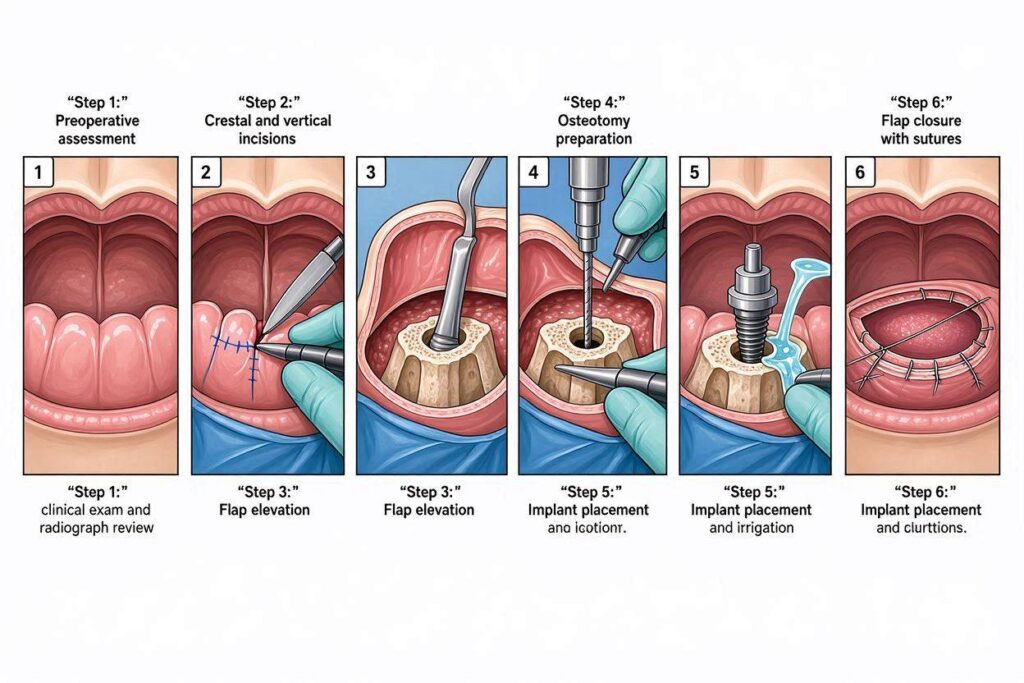
The area is profoundly anesthetized. The dentist uses a scalpel to make an incision along the crest of the ridge where the missing tooth once was. Additional releasing incisions may be made at the ends of this crestal incision to allow the flap to be reflected without tearing. The incision is precise and designed to preserve the blood supply to the tissue.
A periosteal elevator, a specialized instrument, is used to gently separate the gum and the periosteum, the thin membrane covering the bone, from the underlying jawbone. The tissue is reflected to the side, creating a clear window of bone. The flap is held in position by retractors during the drilling and implant placement.
Once the implant is seated and the cover screw or healing abutment is in place, the flap is repositioned. The tissue is sutured back into its original position. The sutures hold the flap edges together so healing can occur. The sutures may be dissolvable or may need removal in one to two weeks.
Flapless Surgery as an Alternative
Flapless implant surgery is a minimally invasive technique where the implant is placed through a small hole punched in the gum tissue, without reflecting a full flap. It requires excellent bone volume and density, precise digital planning, and often the use of a surgical guide. Benefits include less post-operative pain, less swelling, shorter surgery time, and no sutures. The risk is that the dentist cannot directly visualize the bone, so any anatomical surprises are harder to manage. Flapless surgery is not appropriate for every patient.
Healing After Flap Surgery
Post-operative discomfort is generally mild to moderate. Swelling peaks at about 48 hours and then subsides. Ice packs applied to the face in the first 24 hours help minimize swelling. Pain is controlled with over-the-counter analgesics or prescribed medication. The sutures protect the surgical site as healing begins. A soft diet is recommended for the first week. Strenuous activity should be avoided for a few days. Most patients return to normal activities within one to three days.
Possibility Three: Full-Arch Implant Restoration
A significant number of patients seeking dental implant information are missing most or all of their teeth. If your search related to full mouth dental implants, you are exploring a life-changing procedure.
Understanding the Full-Arch Concept
Full-arch implant restoration replaces an entire arch of missing teeth with a fixed, non-removable prosthesis anchored by dental implants. Instead of replacing each tooth with an individual implant, which would be prohibitively expensive and often impossible due to bone limitations, four to six strategically placed implants support a complete bridge of teeth.
The most well-known version is the All-on-Four technique, which uses four implants in specific positions. Two are placed vertically in the anterior region where bone is naturally more abundant. Two are placed at an angle in the posterior region, tilting to avoid the sinus in the upper jaw or the nerve canal in the lower jaw and to engage better-quality bone.
The Full-Arch Procedure Overview
After comprehensive evaluation and digital planning, any remaining failing teeth are extracted. The implants are placed according to the surgical plan. In many cases, a temporary fixed prosthesis is attached to the implants on the same day, allowing the patient to leave the office with a full set of functional teeth. This is called immediate loading. The temporary teeth are made of acrylic and are designed to protect the implants during the healing phase. Over the next four to six months, the implants osseointegrate. The patient follows a soft diet and avoids chewing hard foods with the temporary teeth. Once healing is confirmed, a final prosthesis is fabricated. This is typically a titanium framework supporting acrylic or porcelain teeth and gum-colored acrylic. The final prosthesis is stronger, more aesthetic, and designed for long-term function.
The Transformative Impact
Full-arch implant restoration is not a minor procedure. It is reconstructive surgery. The recovery involves significant swelling, bruising, and dietary modification. But the outcome is transformative. A patient who has struggled with failing teeth or loose dentures for years can regain the ability to eat what they want, speak clearly, and smile with confidence. The prosthesis is fixed in place and does not come out. It is cleaned similarly to natural teeth with brushing and water flossing.
Other Possible Meanings of “Flp”
Your typo may have other origins. Here are brief answers for additional possibilities.
Flip as in an Implant Flip
Dental implants do not flip. They are stationary fixtures. However, a removable implant overdenture can be flipped out of the mouth for cleaning. This is a type of denture that snaps onto implants for stability but is removed daily by the patient.
Floss or Flossing
A very common topic is how to floss around a dental implant. Proper cleaning is essential for long-term implant health. Use implant-specific floss, which has a stiff threader end and a spongy middle section. Gently work the floss between the implant crown and the adjacent tooth. Curve the floss around the implant crown and wipe the surface. A water flosser with a non-metal tip is also an excellent tool for implant maintenance.
Placing or Placement
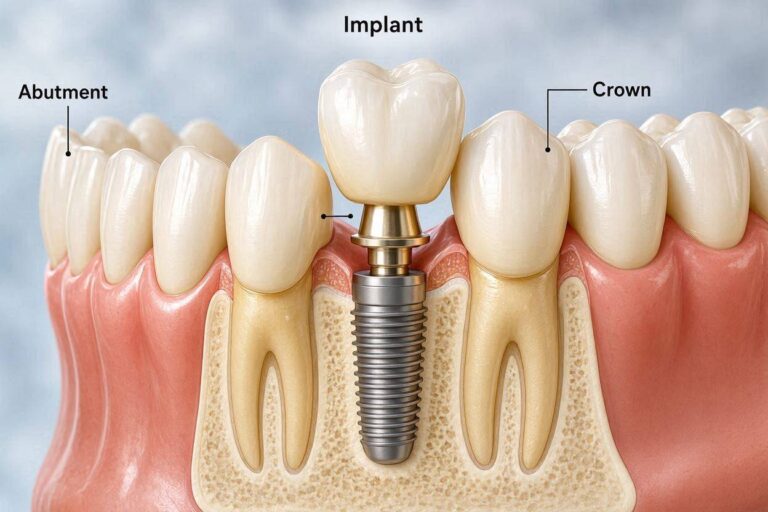
Perhaps you were searching for how an implant is placed or how the process works. The placement involves creating a flap, drilling a precise channel in the bone, screwing the implant into position, and allowing it to heal. This is covered in the flap section above.
Navigating Dental Information with Confidence
A search that begins with a typo does not have to end in frustration. The dental world is filled with technical terms, similar-sounding words, and procedures that can be confusing. If you are unsure about the correct terminology for what you want to know, describe your situation plainly. A good dentist or a well-written resource will help translate your words into the clinical language needed to answer your question. You do not need to know the jargon to deserve a clear answer.
Conclusion
The query “How To Flp In Dental Implant” almost certainly contains a typographical error, but the need behind it is real. You may be asking about a temporary flipper to wear during healing, the surgical flap procedure used to place an implant, or a full-arch restoration to replace all your teeth. Each of these topics addresses a different aspect of the implant journey, and each is important in its own right. Whatever your actual question was, the hope is that it has been answered somewhere in this guide.
Frequently Asked Questions
What is a flipper tooth?
A flipper is a removable, temporary partial denture that replaces one or a few missing teeth. It is often used during the healing period after implant placement to provide an aesthetic temporary tooth.
Is flapless implant surgery better than traditional flap surgery?
Flapless surgery is less invasive and has a faster recovery, but it is only appropriate when bone volume and quality are excellent. Traditional flap surgery provides direct visualization of the bone and is safer for complex cases.
What is an All-on-Four dental implant procedure?
All-on-Four is a full-arch implant technique where four implants support a fixed bridge of teeth. Two posterior implants are placed at an angle to maximize bone contact and avoid anatomical structures.
Can a flipper damage my dental implant?
A flipper that places pressure on a healing implant can disrupt osseointegration and cause failure. The dentist must adjust the flipper so there is a relief space over the implant site.
How do I clean around my dental implant?
Use a soft toothbrush, implant-specific floss with a threader end, interdental brushes, and a water flosser. Clean where the crown meets the gum meticulously every day.
What does the surgical flap procedure feel like?
The procedure is performed under local anesthesia and should not be painful. You will feel pressure and vibration. Post-operative soreness is managed with medication and resolves within days.
Additional Resource:
American College of Prosthodontists – Dental Implants and Restoration Options
https://www.gotoapro.org/dental-implants/