Can Invisalign Move An Implant?
You are considering Invisalign. You have a smile that needs straightening, but there is a complication. You already have a dental implant, a titanium post fused to your jawbone, crowned with a ceramic tooth. It sits there, solid and permanent, among your natural teeth. Now you want to move the teeth around it. The question is logical and critical: can the Invisalign aligners, those clear plastic trays that gently push your teeth into line, also move the dental implant?
The answer is an unequivocal, biologically grounded no. Invisalign cannot move a dental implant. The implant is an immovable object, an ankylosed post. However, Invisalign can and does work brilliantly around a dental implant, moving the natural teeth relative to that fixed point. This article will explain the rigid biology of the implant, how Invisalign treatment is planned around it, and the crucial sequence of orthodontics first, implants second that dictates the standard of care.
The Biological Wall: Why an Implant Will Not Budge
The mechanism by which Invisalign moves teeth is the same as traditional braces. A sustained, gentle force is applied to the crown of a tooth. This force is transmitted down the root to the periodontal ligament, the living, collagenous sling that connects every natural tooth root to the surrounding jawbone. The ligament on the pressure side is compressed, and the ligament on the tension side is stretched. This triggers a cellular cascade. Osteoclasts remove bone on the pressure side. Osteoblasts build new bone on the tension side. The tooth moves slowly, biologically, through living bone.
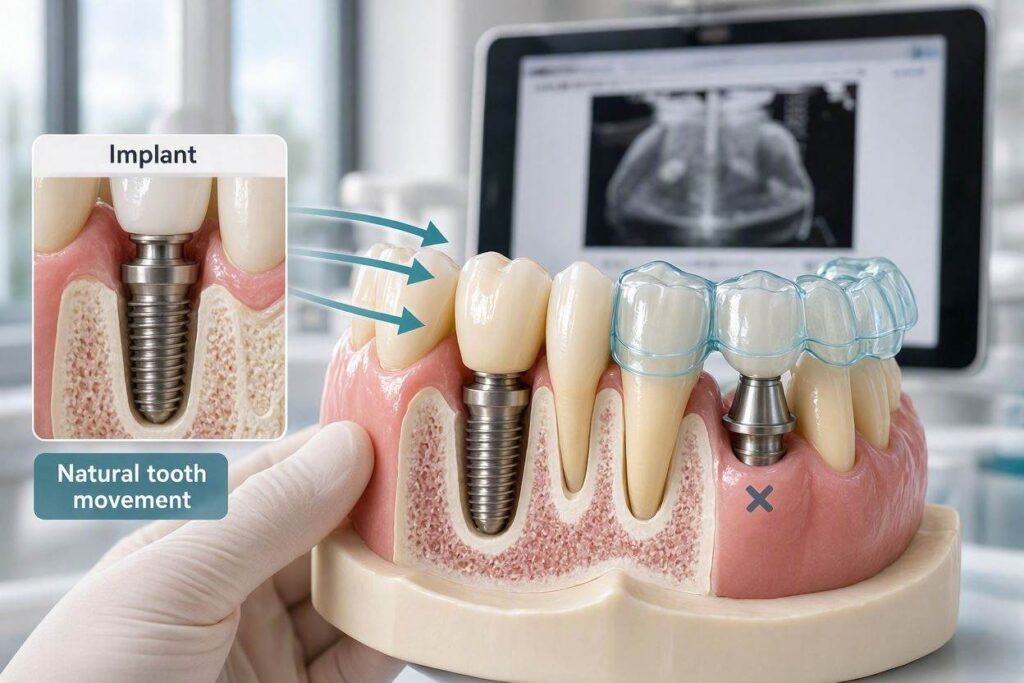
A dental implant has no periodontal ligament. This is the single, critical anatomical fact that governs everything. The titanium implant post has osseointegrated, meaning living bone cells have grown into direct, rigid contact with the microscopic surface of the implant. It is a biological weld. There is no flexible sling, no shock absorber, and no cellular machinery to translate orthodontic force into bone remodeling.
If an Invisalign aligner applies force to an implant crown, the force has nowhere to go. The implant will not move. If the force is light, the aligner will simply be slightly deformed around the implant, and no biological response will occur. If the force is heavy, it will not move the implant. It will be transmitted directly to the bone-implant interface, causing pressure necrosis, microfractures of the bone, and potentially, the catastrophic loss of osseointegration. The implant will fail, not move. The orthodontist and the Invisalign ClinCheck software respect this biological wall absolutely. The implant is designated as a non-moving, fixed anchor point.
The Treatment Plan: Moving Teeth Around a Fixed Point
When you are a candidate for Invisalign and you have an existing dental implant, the digital treatment planning software, ClinCheck, creates a 3D model of your entire mouth from an intraoral scan. The implant and its crown are clearly identified by the orthodontist. They are digitally “locked” in place. They are designated as teeth that will not move, should not move, and cannot move.
The software then simulates the movement of all the natural teeth. The teeth adjacent to the implant, the teeth in the opposing arch, the teeth on the other side of the mouth—all of these have living periodontal ligaments and can be moved. The orthodontist designs a series of aligners that will push, tip, rotate, and torque these natural teeth into their ideal positions, using the immovable implant crown as a fixed reference point. The aligner trays are fabricated to fit passively over the implant crown, applying no active force to it.
The implant crown becomes a known, stable landmark in a shifting landscape. The orthodontist may move the natural teeth to close small gaps adjacent to the implant, or to open a space on the other side of the arch to match the space occupied by the implant crown. The implant does not participate in the movement, but it is an integral part of the aesthetic and functional end goal. The final smile will have the implant crown in its original position, harmoniously integrated with the newly straightened natural teeth.
The Problem of Pre-Existing Implant Position
The success of moving natural teeth around an existing implant hinges on one critical factor: the implant must have been placed in a reasonably correct, prosthetically acceptable position. If the implant is in a severely compromised position—too far forward, too far back, angled incorrectly, or too shallow—it becomes a fixed obstacle to achieving an ideal orthodontic result.
An orthodontist can straighten the teeth, but they cannot change the position of the badly placed implant. The final result may be a straight smile with one tooth that looks oddly rotated or positioned, the unchangeable legacy of a poorly planned implant. In such cases, the patient faces a difficult choice. They can accept the compromised aesthetic, attempt to mask the problem with a new, creatively shaped implant crown, or undergo the costly and time-consuming process of removing the implant, grafting the bone, and starting over. This is a painful and avoidable outcome. It underscores the absolute necessity of placing an implant in a prosthetically driven, orthodontically considered position from the very beginning, even if the patient is not actively planning orthodontics at that moment.
The Reverse Sequence: The Standard of Care
The most common and biologically sound clinical scenario is the reverse. The patient does not yet have an implant. They have a missing tooth and crooked teeth. The question is which comes first, the implant or the Invisalign? The answer, in almost every case, is Invisalign first, implant second.
The orthodontist begins the Invisalign treatment. The natural teeth are moved into their ideal, straight positions. The precise, final dimension of the missing tooth space is established. The space is not just a gap; it is a carefully calibrated window with ideal mesial-distal width, buccal-lingual dimension, and proper root divergence of the adjacent teeth. The patient is then held in this final position with a retainer.
Only at this point is the dental implant placed. The implant surgeon reviews the final Invisalign ClinCheck outcome, takes a new 3D CBCT scan, and places the implant into the exact center of the now perfectly-sized, orthodontically-determined edentulous space. The implant crown is then fabricated to match the newly aligned arch. The sequence is logical, predictable, and results in a final outcome where the implant is seamlessly integrated into a straight, orthodontically ideal smile. This is the standard of care because it respects biology. Orthodontics moves teeth; implants replace them.
Conclusion
Invisalign cannot move a dental implant. The implant is rigidly fused to the bone, lacking the periodontal ligament that translates orthodontic force into biological movement. However, Invisalign can successfully move natural teeth around a well-placed implant, using it as a fixed reference point. The correct and most predictable sequence of care is to complete the Invisalign orthodontic alignment first, creating the perfect space for the future tooth, and then to place the dental implant second into that stable, ideal environment.
Frequently Asked Questions
Will the Invisalign aligner fit over my implant crown?
Yes. The aligner will be fabricated from a digital scan that includes the exact shape of your implant crown. It will fit passively over it. The aligner will not apply any active force to the implant crown. It will simply cover it like a thin, clear glove.
What if my implant is loose? Can it be moved then?
A loose implant is a failed or failing implant. Mobility is the cardinal sign of failed osseointegration. It cannot be “moved” orthodontically. It is not anchored to bone. It must be surgically removed. After the bone has healed, the site can be re-evaluated for a new implant, ideally after any necessary orthodontic alignment has been completed.
I have an implant in the front and want to fix a gap on the side. Can Invisalign do this?
Yes. This is a classic scenario where Invisalign works well. The front implant is a fixed, non-moving anchor. The aligners are designed to move the posterior natural teeth forward to close the side gap, leaving the implant crown undisturbed in its position.
Additional Resource:
For more information on the interaction between orthodontics and dental implants, see the American Association of Orthodontists’ article on braces and implants: https://www.aaoinfo.org/blog/can-i-get-braces-if-i-have-dental-implants/