How Much Are Dental Implants?
The question is direct, urgent, and profoundly personal. You have a missing tooth, or you face the imminent loss of one. You have heard that dental implants are the gold standard, the closest thing to growing a new tooth. But the gleaming promise of a permanent, beautiful, functional restoration collides with the hard reality of your budget. You need a number. Not a range that spans thousands of dollars, not a vague “it depends,” but a realistic, grounded answer to the question: how much are dental implants?
This article is a comprehensive, honest, and detailed answer to that question. We will dissect the cost of a single implant, a multiple-implant bridge, and a full-arch restoration. We will break down each component, from the 3D scan to the final crown, and provide the realistic price ranges you will encounter in the United States in the current market. This is not a marketing promise. It is a financial map.
The Single Tooth Implant: A Line-by-Line Cost Deconstruction
A single dental implant is not one monolithic product with one price tag. It is a sequence of distinct clinical procedures, each generating a professional fee, a laboratory bill, and a material cost. Understanding each line item is the key to interpreting any quote you receive.
Phase 1: Diagnosis and Planning
The journey begins before any surgery. A comprehensive exam, a panoramic X-ray, and critically, a 3D Cone Beam CT scan are the standard of care for safe implant planning. The CBCT scan reveals the three-dimensional volume of your bone, the location of nerves and sinuses, and any hidden pathology. A responsible surgeon will not place an implant without this diagnostic map.
- Cost: $150 – $600 for the imaging, often applied toward the surgical fee if the implant is placed.
Phase 2: Implant Placement Surgery
This is the surgical appointment. The oral surgeon or periodontist numbs the site, makes an incision in the gum, prepares a precisely sized osteotomy (a hole in the bone), and threads the titanium implant post into place. A healing cap or a cover screw is placed over the implant, and the gum is stitched closed. This is a sterile, surgical procedure. The fee includes the surgeon’s time, the surgical assistant, the sterile disposable materials, and the implant fixture itself.
- Cost: $1,500 – $3,000 for the surgical placement of a single implant. This fee is higher for a specialist than for a general dentist, reflecting the specialist’s advanced training.
Phase 3: Adjunctive Procedures (If Needed)
This is the wildcard. Many patients, especially those who have been missing a tooth for a long time, require a bone graft to rebuild the deficient ridge before or at the time of implant placement. A sinus lift may be necessary in the upper posterior jaw. These are separate surgical procedures with their own fees.
- Bone Graft (minor): $400 – $1,200
- Sinus Lift: $1,500 – $3,000
- Cost: Variable, but can add $500 to $3,000+ to the total case.
Phase 4: Abutment and Crown (The Restoration)
After three to six months of healing, the implant is surgically uncovered. A healing abutment is placed to shape the gum tissue. A few weeks later, an impression or digital scan is taken, and sent to a dental laboratory. The lab fabricates a custom abutment and a ceramic crown. At the final appointment, the abutment is torqued into the implant, and the crown is cemented or screwed onto the abutment.
- Abutment: $400 – $800
- Implant Crown (PFM or Zirconia): $1,200 – $2,500
- Total Restorative Cost: $1,600 – $3,300
The Total for a Single Tooth Implant
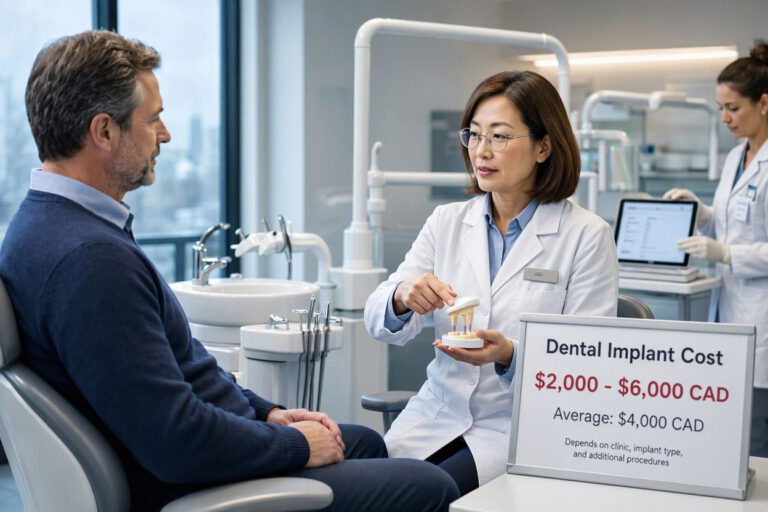
Adding the uncomplicated base components, a single tooth implant, from start to finish, will cost between $3,100 and $6,300. A realistic, mid-range estimate for a high-quality implant (using a premium brand like Straumann or Nobel Biocare) placed by a specialist with a custom abutment and a layered ceramic crown in a metropolitan area is $4,000 to $5,500 per tooth. This is the number to hold in your mind.
The Full-Arch Restoration: All-on-4 and All-on-6 Costs
For a patient who is missing all their teeth in an arch, or whose remaining teeth are hopelessly diseased, the implant-supported full-arch bridge is the transformative solution. This is not four or six single implants. It is a packaged, system-based treatment.
The “All-on-4” protocol, using four strategically placed and angled implants to support a full arch of fixed teeth, is the most well-known concept. The fee is typically presented as a per-arch package.
The Surgical and Immediate Load Package
This phase includes all extractions, implant placement (4-6 implants), and the delivery of a fixed, acrylic temporary bridge on the same day of surgery. The patient leaves with teeth.
- Cost: $12,000 – $18,000 per arch.
The Final Restoration
After four to six months of healing, the temporary bridge is replaced with the final, long-term prosthesis. The material choice dramatically affects the cost.
- Final Acrylic Hybrid Bridge: $3,000 – $5,000 per arch.
- Final Monolithic Zirconia Bridge: $6,000 – $10,000 per arch.
Total for a Single Arch, All-on-4, Final Zirconia: $18,000 to $28,000 per arch.
Total for Full Mouth (Both Arches), Final Zirconia: $36,000 to $56,000.
This is a life-changing investment. It replaces an entire dentition with a fixed, permanent, highly aesthetic, and functional set of teeth. The fee reflects the surgical complexity, the high-cost laboratory fabrication of a precision-milled zirconia bridge, and the skill of the entire team.
The Overdenture: A Lower-Cost Full-Arch Option
An implant-retained overdenture is a removable denture that snaps onto two to four implants. It is significantly more stable than a conventional denture, but it is removed for cleaning and at night. It is not fixed in place.
- 2-Implant Retained Lower Overdenture: $6,000 – $12,000 total.
- 4-Implant Retained Upper Overdenture: $10,000 – $18,000 total.
This is a highly functional, cost-effective middle ground between a conventional loose denture and a fixed full-arch bridge. The implants provide retention and stability, eliminating the floating, clicking nightmare of a standard lower denture.
The Geographic Factor and the Dental Tourism Equation
The cost of living and the local dental market heavily influence implant fees. The same implant, placed by the same brand of specialist, using the same laboratory, will cost significantly more in a high-rent district of Manhattan than in a rural town in the Midwest.
Dental tourism to countries like Mexico, Costa Rica, and Thailand dramatically reduces the fee. As detailed in our first article, a single implant in Mexico can cost $750 to $1,500, and a full-arch All-on-4 can be $7,000 to $12,000 per arch. The savings are real and substantial. The trade-offs, including travel logistics, continuity of care, and the critical importance of vetting the clinic and the materials used, must be carefully weighed. The low cost is a function of a different economic base, not necessarily a different clinical standard.
The Insurance Cap and the HSA Bridge
Dental insurance provides a limited contribution, not comprehensive coverage. A plan with a $1,500 annual maximum will pay $1,500 toward your implant, leaving you with the remaining $3,000 to $4,000 balance for a single tooth. A full-arch case of $25,000 will still leave you with a $23,500 patient responsibility after insurance pays its maximum. Insurance is a helpful subsidy, not a solution.
A Health Savings Account (HSA) or Flexible Spending Account (FSA) is a more powerful tool. As we explored in Article 14, these accounts allow you to pay for your implants with pre-tax dollars, effectively providing a 20-40% discount depending on your tax bracket. A patient planning a $5,000 implant can save $1,500 or more in taxes by routing the payment through their HSA. This is the single most effective financial strategy for the self-funded implant patient.
Conclusion
The cost of a single dental implant, from diagnosis to final crown, ranges from $3,100 to $6,300, with a realistic mid-range of $4,500. A full-arch All-on-4 restoration with a final zirconia bridge costs $18,000 to $28,000 per arch. The fee is a sum of surgical skill, branded materials, precision laboratory art, and diagnostic technology. While dental insurance offers a limited annual contribution, an HSA provides a significant, tax-advantaged discount. The implant is a substantial financial investment, but one that is predictable and transparent when you understand its component parts.
Frequently Asked Questions
Why is there such a large cost range for a single implant?
The range reflects the fee differences between a general dentist and a specialist, a branded premium implant versus a value implant, a stock abutment versus a custom CAD/CAM abutment, and a standard crown versus a master ceramist’s layered porcelain. The cost is a direct reflection of the quality and customization of the components and the expertise of the clinician.
Do I have to pay for the entire implant upfront?
Most practices structure the payment in phases. You pay for the surgical phase (implant placement and any grafting) at the time of surgery. You pay for the restorative phase (abutment and crown) months later, when the restoration is delivered. Many practices offer third-party financing plans that allow you to spread the cost over 12-24 months with low or no interest.
How much does it cost to replace a failed implant?
The cost of replacing a failed implant is a painful financial lesson. It includes the removal of the failed implant, a bone graft to repair the defect, a healing period, and the placement and restoration of a new implant. The total cost can equal or exceed the original implant fee, and is rarely covered by any warranty. This is the reason why choosing a skilled, board-certified surgeon and following all post-operative instructions is an investment in avoiding this catastrophic cost.
Additional Resource:
For a detailed breakdown of the implant procedure and cost considerations, visit the American Academy of Periodontology’s patient information on dental implants: https://www.perio.org/consumer/dental-implants