Is An MRI Impacted By A Dental Implant?
Magnetic Resonance Imaging (MRI) is a powerful diagnostic tool used to visualize internal structures of the body. If you have a dental implant and need an MRI, you may wonder whether the implant will cause problems or affect the quality of the images. The good news is that dental implants are generally safe during MRI scans, though there are some considerations to keep in mind.
This guide explains how dental implants interact with MRI technology, what you should tell your healthcare providers, and what to expect during the scan.
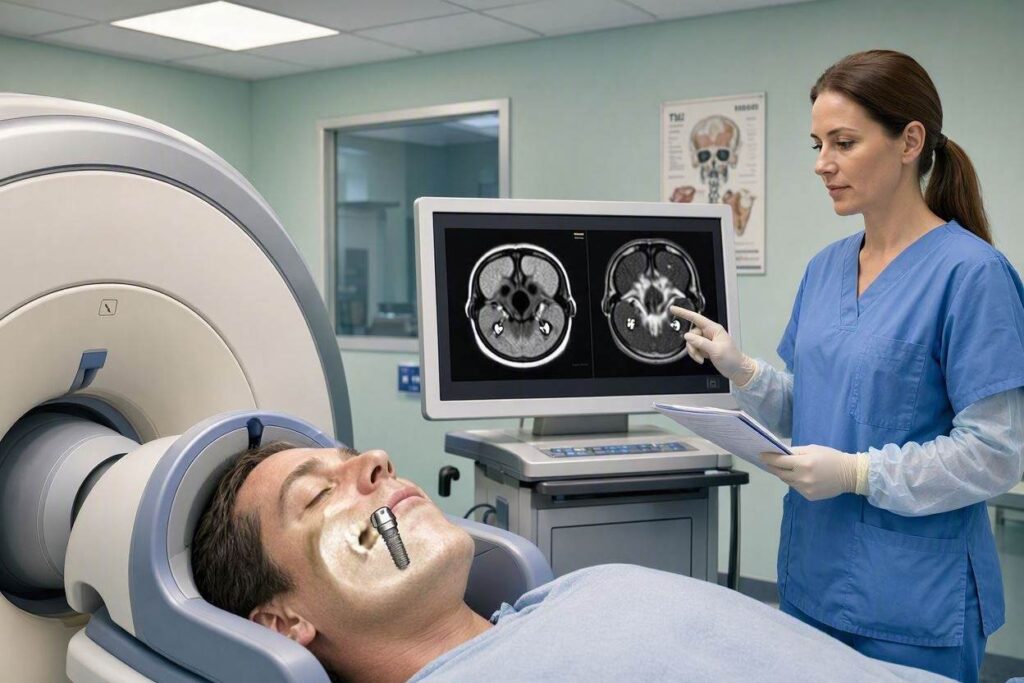
Understanding MRI Technology
Before discussing dental implants, it helps to understand how MRI works.
How MRI Works
MRI uses powerful magnetic fields and radio waves to create detailed images of the body’s internal structures.
The Magnetic Field:
The MRI machine generates a magnetic field thousands of times stronger than Earth’s magnetic field. This field aligns hydrogen atoms in the body.
Radio Waves:
Radio frequency pulses disturb the aligned atoms. When the atoms return to their normal state, they emit signals that the machine detects and converts into images.
Why Metal Matters in MRI
Metal objects can interact with the magnetic field in several ways.
Potential Issues:
- Ferromagnetic metals can be pulled toward the magnet
- Metal can heat up during the scan
- Metal can distort images (artifacts)
Are Dental Implants Safe in MRI?
The short answer is yes, dental implants are safe during MRI scans.
Titanium Is Non-Ferromagnetic
Dental implants are made primarily of titanium, which is non-ferromagnetic.
What This Means:
- Titanium is not attracted to magnets
- The implant will not move or be pulled out during the scan
- The implant will not heat up significantly
Why Titanium Is Used
Titanium is chosen for dental implants specifically because of its biocompatibility and non-ferromagnetic properties.
Properties of Titanium:
- Strong and durable
- Biocompatible (not rejected by the body)
- Non-ferromagnetic (safe for MRI)
- Does not corrode
Other Implant Components
Other components of dental implants are also MRI-safe.
Abutment:
Usually made of titanium or zirconia, both of which are non-ferromagnetic.
Crown:
Typically made of porcelain, ceramic, or zirconia. Some crowns have metal alloys, but these are usually non-ferromagnetic.
Can Dental Implants Affect MRI Image Quality?
While implants are safe, they can affect image quality in certain situations.
Image Artifacts
Dental implants can create artifacts—distortions in the image—that may affect the quality of scans of the head and neck.
What Causes Artifacts:
- The difference in magnetic properties between the implant and surrounding tissue
- The implant’s shape and size
- The type of MRI sequence used
Where Artifacts Matter
Artifacts are most problematic when scanning the area near the implant.
Affected Areas:
- Jaw and facial structures
- Sinuses
- Brain (if scanning the lower brain or brainstem)
Unaffected Areas:
- Spine
- Knees
- Shoulders
- Abdominal organs
- Most other body parts
Minimizing Artifacts
Radiologists can use techniques to reduce artifacts.
Techniques Include:
- Adjusting MRI parameters
- Using specific sequences designed to reduce metal artifacts
- Positioning the patient appropriately
What to Tell Your Healthcare Provider
Communication is essential before an MRI.
Information to Provide
Before your MRI, inform the healthcare team about:
- All dental implants
- Any other metal in your body
- Previous surgeries
- Metal fragments from injuries
- Pacemakers or other implanted devices
Why Disclosure Matters
Even though dental implants are safe, the radiologist needs to know about them to:
- Interpret images correctly
- Adjust scanning parameters
- Distinguish artifacts from actual pathology
What to Expect During the MRI
Understanding the process helps you prepare.
Before the Scan
- You will complete a safety questionnaire
- You may be asked to remove metal objects
- The technologist will explain the procedure
During the Scan
- You lie on a table that slides into the machine
- The machine makes loud knocking sounds
- You must remain still
- The scan takes 15 to 60 minutes
After the Scan
- You can resume normal activities
- A radiologist interprets the images
- Your doctor receives the results
Dental Implants vs. Other Dental Work
Different dental materials interact differently with MRI.
Comparison of Dental Materials
| Material | MRI Safety | Image Artifacts |
|---|---|---|
| Titanium Implants | Safe | Minimal to moderate |
| Zirconia Crowns | Safe | Minimal |
| Porcelain Crowns | Safe | Minimal |
| Gold Crowns | Safe | Moderate |
| Stainless Steel Crowns | Safe (non-ferromagnetic) | Significant |
| Amalgam Fillings | Safe | Moderate |
| Braces (Stainless Steel) | Safe | Significant |
Other Dental Devices
- Braces: Safe but cause significant artifacts
- Retainers: Should be removed before the scan
- Removable Dentures: Should be removed before the scan
- Permanent Retainers: Safe but may cause artifacts
Special Considerations
Certain situations require additional attention.
MRI of the Brain
If you need a brain MRI, dental implants may affect image quality.
What to Know:
- Artifacts may obscure the lower brain and brainstem
- The radiologist can adjust parameters to minimize artifacts
- Most of the brain can be imaged effectively
MRI of the Face or Jaw
Dental implants will cause significant artifacts in these areas.
What to Know:
- The implant will create distortions near the implant site
- Alternative imaging like CT may be recommended
- Discuss your options with your doctor
MRI with Contrast
Contrast agents used in MRI do not interact with dental implants.
What to Know:
- Gadolinium-based contrast agents are safe with implants
- The contrast improves visualization of certain tissues
Safety Guidelines
Following guidelines ensures safety.
FDA Guidelines
The FDA provides guidance on MRI safety with implants.
Key Points:
- Most dental implants are MRI-conditional or MRI-safe
- Always disclose implants before the scan
- The MRI facility will verify safety
Manufacturer Documentation
Implant manufacturers provide documentation regarding MRI safety.
What to Ask:
- Ask your dentist for implant documentation
- Provide this to the MRI facility if requested
Common Concerns Addressed
Here are answers to common concerns.
Will the Implant Heat Up?
Dental implants do not heat up significantly during MRI. Titanium is a poor conductor of heat, and the implant is small.
Will the Implant Move?
No, the implant will not move during the MRI. Titanium is non-ferromagnetic and is not attracted to the magnetic field.
Will the MRI Damage the Implant?
No, MRI does not damage dental implants. The implant remains intact and functional after the scan.
Will the Implant Cause Pain?
No, dental implants do not cause pain during MRI scans.
Conclusion
Dental implants are safe during MRI scans. The titanium used in implants is non-ferromagnetic, meaning it will not move, heat up, or be damaged by the magnetic field. While implants can cause image artifacts that affect scans of the head and neck, radiologists can adjust parameters to minimize these effects. Always inform your healthcare provider about your implants before the scan.
Frequently Asked Questions (FAQ)
Q: Can I have an MRI if I have dental implants?
A: Yes, dental implants are safe during MRI scans. Titanium is non-ferromagnetic and will not be affected by the magnetic field.
Q: Will my dental implant heat up during an MRI?
A: No, dental implants do not heat up significantly during MRI scans.
Q: Can dental implants affect MRI results?
A: Implants can cause image artifacts in scans of the head and neck, but radiologists can adjust parameters to minimize these effects.
Q: Do I need to tell my doctor about my dental implants before an MRI?
A: Yes, always disclose all implants and metal objects before an MRI.
Q: Are there any dental materials that are unsafe in MRI?
A: Most modern dental materials are MRI-safe. Some older stainless steel devices may cause significant artifacts but are still safe.
Q: Can I have a brain MRI with dental implants?
A: Yes, brain MRIs can be performed with dental implants, though artifacts may affect images of the lower brain.
Additional Resource
For more information on MRI safety with implants, visit the American College of Radiology (ACR) at www.acr.org. They provide guidelines on MRI safety.