What Is Bad About Dental Implants?
Dental implants are often presented as the perfect solution. Advertisements show smiling patients biting into apples. Dentists talk about the high success rates. It sounds like a miracle treatment.
But you are smart. You know that nothing in life is perfect. You are searching for the truth. You want to know: What is bad about dental implants?
It is an excellent question. While dental implants are a fantastic option for many people, they are not without flaws. Ignoring the negatives would be a disservice to anyone considering the procedure.
This guide will be honest about the downsides. We will look at the financial burden, the surgical risks, the potential for failure, and the long-term maintenance headaches. This is not meant to scare you away from implants, but to ensure you go into the process with your eyes wide open.
The Biggest Negative: The Price Tag
Let’s start with the most obvious problem. Dental implants are expensive. For many people, the cost is simply prohibitive.
Why It Hurts
A single implant can cost between $3,000 and $6,000. A full mouth restoration can cost as much as a new car—anywhere from $25,000 to $60,000 or more.
Why is it so bad?
- Insurance Gaps: Many dental insurance plans offer little to no coverage for implants. They may cover a traditional denture at 50%, but they classify implants as “cosmetic” or “elective” and leave you to pay out of pocket.
- Hidden Fees: The initial quote might cover the implant fixture, but not the crown, the extraction, the bone graft, the anesthesia, or the follow-up visits.
The Reality:
The financial stress can be significant. Some patients go into debt to afford the surgery. For others, the price tag means they simply cannot access the treatment they need. This is the single worst thing about dental implants for the average person.
The Surgical Reality: Pain, Swelling, and Time
Dental implant placement is a surgical procedure. It involves cutting, drilling, and suturing. It is not a quick, painless visit to the dentist.
The Immediate Pain
While the surgery itself is usually painless due to local anesthesia, the recovery is not.
- Day 1-3: Swelling, bruising, and throbbing pain. You will likely need painkillers.
- Week 1: Soreness when eating or talking. You are limited to soft foods.
- Week 2-4: Dull aching as the bone begins to heal.
For a single implant, this is manageable. For full mouth implants, the recovery is more intense. The swelling can be dramatic, and the patient may be unable to wear their temporary teeth comfortably.
The Time Commitment
Unlike a denture, which can be made in a few weeks, implants take time.
- Standard Timeline: 4 to 6 months from surgery to final crown.
- With Bone Grafting: 6 to 12 months.
You might spend a long period missing a tooth or wearing a temporary denture. This requires patience and multiple visits to the dental office.
The Risk of Failure: It Does Not Always Work
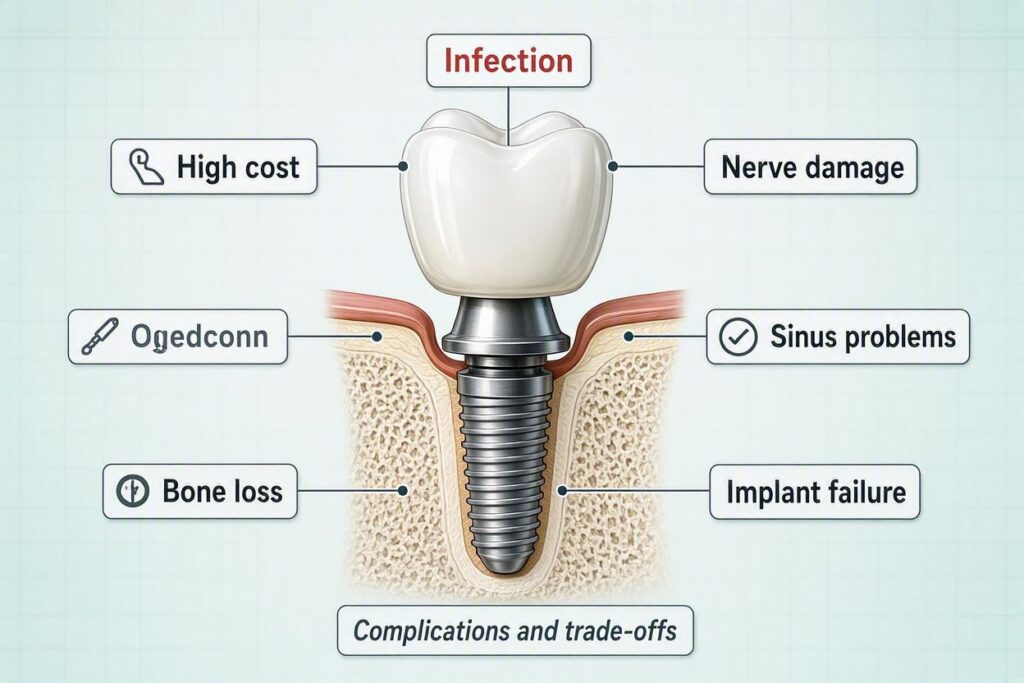
Dental implants have a high success rate (95%+). But that means they fail in about 5% of cases. When they fail, the experience is miserable.
What Does Failure Look Like?
- Early Failure: The bone does not fuse to the implant (osseointegration fails). The implant is loose. It must be removed.
- Late Failure: The implant was successful for years, but then peri-implantitis (infection) causes the bone to melt away. The implant loses support.
What Happens After Failure?
This is the “bad” part that no one talks about.
- Bone Loss: The failed implant often leaves a larger hole in the bone than was there before.
- Bone Grafting: You may need a major bone graft to rebuild the area before you can try again.
- The Cost: You have to pay for the removal, the graft, and the replacement implant. You pay twice.
Factors That Increase Failure Risk:
- Smoking
- Uncontrolled diabetes
- Poor oral hygiene
- Grinding teeth (bruxism)
- Low-quality implant brands
The Maintenance Burden: It Is Not “Set and Forget”
Some patients believe that once the implant is in, they are done. They think they never have to worry about that tooth again. This is a misconception.
The Cleaning Challenge
Natural teeth have a gum seal that helps keep bacteria out. Implants do not have this natural defense.
You must be meticulous about cleaning around the implant.
- Single Implants: You need special floss (superfloss) or interdental brushes to clean around the post.
- Full Bridges (All-on-4): You must thread floss or use a water flosser to clean underneath the bridge.
If you are lazy about cleaning, the implant will fail. This is a lifelong commitment.
The “Mechanical” Wear
The crown or bridge attached to the implant is not indestructible.
- Porcelain Chipping: If you bite into a hard object, the porcelain can chip.
- Screw Loosening: The screw holding the crown can vibrate loose. It makes a clicking sound or the crown feels spongy. You have to return to the dentist to have it tightened.
- Replacement: The acrylic or porcelain teeth on a full bridge may need to be replaced every 10-15 years. This costs thousands of dollars.
The Aesthetic Risks
Sometimes, implants do not look perfect. There is a risk of “pink esthetics” issues.
The Grey Line Problem
If you have thin gums, the dark titanium metal of the implant can show through the gum tissue. This creates a grey, shadowed look at the gum line. It looks unnatural.
Gum Recession
Over time, the gum around the implant can recede. This exposes the metal abutment or the edge of the crown. This looks like a black triangle or a dark gap between the teeth.
Solutions:
- Using zirconia (white ceramic) implants and abutments instead of titanium.
- Gum grafting surgery to thicken the tissue.
These solutions add cost and complexity.
The “Nerve Damage” Nightmare
This is perhaps the scariest potential complication. It is rare, but when it happens, it is devastating.
How It Happens
The inferior alveolar nerve runs through the lower jaw. It gives sensation to your lip, chin, and lower teeth. If an implant is placed too deep or in the wrong position, it can bruise or sever this nerve.
The Result
- Permanent numbness in the lip and chin.
- Drooling because you cannot feel your lip.
- Difficulty speaking or eating.
- In some cases, chronic nerve pain (neuropathy).
The Prevention:
This is almost always avoidable with proper 3D imaging (Cone Beam CT scan). A dentist who skips this step is putting you at risk. If a dentist says they can do implants without a 3D scan, leave.
The Verdict
So, what is bad about dental implants?
They are expensive. They require surgery and a healing period. They can fail. They require meticulous, lifelong maintenance. There is a risk of aesthetic issues and nerve damage.
However, for most people, the benefits outweigh these negatives. The alternative—living with missing teeth or wearing a loose, painful denture—is often much worse.
The key is to be an informed consumer. Do not believe the hype that implants are perfect. Acknowledge the risks. Choose a highly skilled dentist. Quit smoking. Commit to cleaning.
If you do those things, you can minimize the “bad” and enjoy the good.
Frequently Asked Questions
Q: Can dental implants cause cancer?
A: No. There is no scientific evidence linking dental implants to cancer. The titanium used is biocompatible and inert.
Q: Do dental implants cause bad breath?
A: Not if they are clean. If you do not clean under the bridge or around the implant, bacteria and food debris will decompose, causing an odor. The implant itself does not smell.
Q: Can I be allergic to dental implants?
A: Allergy to titanium is extremely rare. Some patients have a sensitivity to the metal. If you have a known metal allergy, you can ask for a zirconia implant or a titanium allergy test before surgery.
Q: Is it painful to have dental implants removed?
A: Removing a failed implant is usually similar to the initial surgery. It requires local anesthesia. If the implant is loose, it may come out easily. If it is fused but infected, the dentist may need to use special tools to remove it.
Additional Resource:
For more information on the risks and benefits of dental devices, visit the U.S. National Library of Medicine: https://medlineplus.gov/.