Why Should I Get Implants In My Teeth?
You are standing in front of the mirror. You have a gap in your smile. Or perhaps you are struggling with a denture that moves when you talk. You are tired of it. You are wondering: Why should I get implants in my teeth?
It is a fair question. Dental implants require a significant investment of money, time, and physical recovery. You need a compelling reason to go through with it. You need to know that the outcome is worth the hassle.
The answer is not just about looks. It is about your health, your confidence, and your future. Dental implants are the closest modern dentistry can get to regrowing your natural teeth.
This guide will explore the profound reasons why dental implants are often the right choice. We will move beyond the marketing slogans and focus on the practical, life-altering benefits.
Reason 1: To Stop the “Melting” of Your Face (Bone Preservation)
This is the most important medical reason to choose implants, and it is one that most people do not know about until it is too late.
The Invisible Problem
Your jawbone has a job: to hold your teeth. When a tooth is removed, the bone in that specific area no longer receives stimulation. The body, being efficient, begins to reabsorb the minerals from that bone and use them elsewhere. This is called resorption.
It is a relentless process. The bone shrinks. It changes the shape of your face.
The Consequence of Ignoring It
If you choose a traditional bridge or a denture, the bone loss continues.
- The bridge sits on the surface; it does not stimulate the bone underneath.
- The denture actually presses down on the bone, potentially speeding up the bone loss.
The Implant Solution
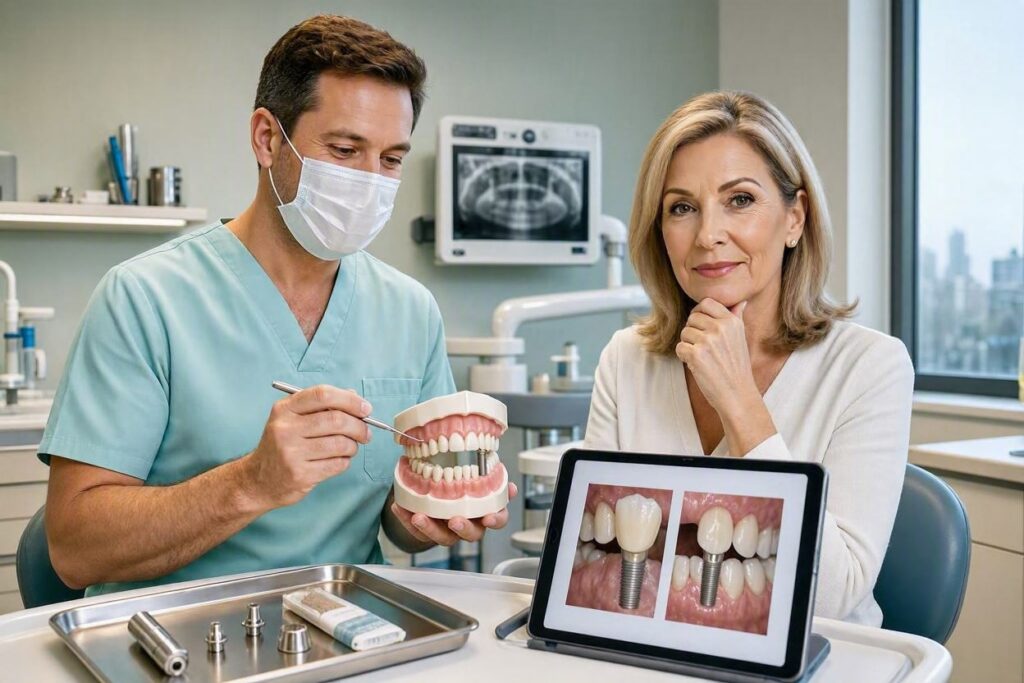
An implant replaces the root. It extends down into the bone. When you chew, the force travels down the implant into the bone. The bone recognizes this as “work” and maintains its density.
The Bottom Line: Getting an implant is the only way to prevent your jawbone from shrinking away. You are not just filling a gap; you are preserving the structural integrity of your skull.
Reason 2: To Be Able to Eat Real Food Again
We often take chewing for granted until we lose it. If you have a missing tooth or a loose denture, you know the struggle. You have to cut your food into tiny pieces. You avoid certain foods altogether.
The “Denture Diet” Trap
Patients with traditional dentures often silently eliminate:
- Steak and other tough meats
- Raw vegetables (carrots, celery)
- Crunchy fruits (apples, pears)
- Nuts and seeds
- Crusty bread
These are the foods that provide the highest nutritional value. When you stop eating them, your health suffers. You might gain weight from eating soft, processed carbs. You might develop digestive issues from not chewing your food properly.
The Implant Advantage
Dental implants restore your bite force to nearly that of natural teeth. You can bite into an apple. You can chew a piece of steak. You can enjoy a salad without worrying about the lettuce getting stuck under a denture.
The Bottom Line: Implants restore the pleasure of eating. Meals become a source of joy and nutrition again, not a source of anxiety and frustration.
Reason 3: To Protect Your Remaining Teeth
When you lose a tooth and do not replace it, the neighboring teeth begin to shift. They tilt into the empty space. The tooth in the opposite jaw (the one that used to bite against the missing tooth) begins to drift upward or downward. This is called supereruption.
The Domino Effect
This shifting causes a chain reaction:
- Your bite becomes misaligned.
- You create “food traps” where plaque builds up, leading to cavities.
- The shifting teeth become loose because they are being pushed in ways they were not designed to move.
- You may develop TMJ (jaw joint) pain from the uneven bite.
The Implant Solution
An implant fills the empty space. It acts as a placeholder, keeping the other teeth in their proper positions. It maintains the integrity of your entire dental arch.
The Bottom Line: Replacing a missing tooth with an implant protects your investment in your other teeth. It prevents the slow collapse of your bite.
Reason 4: To Regain Your Confidence and Mental Health
We cannot talk about dental implants without addressing the psychological impact. Living with missing teeth is exhausting.
The Social Anxiety
Do you cover your mouth when you laugh? Do you smile with your lips closed? Do you turn your head when you talk to someone close? Do you avoid photos?
This constant self-monitoring is draining. It takes a toll on your self-esteem. It makes you seem less friendly, less confident, and less approachable. It can even affect your career and your relationships.
The Implant Solution
Dental implants are secure. They do not move. They do not click. They look and feel like natural teeth.
Patients who receive implants often report feeling like they got their life back. They smile freely. They laugh out loud. They go on dates and attend job interviews without the background noise of dental anxiety.
The Bottom Line: The mental health benefits of dental implants are just as significant as the physical benefits. Restoring your smile restores your identity.
Reason 5: The Convenience Factor
Traditional dentures are high-maintenance.
- You have to take them out at night.
- You have to soak them in cleaning solutions.
- You have to brush them and your gums.
- You have to deal with sticky adhesives.
Dental implants (especially fixed bridges) become a part of your body. You brush them just like natural teeth. You do not take them out. You do not soak them in a cup by the bed.
The Bottom Line: Implants simplify your life. They eliminate the daily routine and embarrassment associated with removable dentures.
Reason 6: Long-Term Cost Effectiveness
This seems counterintuitive because the upfront cost is high. But let’s look at the finances over 20 years.
The Cost of “Cheap”
A traditional bridge might cost $1,500. But it might need to be replaced every 5 to 10 years. A denture needs relines and adhesives. These costs add up.
More importantly, a bridge requires cutting down (drilling) the two healthy teeth next to the gap. If those teeth fail later, you have lost three teeth instead of one.
The Value of Implants
An implant might cost $4,500. But it can last 25 years or a lifetime. It does not damage adjacent teeth. It preserves bone.
When you do the math over a lifetime, the implant is often the better investment.
The Verdict
Why should you get implants in your teeth?
Because you value your health. Because you want to eat well. Because you want to smile without shame. Because you want a permanent solution, not a temporary fix.
Yes, it is an investment. Yes, it involves surgery. But for millions of people, it is the decision that finally allowed them to move on from the pain and embarrassment of missing teeth.
You deserve to have teeth that work. You deserve to feel good about your smile. Dental implants are not just about replacing teeth; they are about restoring your quality of life.
Frequently Asked Questions
Q: Am I too old for dental implants?
A: Age is usually not a barrier. The primary factor is your overall health. If you are healthy enough to have a tooth extracted, you are likely healthy enough for an implant.
Q: Is it better to get an implant right after extraction or wait?
A: In many cases, an implant can be placed at the same time as the extraction (immediate placement). This saves time and preserves bone. However, if there is infection, the dentist may recommend waiting for it to clear first.
Q: Will people be able to tell I have an implant?
A: No. The crown is custom-made to match the color, shape, and translucency of your other teeth. It is virtually indistinguishable.
Q: What if I do not have enough bone for an implant?
A: You may be a candidate for a bone graft. This is a procedure where donor or synthetic bone is placed in the area to build up volume. Once it heals, the implant can be placed.
Additional Resource:
For more information on the benefits of dental implants versus other treatments, visit the American Academy of Implant Dentistry: https://www.aaid.com/.