Are Implants More Dangerous Than Dentures?
When you are deciding how to replace missing teeth, safety is a top priority. You want a solution that works, but you also want to avoid pain, complications, and long-term health problems.
The question often arises: Are implants more dangerous than dentures?
The answer is not as simple as yes or no. It depends on how you define “danger.” Do you mean immediate surgical risk? Do you mean long-term health consequences? Do you mean the risk of discomfort?
If you look at the immediate risks, yes, dental implants involve a surgical procedure, which inherently carries more acute risk than simply placing a denture in your mouth. However, if you look at the long-term safety of your overall health, dentures present a host of silent dangers that implants actually prevent.
This guide will provide a balanced, honest comparison. We will look at the risks of both options so you can make a decision based on facts, not fear.
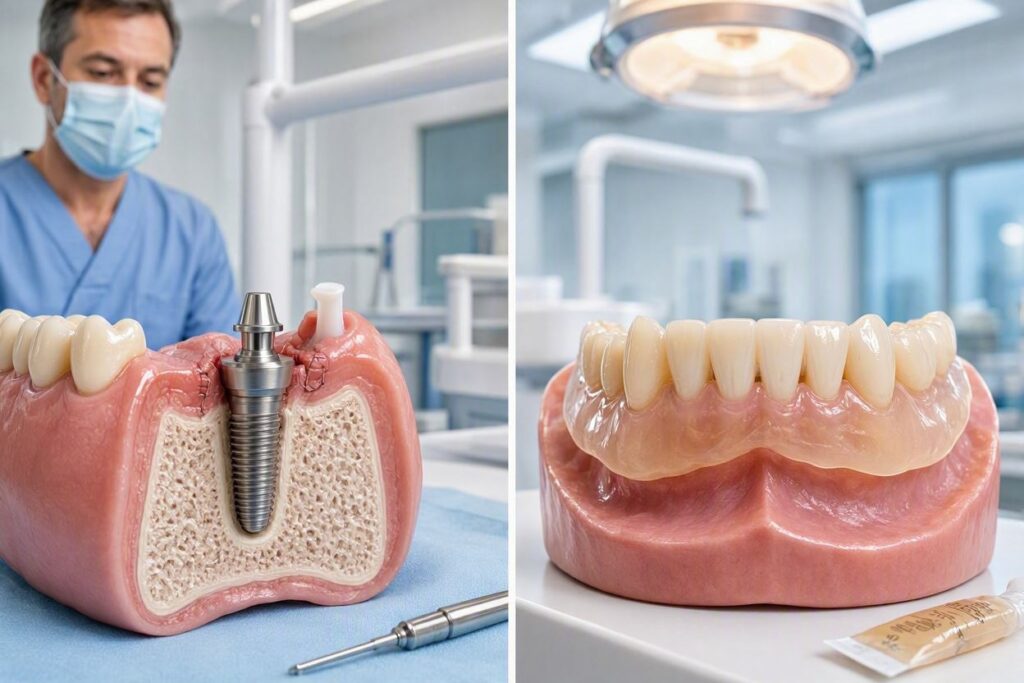
The Risk Profile of Dentures: The “Safe” Illusion
Dentures are often seen as the “safe” choice because they do not involve surgery. You walk into a dental office, and you walk out with teeth. No incisions, no drills, no anesthesia.
But this perception of safety ignores the long-term reality. Dentures are a mechanical device that sits on living tissue. Over time, they create problems.
1. The Danger of Accelerated Bone Loss
This is the most significant medical risk of dentures.
When you lose teeth, the body stops sending resources to the jawbone in that area. The bone begins to resorb (shrink). This is a natural process.
A traditional denture sits on top of this bone. When you chew, the denture presses down on the bone. This pressure actually restricts blood flow to the bone tissue. It accelerates the resorption process.
The Danger:
As the bone disappears, your face collapses. The chin moves forward, the lips sink in, and wrinkles deepen. You develop the “sunken face” look associated with old age. This is not just a cosmetic problem; it is a structural problem.
2. The Risk of Aspiration (Choking)
This is a very real and underreported danger. Dentures, especially lower dentures, can become loose. If they slip backward while you are eating or sleeping, they can block the airway.
While rare, there are documented cases of patients choking on their own dentures. For elderly patients or those with swallowing difficulties, this is a genuine safety risk.
3. Chronic Inflammation and Infection
A denture traps bacteria against the gums. It creates a warm, moist environment for fungus (like Candida) to thrive.
The Consequences:
- Denture Stomatitis: A painful, red inflammation of the gum tissue under the denture.
- Chronic Sore Throat: Constant irritation from bacteria.
- Angular Cheilitis: Painful cracks at the corners of the mouth.
These infections are rarely life-threatening, but they are a constant drain on the immune system and a source of chronic pain.
4. The Nutrition Risk
This is perhaps the most dangerous long-term risk. A denture limits your ability to chew fibrous foods like raw vegetables, fruits, and meats.
The Danger:
Patients with dentures often shift to a diet of soft, processed foods. These foods are high in carbohydrates and sugars but low in essential nutrients. This leads to:
- Malnutrition
- Weight gain
- Diabetes
- Digestive problems
The inability to chew food properly is a direct threat to your overall health. Poor nutrition is a “silent killer” that dentures often contribute to.
The Risk Profile of Implants: The “Surgical” Reality
Dental implants require surgery. This is a fact. It is an invasive procedure. Let’s look at the real risks without downplaying them.
1. Surgical Complications
As discussed in previous articles, surgery carries risks:
- Infection: Bacteria entering the surgical site.
- Nerve Damage: Damage to the inferior alveolar nerve (lower jaw) causing numbness in the lip and chin.
- Sinus Perforation: For upper implants, the implant can push into the sinus cavity.
- Bleeding: Excessive bleeding or hematoma formation.
How Dangerous Are These?
In the hands of a qualified surgeon using 3D imaging, these risks are very low. The infection rate is low. Nerve damage is rare when proper planning is done. Most complications are minor and treatable.
2. Anesthesia Risks
Implant surgery typically requires local anesthesia. Some patients opt for sedation (IV sedation or general anesthesia).
The Danger:
Any time you are sedated, there is a risk of respiratory depression or allergic reaction. However, for healthy patients, the risk is extremely low. Your anesthesiologist or dentist should screen you for health issues (heart conditions, lung problems) before proceeding.
3. Peri-Implantitis
This is the long-term risk of implants. It is the equivalent of gum disease but affects the bone around the implant.
The Danger:
If you do not clean the implant, bacteria cause inflammation. The bone supporting the implant dissolves. The implant becomes loose and eventually fails.
Is this more dangerous than denture stomatitis?
Peri-implantitis is more dangerous because it can lead to the loss of the implant and the need for further surgery. However, it is preventable with good hygiene.
Comparing the “Danger” Levels
So, which is more dangerous? Let’s look at the type of risk.
| Risk Category | Traditional Denture | Dental Implants |
|---|---|---|
| Immediate Surgical Risk | None | Low (infection, nerve damage) |
| Long-Term Bone Health | Dangerous (accelerates bone loss) | Safe (prevents bone loss) |
| Risk of Malnutrition | High (limited chewing ability) | Low (restores chewing ability) |
| Risk of Chronic Infection | High (denture stomatitis) | Low (if maintained properly) |
| Risk of Mechanical Failure | Low (breaks rarely) | Medium (screws loosen, porcelain chips) |
| Risk of Airway Obstruction | Rare but possible | None |
Important Note: The “danger” of implants is front-loaded. The risks happen during and immediately after surgery. The “danger” of dentures is back-loaded. The risks accumulate over years of wear and bone loss.
Who Is More at Risk?
The danger of a treatment depends on who is receiving it.
Dentures Are More Dangerous For:
- Younger Patients: If you get dentures at age 50, you face decades of progressive bone loss, eventually leading to a point where even dentures cannot fit because there is no bone left to support them.
- Patients with Nutrition Issues: If you already struggle to eat well, dentures will make it worse.
- Patients with Sensitive Gums: The friction of dentures causes constant pain.
Implants Are More Dangerous For:
- Smokers: Nicotine significantly impairs healing and increases the risk of implant failure.
- Uncontrolled Diabetics: High blood sugar prevents bone fusion.
- Patients with Bleeding Disorders: Surgery poses a higher risk of hemorrhage.
- Patients with Severe Osteoporosis: Particularly those taking certain IV medications.
The “No Treatment” Danger
We often forget the third option: doing nothing. Leaving missing teeth untreated is arguably more dangerous than either solution.
- Tooth Shifting: Adjacent teeth drift into the gap, causing bite misalignment.
- TMJ Disorders: An uneven bite leads to jaw joint pain and headaches.
- Further Tooth Loss: The stress on remaining teeth increases, leading to more failures.
When you compare the danger of implants vs. dentures, you must also compare them to the danger of doing nothing.
The Verdict
Are implants more dangerous than dentures?
In the immediate term, yes. Implants involve the risks of a surgical procedure. There is no way to avoid that.
However, in the long term, implants are significantly safer for your overall health. They prevent the bone loss, malnutrition, and chronic inflammation that dentures cause. They restore normal chewing function and support the structure of your face.
Dentures are not “safer”; they are simply less invasive at first. If you measure safety over a 10 or 20-year period, the denture wears down the body, while the implant supports it.
The choice depends on your health status. If you are elderly and cannot tolerate surgery, a denture is the safe choice. If you are healthy and want to protect your long-term health, the implant is the safer investment.
Do not mistake “non-surgical” for “risk-free.” A denture is a slow burn of health risks. An implant is a short, controlled risk with a long, stable outcome.
Frequently Asked Questions
Q: Can a dental implant cause a heart attack?
A: There is no evidence that dental implants cause heart attacks. However, if you have a severe heart condition, the stress of surgery or the use of certain anesthetics could theoretically pose a risk. This is why a full medical history is required before surgery.
Q: Do dentures shorten your life expectancy?
A: Indirectly, they can. Studies have shown that poor nutrition and the inability to chew food properly are linked to increased mortality in older adults. Dentures that limit your diet can contribute to this decline.
Q: Which is safer for an 80-year-old?
A: It depends on their health. If they are medically stable and have adequate bone, implants can be safely placed in an 80-year-old. If they are frail, on many medications, or have significant health problems, a well-fitting traditional denture might be safer because it avoids surgery.
Q: Can I get an infection from a denture that spreads to my body?
A: Yes, in rare cases. If the gums are raw and ulcerated under a dirty denture, bacteria can enter the bloodstream. This is called bacteremia. For patients with heart conditions or compromised immune systems, this can be dangerous.
Additional Resource:
For information on the links between oral health and overall systemic health, visit the Centers for Disease Control and Prevention (CDC): https://www.cdc.gov/oralhealth/.