How Soon Can Dental Implants Be Put In?
You have made the decision. You are tired of the gap in your smile or the loose denture. You want dental implants, and you want them now. The most natural question in the world is: How soon can dental implants be put in?
The answer depends on your unique situation. It depends on the health of your mouth, the condition of your bone, and the type of procedure you need. The timeline can range from the same day as your extraction to several months after.
This guide will break down the different timelines. We will explain the difference between “immediate” implants and “delayed” implants. We will look at the factors that speed up the process and the factors that slow it down.
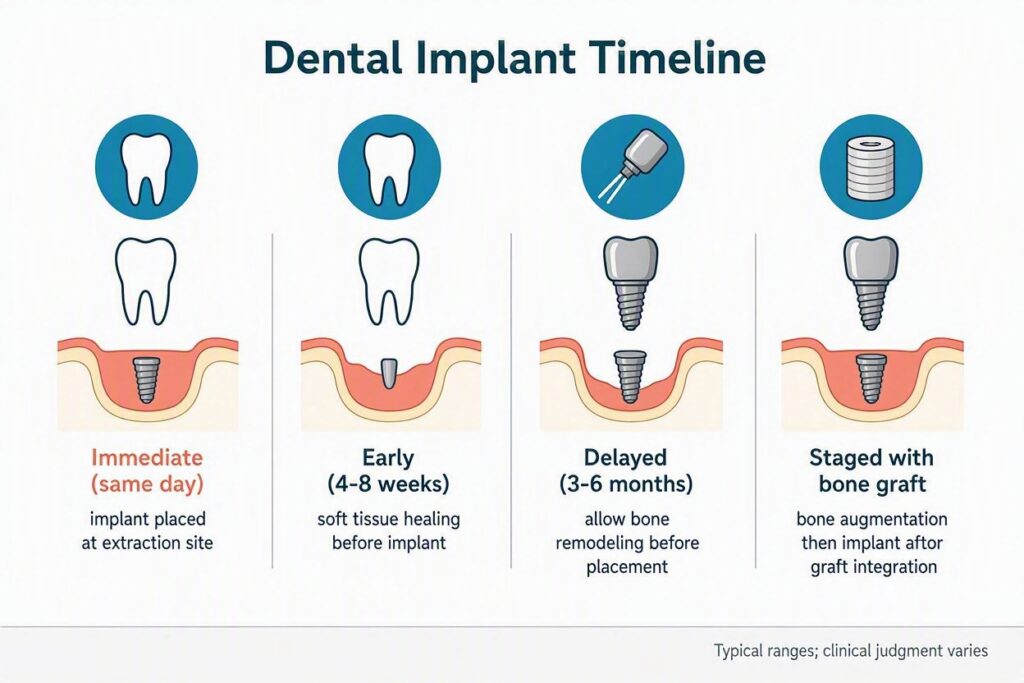
The Three Main Timing Protocols
Dentists generally categorize implant placement into three distinct timeframes relative to the extraction of the failing tooth. Understanding these will help you manage your expectations.
1. Immediate Implant Placement (Same Day)
This is the fastest option. The dentist removes the bad tooth and places the implant into the empty socket during the same appointment.
When is it possible?
- The tooth is a single root (like a front tooth or a premolar).
- There is no active infection (abscess) at the root tip.
- There is enough healthy bone around the socket to stabilize the implant.
- The gums are healthy.
The Advantage:
- One surgery instead of two.
- Faster overall treatment time.
- Preserves bone and gum shape.
The Catch:
Not every tooth is a candidate. Molars (back teeth) often have multiple roots and large sockets, making immediate placement risky. If there is an infection, the dentist must wait.
2. Early Implant Placement (2 to 3 Months)
This is a very common approach. The tooth is extracted. The site is allowed to heal for a period of 8 to 12 weeks.
Why wait?
- To allow the infection to clear.
- To allow the soft tissue (gums) to heal over the socket.
- To allow some initial bone formation to strengthen the site.
The Advantage:
A more predictable environment for the implant. The risk of infection is lower.
The Catch:
You will be missing a tooth for a few months (though you can usually wear a temporary flipper or denture).
3. Delayed Implant Placement (3 to 6+ Months)
This is the traditional, most conservative approach. The tooth is removed, and the site is allowed to heal completely for 3 to 6 months (or longer).
Why wait so long?
- The bone needs significant healing time.
- The patient had severe infection or a large cyst.
- The patient needs a bone graft before the implant can be placed.
The Advantage:
The highest success rate for complex cases. The bone is mature and stable.
The Catch:
The longest treatment time. Significant bone loss can occur during the waiting period if a graft is not placed.
The “Teeth in a Day” Protocol (Full Mouth)
If you are having all your teeth removed and replaced with a full bridge (like All-on-4), the timeline is different. This is often marketed as “Teeth in a Day.”
How It Works
- Morning: The dentist extracts the remaining teeth.
- Midday: The implants (usually 4 to 6 per arch) are placed into the bone.
- Afternoon: A temporary, fixed bridge is attached to the implants.
You walk out with teeth the same day.
The Reality Check:
- This temporary bridge is not your final set of teeth. It is a healing prosthesis. You must eat a soft diet for 3 to 6 months while the bone heals.
- The final, stronger bridge is made after healing is complete.
Factors That Can Delay Your Implants
You might want the implant tomorrow, but your body might say otherwise. Here are the most common roadblocks.
1. Bone Grafting
This is the number one reason for delays. If you have been missing a tooth for years, the bone has likely shrunk. There is not enough volume to hold an implant.
The Solution:
A bone graft. The dentist places bone material into the defect.
- Healing Time: 3 to 6 months (sometimes longer) before the implant can be placed.
- The “Two-Stage” Process: You have surgery to graft, wait, then have surgery to place the implant. This adds significant time to the overall process.
2. Periodontal Disease (Gum Disease)
If you have active gum disease, the bacteria in your mouth are dangerous. They can infect the surgical site and cause the implant to fail.
The Solution:
You must treat the gum disease first. This involves deep cleanings (scaling and root planing), possibly laser therapy, and improved home care.
The Timeline:
Depending on the severity, it can take 2 to 4 months to get your gums healthy enough for surgery.
3. Smoking
As mentioned in previous articles, smoking severely impairs healing. Many reputable dentists will refuse to place implants in heavy smokers.
The Solution:
Quit smoking. Many dentists require you to be nicotine-free for at least 2 weeks before and 2 months after surgery.
4. Medical Clearance
If you have a complex medical history (heart condition, diabetes, recent surgery), your dentist may require clearance from your medical doctor. This can add time to the scheduling process.
The General Timeline: From Consultation to Crown
Let’s assume you are a healthy patient with no complications. What does the standard timeline look like?
Week 1: Consultation and 3D Scan
You meet the dentist. They take a scan, review your history, and create a treatment plan.
Week 2: Surgery (Implant Placement)
The implant is placed. You go home with stitches.
Week 2 – 6: Osseointegration Begins
The bone starts to fuse to the implant. You wear a temporary tooth or go without.
Month 3 – 4: Implant Uncovered
If the implant was buried, the dentist makes a small incision to expose the top. A healing cap is placed.
Month 4 – 5: Impressions
The dentist takes a digital scan of your mouth. The lab begins making your permanent crown.
Month 5 – 6: Final Delivery
The permanent crown is screwed or cemented into place. You are done.
Total Time: Approximately 4 to 6 months.
The Verdict
So, how soon can dental implants be put in?
If you are healthy and the site is ready, it could be the same day as your extraction. If you need bone grafts or treatment for gum disease, it could be 4 to 6 months before the implant is placed.
The key is not to rush the biology. The implant needs time to fuse to the bone. A dentist who promises a guaranteed timeline without looking at your 3D scan is not being honest.
Be patient. The process takes time, but the result—a permanent, stable tooth—is worth the wait.
Frequently Asked Questions
Q: Can I get a temporary tooth while I wait for the implant to heal?
A: Yes. There are several options. You can wear a “flipper” (a removable single-tooth denture), or the dentist can make a temporary bridge. You will not have to walk around with a visible gap in most cases.
Q: Does the implant surgery hurt?
A: No. You will be numbed with local anesthesia. You may feel pressure and vibration, but no sharp pain. After the numbness wears off, you will experience soreness for a few days.
Q: How long after a bone graft can I get the implant?
A: It depends on the size of the graft. Small grafts may heal in 3 months. Large grafts (like a sinus lift) may require 6 to 9 months of healing before the implant can be placed.
Q: Can I speed up the healing process?
A: Not significantly. The bone needs time to grow. You can support the process by eating a healthy diet, taking prescribed vitamins (like Vitamin D and Calcium), avoiding smoking, and following your dentist’s post-operative instructions closely.
Additional Resource:
For more information on bone grafting and healing times, visit the American Academy of Periodontology: https://www.perio.org/.